Tag: property tax

  • Stamp Duty by State Australia 2026-27: Rates, First Home Buyer Rules & $750k Compared

    Stamp Duty by State Australia 2026-27: Rates, First Home Buyer Rules & $750k Compared

    The short answer

    Stamp duty on the same $750,000 home ranges from $19,208 in the ACT to $40,070 in Victoria in 2026-27. That is a $20,862 difference for the exact same house, decided entirely by which side of a state border it sits on. And first home buyers pay nothing at all on that $750,000 home in New South Wales and the ACT – while in South Australia, Tasmania and the Northern Territory they pay the full amount.

    There is no national stamp duty rate. Each state and territory sets its own brackets, its own first home buyer rules, and its own foreign buyer surcharge. The rules also moved a lot in 2026: Western Australia lifted its first home buyer thresholds in May, Tasmania ended its first home buyer exemption on 30 June, and the ACT abolished first home buyer duty entirely from 1 July. A guide written in early 2026 is now wrong in three jurisdictions.

    This guide gives you every 2026-27 rate, the first home buyer position in each state, and worked examples at $500,000 and $750,000 so you can see exactly what you will pay. If you are buying in NSW or Victoria, read our NSW and Victoria stamp duty guide for the full detail on those two states – this article covers the other six jurisdictions in depth and compares all eight.

    Stamp duty on a $750,000 home: every state compared

    The table below assumes an established (previously lived-in) home bought for $750,000 by an owner-occupier. Queensland shows two figures because it runs two different scales – the lower home concession rate for people who will live in the property, and the general rate for everyone else. The ACT figure is also the owner-occupier rate; investors pay more.

    State / territory Standard buyer Eligible first home buyer
    New South Wales $27,937 $0
    Victoria $40,070 $40,070
    Queensland $19,600 (home) / $26,775 (general) $10,925
    Western Australia $29,741 $24,225
    South Australia $35,080 $35,080
    Tasmania $28,935 $28,935
    Australian Capital Territory $19,208 $0
    Northern Territory $37,125 $37,125

    Three things jump out. First, Victoria is the most expensive at this price by a wide margin – $40,070, more than double the ACT. Second, the first home buyer column is all or nothing: you either pay zero or you pay the full standard amount, except in Queensland and Western Australia where the relief tapers. Third, Queensland’s two scales matter more than most buyers realise – an investor pays $7,175 more than an owner-occupier on the same $750,000 home.

    Stamp duty on a $500,000 home: every state compared

    At $500,000 the ranking shuffles. The ACT is cheapest at $8,408, Queensland’s home concession rate is nearly as cheap at $8,750, and the Northern Territory is the most expensive at $23,929 despite having no first home buyer concession at all.

    State / territory Standard buyer Eligible first home buyer
    New South Wales $16,687 $0
    Victoria $21,970 $0
    Queensland $8,750 (home) / $15,925 (general) $0
    Western Australia $17,765 $0
    South Australia $21,330 $21,330
    Tasmania $18,248 $18,248
    Australian Capital Territory $8,408 $0
    Northern Territory $23,929 $23,929

    At $500,000, five of the eight jurisdictions charge first home buyers nothing. The three that do not – South Australia, Tasmania and the Northern Territory – are the ones where buyers most often get caught out, because the national conversation about “first home buyers pay no stamp duty” simply does not apply there for established homes.

    How stamp duty is actually calculated

    Every state uses a sliding scale, not a flat percentage. Your purchase price is split across brackets, and each slice is charged at that bracket’s rate. Only the slice above a threshold pays the higher rate – the part below it keeps the lower rate. That is why the bill grows more slowly than the price at first, then accelerates.

    Three rules apply almost everywhere and trip people up:

    • Duty is charged on the higher of the purchase price or the market value. Buy a $750,000 home the valuer says is worth $800,000 and you pay duty on $800,000.
    • Most states round up to the next $100. Queensland, South Australia, Tasmania and Western Australia charge “for every $100 or part of $100”, so a $750,050 price is assessed as $750,100. The difference is small, but it is real.
    • The contract date sets the rate year, not the settlement date. Sign in June 2026 and you pay 2025-26 rates even if you settle in August. The ACT states this explicitly, and the same principle applies across the states.

    Use our stamp duty calculator to run your exact price and buyer type before you make an offer. The tables below show you how the calculator gets its answer.

    Queensland: two scales, and new homes are free for first home buyers

    Queensland calls it transfer duty, and it is the only state that runs two genuinely different scales for the same property. Owner-occupiers get the home concession rate – 1% on the first $350,000 of value. Investors and buyers who will not live in the property pay the general rate. On a $750,000 home that is $19,600 against $26,775, a $7,175 gap. If a calculator gives you a Queensland figure without asking whether you will live there, it is guessing.

    Queensland general rates for 2026-27:

    Dutiable value Duty
    Up to $5,000 Nil
    $5,001 to $75,000 1.5% of the amount over $5,000
    $75,001 to $540,000 $1,050 plus 3.5% over $75,000
    $540,001 to $1,000,000 $17,325 plus 4.5% over $540,000
    Over $1,000,000 $38,025 plus 5.75% over $1,000,000

    The home concession rate replaces the first $350,000 at 1%, then follows the same steps above $350,000. First home buyers get more: nothing on an established home up to $700,000, with the concession tapering away to zero at $800,000. On a brand-new home, or vacant land to build on, eligible first home buyers pay no duty at any price for contracts signed on or after 1 May 2025. And from 1 August 2026, anyone claiming a Queensland home concession must be an Australian citizen, a permanent resident or a specified foreign retiree when the contract is signed.

    Worked example: first home buyer, established home, $750,000. Home concession duty is $10,150 plus 4.5% of the $210,000 over $540,000, which is $19,600. The first home concession for a $750,000 purchase is $8,675. Duty payable: $19,600 minus $8,675 = $10,925. The same buyer on a new $750,000 home pays $0 – and may also qualify for the $30,000 First Home Owner Grant on a new home valued under $750,000. Foreign buyers pay an 8% additional foreign acquirer duty on top.

    Western Australia: the May 2026 threshold lift changed everything

    Western Australia’s 2026-27 Budget, handed down on 7 May 2026, delivered the third stamp duty cut for first home buyers in three years. The full exemption rose from $500,000 to $600,000, and the concessional band now runs to $800,000 instead of $700,000. Vacant land thresholds rose too: no duty to $450,000, concessional to $550,000. The $10,000 First Home Owner Grant cap rose from $750,000 to $800,000.

    Western Australia general rates for 2026-27:

    Dutiable value Duty
    Up to $120,000 $1.90 per $100
    $120,001 to $150,000 $2,280 plus $2.85 per $100 over $120,000
    $150,001 to $360,000 $3,135 plus $3.80 per $100 over $150,000
    $360,001 to $725,000 $11,115 plus $4.75 per $100 over $360,000
    Over $725,000 $28,453 plus $5.15 per $100 over $725,000

    Worked example: first home buyer, $750,000 home. Standard duty is $28,453 plus 5.15% of the $25,000 over $725,000, which is $29,741. As a first home buyer you pay the concessional rate of $16.15 per $100 above $600,000: $16.15 x 1,500 = $24,225. The concession saves $5,516. At $600,000 or below the saving is the whole bill – $22,515 at exactly $600,000. Western Australia has no foreign buyer surcharge, which makes it the cheapest state in the country for an overseas buyer at most prices.

    South Australia: free for new homes, full price for established homes

    South Australia has one scale for everyone – no owner-occupier discount – and it reaches its top marginal rate of 5.5% at just $500,000, the lowest top threshold in the country. That makes Adelaide buyers pay close to the top rate on most of the purchase. But first home buyers who buy or build a new home pay no duty at all, at any price, for contracts signed on or after 6 June 2024. There is no price cap. The catch is absolute: there is no first home buyer relief on established homes whatsoever.

    South Australia rates for 2026-27:

    Dutiable value Duty
    Up to $12,000 $1.00 per $100
    $12,001 to $30,000 $120 plus $2.00 per $100 over $12,000
    $30,001 to $50,000 $480 plus $3.00 per $100 over $30,000
    $50,001 to $100,000 $1,080 plus $3.50 per $100 over $50,000
    $100,001 to $200,000 $2,830 plus $4.00 per $100 over $100,000
    $200,001 to $250,000 $6,830 plus $4.25 per $100 over $200,000
    $250,001 to $300,000 $8,955 plus $4.75 per $100 over $250,000
    $300,001 to $500,000 $11,330 plus $5.00 per $100 over $300,000
    Over $500,000 $21,330 plus $5.50 per $100 over $500,000

    Worked example: a first home buyer choosing between two $600,000 homes in Adelaide. The new home costs $0 in duty. The established home costs $21,330 plus 5.5% of the $100,000 over $500,000, which is $26,830. That $26,830 gap is the single biggest reason to at least look at new builds in South Australia. The $15,000 First Home Owner Grant for new homes can stack on top. Foreign buyers pay a 7% surcharge.

    Tasmania: the first home buyer exemption is gone

    This is the change most guides still get wrong. Tasmania’s 100% first home buyer exemption on established homes up to $750,000 ended on 30 June 2026, and the 50% concession for off-the-plan apartments ended the same day. As of 1 July 2026, Tasmania has no stamp duty concession for first home buyers at all. Several popular guides still quote the 50% discount as current – it is not.

    Tasmania rates (unchanged since 2013):

    Dutiable value Duty
    Up to $3,000 $50
    $3,001 to $25,000 $50 plus $1.75 per $100 over $3,000
    $25,001 to $75,000 $435 plus $2.25 per $100 over $25,000
    $75,001 to $200,000 $1,560 plus $3.50 per $100 over $75,000
    $200,001 to $375,000 $5,935 plus $4.00 per $100 over $200,000
    $375,001 to $725,000 $12,935 plus $4.25 per $100 over $375,000
    Over $725,000 $27,810 plus $4.50 per $100 over $725,000

    Worked example: $500,000 home. Duty is $12,935 plus 4.25% of the $125,000 over $375,000, which is $12,935 plus $5,312.50 = $18,247.50. First home buyer or not, the bill is the same. What Tasmania does still offer is a $20,000 First Home Owner Grant for new homes – the grant, not a duty concession, is now the main support. Foreign buyers pay an 8% surcharge.

    Australian Capital Territory: zero duty for first home buyers at any price

    The ACT is now the most generous jurisdiction in Australia for first home buyers. From 1 July 2026, the Home Buyer Concession Scheme charges eligible buyers no conveyance duty at all – no price cap and no income test. The only conditions are that you have not owned property in the last five years and you live in the home for at least 12 months. The same exemption was extended to pensioners, NDIS participants and people who have not owned property for five years.

    The ACT is also the only jurisdiction with two completely different rate scales. Eligible owner-occupiers pay a lower scale than investors, and the rates fall a little every July as part of a 20-year tax reform that shifts revenue onto general rates. Owner-occupier rates for 2026-27:

    Dutiable value Duty
    Up to $260,000 $0.28 per $100
    $260,001 to $300,000 $728 plus $2.20 per $100 over $260,000
    $300,001 to $500,000 $1,608 plus $3.40 per $100 over $300,000
    $500,001 to $750,000 $8,408 plus $4.32 per $100 over $500,000
    $750,001 to $1,000,000 $19,208 plus $5.90 per $100 over $750,000
    $1,000,001 to $1,455,000 $33,958 plus $6.40 per $100 over $1,000,000
    Over $1,455,000 Flat 4.54% of the total value

    Worked example: owner-occupier, $750,000 home. Duty is $8,408 plus 4.32% of the $250,000 over $500,000, which is $8,408 plus $10,800 = $19,208. An investor pays $22,200 on the same home. An eligible first home buyer pays $0. Note the trap at the top of the scale: above $1,455,000 the 4.54% rate applies to the whole value, not just the slice above the threshold. The ACT has no First Home Owner Grant – the duty exemption is the benefit – and no foreign buyer surcharge.

    Northern Territory: a formula, not brackets – and grants instead of concessions

    The Northern Territory does not use brackets at all. Below $525,000, duty is calculated with a formula: (0.06571441 x V squared) + (15 x V), where V is the value divided by 1,000. Above $525,000 it is a flat 4.95% of the whole value up to $3 million, then 5.75% to $5 million and 5.95% above that.

    Worked example: $400,000 home. V is 400. Duty is (0.06571441 x 160,000) + (15 x 400) = $10,514.31 + $6,000 = $16,514. At $750,000 the flat rate applies: 4.95% x $750,000 = $37,125. At $500,000 the formula gives $23,929.

    The Territory offers no first home buyer duty concession. Instead it pays cash: the $50,000 HomeGrown Territory Grant for first home buyers of new homes, for contracts signed by 30 September 2027. There is also a House and Land Package Exemption that removes duty entirely for eligible buyers of a house-and-land package from a builder, with no price cap – often worth more than the grant. The Territory has no foreign buyer surcharge.

    New South Wales and Victoria: the recap

    For completeness, the two biggest states in brief – full detail is in our NSW and Victoria stamp duty guide. In NSW for 2026-27, first home buyers pay $0 on homes up to $800,000, a concessional rate from $800,001 to $999,999, and full duty from $1,000,000. Standard duty on a $750,000 home is $27,937. NSW charges a 9% foreign buyer surcharge, the highest in the country. In Victoria, first home buyers pay $0 up to $600,000, a concessional rate to $750,000, and full duty above that – so at exactly $750,000 a Victorian first home buyer pays the full $40,070. Victoria charges an 8% foreign surcharge.

    What changed in 2026: the timeline

    • 1 May 2025, Queensland: first home buyers pay no transfer duty on new homes or vacant land at any price.
    • 7 May 2026, Western Australia: first home buyer exemption lifted from $500,000 to $600,000; concessional ceiling lifted from $700,000 to $800,000; vacant land exemption lifted from $350,000 to $450,000; First Home Owner Grant cap lifted to $800,000.
    • 30 June 2026, Tasmania: first home buyer exemption and 50% off-the-plan concession both end.
    • 1 July 2026, ACT: Home Buyer Concession Scheme uncapped – no duty at any price, no income test. NSW thresholds indexed for CPI.
    • 1 August 2026, Queensland: home and first home concessions restricted to Australian citizens, permanent residents and specified foreign retirees.

    If the guide you are reading does not mention at least three of these, it is out of date and its Tasmanian and Western Australian figures are wrong.

    New home or established home? The maths that decides it

    In Queensland and South Australia, the new-versus-established choice is worth tens of thousands in duty alone for a first home buyer. A $600,000 new home in Adelaide costs $0 in duty; the same-priced established home costs $26,830. In Queensland, a new $750,000 home costs $0; an established one costs $10,925 even with the first home concession. Add the First Home Owner Grant – $30,000 in Queensland, $15,000 in South Australia, $10,000 in Western Australia – and the gap widens further. Our first home buyer grants guide compares every state’s grant side by side.

    Building instead of buying has a second advantage everywhere: you generally pay duty only on the land, not on the construction cost. A $300,000 block plus a $450,000 build attracts duty on $300,000, while a $750,000 established home attracts duty on the full $750,000. In Western Australia that difference alone is worth roughly $15,000. Check the land thresholds in your state before you sign a house-and-land package as a single contract – splitting land and build into separate contracts is often the move, and your conveyancer should confirm it.

    First Home Owner Grants: what stacks on top

    Grants are separate from duty – a cash payment, usually for new homes only, with its own value limits. The maximums for 2026-27:

    State / territory Maximum grant (new homes)
    Northern Territory $50,000 (HomeGrown Territory, to 30 Sep 2027)
    Queensland $30,000 (new homes under $750,000)
    Tasmania $20,000
    South Australia $15,000
    New South Wales $10,000
    Victoria $10,000
    Western Australia $10,000 (homes to $800,000)
    Australian Capital Territory No grant – the duty exemption is the benefit

    Grants and duty relief stack. A Queensland first home buyer on a new $700,000 home can pay $0 duty and receive $30,000. A Northern Territory buyer on a new home can receive $50,000 while paying full duty – which is why the Territory’s “no concession” headline is misleading without the grant beside it. If you are using super to save a deposit, read our First Home Super Saver Scheme guide too.

    Foreign buyer surcharges

    Foreign buyers pay a surcharge on top of standard duty in five jurisdictions. It applies to the whole purchase price, so it dwarfs the ordinary duty on expensive homes.

    State / territory Foreign buyer surcharge
    New South Wales 9%
    Victoria 8%
    Queensland 8%
    Tasmania 8%
    South Australia 7%
    Western Australia None
    Australian Capital Territory None
    Northern Territory None

    On a $750,000 home, the NSW surcharge alone is $67,500. Queensland’s 1 August 2026 rule change also means temporary residents can no longer claim the home or first home concessions at all. If you are buying on a visa, confirm your status with your conveyancer before you sign – the concession rules changed after many buyers had already started looking.

    Five mistakes that cost buyers thousands

    1. Budgeting on the wrong Queensland scale. The home concession rate and the general rate differ by $7,175 on a $750,000 home. Confirm which one your calculator used.

    2. Trusting a stale guide. Tasmania’s exemption ended 30 June 2026 and Western Australia’s thresholds rose on 7 May 2026. Any guide that still shows the old figures will mislead you by thousands.

    3. Bidding $1 over a cliff. In Victoria, bidding $755,000 instead of $745,000 at auction can cost you $25,000 in lost concessions. In NSW, crossing $1,000,000 ends the relief entirely. Know your cliff before you bid, not after.

    4. Assuming first home buyer relief covers established homes everywhere. It does not in South Australia, Tasmania or the Northern Territory. In those three, an established home means full duty.

    5. Forgetting duty is on the higher of price or value. A below-market purchase from family, or a valuation that comes in above your price, can push the duty bill – and push you over a concession threshold you thought you were safely under. Remember that duty is only one of the ongoing costs of owning property: land tax and, for investors, negative gearing rules also vary by state.

    Frequently asked questions

    Which state has the cheapest stamp duty?

    For an owner-occupier buying a $750,000 established home, the ACT is cheapest at $19,208, with Queensland’s home concession rate a close second at $19,600. Victoria is the most expensive at $40,070. But the cheapest state depends on your price and buyer type: at $500,000 the ACT and Queensland are nearly tied, and for first home buyers NSW, the ACT and Queensland (new homes) all charge $0.

    Do first home buyers pay stamp duty in Tasmania?

    Yes, the full amount, since 1 July 2026. Tasmania’s 100% exemption on established homes up to $750,000 ended on 30 June 2026, and there is currently no first home buyer duty concession in the state. First home buyers can still claim the $20,000 First Home Owner Grant on a new home.

    Is stamp duty cheaper on a new home?

    For first home buyers in Queensland and South Australia, yes – dramatically. Both states charge $0 duty on new homes at any price, while established homes attract full duty (South Australia) or a capped concession (Queensland). In other states the new-versus-established difference is smaller, but building usually means duty is charged on the land value only, not the construction cost.

    How much is stamp duty on a $750,000 house?

    For an owner-occupier buying an established home: NSW $27,937, Victoria $40,070, Queensland $19,600, Western Australia $29,741, South Australia $35,080, Tasmania $28,935, ACT $19,208, Northern Territory $37,125. First home buyers pay $0 in NSW and the ACT, $10,925 in Queensland and $24,225 in Western Australia at this price.

    Can you add stamp duty to your home loan?

    Usually not. Most lenders will not lend you the duty amount, so it has to come from your deposit or savings, in cash, at settlement. A few lenders allow it in limited circumstances, but you should budget as though it comes out of your own pocket. Your conveyancer arranges the payment as part of settlement.

    When is stamp duty due?

    Almost always at settlement, arranged by your conveyancer. The ACT requires payment within 14 days of lodging the title registration notice. The amount is calculated on your contract date, so a change in rates between exchange and settlement does not change your bill.

    The bottom line

    Stamp duty is the most state-dependent tax in Australia. On a $750,000 home the bill runs from $19,208 to $40,070, and whether you pay anything at all as a first home buyer depends entirely on where you buy and whether the home is new or established. The three things that save the most money are knowing your state’s concession thresholds before you make an offer, considering a new home in Queensland or South Australia, and never bidding blind over a cliff threshold. Run your exact figures through our stamp duty calculator before you sign anything – and if you are buying in NSW or Victoria, read the detailed NSW and Victoria guide for the cliffs that matter there.

    Figures in this guide are the 2026-27 rates published by each state and territory revenue office, current as of November 2026. Rates and concessions change with state budgets. Confirm your exact figure with your state revenue office or conveyancer before you sign a contract. This article is general information, not tax or legal advice.

    Sources: Queensland Revenue Office – transfer duty concession rates; Revenue NSW – how to calculate transfer duty; ACT Revenue Office – about conveyance duty.
  • CGT Contract Date vs Settlement: Which Year Counts? 2026-27

    CGT Contract Date vs Settlement: Which Year Counts? 2026-27

    The contract date decides. If you sign the sale contract for your investment property on 25 June 2027 and settlement happens on 24 August 2027, your capital gain belongs in your 2026–27 tax return — not 2027–28. The settlement date has no bearing on which financial year your capital gain or loss falls in.

    This confuses almost every first-time seller, and for good reason: the money arrives at settlement. But the ATO treats the sale as happening when you commit, not when you get paid. Get this wrong and you can report a six-figure gain in the wrong year’s return, fail the 12-month discount test, or miss a once-in-a-generation reform boundary that hinges entirely on which side of 1 July 2027 your contract falls. Here’s how the rule works, in real 2026–27 dollars.

    How CGT timing actually works (CGT event A1)

    Capital gains tax doesn’t apply when cash changes hands — it applies when a CGT event happens. For most property and share sales, that’s CGT event A1: the disposal of a CGT asset. The ATO states the timing plainly: the event happens “when the disposal contract is entered into or, if none, when the entity stops being the asset’s owner.”

    In practice, that means:

    • Property: the date the contract of sale is signed (exchange), not settlement day.
    • Shares: the trade date on your contract note — not the T+2 settlement date.
    • Crypto: the date the trade executes on the exchange, not when you withdraw to your bank.

    What about conditional contracts? If your sale is subject to finance approval or a building-and-pest inspection, the CGT event is still the contract date — the conditions don’t move it, according to ATO guidance. And when there is no contract at all (a gift, an inheritance transfer, some forced disposals), the event happens when ownership actually changes hands.

    Contract date vs settlement date: what each one decides

    What needs deciding Contract date Settlement date
    Which financial year the gain or loss is reported in ✓ Decides it — Irrelevant
    The end date for the 12-month discount test ✓ Decides it — Irrelevant
    Which year’s tax rates apply to the gain ✓ Decides it — Irrelevant
    Which CGT regime applies (pre- vs post-1 July 2027 reform) ✓ Decides it — Irrelevant
    When you actually receive the money — ✓ Decides it
    Foreign resident capital gains withholding (FRCGW) timing — ✓ Withheld and remitted here
    Agent commission and sale costs are deductible in CGT terms Added to the cost base regardless of when they’re paid

    Worked example: signed in June, settled in August (2026–27 dollars)

    Let’s make this concrete. Sarah bought an investment unit in Newcastle:

    • Purchase contract: 14 March 2024 — $520,000
    • Stamp duty: $18,940 · Conveyancing on purchase: $2,500
    • Starting cost base: $520,000 + $18,940 + $2,500 = $541,440

    Three years later she sells:

    • Sale contract signed: 25 June 2027 — $640,000
    • Settlement: 24 August 2027 (the money arrives two months later)
    • Agent commission (2%): $12,800 · Sale legal fees: $1,800

    Now the CGT calculation, step by step:

    1. Final cost base: $541,440 + $12,800 + $1,800 = $556,040. (Sale costs are added to the cost base — you don’t subtract them from the price separately.)
    2. Gross capital gain: $640,000 − $556,040 = $83,960.
    3. 50% CGT discount: she bought 14 March 2024 and the sale contract is 25 June 2027 — well over 12 months — so the discount applies. Assessable gain: $83,960 × 50% = $41,980.
    4. Which year? The contract was signed 25 June 2027, so the whole $41,980 goes into her 2026–27 tax return — even though she doesn’t see the cash until August 2027.

    What does it cost her in tax? Sarah’s other taxable income for 2026–27 is $92,000. Under the 2026–27 resident tax rates:

    • Tax on $92,000 without the gain: $4,020 + 30% × $47,000 = $18,120
    • Tax on $133,980 with the gain: $4,020 + 30% × $88,980 = $30,714
    • Extra income tax from the sale: $12,594
    • Medicare levy on the net gain: 2% × $41,980 = $839.60

    Total extra tax: about $13,434 — roughly 32% of the discounted gain. That’s the cash-flow trap: settlement money lands in August 2027, but the tax isn’t payable until her 2026–27 return is lodged and assessed (by 31 October 2027, or later if she uses a tax agent). The classic advice holds: park roughly 30% of the profit where you won’t spend it.

    Want to check your own sale? Run your numbers in our free CGT calculator — it uses current 2026–27 rates.

    The 12-month discount clock runs contract to contract

    The 50% CGT discount needs you to have owned the asset for at least 12 months before the CGT event — and the CGT event is the sale contract date. Both ends of the 12 months are contract dates, not settlement dates. For the full rules, see our guide to the 50% CGT discount and the 12-month rule.

    This is where a few days can be worth five figures. Imagine Sarah’s twin brother buys an identical unit with a purchase contract dated 20 June 2025 and signs a sale contract on 10 June 2026 — 11 months and 21 days later. No discount: the entire gain is assessable. If he’d waited just ten more days and signed on or after 20 June 2026, the 50% discount would have applied, halving the taxable gain.

    Don’t try to land exactly on day 365. Public holidays, weekends and state-based exchange conventions can shift which date the contract is legally “entered into” — give yourself a buffer of a few weeks if you can.

    When there’s no contract: fall-throughs, deposits and options

    The contract falls through — is there a CGT event?

    If the buyer defaults and the sale never settles, there is no disposal, so CGT event A1 never happens. You don’t report a gain on a sale that didn’t occur. But the deposit is a different story.

    A forfeited deposit is its own CGT event — CGT event H1 (forfeiture of a deposit, section 104-150 of the tax law) — in the year the deposit is forfeited. The agent’s and legal fees tied to the failed sale form the cost base of that event. Then there’s a twist from Taxation Ruling TR 1999/19: if the forfeiture happens as part of a “continuum of events” leading to a later successful sale of the same property, the deposit is folded into the capital proceeds of that later sale instead.

    Bottom line: a collapsed sale doesn’t mean collapsed tax. The deposit you kept is assessable in some form — either as its own H1 event or as part of the eventual sale.

    Deposit paid, but no contract signed yet

    An expression of interest, an auction-day handshake, or contracts that haven’t been exchanged yet: none of these is a CGT event. There’s no disposal contract, so nothing has happened for tax purposes. Be careful with options and call-and-put arrangements, though — granting an option is a different CGT event (D2 for the grantor) that happens on grant, not on exercise.

    Off-the-plan and long delayed settlements

    Sign an off-the-plan contract in 2026 with settlement in 2029 and the gain still belongs to the 2026 contract year — even if you won’t see a dollar for three years. (There is administrative relief in Taxation Determination TD 94/89: you generally amend the contract year’s return after settlement rather than lodging early — but the income year itself doesn’t move.) And if you on-sell the off-the-plan contract before settlement, that resale is a fresh CGT event A1 at the date of the new contract.

    The 1 July 2027 reform boundary hinges on your contract date

    This is the highest-stakes timing question in Australian tax right now. Under the CGT reform announced in the 2026–27 Budget (now law under the Treasury Laws Amendment (Tax Reform No. 1) Act 2026):

    • From 1 July 2027, the 50% CGT discount for resident individuals, trusts and partnerships is replaced with cost base indexation on gains that accrue on or after that date.
    • A 30% minimum tax will apply to certain net capital gains accruing on or after 1 July 2027.
    • Gains that arose before 1 July 2027 keep the 50% discount, with transitional rules splitting pre- and post-1 July 2027 growth for assets held across the boundary.
    • The 2027–28 tax return is the first return the changes can affect.

    Because a capital gain arises when the CGT event happens — the contract date — the boundary hinges on when you sign. Go back to Sarah: her sale contract is dated 25 June 2027, so the gain arises in 2026–27 and the 50% discount applies. If she’d signed the identical contract on 1 July 2027, the gain would arise under the new regime — indexation plus the 30% minimum tax, with transitional splitting for the growth that accrued before 1 July 2027.

    That’s one week turning a settled rule into a brand-new calculation. The ATO is still finalising detailed guidance, so treat this as a flag to get professional advice before timing a sale around the boundary — and read our full CGT reform 1 July 2027 guide with worked scenarios.

    Foreign resident withholding: a settlement-day event, not a contract-day one

    Here’s where the two dates split apart. Since 1 January 2025, foreign resident capital gains withholding (FRCGW) is 15% of the sale price with no threshold. The buyer withholds it at settlement and remits it to the ATO — it’s a credit against the vendor’s final tax bill, not a final tax.

    So on a cross-financial-year sale, you can have the gain taxed in the contract year’s return while the 15% withholding physically leaves at settlement in the next financial year. On Sarah’s $640,000 sale that would be $96,000 held back at the August settlement — claimed back as a credit when she lodges the 2026–27 return the gain belongs to.

    If you’re an Australian resident seller, avoid this entirely: give the buyer a valid ATO clearance certificate before settlement. Full mechanics are in our foreign resident CGT and withholding guide.

    Which return, and where in myTax

    The gain goes in the tax return for the financial year in which the contract was signed — never the settlement year. In myTax, go to Personalise return → Capital gains, then complete the Capital gains tax schedule. In the supplementary section (item 18), you report:

    • Label A — your net capital gain (the discounted, post-loss figure added to your taxable income)
    • Label H — your total current-year capital gains before discounts and losses

    For Sarah: label H shows $83,960 and label A shows $41,980, both in her 2026–27 return. (If you have a capital loss carried forward, apply it to the gain before the discount — never after.)

    Common mistakes

    1. Reporting in the settlement year. The most common error. Contract June, settled August — the gain belongs to the June financial year.
    2. Measuring the 12 months from settlement. Both ends of the discount test are contract dates. Settlement-to-settlement can wrongly pass or fail the test.
    3. Treating a fall-through as a non-event. No sale, no A1 — but the forfeited deposit is CGT event H1 in its own right.
    4. Using the wrong year’s tax rates. The gain is taxed at the contract year’s rates. For 2026–27 that’s 15/30/37/45 cents in the dollar plus 2% Medicare levy — the second bracket dropped from 16% to 15% on 1 July 2026, so 2025–26 calculators give wrong answers.
    5. Assuming you can defer reporting until you “have the cash.” The income year is fixed by the contract; delayed-settlement relief is an administrative path (amend after settlement), not a different year.
    6. Spending the proceeds before the bill arrives. The tax is assessed months after settlement. Set aside roughly 30% of the profit.

    Frequently asked questions

    I signed in June and settled in August — which year’s tax return?

    The contract year’s. A contract signed 25 June 2027 goes in your 2026–27 return, lodged in 2027, even though settlement and payment happened in August 2027. This is exactly the ATO’s own example: contracts exchanged 4 June 2026, settled 6 July 2026 → the gain belongs in the 2025–26 return.

    The contract fell through after 30 June — do I still report a gain?

    No gain on the sale itself, because no disposal occurred — there’s no CGT event A1. But if you kept the buyer’s deposit, that’s a separate CGT event H1 in the year it was forfeited. Check with your accountant whether it counts as its own event or folds into a later sale of the same property.

    I paid a deposit but there’s no signed contract. Any CGT event?

    Not yet. Until a disposal contract is entered into, nothing has happened for CGT purposes. (An option you granted is different — granting it can be CGT event D2 on the grant date.)

    Does the contract date decide the 12-month discount?

    Yes — both the acquisition date and the sale date used in the 12-month test are contract dates. Settlement dates are irrelevant. If your purchase contract is dated 20 June 2025, sign the sale contract on or after 20 June 2026 (with a buffer) to qualify for the 50% discount.

    Which year’s tax rates apply — contract year or settlement year?

    The contract year’s. The net capital gain is added to your assessable income for the year the contract was signed, so that year’s brackets and rates apply. For sales contracted in 2026–27, use the 2026–27 rates (15/30/37/45% + 2% Medicare) — our CGT calculator already does this.

    The buyer withheld 15% FRCGW at a July settlement, but my contract was signed in June. How does that work?

    Two different clocks. The gain is reported in the June financial year’s return; the 15% withheld at the July settlement is claimed as a credit in that same return. If the withholding exceeds your actual tax on the gain, the difference comes back as a refund.

    The date that matters is the one on the contract

    Strip away the jargon and the rule is one sentence: your capital gain belongs to the financial year you sign the sale contract — not the year you get paid. That date sets your return year, your tax rates, your 12-month discount test, and — from 1 July 2027 — which CGT regime your gain falls under. Check the contract date before you check anything else, and if a sale is hovering near 30 June or the 2027 reform boundary, model both scenarios before you sign. Our complete CGT on property guide walks through the full calculation when you’re ready.

  • Granny Flat CGT Australia 2026-27: Rules, Mistakes, Examples

    Granny Flat CGT Australia 2026-27: Rules, Mistakes, Examples

    Mum hands over $400,000 so a flat can be built on your property for her to live in. Everyone’s heard a version of this story — and then someone asks: does the tax office treat that $400,000 as a taxable capital gain?

    The short answer: no CGT applies, as long as the arrangement meets the ATO’s granny flat rules. Since 1 July 2021, creating, varying or terminating an eligible granny flat arrangement is exempt from CGT. Get any of the conditions wrong, though, and the owner can face a five- or six-figure capital gain on what was meant to be a family favour. This guide walks through the rules, the traps, and two worked examples with real numbers.

    What counts as a granny flat arrangement (for tax purposes)?

    Forget the building itself. For tax purposes, a granny flat arrangement is a written agreement that gives an individual the right to occupy a property for life. It doesn’t have to be a literal granny flat out the back — the interest can be over part or all of the property, and it can be any dwelling, including the owner’s own home. What matters is the lifetime right to occupy, granted under a written, binding agreement that isn’t commercial in nature.

    This matters because, without a special exemption, handing someone a lifetime right to occupy your property is a CGT event — specifically CGT event D1, the creation of a contractual or other right. The ATO recognised this was a cruel trap for families caring for ageing parents, so the exemption was introduced from 1 July 2021.

    The CGT exemption: four conditions, all of them mandatory

    A granny flat arrangement is exempt from CGT only if every one of these is true:

    Condition What it means in practice
    Owner is an individual The property owner or owners must be individuals — not a company or a trust.
    Eligible granny flat interest One or more individuals hold a lifetime right to occupy under the arrangement, and they are pension age or need daily assistance (see below).
    Written and binding agreement The arrangement must be in writing and show the parties intend to be legally bound. A handshake doesn’t count.
    Not commercial in nature Contributing to household costs like electricity and water is fine; paying market-rate rent is not.

    The exemption covers only the creation, variation and termination of the arrangement. It is not a blanket shield around the property. The ATO is explicit: CGT events that sit outside the arrangement follow the normal CGT rules.

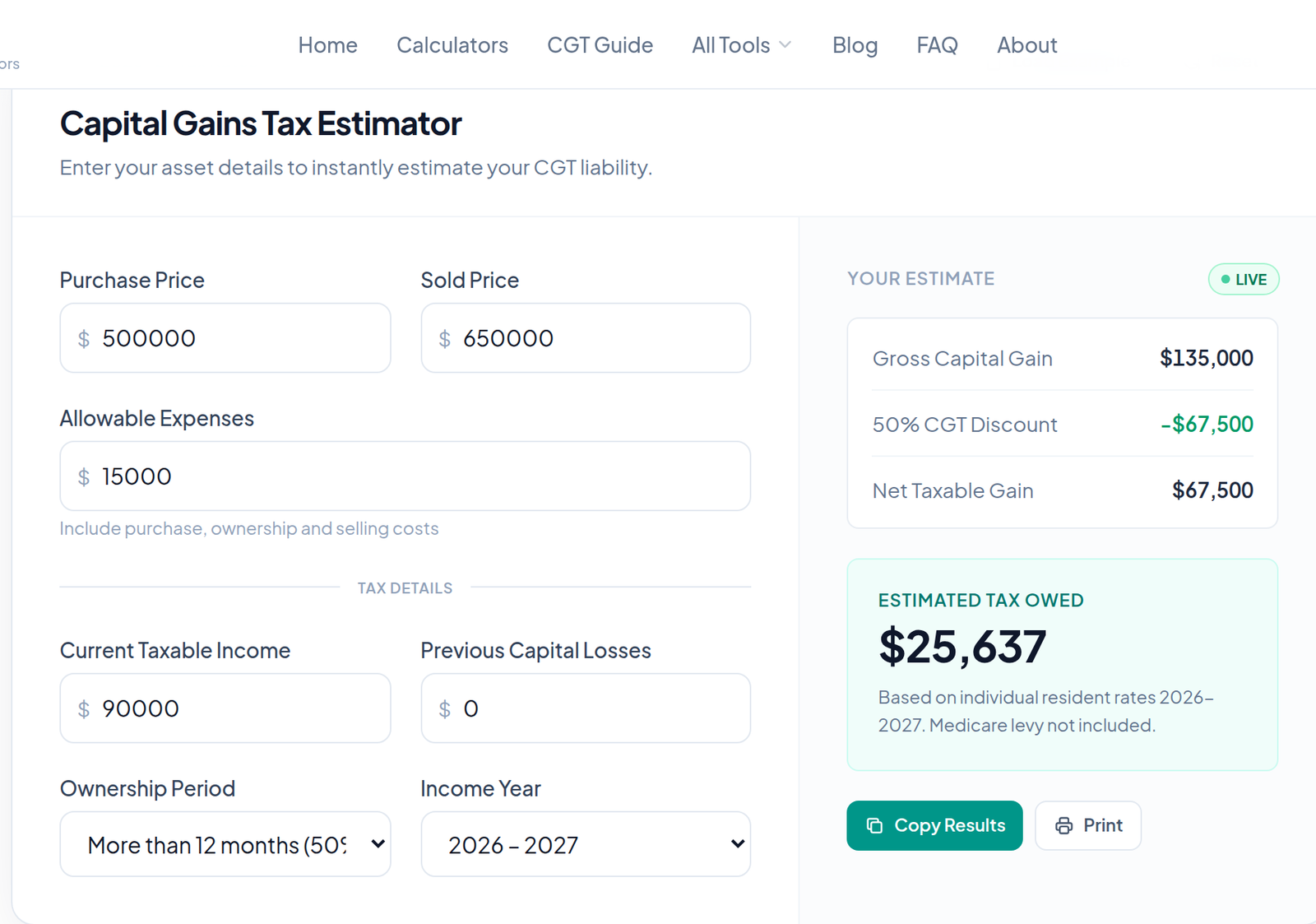
    CGT calculator worked example — $25,637 estimated tax on a $135,000 capital gain for 2026-27
    The cgthub.au CGT calculator with a worked example: $500,000 purchase, $650,000 sale, $15,000 expenses, $90,000 taxable income — estimated tax $25,637 for 2026–27 (50% discount applied).

    Who is “eligible” for a granny flat interest?

    The person getting the lifetime right must meet one of two tests at the time the arrangement is entered into:

    • Pension age. They have reached the qualifying age for the Age Pension. For anyone born on or after 1 January 1957, that age is 67 — and it applies equally to men and women. (Older birth cohorts have lower thresholds; the transition from 65 to 67 completed on 1 July 2023.)
    • Disability. They need, and are likely to continue needing for the next 12 months, assistance to carry out most day-to-day activities because of a disability. Employment or a chance of recovery doesn’t disqualify them.

    Note the subtlety: the test is about being of pension age, not about actually receiving the pension. And the right covers the dwelling plus adjacent land and structures, up to a 2-hectare limit.

    What the exemption covers — and what it doesn’t

    Event CGT treatment
    Creating the arrangement (parent pays to build) Exempt — CGT event D1 doesn’t happen.
    Varying the arrangement (e.g. changing who pays for repairs) Exempt.
    Terminating the arrangement (parent moves into aged care) Exempt.
    Parent sells shares to fund the build Taxable. The share sale isn’t part of the arrangement — normal CGT applies.
    Owner later sells the whole property Normal CGT rules. The main residence exemption still works as usual (see below).
    Owner rents the “granny flat” out at market rent Taxable. This is now a commercial arrangement — the exemption doesn’t apply.

    Step-by-step: getting the exemption right

    1. Check eligibility. Confirm the person receiving the lifetime right is of pension age (67 for anyone born on/after 1 January 1957) or meets the disability test.
    2. Put it in writing. A written, binding agreement naming both parties, the property, and the lifetime right to occupy. Have it witnessed or drafted by a solicitor — this is the single most common failure point.
    3. Keep it non-commercial. The parent can chip in for power, water and maintenance, but don’t set anything resembling market rent. Also make sure the owner is an individual, not a trust or company.
    4. Sort Centrelink separately. Services Australia assesses the granny flat interest for the assets test under its own rules — tax exemption and Centrelink treatment are two different systems. Don’t assume one follows the other.
    5. Keep records. File the signed agreement, the build invoices, and any payments. If the ATO ever asks, this paper trail is your proof.

    Worked example 1: an eligible arrangement — $450,000 contribution

    Margaret, 71, gives her daughter Sandra $450,000 to build an attached flat on Sandra’s Sydney property, where Margaret will live for the rest of her life. They sign a written, binding agreement. Sandra owns the property as an individual, Margaret pays $150 a fortnight toward electricity and water, and legal fees for the agreement are $2,000.

    Without the exemption: Sandra has created a contractual right in exchange for $450,000 — CGT event D1. Her capital gain would be the $450,000 capital proceeds less her $2,000 incidental costs: $448,000. Sandra has owned the property for more than 12 months, so the 50% CGT discount would apply, leaving $224,000 added to her taxable income. On top of a $110,000 salary in 2026-27, that extra income sits squarely in the 45% bracket plus the 2% Medicare levy — a marginal hit of roughly $105,000 in extra tax, all from helping her mum.

    With the exemption: all four conditions are met — individual owner, eligible interest (Margaret is 71), written agreement, non-commercial. CGT event D1 doesn’t happen. Capital gain: $0.

    The numbers above are illustrative — your marginal rate, other income and cost base will differ — but they show why getting the paperwork right matters. Run your own figures on our CGT calculator to see the scale.

    Worked example 2: verbal agreement plus market rent — the exemption fails

    Now flip the facts. Tom, 68, gives his son James $300,000 to build a granny flat on James’s investment property. There’s no written agreement — “we’re family, we trust each other” — and when Tom later moves into residential aged care, James rents the flat out at $420 a week, which is market rent for the area.

    Two things have gone wrong. First, without a written and binding agreement, the arrangement fails the exemption conditions from day one — CGT event D1 happened when the $300,000 changed hands. Second, renting the flat at market rent makes the arrangement commercial in nature, which independently kills the exemption.

    The rough maths: James created a right for $300,000 in capital proceeds. After the 50% discount (property held over 12 months), about $150,000 lands in his taxable income — worth roughly $67,000+ in extra tax at top marginal rates. A one-page agreement would have cost a fraction of that.

    This is also where family gifts can create a second problem: handing property interests to relatives without the exemption can trigger CGT at market value even when no money changes hands. See our guide to CGT on gifting property to family for the full picture.

    Common mistakes families make

    • No written agreement. The single biggest trap. A verbal family understanding is not a “written and binding arrangement”, and the ATO has no discretion to waive this.
    • Charging market rent. Any payment that looks like rent at market rates makes the arrangement commercial. Modest contributions to bills are fine.
    • Owner is a trust or company. The exemption requires the owner to be an individual. If the property sits in a family trust, the exemption is unavailable.
    • Assuming Centrelink and the ATO agree. Services Australia values the granny flat interest for the assets test separately. Tax-exempt doesn’t mean pension-exempt.
    • Thinking the exemption covers the eventual sale. When the property is sold later, the main residence exemption and normal CGT on property rules decide the outcome — the granny flat history doesn’t change that.
    • Selling assets to fund the build. If mum sells shares or an investment property to raise the contribution money, that sale is a normal CGT event — the proceeds’ use doesn’t make it exempt.

    Tips for setting one up cleanly

    • Get a solicitor to draft the agreement, even for a simple family setup. One page, properly witnessed, beats a handshake every time.
    • Spell out what happens if the arrangement ends — for example, if the parent moves into aged care — so the termination is clearly covered by the same exemption.
    • If the parent is under pension age and relying on the disability test, get the medical evidence documented at the time, not years later.
    • Talk to Services Australia before signing if the parent receives or may apply for the Age Pension — the granny flat interest affects the assets test.
    • Keep the build invoices and payment records with the agreement; your cost base records matter too. See our guide to CGT cost base rules.

    How this affects the main residence exemption

    Good news: creating a granny flat arrangement over your main residence doesn’t dent your main residence exemption. The ATO treats the arrangement as a right to occupy the property, not a right to the property itself, so the full exemption survives. If you sell the home years later, the normal main residence rules apply — read our main residence exemption guide for the details.

    Frequently asked questions

    Does CGT apply when my parent pays me to build a granny flat?

    No — as long as the arrangement meets all four exemption conditions (individual owner, eligible interest, written binding agreement, non-commercial), no CGT event happens when the arrangement is created. This has been the rule since 1 July 2021.

    What is a “reverse” granny flat arrangement?

    It’s when the younger generation builds on the parents’ property — for example, you build a $300,000 transportable on your parents’ rural land and live in it. The CGT exemption works exactly the same way, provided the conditions are met: the owners (your parents) are individuals, you hold an eligible interest, the agreement is written and binding, and it’s non-commercial. The ATO has confirmed this in its community guidance.

    Do I need a lawyer, or can we write the agreement ourselves?

    The law doesn’t require a solicitor — it requires the arrangement to be in writing and to show the parties intend to be legally bound. In practice, a solicitor-drafted agreement is cheap insurance: it removes any argument about whether your document qualifies.

    What happens when the arrangement ends — for example, if mum moves into aged care?

    Terminating the arrangement is also covered by the exemption, so no CGT arises on termination. If the property is later sold, normal CGT rules apply to the sale itself.

    Can the parent still get the Age Pension with a granny flat interest?

    Maybe — but it’s a separate assessment. Services Australia values the granny flat interest for the assets test under social security law, which is independent of the tax exemption. Get Centrelink advice before signing.

    What if we never wrote anything down?

    Then you don’t have a granny flat arrangement in the tax law’s eyes, and the CGT exemption doesn’t apply. Creating the right to occupy is CGT event D1, and the owner may face a capital gain based on the money received. Get an agreement put in place and seek tax advice on the position so far.

    Final word

    The granny flat CGT exemption is one of the more generous provisions in the tax law: it lets families care for ageing parents without a tax bill landing on the gesture. But it is a checklist exemption — individual owner, eligible interest, written binding agreement, non-commercial — and missing any single item turns a $0 outcome into a five- or six-figure one. Get the agreement signed, keep it genuine, and the tax side takes care of itself.

  • Airbnb Tax Australia 2026-27: Hosts’ Complete Guide

    Airbnb Tax Australia 2026-27: Hosts’ Complete Guide

    Do you pay tax on Airbnb income in Australia?

    Yes — every dollar of it. Whether you rent out a spare bedroom for a few weekends or run a full-time holiday let, the Australian Taxation Office treats short-term rental income exactly like ordinary rental income: it’s assessable, it goes in your tax return, and the ATO probably already knows the amount before you lodge. Since 1 July 2023, platforms like Airbnb, Stayz and Booking.com have reported host income directly to the ATO twice a year under the Sharing Economy Reporting Regime.

    And the rules just got tougher. From 1 July 2026, new ATO guidance (Taxation Ruling TR 2026/1 and compliance guidelines PCG 2026/2 and PCG 2026/3) overhauled how holiday homes and short-term rentals are assessed. If your property doubles as a holiday home, you can now only claim ownership expenses like mortgage interest and council rates if the place is mainly used to produce rental income. Block it out every Christmas for your own family and those big deductions can disappear entirely — not apportioned, denied.

    This guide covers how Airbnb income is taxed in 2026–27: what counts as income, what you can claim, the area-and-time apportionment formula, the new holiday-home rules, GST, Victoria’s 7.5% short stay levy, and the capital gains tax bill waiting when you sell — each with worked numbers.

    What counts as Airbnb income

    You must declare the gross amount — not the payout that lands in your bank account after Airbnb takes its cut. That includes:

    • Nightly rates and any weekly or monthly amounts guests pay
    • Cleaning fees charged to guests (assessable income, even if you pass every cent to your cleaner)
    • The platform’s guest service fee where it forms part of the booking price
    • Bond money you keep for damage, insurance payouts for lost rent, and reimbursements from guests

    Declaring only the net payout is one of the most common errors the ATO flags. Its guidance is explicit: report the gross rent paid by the tenant, not the amount you receive after fees are deducted. The platform commission is deductible separately, so you end up in the right place — but only if you get both sides right.

    Income is reported in the year the guest pays it, which can differ from when your managing agent or Airbnb releases it to you. A guest who books and pays in June 2027 for a July stay creates 2026–27 income, not 2027–28.

    The Sharing Economy Reporting Regime

    Since 1 July 2023, short-term accommodation platforms have been required to report host activity to the ATO twice yearly: by 31 January for the July–December half and by 31 July for the January–June half. Each report includes the host’s name, TFN or ABN, total income, number of transactions and the property address. The ATO’s data-matching program then checks those figures against what appears in your tax return, and its media releases are blunt that discrepancies get followed up. The ATO is also writing to taxpayers whose rental income looks significantly lower than the expenses they’ve claimed over multiple years — a letter no host wants to receive.

    Deductions: what Airbnb hosts can claim

    The same expenses available to long-term landlords are available to short-term hosts, with one big difference: almost everything must be apportioned between income-producing use and private use. You can claim the portion of these expenses that relates to earning rental income:

    • Interest on the loan used to buy the property
    • Council rates, water charges and land tax
    • Building, contents and public liability insurance
    • Cleaning costs after a guest stays, linen and laundry
    • Repairs and maintenance (not improvements)
    • Platform commissions and booking fees — 100% deductible, no apportionment needed
    • Advertising, professional photography for your listing, pest control, gardening
    • Utilities — electricity, gas, internet — for the rental period

    Costs spread over several years: depreciation of furniture and appliances (Division 40), capital works like a new deck or renovation (Division 43 at 2.5% a year), and borrowing expenses. Note that any Division 43 and Division 40 amounts you claim reduce your cost base for CGT later — deductions now, a bigger capital gain on sale (see our investment property depreciation guide).

    You cannot claim the private-use portion of any expense, acquisition and disposal costs of the property itself, or — unchanged since 1 July 2019 — holding costs on vacant land.

    The apportionment formula: area × time

    When you rent out part of your home, the ATO requires a two-step calculation. First the area-based method: (your room’s square metres + half the shared areas) ÷ total square metres. Then the time-based method: days the space produced income ÷ 365. Multiply the two percentages together and apply the result to your annual shared expenses.

    If you rent out your whole home occasionally — say while you’re travelling — only the time-based step applies.

    Worked example: Maya’s spare room

    Maya rents her spare bedroom on Airbnb. The room is 12 square metres, the shared living areas are 60 square metres, and the house is 140 square metres in total.

    • Area: (12 + 60 ÷ 2) ÷ 140 = 42 ÷ 140 = 30%
    • Time: rented for 140 days → 140 ÷ 365 = 38.4%
    • Combined: 30% × 38.4% = 11.5%

    Maya’s annual shared expenses — interest, rates, insurance, electricity and internet — total $24,000. Her deductible share is 11.5% × $24,000 = $2,760. She also paid $890 in Airbnb host service fees, which are 100% deductible, giving her total rental deductions of $3,650.

    One trap: listing the room all year doesn’t mean 365 income days. The ATO counts only days the room was actually rented (or genuinely held for rent) — an empty, unlisted spare room is treated as private use of your home, not as available-for-rent days.

    New from 1 July 2026: the “mainly” test (TR 2026/1)

    This is the change most holiday-home hosts still haven’t priced in. From 1 July 2026, if your property doubles as a holiday home, you can only claim ownership and use expenses — interest, council and water rates, body corporate fees, repairs and maintenance, capital works, decline in value — if the home is mainly used (or held mainly for use) to produce rental income.

    If it fails that test, those expenses are denied entirely — not apportioned down, gone. The only deductions that survive are expenses directly tied to letting it out: advertising, booking or commission fees, and cleaning after a guest stays.

    How does the ATO decide what “mainly” means? It looks at how the property is used, how long it was dedicated to income-producing use, how much time you and your family used it, and — crucially — whether it was available during peak demand periods such as school holidays, public holidays and Christmas. A property that is blocked out every Christmas for the owner’s family looks, to the ATO, like a private holiday home that happens to be rented, not a rental that happens to be used privately. If the property passes the test but has some minor private use (a week or two in the off-season), ownership expenses remain claimable but must be apportioned for those private days.

    Worked example: Chris’s Noosa unit

    Chris owns a Noosa unit with annual ownership costs of $31,000 (interest $22,000, body corporate $5,500, rates and insurance $3,500). He rents it on Airbnb for 90 days and uses it himself — and for family — for 6 weeks, including every Christmas and Easter.

    Because the unit is blocked out through every peak period, the ATO is likely to treat it as mainly a private holiday home. Result: $0 of the $31,000 ownership costs are deductible. Chris can still claim his advertising, Airbnb commissions and post-stay cleaning — perhaps $2,000 — but the big-ticket deductions vanish, while the full $18,000 of rental income stays assessable.

    Contrast this with the same unit listed and genuinely available all year — including Christmas — at market rates, rented 90 days and used privately for two quiet off-season weeks. Then the ownership costs are claimable, apportioned for the two private weeks. The difference between the two scenarios is roughly $9,000–$11,000 of deductions on a $31,000 cost base, depending on Chris’s marginal rate. Peak-period availability is now a tax strategy, not just a pricing one.

    GST: you almost certainly don’t have it

    Residential rent in Australia is input-taxed (effectively GST-free). That means standard Airbnb hosting of a residential property attracts no GST — and you cannot claim GST credits on your hosting expenses — even if your turnover exceeds the $75,000 GST registration threshold. The threshold simply doesn’t bite on input-taxed supplies.

    The exception is commercial residential premises: hotel-style operations such as serviced apartments, motels or bed-and-breakfast accommodation run as an enterprise, where GST can apply. The ATO’s own line is that it is rare for someone to be carrying on a business merely by renting out a property, so this won’t capture ordinary hosts. If you’re running multiple whole properties with hotel-style services, get advice — that’s the fact pattern where the exception lives.

    Note: Victoria’s short stay levy is a state levy, not GST — the two have nothing to do with each other.

    Victoria’s 7.5% short stay levy

    Since 1 January 2025, Victoria charges a short stay levy of 7.5% of the total booking fee on any stay of fewer than 28 continuous days. The “total booking fee” is broad: it includes cleaning fees, GST and service charges (credit card fees are excluded).

    How you take bookings Who pays the levy
    Through a platform (Airbnb, Stayz, Booking.com) The platform — it collects 7.5% from the guest and remits it. Your payout is unaffected.
    Direct bookings (your own website, repeat guests) You — you must register with the State Revenue Office and lodge returns.

    The levy doesn’t apply to stays of 28 days or more, or to a short stay in someone’s principal place of residence — if you list your own home while you’re away on holidays, those guest stays are exempt. But it does apply to a granny flat on the same land as your PPR, a private room in a house that isn’t anyone’s PPR, and tiny homes.

    For direct-book hosts, the compliance mechanics matter: properties earning up to $75,000 in short-stay revenue lodge an annual statement (the first was due 30 January 2026); above that, quarterly returns. The ACT has also introduced a short stay levy (reported as 5% in early 2026). No other state or territory had one as of early 2026 — but councils are circling, so check your local rules before you list.

    The key tax point: the levy is collected from the guest on platform bookings, so it doesn’t reduce your assessable income — but it does make your listing 7.5% more expensive to the guest, which is a pricing and occupancy consideration, not a deduction.

    CGT when you sell: the partial exemption

    Every deduction you claim while hosting chips away at your main residence exemption. The formula mirrors the apportionment above: the percentage of floor area rented × the percentage of ownership days it produced income gives the share of the capital gain exposed to CGT.

    Worked example: Priya’s spare room

    Priya rents out 25% of her home’s floor area on Airbnb for 3 of the 10 years she owns the property, then sells for a $300,000 gain.

    • Exposed share: 25% × (3 ÷ 10) = 7.5%
    • Taxable gain before discount: 7.5% × $300,000 = $22,500
    • 50% CGT discount (held more than 12 months): $22,500 → $11,250 assessable
    • Tax at a 30% marginal rate plus Medicare levy: roughly $3,600

    Three years of hosting revenue, one $3,600 tax bill on sale — most hosts never model this. And remember the Division 43 and Division 40 deductions claimed along the way reduce your cost base, pushing the gain higher.

    Two important nuances. First, the 6-year rule (treating a former home as your main residence for up to 6 years of absence) applies to whole-home absences — it doesn’t rescue a spare room rented while you were living there. Second, from 1 July 2027 the CGT discount rules change: the contract date — not settlement — determines which regime applies, so if a sale is on the horizon, timing the contract matters more than ever. See our CGT reform guide for the dollar-for-dollar comparisons.

    Common mistakes the ATO is actively hunting

    1. Claiming 100% of expenses on a property you use yourself. The ATO’s top short-term rental complaint. Deductions are limited to days rented or genuinely available for rent — and from 1 July 2026, the TR 2026/1 “mainly” test can wipe out ownership expenses entirely.
    2. Declaring net payouts instead of gross income. Airbnb’s data feed shows the gross. Your return should match it.
    3. Friends and family at mate’s rates. If you let family stay for free or at a reduced rate, your deductions for those periods are capped at the rent actually received — you can’t manufacture a loss on a $50-a-night “rental” of a $300-a-night property.
    4. Leaving platform income off entirely. The data-matching program means undeclared Airbnb income is one of the easiest things the ATO finds.
    5. Assuming the 6-year rule covers Airbnb use. It covers moving out — not hosting from the spare room while you live there, and not holiday-home private use.
    6. Claiming “genuinely available” days that weren’t. Listing at above-market rates, refusing most enquiries, or blocking peak periods all signal the property wasn’t genuinely available — and deductions get limited to actual rental days.

    Record-keeping: what to keep

    The ATO expects contemporaneous records, not reconstructions at tax time. Keep:

    • Monthly platform statements showing gross income, fees and payouts
    • Your booking calendar — including blocked-out personal-use periods
    • Receipts for every deductible expense, with private/business splits noted
    • Floor-area measurements for the rented space and shared areas
    • Evidence of market-rate pricing (comparable listings) for periods you claim as “available for rent”
    • A simple diary of days the property was rented, available, or used privately

    Frequently asked questions

    I only hosted for one weekend — do I really have to declare it?

    Yes. There is no minimum threshold, no “occasional use” exemption, and no “I thought it was a hobby” defence. All rental income is assessable regardless of how rarely you host.

    Do I declare the gross booking amount or what Airbnb pays me?

    The gross amount the guest pays — including cleaning fees and the guest service fee — then claim the platform’s commission as a separate 100% deduction. Your return’s income figure should reconcile with what Airbnb reports to the ATO.

    Do I need to register for GST if my Airbnb earns over $75,000?

    Almost certainly not. Residential rent is input-taxed, so the $75,000 threshold doesn’t trigger GST registration for ordinary hosts — but it also means you can’t claim GST credits on expenses. The exception is genuinely commercial, hotel-style operations.

    Can I claim a full year of interest if my holiday home was listed all year but only booked 60 days?

    No. At best you apportion to the 60 rental days plus any days it was genuinely available at market rates. From 1 July 2026, if the property is mainly a private holiday home under TR 2026/1, the interest isn’t deductible at all.

    Will Airbnb’ing my spare room destroy my main residence exemption?

    It erodes it in proportion to the area rented and the days rented — it doesn’t destroy the whole exemption. But the 6-year rule won’t help: it only applies when you’ve moved out of the entire home.

    Is Victoria’s short stay levy an extra tax I have to pay?

    Not on platform bookings — Airbnb collects it from the guest and your payout is unchanged. You only handle it yourself on direct bookings, where SRO registration and returns are required.

    The bottom line

    Short-term rental tax in 2026–27 comes down to three numbers: what came in (gross), what fraction of the property and the year produced it (area × time), and whether your holiday home is genuinely, mainly, a rental (the TR 2026/1 test). Get those right and Airbnb income is straightforward; get them wrong and you’re either leaving deductions unclaimed or inviting an ATO letter armed with your own platform data. Run your numbers through our income tax calculator and CGT calculator, and if the property doubles as a holiday home, review your peak-period availability before you lodge — under the new rules, it’s a tax decision.

    Related reading: rental income tax, main residence exemption, the 6-year rule, negative gearing.

  • CGT on Subdivided Land Australia 2026-27: Rules & Examples

    CGT on Subdivided Land Australia 2026-27: Rules & Examples

    Subdividing your land doesn’t trigger capital gains tax — selling one of the new lots does. That distinction trips up almost everyone who carves off a backyard block. The vacant lot becomes a brand-new CGT asset with its share of your original cost base, and the main residence exemption that protected your home won’t protect the lot you sell separately. In 2026-27 the 50% CGT discount still applies after 12 months of ownership — but one date now dominates every subdivision decision: 1 July 2027, when the discount is legislated to disappear. This guide runs the real rules with dollar figures, the traps the accountant blogs gloss over, and the GST angle most of them ignore.

    The short answer

    • Subdivision itself is not a CGT event. The ATO splits your parcel into two or more separate CGT assets; nothing is taxed until you sell or transfer one of the new lots (CGT event A1).
    • A separately sold lot never gets the main residence exemption. Only land sold with your dwelling is covered. Sell the backyard block on its own and it’s fully taxable, however long it was “part of your home”.
    • The cost base is split on a reasonable basis. Original purchase price, stamp duty and legals — plus survey, council and subdivision costs — are apportioned across the new lots, usually by area or market value.
    • CGT is timed at the contract date, not settlement. Sign before 30 June 2027 and the old 50% discount still applies (12-month hold); sign on or after 1 July 2027 and the new indexation-plus-30%-floor rules take over.
    • Bought to subdivide and sell? That’s ordinary income, not a capital gain. No 50% discount, no capital losses to offset it — and GST may apply on top.

    How subdivision triggers CGT

    The ATO’s sequence, from its Subdividing land guidance: you subdivide (no tax event), each new lot keeps the original acquisition date — the 12-month discount clock doesn’t restart — and when you sell a lot, CGT event A1 happens. Gain equals sale price minus that lot’s apportioned cost base. Sell one lot this year, keep the other for a decade: they’re taxed completely separately.

    The part people under-budget is how wide the cost base is: purchase price plus stamp duty and legals, the surveyor, council DA and application fees, civil works, connections, the valuer’s fee, and the commission and legals when you sell the lot. Every receipt you lose is profit you’re paying tax on.

    “Mere realisation” vs a profit-making scheme

    The ATO taxes your profit as ordinary income (not a capital gain) if both of these are true: your intention or purpose in subdividing was to make a profit, and it was made in the course of carrying on a business, a business operation or commercial transaction. That second limb catches you even if you aren’t in business — the ATO says so explicitly, including one-off transactions by individuals (TR 92/3).

    Two archetypes:

    The mere realiser (capital account). You bought the house to live in years ago; the kids moved out, the big block is too much garden, you carve off the back and sell it. You were realising a long-held asset, not running a development. CGT applies, the 50% discount is available after 12 months, and the main residence exemption keeps protecting the lot with the house.

    The profit-maker (revenue account). You bought the block with a plan — subdivide into four, sell the lots, bank the margin — and acted like a developer: agents, marketing, maybe a previous project. That profit is ordinary income under section 6-5. No 50% discount however long you held, capital losses can’t reduce it, and it’s taxed at your marginal rates in the year you derive it.

    The danger zone is the borderline: a duplex where you keep one and sell the other is often still capital if your intention for your half never changed — but multiple lots plus marketing plus development finance looks like a commercial operation, and the whole tax outcome shifts with it. If there’s doubt, get advice before you lodge the DA, not after the sale contracts are signed.

    The main residence exemption trap

    The costliest trap for ordinary families sits in section 118-165: the exemption does not apply to land unless the CGT event also happens in relation to the dwelling. The ATO’s line: the exemption applies only to the allotment containing the dwelling — the sale of the second allotment is subject to CGT.

    The classic case: house on 1,000m² bought in 2019, lived in throughout, subdivided in 2026 into a 500m² house lot and a 500m² vacant lot, vacant lot sold. The house lot keeps its full exemption for a future sale as your home. The vacant lot gets zero exemption — not half, not pro-rata, zero — even though it was “your backyard” for seven years.

    A warning about something you’ll read elsewhere: one accountant blog claims a subdivided lot can get the full exemption if sold “within two years of moving into the retained residence”. That is not how section 118-165 works — don’t plan around it.

    The s118-192 reset: a second trap for former rentals

    Say you lived in the house, moved out in 2022 and rented it under the six-year rule, then subdivided and sold the back lot in 2026. Section 118-192 deems you to have acquired the property at its market value on the day it was first rented (first rentals after 7:30pm on 20 August 1996) — everything before that day drops out of the cost base, and the reset value is apportioned to the new lots. The six-year absence rule can’t save the back lot: it only exempts a dwelling when the whole property is disposed of together. Get a valuation at the first-rental date — without it, your cost base is guesswork. Our six-year rule guide covers the absence rule in full.

    GST on subdivided lot sales

    GST is the tax most small subdividers never see coming: it turns on whether you were carrying on an enterprise — not on whether the land was your home.

    One-off backyard subdivision by a private owner: usually no GST. Carve off part of your long-held home block and you’re not in an enterprise — CGT is your only concern.

    Subdivision as a business or commercial project: GST applies. Each lot sale is a taxable supply. You register for GST and claim credits on development costs — but the buyer of “potential residential land” may have to withhold the GST at settlement and pay it straight to the ATO.

    The margin scheme is the relief valve: with a written agreement in the sale contract, GST is 1/11th of the margin (sale price minus apportioned original price) instead of 1/11th of the full price. Quick maths: block bought for $350,000, four lots, one sold for $200,000. Apportioned price: $87,500. Margin: $112,500. GST: $10,227 — versus $18,182 without the scheme, roughly $8,000 saved per lot. The agreement must be in the contract before settlement; miss that clause and there’s no fixing it afterwards.

    Step by step: working out your CGT

    1. Confirm acquisition date and cost base. Purchase price plus stamp duty, legals and capital costs — minus anything already claimed as a deduction.
    2. Add the subdivision costs. Surveyor, council DA fees, civil works, connections, valuer.
    3. Apportion on a reasonable basis. By area for equal-value lots; by market value (registered valuer) when they differ.
    4. Add the sale costs of the lot you sold. Commission, advertising, conveyancing.
    5. Gain = sale price − apportioned cost base.
    6. Apply the discount if eligible. Individual or trust, held 12+ months, CGT event before 1 July 2027 → halve the gain.
    7. Add the net gain to taxable income. No separate CGT rate — it’s taxed at your marginal rate. Try the CGT calculator.

    The 1 July 2027 line: the 50% discount survives for CGT events up to 30 June 2027 — the “event” is the contract date, not settlement. From 1 July 2027 the legislated reform replaces it with CPI indexation plus a 30% minimum tax on the real gain; pre-July 2027 gains keep the old treatment. Get a valuation dated near 1 July 2027 either way. Full detail in our CGT reform guide.

    Worked example 1: the backyard subdivider

    Sarah bought a house on 1,200m² in March 2019 for $800,000 plus $30,000 stamp duty and legals, and lived there throughout. In early 2026 she subdivided into two equal 600m² lots for $35,000, then sold the vacant lot in May 2026 for $650,000. Sale costs: $17,000.

    Cost base item Amount
    Original cost base apportioned (50% of $830,000) $415,000
    Share of subdivision costs (50% of $35,000) $17,500
    Sale costs (commission + legal) $17,000
    Total cost base of the sold lot $449,500
    Sale price $650,000
    Capital gain $200,500
    50% CGT discount (held since 2019; contract May 2026) ÷ 2
    Net gain added to income $100,250

    No main residence exemption on the sold lot — sold separately from the dwelling. The retained house lot keeps its full exemption.

    Tax effect: on her $95,000 salary, Sarah’s taxable income jumps to $195,250. At 2026-27 rates her income tax rises from $19,020 to about $53,732 — roughly $34,700 extra, plus about $2,000 in extra Medicare levy. That “free money” from the backyard just cost nearly $37,000 in tax. Model your own salary-plus-gain in the income tax calculator.

    Worked example 2: a couple splits two lots

    Daniel and Aisha bought a house on 1,000m² in 2020 for $1,150,000 (joint tenants, 50/50) with $50,000 purchase costs. In 2026 they subdivide into two equal lots for $40,000 and sell the vacant lot for $720,000 (contract September 2026), with $15,000 sale costs.

    Cost base of the sold lot: $600,000 + $20,000 + $15,000 = $635,000. Gain: $85,000, split $42,500 each; each applies the 50% discount → $21,250 each added to taxable income. Nuance: unused capital losses apply against a partner’s $42,500 share before the discount — the other partner can’t use them. If the couple later sells the retained house lot as their main residence, that sale is fully exempt.

    Worked example 3: the developer who loses the discount

    Sam buys a vacant 2,000m² block in January 2026 for $350,000 to subdivide into four lots and sell. Subdivision and holding costs: $150,000. He sells all four at $200,000 each — $800,000 total.

    The plan from day one was subdivision for profit in a commercial-style operation, so the $300,000 profit is ordinary income, not a capital gain. No 50% discount — the full $300,000 is assessable at marginal rates, and no capital losses can offset it. As a discounted capital gain, only $150,000 would have been taxable.

    GST bites too if Sam is registered as an enterprise: with the margin scheme in the contracts, GST per lot is ($200,000 − $87,500) ÷ 11 = $10,227 (~$40,909 total) versus $18,182 per lot without it. One contract clause saves over $30,000 — and the buyers withhold the GST at settlement for the ATO.

    Common mistakes

    1. Assuming the backyard lot is exempt because the home is. The exemption covers the dwelling and land sold with it — never a separately titled lot.

    2. Timing the gain to settlement. CGT event A1 is the contract date. A 28 June 2027 contract with August settlement keeps the old discount rules; a 3 July 2027 contract doesn’t.

    3. Leaving subdivision costs out of the cost base. Survey, DA fees, civil works, connections, valuer — all shrink the gain.

    4. Splitting 50/50 by area when the lots differ in value. “Reasonable basis” is the test — a valuer’s report at subdivision date is cheap insurance.

    5. Claiming the 50% discount on a development profit. Recharacterised as a profit-making scheme, the discount vanishes — and capital losses can’t touch the profit.

    6. Forgetting GST entirely. Private one-off? Fine. Enterprise-like? GST, margin scheme and buyer withholding apply — budget for them first.

    7. No valuation at the key dates. Subdivision date, first-rental date, 1 July 2027. Retrospective valuations are harder and dearer.

    Tips before you subdivide

    • Get tax advice before the DA, not after the sale. Capital vs revenue turns on your intention and conduct.
    • Commission a registered valuation at subdivision. It locks in an apportionment the ATO will accept.
    • Keep every invoice. Council, surveyor, solicitor, works, connections, agent — if it’s in the cost base, you need proof.
    • Mind the contract date around 30 June 2027. Days can decide whether the 50% discount applies to a six-figure gain. Our property CGT guide covers the discount rules.
    • Put the margin-scheme clause in the contract. If GST applies, the written buyer agreement must predate settlement.
    • Plan the retained lot too. Today’s cost-base split sets up the gain on the lot you keep. See our main residence exemption guide.

    FAQ

    Does subdividing my land trigger CGT by itself?

    No. One asset becomes two or more, each keeping the original acquisition date. CGT bites when you sell or transfer a new lot (CGT event A1).

    Is the subdivided backyard covered by my main residence exemption?

    No, if sold separately from your home: s118-165 limits the exemption to land sold with the dwelling, so the vacant lot’s gain is fully taxable.

    Can I get the 50% CGT discount on a subdivided lot?

    Yes — individual or trust, 12+ months held, capital account, CGT event before 1 July 2027. Profit-making schemes taxed as ordinary income get no discount.

    Do I pay GST when I sell a subdivided lot?

    It turns on the enterprise test, not the land. A one-off subdivision of your long-held home block is usually not an enterprise — no GST. A commercial project is — GST applies, the margin scheme can cut it to 1/11th of the margin, and the buyer may withhold GST at settlement.

    How do I split the cost base between the new lots?

    On any “reasonable basis”: by area for equal-value lots, by market value (registered valuer) when they differ — folding in purchase costs, stamp duty, subdivision costs and sale costs.

    What if I bought the land before 20 September 1985 (pre-CGT)?

    The lots inherit pre-CGT status, so gains are generally exempt today. Caveats: big improvements can be separate post-CGT assets, and the 2027 reform brings post-2027 growth on pre-CGT assets into the CGT net — get a valuation near 1 July 2027.

    The bottom line

    Subdivision rewards the prepared and punishes the casual. The families who come unstuck assumed the backyard lot was exempt, left subdivision costs out of the cost base, or signed the sale contract without knowing which side of 1 July 2027 they were on. Get classification right, get a valuer’s apportionment, keep every invoice, and check GST before the DA goes in.

    Checked against the ATO’s Subdividing land guidance and the CGT guide’s real estate section, plus the Treasury Laws Amendment (Tax Reform No. 1) Act 2026. Anything beyond a simple backyard carve-off deserves a registered tax agent before you sell.

  • CGT for Non-Residents Australia 2026-27: Rules & Withholding

    CGT for Non-Residents Australia 2026-27: Rules & Withholding

    If you sell Australian property while you’re a foreign resident for tax purposes, three rules hit you at once — and most expats only discover the first on settlement day, when $135,000 of a $900,000 sale price doesn’t reach them. This guide explains the 15% foreign resident capital gains withholding, the two CGT concessions you lose as a non-resident, and how to claim the withheld amount back. Every figure is checked against the ATO’s current published guidance for 2026–27.

    The short answer

    When a foreign resident sells Australian real property:

    1. The buyer withholds 15% of the sale price at settlement and pays it to the ATO. For contracts signed on or after 1 January 2025 there is no minimum threshold — every sale at any price is caught. It’s a withholding, not a final tax; you claim it as a credit in your tax return.
    2. You cannot claim the main residence exemption if you are a foreign resident at sale time (disposals after 30 June 2020), unless you pass a narrow “life events” test. The years you lived in the home as a resident don’t save you.
    3. You don’t get the 50% CGT discount on growth that accrued while you were a foreign resident (assets bought after 8 May 2012). Only an apportioned discount for days you were an Australian resident after that date.

    One date controls almost everything here: the contract date. The old withholding rules (12.5% on $750,000+ sales) still apply to contracts signed before 1 January 2025, even if they settle later — and your return year is the contract year, not the settlement year.

    Withholding: old rules vs new rules

    The regime has been tightened twice, and plenty of online advice still quotes the old numbers. Get your contract date into the right row:

    Contract date Rate Threshold
    1 Jul 2016 – 30 Jun 2017 10% $2 million+
    1 Jul 2017 – 31 Dec 2024 12.5% $750,000+
    On or after 1 Jan 2025 15% None — every sale

    The 15% applies to the market value — for an arm’s-length sale, the contract price — not your gain. On a $900,000 sale the buyer holds back $135,000 even if your actual gain is only $50,000. The ATO owes you the difference once your return is assessed.

    It’s broader than houses: residential and commercial property, vacant land, leases over Australian real property, mining/quarrying/prospecting rights, indirect real-property interests (with a right to occupy), and options or rights to acquire any of these. Excluded: approved stock-exchange transactions, securities lending, and vendors in external administration. The ATO’s FRCGW overview lists every asset type caught.

    What happens on settlement day

    1. The buyer must withhold unless you prove otherwise. No clearance certificate or variation notice in the buyer’s hands at or before settlement = 15% withheld. This catches genuine Australian residents who forgot to apply, too.
    2. It runs through the settlement platform. Typically a PEXA financial settlement direction routes the withheld amount to the ATO, shown as its own line on the settlement statement. The buyer remits on or before settlement day.
    3. Buyers face penalties for failing to withhold — which is why conveyancers enforce it strictly.
    4. The credit lands in your contract-year return. Individuals claim it at question 18, label X of the supplementary return (trusts: item 21 label B; companies: label H8). If the credit exceeds your tax, the balance is refunded — after the return is assessed, which takes months.

    A vendor declaration (a written statement that you’re a resident) cannot avoid withholding on a real property disposal — real property needs a clearance certificate. False declarations attract penalties of up to 120 penalty units.

    Clearance certificates: apply early, not after exchange

    • Apply the moment you decide to sell. Certificates take up to 28 days and last 12 months, so they can comfortably pre-date your listing. It’s free.
    • Every person on the title needs their own — joint applications don’t exist.
    • It must reach the buyer at or before settlement. A certificate issued the day after is worthless for that sale.
    • Miss it and 15% of the price is held up. On $900,000 that’s $135,000, refundable only after your contract-year return is assessed.

    Foreign-resident vendors can’t get clearance certificates but can seek a variation notice reducing the rate to anywhere from 0% to 14.99%. Grounds that work: a small or zero gain, a capital loss, or no Australian tax liability on the disposal. Apply as soon as the contract is signed with the contract and title documents, at least 28 days before settlement — and get all tax lodgements up to date first, or the application stalls.

    Worked example: Daniel sells his Brisbane unit

    Daniel is an Australian citizen, a foreign resident for tax purposes since moving to Singapore in 2023. He sells his Brisbane investment unit in November 2026:

    • Sale price: $900,000 (contract 15 Nov 2026, settles Jan 2027)
    • Bought 2015 for $600,000; selling costs $25,000
    • Capital gain: $900,000 − $600,000 − $25,000 = $275,000

    Withholding at settlement: contract after 1 Jan 2025 → buyer withholds 15% × $900,000 = $135,000. Daniel receives $765,000.

    CGT discount: bought after 8 May 2012, so the discount is apportioned — 50% × (resident days after 8 May 2012 ÷ total days from 8 May 2012 to sale). Daniel was resident for most of the ownership period, so it works out to roughly 35% here (get the exact day count from your accountant). Net gain ≈ $275,000 − $96,250 = $178,750.

    The tax: non-residents have no tax-free threshold — 30c to $135,000, 37c to $190,000, 45c above (the ATO’s latest published non-resident table is the 2025–26 edition; the 2026–27 edition had not been re-published at the time of writing). No Medicare levy for foreign residents. On $178,750: 30% × $135,000 = $40,500 plus 37% × $43,750 = $16,187.50 → $56,687.50.

    The refund: $135,000 withheld against a $56,687.50 liability — roughly $78,300 comes back once the 2026–27 return is assessed. A variation notice at ~6.3% ($56,688 ÷ $900,000) would have matched the settlement-day cash flow to the real liability — exactly what the variation system is for.

    The lesson: 15% of the price is almost always far larger than the tax on the gain. The system assumes the worst and refunds the difference.

    The main residence exemption: gone for foreign residents

    Dispose of the property as a foreign resident after 30 June 2020 and you cannot claim the main residence exemption at all — not partially, not apportioned to the years you lived there. A 12-year family home sold from overseas is fully taxable.

    The only exception is the life events test: you were a foreign resident for a continuous period of six years or less, and during that period you, your spouse, or a child under 18 suffered a terminal medical condition or died — or you entered a formal agreement on a marriage or relationship breakdown.

    Old grandfathering (holdings before 7:30pm AEST 9 May 2017, sold by 30 June 2020) is closed — see the ATO’s page on the main residence exemption for foreign residents. For the resident-side rules — the 6-year absence rule, moving between homes — see our main residence exemption guide and the 6-year rule explainer.

    The 50% discount, apportioned

    For assets acquired after 8 May 2012: discount % = 50% × (days as an Australian resident after 8 May 2012 ÷ days from 8 May 2012 to the CGT event). Only pre-9 May 2012 growth keeps a full discount. Buy as a non-resident and never live here during ownership? The discount is zero and the whole gain is taxed at full non-resident rates.

    The day-count is where DIY filers go wrong — it’s your actual residency status day by day, not your citizenship or visa label. Our 50% discount guide covers the resident mechanics, and the cost base guide shows how to maximise the figure it applies to.

    The “I moved overseas after buying” trap: CGT event I1

    When you stop being an Australian resident, CGT event I1 triggers a deemed disposal of assets that aren’t taxable Australian property — shares, ETFs, crypto — at market value on the day residency ends. Real property is exempt (it stays in the Australian CGT net).

    You can elect under section 104-165 to disregard the deemed gain or loss; the assets then become taxable Australian property until sold or until residency resumes. No separate notification — the return as lodged evidences the choice. It’s a one-way-feeling decision made on paper at the worst possible time (emigration), which is why most people first hear of it from an accountant years later.

    New from 1 October 2026: the regime just got tougher

    The Strengthening the Foreign Resident CGT Regime measure commenced 1 October 2026 — ten days before this article. In plain English:

    • “Real property” has a statutory definition: land, rights and interests relating to land, assets fixed to land (wind turbines, solar panels, mining equipment), leases and licences over them. Water rights are included too.
    • The principal asset test is now measured over 365 days, not at a point in time — no more restructuring just before sale.
    • Pre-settlement notification: foreign vendors declaring a disposal isn’t an indirect Australian real property interest, on transactions of $50m+ (including related transactions), must notify the ATO at least 28 days before settlement.
    • Buyers must consider whether they reasonably believe a vendor declaration is false, any time before settlement.
    • Transitional concession: eligible foreign residents disposing of certain renewable energy assets (1 Oct 2026 – 1 Jul 2040) keep a 50% CGT discount.

    Mostly this bites large, complex transactions — but the broadened definition matters if your sale involves anything beyond a straightforward house or unit. The ATO’s detail page on the measure has the full legislative breakdown.

    Two companion traps

    Vacant land is the worst of both worlds. Since 1 July 2019 you can’t deduct holding costs for vacant land — no interest, no rates, no maintenance, even for land bought earlier (narrow exceptions for companies, businesses, primary producers). And a vacant-land sale is still caught by FRCGW: costs you can’t deduct, proceeds the buyer withholds from.

    Your home country will tax it too. Australia’s double tax agreements (UK, US, Japan, Singapore, France and 40-plus others) preserve Australia’s primary taxing right over Australian real-property gains. Your country of residence typically grants a foreign tax credit for the Australian tax paid — keep immaculate records of what was withheld and when. Treaty specifics vary: get advice.

    Frequently asked questions

    I’m an Australian citizen living in Singapore — the 15% can’t apply to me, can it?

    It can. The regime cares only about tax residency, not citizenship. A citizen who is a foreign resident for tax purposes is caught like any other non-resident: no clearance certificate, 15% withheld unless a variation notice reduces it.

    Is the 15% taken from my gain or the sale price?

    The sale price — the most misunderstood fact in the regime. On a $900,000 sale with a $50,000 gain, $135,000 is withheld: nearly three times the gain. The excess comes back as a credit/refund after your contract-year return is assessed.

    My contract was signed in December 2024 but settles in 2025 — which rules apply?

    The contract date governs. Signed before 1 January 2025, the old rules apply (12.5% on $750,000+ sales) even with a later settlement — and the credit belongs to the contract year’s return.

    I lived in the house 12 years before moving overseas. Doesn’t the exemption cover those years?

    No. A foreign resident disposing after 30 June 2020 (outside the life events test) gets no exemption on the entire gain, including the resident years. This generates the biggest unexpected bills in expat forums.

    I held the property 15 years — I get the 50% discount, right?

    Only apportioned: 50% × (resident days after 8 May 2012 ÷ total days since 8 May 2012). Growth while foreign-resident gets no discount; a non-resident for the whole ownership period gets zero.

    How long until I get the withheld amount back?

    Only after the ATO assesses the return for the contract year — months after lodgement, with no fast-track release. A variation notice up front beats waiting for a refund.

    What to do before you sign anything

    Run the numbers on our CGT calculator, then: (1) confirm your tax residency for the contract year; (2) residents — apply for a clearance certificate the day you decide to sell; (3) foreign residents — discuss a variation notice with your conveyancer before exchange, with 28+ days to settlement; (4) diarise the contract date — it fixes the withholding rules, the return year and the discount apportionment; (5) keep every withholding receipt for the home-country foreign tax credit. For the broader picture, see our complete CGT on property guide and the inherited property guide.

    Figures from the ATO’s published guidance as at October 2026. Residency and treaty questions turn on individual facts — get personal advice before you sign.

  • Land Tax Australia 2026-27: State Rates & Thresholds

    Land Tax Australia 2026-27: State Rates & Thresholds

    If you own an investment property in Australia, there’s a tax bill that arrives every year that most first-time landlords never see coming. It’s not council rates. It’s not stamp duty. It’s land tax — and in some states, you can owe it on a single investment unit you assumed was far too modest to attract any tax.

    Here’s the short answer: land tax is a state government tax on the land value of property you own, assessed once a year. In 2026-27, you pay it only if your total taxable land value exceeds your state’s threshold — $1,075,000 in NSW, $50,000 in Victoria, $600,000 in Queensland, $936,000 in South Australia and $300,000 in Western Australia. Your own home is generally exempt, but investment properties, vacant blocks and holiday houses are not.

    This guide covers how land tax works in 2026-27, every major state’s rate tables, two fully worked calculations, the exemptions people wrongly assume they have, and the mistakes that cost investors the most money. Pair it with our stamp duty guide for NSW and VIC.

    How land tax actually works

    Land tax is levied by each state and territory government on land you own — not by your local council, and not by the ATO. Three things trip up almost everyone who encounters it for the first time:

    1. It’s taxed on the land value, not the property value. The figure used is the unimproved or “site” value — what the bare block is worth, excluding buildings. You’ll find it on your council rates notice. On a $900,000 apartment, the land component might be only $350,000 (apartments share the land); on a $900,000 house on a big block it might be $700,000. Same purchase price, very different land tax bills.

    2. All your land in that state is added together. Every state aggregates the taxable land value of every property you own in that state, then applies the threshold and rates once to the total. Own three NSW investment units with land values of $400,000 each? That’s a combined $1,200,000 — above the $1,075,000 threshold — so you’re paying land tax even though no single property is worth much.

    3. It’s a snapshot on one date each year. Land tax is assessed on what you owned at midnight on a single date: 31 December in NSW and Victoria, 30 June in Queensland, South Australia and Western Australia. Sell a property on 2 January in NSW and you’re still the person who owned it on 31 December — so you cop the full year’s assessment, not the buyer.

    Land tax vs council rates: not the same thing

    This is the single most common confusion in every Australian property forum, so let’s settle it. Council rates are charged by your local council to fund local services — rubbish, roads, parks — and every property owner pays them. Land tax is charged by the state government, most owner-occupiers pay nothing because their home is exempt, and the money funds state services like schools and hospitals. You can pay both on the same property. Neither offsets the other.

    State-by-state thresholds and rates for 2026-27

    Every state sets its own threshold, rates and assessment date:

    State Tax-free threshold (individuals) Top marginal rate Assessment date
    NSW $1,075,000 2% above $6,571,000 31 Dec
    VIC $50,000 2.65% above $3,000,000 31 Dec
    QLD $600,000 2.25% above $10,000,000 30 Jun
    SA $936,000 2.40% above $3,504,000 31 Dec
    WA $300,000 2.67% above $11,000,000 30 Jun

    NT charges no land tax. The ACT taxes investment properties with no general tax-free threshold; Tasmania’s threshold is low — check the relevant revenue office for current figures.

    New South Wales

    NSW’s general threshold for the 2026 land tax year is $1,075,000, with a premium threshold of $6,571,000 — both frozen at their 2024 levels, with a review flagged for 1 June 2027. Rates: $100 plus 1.6% of the land value above the general threshold; $88,036 plus 2% above the premium threshold. Two quirks matter. First, NSW uses a three-year average of your land values, which smooths valuation spikes. Second, land held in most discretionary and family trusts is taxed at a special trust rate from the first dollar — no threshold — unless the trust qualifies as a fixed trust. Foreign persons pay a separate surcharge on residential land with no threshold (recently 5% — confirm the current figure with Revenue NSW).

    Victoria

    Victoria is where most investors get the shock. The general threshold is just $50,000 — cut from $300,000 in the 2024 land tax year — and the rates introduced in 2024 are legislated through 2033. The full general scale for 2026 (published by the State Revenue Office Victoria):

    Total taxable site value Land tax payable
    Under $50,000 Nil
    $50,000 to under $100,000 $500
    $100,000 to under $300,000 $975
    $300,000 to under $600,000 $1,350 + 0.3% of amount above $300,000
    $600,000 to under $1,000,000 $2,250 + 0.6% of amount above $600,000
    $1,000,000 to under $1,800,000 $4,650 + 0.9% of amount above $1,000,000
    $1,800,000 to under $3,000,000 $11,850 + 1.65% of amount above $1,800,000
    $3,000,000 and over $31,650 + 2.65% of amount above $3,000,000

    Land held through most trusts is assessed from a lower $25,000 threshold at higher surcharge rates. Absentee owners — including many Australians living overseas — pay an extra 4% of the total taxable value on top. And since 2025, Victoria’s vacant residential land tax (VRLT) applies statewide: 1% of the capital improved value in the first vacant year, 2% in the second, 3% from the third.

    Queensland

    Queensland assesses land tax at midnight on 30 June — and only Queensland land is counted; interstate holdings are not aggregated. The individual threshold is $600,000 and hasn’t moved since 2007, which is why so many Brisbane investors have drifted into liability as values rose. Rates for individuals (per the Queensland Revenue Office):

    Total taxable value Rate of tax
    $0–$599,999 Nil
    $600,000–$999,999 $500 + 1¢ for each $1 above $600,000
    $1,000,000–$2,999,999 $4,500 + 1.65¢ for each $1 above $1,000,000
    $3,000,000–$4,999,999 $37,500 + 1.25¢ for each $1 above $3,000,000
    $5,000,000–$9,999,999 $62,500 + 1.75¢ for each $1 above $5,000,000
    $10,000,000 or more $150,000 + 2.25¢ for each $1 above $10,000,000

    Companies and trustees face a lower $350,000 threshold with higher marginal rates (up to 2.75%). An absentee surcharge applies on top for foreign and interstate absentee owners — reported around 2.5–3% for 2025-26; check the Queensland Revenue Office for the current figure.

    South Australia

    SA indexes its thresholds annually to movements in site values. For 2026-27 the general threshold jumped to $936,000 (up from $833,000), with further thresholds at $1,504,000, $2,188,000 and $3,504,000. Rates: 0.5% of the value above $936,000 up to $1,504,000; $2,840 + 1% above $1,504,000 up to $2,188,000; $9,680 + 2% above $2,188,000 up to $3,504,000; $36,000 + 2.4% above $3,504,000. Land held on trust is assessed from just $25,000. One SA quirk in your favour: there is no foreign surcharge on land tax — SA’s 7% foreign ownership surcharge applies to stamp duty on acquisition instead.

    Western Australia

    WA’s threshold is $300,000, assessed at midnight on 30 June, with the taxable value capped at the lesser of the current unimproved value or 150% of the previous year’s. The scale: $300 flat for $300,001–$420,000; $300 + 0.25% of the amount above $420,000 up to $1,000,000; $1,750 + 0.9% above $1,000,000 up to $1,800,000; $8,950 + 1.8% above $1,800,000 up to $5,000,000; $66,550 + 2% above $5,000,000 up to $11,000,000; $186,550 + 2.67% above $11,000,000. WA currently imposes no foreign-owner surcharge on land tax.

    How to calculate your land tax: step by step

    1. Find the taxable land value of each property — the site/unimproved value from your council rates notice, not the purchase price.
    2. Subtract any exempt land — your principal place of residence and any other exempt holdings come out entirely.
    3. Add everything in the same state together — each state assesses only its own land.
    4. Compare the total to your state’s threshold — below it, you owe nothing.
    5. Apply the rate table — the tax is on the excess over the threshold, not the whole value.

    Worked example 1: NSW investor

    Sarah owns two Sydney investment properties. After Revenue NSW’s three-year averaging, her combined taxable land value for the 2026 land tax year is $1,300,000:

    • Amount above threshold: $1,300,000 − $1,075,000 = $225,000
    • Tax: $100 + (1.6% × $225,000) = $100 + $3,600 = $3,700 for the year

    Sarah’s properties are worth well over $2 million combined, but her land tax is $3,700 — because the tax bites only on the land component above the threshold. That’s why the frozen NSW threshold matters: every year land values rise, more investors cross a line that no longer moves with them. And this figure is generally deductible against her rental income, as we cover in our rental income tax guide.

    Worked example 2: Victorian investor

    David owns one investment unit in Melbourne with a total taxable site value of $450,000 — in the $300,000–$600,000 bracket:

    • Amount above $300,000: $450,000 − $300,000 = $150,000
    • Tax: $1,350 + (0.3% × $150,000) = $1,350 + $450 = $1,800 for the year

    A single unit, one property — and a $1,800 annual bill. Now the absentee version: with an $800,000 site value, the general tax would be $2,250 + (0.6% × $200,000) = $3,450 — plus the 4% absentee surcharge of $32,000. Total: $35,450. That surcharge is the most expensive line in Australian land tax, and expats holding Victorian property are the people it hits.

    Exemptions and concessions

    Your principal place of residence (PPR) is exempt in every state — but the exemption isn’t always automatic. In several states you must claim it, and it can be lost: move out and rent the home for more than the allowed period and it may become taxable.

    Primary production land (genuine farms) is exempt or concessional in most states. Charitable and religious land is generally exempt. Retirement villages and aged care have specific concessions, and NSW offers eligible build-to-rent properties a 50% land tax reduction.

    Trusts and companies get harsher treatment. In NSW, most discretionary trusts are taxed from the first dollar at the special trust rate. In Victoria, trust land is assessed from $25,000 at surcharge rates. In Queensland, companies and trustees start at $350,000 with higher marginal rates. If your properties sit in a trust, get advice before restructuring — fixing land tax can trigger stamp duty and capital gains tax that dwarf the saving.

    Five mistakes that cost investors real money

    1. “My home is exempt, so I’m fine.” Your home is exempt — your investment property and holiday house aren’t. The PPR exemption covers the one property you actually live in; everything else counts toward the aggregated total.

    2. Selling at the wrong time of year. Because land tax is a snapshot at midnight on 31 December (NSW/VIC) or 30 June (QLD/SA/WA), selling on 2 January in NSW means you wear the entire year’s assessment. If a sale is planned near year-end, the settlement date genuinely changes who pays — and parties routinely adjust the price for it.

    3. Forgetting land tax is deductible. Land tax on an income-producing property is generally deductible against your rental income — the same as interest, insurance and agent fees. Investors who leave it off their tax return are donating money to the ATO. Our negative gearing guide shows how these holding costs interact with your overall position.

    4. Ignoring the trust threshold trap. Buying through a discretionary trust for asset protection, then discovering NSW taxes the land from the first dollar, is an expensive lesson. Model the land tax position of the ownership structure before you buy.

    5. Assuming the valuation is right. Land tax is only as accurate as the Valuer-General’s figure behind it — and those valuations are mass-produced. Every state gives you a window to object (in NSW it’s generally 60 days from the assessment). If your land value looks inflated against comparable sales, an objection can cut your bill for years, because the corrected value flows into future assessments too.

    Tips to keep your land tax under control

    • Check your valuations and claim every exemption — PPR, primary production, charitable use. Some must be applied for; they aren’t automatic.
    • Spread purchases across states strategically — thresholds apply per state, so $1.5 million of land split between NSW and Queensland may attract no tax, while the same value in one state does. Factor it in, but don’t let tax drive the investment decision.
    • Time disposals around the assessment date where a sale is already planned.
    • Keep land tax records with your rental records so the deduction is never missed at tax time.

    Frequently asked questions

    Do I pay land tax on my own home?
    No — your principal place of residence is exempt in every state. Investment properties, vacant land and holiday houses are taxable, and their values are aggregated. Move out and rent your former home and the exemption can fall away.

    Is land tax the same as council rates?
    No — see the section above. Council rates go to your local council for local services and everyone pays them; land tax goes to the state government and most owner-occupiers are exempt. Separate bills, separate governments.

    I sold my investment property in February — why did I get a land tax bill?
    Land tax is assessed on ownership at midnight on the assessment date (31 December in NSW/VIC, 30 June in QLD/SA/WA). If you owned it then, the full year’s bill is yours — even if you sold the next month. Adjustments between buyer and seller at settlement are common; check your contract.

    Is land tax tax-deductible?
    Yes, where the property produces assessable income — generally deductible against that rental income. Land tax on your own home is not.

    How is land tax different from stamp duty and CGT?
    Stamp duty is a one-off tax when you buy; capital gains tax applies when you sell at a profit; land tax is the annual tax for holding. One property can attract all three across its life.

    Do trusts pay more land tax?
    Usually, yes. Most states tax trust-held land from a much lower threshold — or from the first dollar — and at higher rates than individual ownership. Fixed trusts and SMSFs have their own rules, so check your state’s revenue office for your specific structure.

    The bottom line

    Land tax is the holding cost investors most often underestimate — not because the rates are hidden, but because of the mechanics: aggregation across properties, site values instead of purchase prices, a once-a-year snapshot date, and thresholds that haven’t moved in years. Pull your land valuations once a year, run the numbers, claim your exemptions, and make sure the deduction lands on your tax return. Ten minutes of attention here reliably saves real money.