Tag: PAYG withholding

  • Is Paid Parental Leave Taxed in Australia? 2026-27 Guide

    Is Paid Parental Leave Taxed in Australia? 2026-27 Guide

    Quick answer: yes — Paid Parental Leave is taxable income in Australia. Every dollar of Parental Leave Pay lands in your taxable income for the year, and the ATO taxes it at your marginal rate like ordinary wages. The part that catches people out isn’t the rule itself — it’s the 15% flat tax Services Australia withholds by default when the payment comes directly from them. That 15% is just a withholding guess, not your tax rate. Depending on what else you earned that year, it can leave you with a surprise refund… or a surprise bill of several thousand dollars. Below: the 2026-27 rates, both payment paths, and the maths in real dollars.

    How Parental Leave Pay works in 2026-27

    Parental Leave Pay (PPL) is the Australian Government payment for parents of a newborn or newly adopted child, administered by Services Australia. For children born or adopted on or after 1 July 2026, the scheme reached its full size:

    2026-27 detail Figure (before tax)
    Daily rate $200.94 (the national minimum wage)
    Weekly equivalent (5-day week) $1,004.70
    Fortnightly $2,009.40
    Maximum entitlement 130 days (26 weeks)
    Full entitlement, total $26,122.20
    Reserved for your partner 20 days — use it or lose it ($4,018.80)
    Superannuation on PPL 12% paid by the ATO after the financial year (~$3,135 on the full entitlement)

    The rate follows the minimum wage each 1 July, so leave straddling 30 June is paid at two daily rates. Days are flexible — blocks or single days, including weekends, any time before your child’s second birthday. An income test also applies (the published individual threshold is $186,487 — indexed, so confirm the current figure on Services Australia), plus a work test of 330 hours in 10 of the 13 months before the birth.

    The two ways the money reaches you — and why it matters for tax

    There are two payment paths, and they withhold tax differently:

    1. Through your employer. If you’ve been with your employer 12+ months and take a block of 8+ weeks, they may have to pass the government payment through payroll. Services Australia reimburses them — but for you it arrives like ordinary wages, with PAYG withheld at your normal payroll rate.
    2. Directly from Services Australia. If the employer path doesn’t apply, Services Australia pays you directly — and withholds a flat 15% from every payment unless you ask for a different rate.

    Either way, the payment is taxable. The only difference is the withholding mechanics — and as the worked examples below show, that difference is where the surprises live.
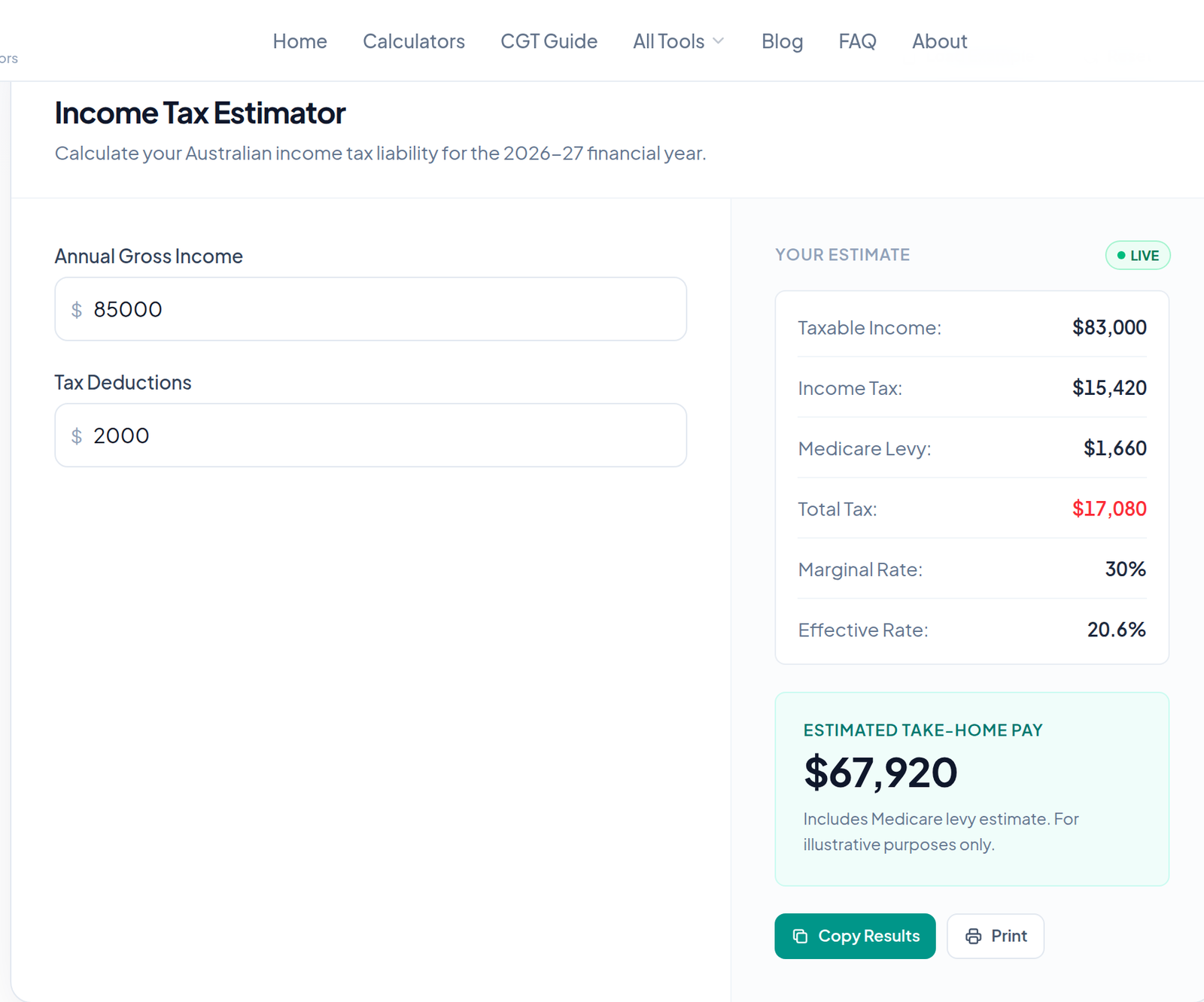
    Income tax calculator showing $15,420 income tax on $83,000 taxable income for 2026-27
    Our income tax calculator with $85,000 income and $2,000 deductions (2026-27 rates): $17,080 total tax.

    How the tax on PPL is actually worked out

    Think of it in two separate steps, because confusing them is the #1 mistake:

    Step 1 — withholding (the guess). Tax taken from each payment before it reaches you: either your employer’s payroll tables or Services Australia’s flat 15%. Not your tax bill — a prepayment credited against it.

    Step 2 — your actual liability (the truth). At tax time, the ATO adds your PPL to everything else you earned and taxes the total at the 2026-27 marginal rates: 0% to $18,200, then 15% to $45,000, 30% to $135,000, 37% to $190,000 and 45% above — plus the 2% Medicare levy where it applies.

    Crucially, your PPL stacks on top of your other income. It doesn’t get its own concessional rate — the last dollar of PPL is taxed at whatever marginal rate your total income puts you in. That’s why the same $26,122 of PPL can produce a refund for one parent and a $4,000+ bill for another.

    On your return, PPL is usually pre-filled in myTax — via Single Touch Payroll if it came through your employer, or a payment summary from Services Australia if it came direct. Check it’s there; don’t assume.

    Worked example 1: PPL as your only income — the refund surprise

    Meet Priya. She takes the full 130 days in 2026-27 and has no other income that year. Here’s her position:

    • Gross PPL: 130 × $200.94 = $26,122.20
    • Tax withheld (15% flat): $26,122.20 × 15% = $3,918.33
    • Actual income tax: ($26,122.20 − $18,200) × 15% = $1,188.33
    • Medicare levy: $0 — $26,122 sits under the 2026-27 single low-income threshold of $28,011
    • Result: a refund of about $2,730

    Why the refund? The 15% withholding ignores the $18,200 tax-free threshold — it taxes the first dollar, while the ATO taxes only dollars above $18,200. If PPL is most or all of your year’s income, the flat withholding over-withholds and the difference comes back. (Exception: a HECS/HELP debt can divert the refund — see below.)

    Worked example 2: salary plus PPL — the shortfall bill

    Now meet Daniel. Across 2026-27 he earned $85,000 all up — part salary, part Parental Leave Pay — and claims $2,000 of work-related deductions. Run it through our income tax calculator (screenshot below):

    • Taxable income: $85,000 − $2,000 = $83,000
    • Income tax: $4,020 + ($83,000 − $45,000) × 30% = $15,420
    • Medicare levy: 2% × $83,000 = $1,660
    • Total liability: $17,080

    Now the withholding sting. Say $26,122 of Daniel’s $85,000 was PPL paid directly by Services Australia, with only the default 15% withheld: $3,918. But that PPL stacks on top of his salary at his 30% marginal rate — the real tax on the PPL portion is $7,837 of income tax plus $522 of Medicare levy = $8,359.

    Shortfall on the PPL alone: roughly $4,441. His employer’s PAYG withholding on the salary was roughly right; the entire bill comes from the under-withheld PPL. This is the single most common PPL tax shock, and it’s entirely predictable once you see the stacking.

    The HECS/HELP sting nobody warns you about

    Here’s the trap that turns even Example 1’s refund into a bill. Parental Leave Pay counts as repayment income for HECS/HELP purposes — it sits inside your taxable income, which is the base the ATO uses for compulsory student-loan repayments. And the 15% Services Australia withholds does not cover HELP at all.

    The real-world version: a parent on maternity leave earns less than usual, expects a refund, then discovers the ATO applied $3,000 of it to their student debt — with a bill on top — because PPL pushed their repayment income over the threshold. If you have a HELP debt, check your TFN declaration has the HELP box ticked, and consider raising the withholding rate on your PPL via myGov. Our HECS/HELP repayment guide has the current thresholds and rates.

    Super is now paid on your PPL — the details that matter

    For children born or adopted from 1 July 2025, the ATO pays a 12% superannuation contribution on your Parental Leave Pay — the Paid Parental Leave Super Contribution (PPLSC). On the full 130-day entitlement that’s 12% × $26,122.20 ≈ $3,135 extra in your super. The fine print:

    • Timing: it’s paid after the financial year ends. PPL paid in 2026-27 won’t land in your fund until after 30 June 2027 — don’t go looking for it in December.
    • Tax treatment: it’s a concessional contribution, taxed at 15% inside your fund — same as employer SG.
    • It counts toward your $32,500 concessional cap. Usually irrelevant while you’re on leave (employer SG drops too), but heavy salary-sacrificers should allow for the ~$3,135 in the year the fund receives it.
    • It’s not counted as income for Centrelink, family assistance or child support purposes.
    • It needs your TFN. If your super fund doesn’t have your tax file number, or your name and address don’t match across Services Australia, the ATO and your fund, the contribution can go astray. Check it in myGov (ATO online → Super).

    The interaction checklist: everywhere else PPL lands

    PPL doesn’t just affect your income tax return. Because it’s ordinary taxable income, it flows into every income-tested calculation in the system:

    Calculation How PPL affects it
    Medicare levy (2%) Applies to your total taxable income including PPL. Under the low-income thresholds (singles $28,011 in 2026-27) you may pay nothing — but the PPL still counts toward the threshold test.
    Medicare levy surcharge PPL counts in your income for surcharge purposes. Only bites if your total pushes you over $105,000 (singles) without hospital cover.
    HECS/HELP repayments PPL is part of your repayment income. Can trigger or increase a compulsory repayment the 15% withholding never covered.
    Child Care Subsidy & Family Tax Benefit You must include PPL in your family assistance income estimate — Services Australia says so explicitly. Underestimating means a reconciliation debt at balancing time.
    Income support payments PPL counts as income for income-support calculations (unlike FTB itself, which isn’t taxable).
    Super contribution (PPLSC) Deliberately excluded — the 12% super top-up is not counted as income for Centrelink or family assistance.

    Six mistakes that cost parents money

    1. Assuming PPL is tax-free. It’s the most common myth — and yes, some websites still claim it. Parental Leave Pay is assessable income, full stop. The ATO’s withholding law was specifically amended to cover it.

    2. Treating the 15% withheld as your tax rate. It’s a default prepayment. Your actual rate is your marginal rate on total yearly income — which for anyone who worked part of the year is almost certainly higher than 15%.

    3. Forgetting the stacking. PPL doesn’t get taxed in isolation at some gentle rate. It piles on top of your salary, and every dollar of it can be taxed at your top marginal rate.

    4. The HECS blind spot. The 15% withholding covers income tax only. If you have a student debt, the compulsory HELP repayment is a separate impost the withholding never anticipated.

    5. Leaving PPL out of the CCS/FTB income estimate. Family assistance is reconciled against actual income at year end. An estimate that “forgot” $26,000 of PPL becomes a debt notice.

    6. Thinking employer-paid and government-paid PPL are taxed differently. They’re not — both are taxable. Only the withholding method differs (normal payroll rates vs flat 15%). The end liability is identical.

    Five tips to get the numbers right

    1. Vary the withholding rate if you’ll have other income. Once your Centrelink record is linked to myGov, you can change the 15% deduction online. If Daniel from Example 2 had raised his to 32%, the $4,441 bill would never have arrived.

    2. Time your days across 30 June deliberately. PPL is taxed in the financial year it’s paid, and days can spread over two years. Loading more days into the lower-income year genuinely cuts the tax — just note the daily rate changes each 1 July.

    3. Lump sum or weekly makes no difference to the total. Whether Services Australia pays you weekly or your employer passes on a lump sum, your liability is driven by total income for the year, not the payment pattern. (Which year it lands in is what matters — see tip 2.)

    4. Match your details everywhere for the super contribution. Name, address and TFN need to agree across Services Australia, the ATO and your super fund, or the 12% PPLSC can miss your account. Check myGov after 30 June.

    5. If PPL is your main income, expect money back — and check the pre-fill. As Example 1 shows, the flat 15% over-withholds when you have little other income. Make sure the PPL appears correctly in myTax before you lodge; a missing pre-fill is your mistake to catch, not the ATO’s.

    One more timing note for planners: if you’re weighing extra income from a second job against leave days in the same year, remember both stack at your marginal rate — model the combined figure, not each in isolation.

    Frequently asked questions

    Centrelink only withholds 15% — is that my actual tax rate, or will I owe more?

    It’s just a default withholding, not your tax rate. PPL is taxed at your marginal rate on total yearly income. If you earned salary as well, 15% almost certainly under-withholds — Example 2 shows a ~$4,441 shortfall on exactly this pattern. Request a higher rate through myGov.

    Is government PPL treated differently from my employer’s paid parental leave for tax?

    No. Both are taxable income. The only difference is withholding: government-paid PPL via Services Australia has 15% withheld by default; employer-paid (or employer-passed-through) PPL goes through normal payroll withholding like ordinary wages. Both are declared on your tax return and end up taxed identically.

    If I take my PPL as a lump sum instead of weekly payments, do I pay more tax?

    No — your total tax follows total income for the year, not the payment pattern. Weekly, fortnightly or lump sum all reconcile to the same liability. What does matter is which financial year the money lands in.

    Will Paid Parental Leave trigger a HECS/HELP repayment?

    It can. PPL forms part of your repayment income, so it can push you over the compulsory repayment threshold (or increase the repayment rate) even in a year you earned less than usual. The 15% Services Australia withholds doesn’t cover HELP — this is the classic surprise where an expected refund gets diverted to a student debt with a bill on top.

    Do I need to include PPL in my income estimate for Family Tax Benefit or the Child Care Subsidy?

    Yes. Services Australia requires PPL to be included in your taxable-income estimate for family assistance, and it counts as income in CCS calculations. If your estimate is too low, you’ll face a reconciliation debt when payments are balanced at year end — update the estimate as soon as your PPL starts.

    When is the super paid on my PPL, and how do I check it arrived?

    The ATO pays the 12% super contribution after the financial year the PPL was paid in — so for 2026-27 PPL, expect it after 30 June 2027. Check myGov (ATO online services → Super) and your fund’s transaction list for an ATO-sourced contribution. If it’s missing, check the timing first, then that your TFN and details match across Services Australia, the ATO and your fund.

    The bottom line

    Paid Parental Leave is taxable income — that part is simple. Everything expensive about it comes from the gap between the 15% withheld and your actual marginal rate. If PPL dominates your year, that gap hands you a refund (around $2,730 on the full entitlement with no other income). If you also worked, the same gap hands you a bill (around $4,400 when PPL stacks at 30%). Add the HECS overlay, the family-assistance estimates and the super timing, and you have the complete picture — in numbers your return will actually match.

    Verification: rates and rules checked against Services Australia’s tax-deduction guidance (15% default withholding, changeable via myGov), Services Australia’s Parental Leave Pay pages (PPL is taxable; include it in family assistance estimates), the ATO’s withholding provisions for parental leave pay (s 12-110, Sch 1 Taxation Administration Act), and the 2026-27 payment figures ($200.94/day, 130 days, 12% PPLSC). Brackets per the 2026-27 income tax rates; Medicare thresholds per the 2026-27 Medicare levy guide; concessional cap per the 2026-27 super caps guide. Rates change — confirm before acting. Not personal tax advice.

  • Tax-Free Threshold Australia 2026-27: $18,200 Explained

    Tax-Free Threshold Australia 2026-27: $18,200 Explained

    The short answer

    If you are an Australian resident for tax purposes, the first $18,200 you earn in 2026-27 is free of income tax. That is the statutory tax-free threshold, and it has not moved since 2012-13.

    But here is what most guides gloss over: because of the Low Income Tax Offset, you actually pay no income tax until about $22,867. Add the Medicare levy and seniors’ offsets, and there are really four different “tax-free” points depending on who you are. This guide lays out all four, shows exactly how to claim the threshold on your TFN declaration, and runs the dollars on the mistakes that cost people thousands — the two-job double-claim, the part-year trap for new migrants, and the 28-day TFN rule almost nobody warns you about.

    What the tax-free threshold actually is

    The tax-free threshold is the slice of your annual taxable income the ATO taxes at 0%. For a full-year Australian resident in 2026-27, that slice is $18,200. Everything above it is taxed at the marginal rates:

    Taxable income 2026-27 Tax rate
    $0 – $18,200 Nil (tax-free threshold)
    $18,201 – $45,000 15c for each $1 over $18,200
    $45,001 – $135,000 $4,020 + 30c for each $1 over $45,000
    $135,001 – $190,000 $31,020 + 37c for each $1 over $135,000
    Over $190,000 $51,370 + 45c for each $1 over $190,000

    Two things to note. First, these rates exclude the 2% Medicare levy, which has its own thresholds. Second, the 15% second-bracket rate is new: it dropped from 16% on 1 July 2026, and it is already legislated to fall to 14% from 1 July 2027. Our income tax rates guide covers the full picture.

    And here is the number that surprises people: $18,200 has been frozen since 2012-13 — fourteen years. In real terms it buys roughly half what it did when it was set. Nobody in Canberra is talking about raising it, so treat the figure as permanent and plan around it.

    The four layers: where tax really starts for you

    Ask “how much can I earn before paying tax?” and you will get different correct answers depending on which tax you mean. Here is the full ladder for 2026-27:

    Layer Amount What it means
    1. Statutory threshold $18,200 No income tax on the first $18,200 (residents)
    2. With LITO ~$22,867 The $700 Low Income Tax Offset wipes out the 15% tax on the next $4,667 — real income-tax-free point
    3. Medicare levy $28,011 Levy starts phasing in for singles at 10% of the excess, reaching the full 2% at $35,013
    4. Seniors (SAPTO) ~$36,960 Single seniors combining SAPTO + LITO pay no income tax to roughly this point

    So a 24-year-old barista earning $25,000 pays a little income tax ($320 after LITO) but no Medicare levy. A retiree on $35,000 of super pension income pays no income tax at all. Same threshold, very different outcomes — which is why the one-number answers on most sites mislead.

    Check the maths on layer 2 yourself: tax on $22,867 is 15c × ($22,867 − $18,200) = $700.05, and the full $700 LITO cancels it to zero. For the offsets in detail, see our tax offsets guide; for the levy, our Medicare levy explainer has the family thresholds and the shade-in worked in dollars.

    How to claim it: the TFN declaration

    You do not get the threshold automatically in your payslip — you claim it. When you start a job, you complete a Tax File Number declaration (paper form NAT 3092, or digitally through your employer’s onboarding or ATO online services). One question on it reads:

    “Do you want to claim the tax-free threshold from this payer?”

    Answer yes and your employer uses the ATO’s “with tax-free threshold” withholding tables, which spread your $18,200 across the year:

    • $350 tax-free per week
    • $700 tax-free per fortnight
    • $1,517 tax-free per month

    Earn under those amounts in a pay cycle and little or no tax is withheld. Earn over them and tax comes out of the excess only.

    Answer no and tax is withheld from the first dollar. That is not a punishment — it is the correct choice for a second job, and we will show why below.

    Changing your answer mid-year

    Circumstances change: your second job becomes your main one, or you leave the job you claimed from. You do not fill in a whole new TFN declaration — you give the payer a Withholding declaration (NAT 3093) with your new answer. The new withholding applies from the next pay cycle. It takes two minutes and it is the single most underused form in the Australian tax system.

    The one-payer rule (and the $4,300 mistake)

    The threshold is $18,200 in total, not $18,200 per job. Claim it from two payers at once and each withholds as though $18,200 of your income is untaxed — the threshold is applied twice, withholding falls short, and the shortfall lands as a bill when you lodge.

    Here is what that looks like in 2026-27 dollars. Say your main job pays $40,000 and your weekend job pays $15,000 — $55,000 combined.

    Scenario A — claimed from both jobs (the mistake):

    • Main job withholds: 15c × ($40,000 − $18,200) = $3,270
    • Second job withholds: $0 (under $18,200, threshold applied)
    • Total withheld: $3,270

    Scenario B — claimed from the main job only (correct):

    • Main job withholds: $3,270 (same as above)
    • Second job withholds roughly 15% of $15,000 = ~$2,250 (no-threshold tables)
    • Total withheld: ~$5,520

    Your actual liability on $55,000: income tax of $7,020, minus $550 LITO, plus $1,100 Medicare levy = $7,570.

    • Scenario A bill: $7,570 − $3,270 = ~$4,300
    • Scenario B bill: $7,570 − $5,520 = ~$2,050

    Notice two things. First, the double-claim alone cost about $2,250 — real money for a weekend worker. Second, even done correctly there is still a ~$2,050 shortfall, because neither employer sees your combined income pushing $10,000 into the 30% bracket. That residual second-job gap is normal, and our second job tax guide shows how to close it by asking your employer to withhold extra.

    The rule: claim it from your highest-paying payer — and “payer” includes Centrelink, not just employers. One narrow exception: if your total income from every source will stay under $18,200 for the year, double-claiming cannot create a bill, because no tax is owed either way. Students with two small casual jobs, take note.

    Part-year residents: the formula that trips up new migrants

    Become an Australian resident for tax purposes partway through the year — or stop being one — and the full $18,200 shrinks to a part-year amount:

    Part-year threshold = $13,464 + ($4,736 × months as a resident ÷ 12)

    The month you arrive counts as a full month. Worked example: you arrive on 14 January 2027 and become a resident immediately. You are a resident for 6 months (January to June), so your 2026-27 threshold is $13,464 + ($4,736 × 6 ÷ 12) = $15,832. The 15% rate starts biting $2,368 earlier than for a full-year resident.

    Critical nuance most guides bury: this is about your tax residency changing, not about working part of the year. If you were an Australian resident all year but only worked six months — a gap between jobs, a semester off, parental leave — you keep the full $18,200. Everything squares up when you lodge, and any over-withholding comes back as a refund.

    If residency rules are murky for you, our tax residency guide walks through the tests with worked examples.

    Who gets no threshold at all

    • Foreign residents (non-residents for the full year): no tax-free threshold — 30c in the dollar from the first dollar of Australian income.
    • Working holiday makers (subclass 417 and 462): taxed under their own scale starting at 15% from the first dollar, regardless of residency.

    This is the single biggest shock for newcomers: the same $50,000 salary costs a resident about $6,920 in income tax and a foreign resident $15,000. If your visa or living situation changed mid-year, check your residency status before you assume anything.

    Centrelink + wages: which payer gets it?

    Taxable Centrelink payments — JobSeeker, Youth Allowance, Austudy, Parenting Payment — count as income and Centrelink counts as a payer. You give Centrelink a TFN declaration too, and the same one-payer logic applies: claim from whichever payer pays you the most.

    Example: you receive $16,000 in JobSeeker across the year and earn $22,000 from part-time retail. Claim the threshold from the retail job ($22,000 > $16,000). Centrelink then withholds from the first dollar of your payment at the no-threshold rate — which feels harsh, but it prevents a bill, because your combined $38,000 sits well above $18,200. If you claimed from Centrelink instead, the retail job would under-withhold by roughly 15c × $18,200 ≈ $2,730 across the year.

    Common mistakes

    1. Claiming from two payers at once. The classic. Costs thousands, as the worked example above shows. Fix it with a Withholding declaration the moment you notice.

    2. Not claiming when you should. Single job, resident, earning over $18,200 — and you answered “no” (or never gave your TFN declaration). You are over-withholding every pay. It is not lost money — it comes back as a refund at tax time — but you have given the ATO an interest-free loan.

    3. The 28-day TFN trap. If you do not provide your TFN within 28 days of starting work, your employer must withhold at the top marginal rate — 47% — from that point on. New migrants waiting on TFN paperwork get hit by this constantly. Tell your employer you have applied; they can use standard rates during the 28-day window.

    4. Thinking the threshold is per job. It is $18,200 total across all income — wages, Centrelink, ABN income, bank interest, all of it counts toward the one threshold.

    5. Forgetting the Medicare levy. “Tax-free” means income-tax-free. The 2% Medicare levy runs on its own thresholds ($28,011 single phase-in), and LITO does not reduce it.

    6. Assuming you must lodge. If your total income is under the threshold, nothing was withheld, and you have no other reason to lodge, you may only need to submit a non-lodgment advice to keep your record clean — not a full return.

    Tips to get it right

    • One job: claim it, always. Less withholding now, no downside — the ATO reconciles everything at lodgment.
    • Two jobs: claim from the highest payer; answer “no” everywhere else. If you will earn under $18,200 total, the double-claim cannot hurt you.
    • Changing jobs: you can claim from the new employer even if you claimed from the old one — sequential claims are fine; simultaneous ones are the problem.
    • Side income (ABN): no one withholds for you. Set aside roughly your marginal rate from each invoice, or enter PAYG instalments — our PAYG instalments guide explains the system.
    • Check mid-year: got a second job in January? Lodge a Withholding declaration with both payers that week, not in June.
    • Run your own numbers: our income tax calculator shows your 2026-27 liability at any salary, and the $100k salary breakdown walks through a full payslip line by line.

    FAQ

    What is the tax-free threshold in Australia for 2026-27?

    $18,200 for full-year Australian residents. With the $700 Low Income Tax Offset, no income tax is actually payable until about $22,867.

    How do I claim the tax-free threshold?

    On the TFN declaration you give each payer — answer “yes” to “Do you want to claim the tax-free threshold from this payer?” for one payer (usually your highest-paying one). Change it later with a Withholding declaration (NAT 3093).

    Can I claim the tax-free threshold from two jobs?

    You can, but you generally should not: each payer withholds as though $18,200 is untaxed, so you will be under-withheld and face a bill at tax time. The exception is when your total income from all sources stays under $18,200.

    What happens if I don’t claim the tax-free threshold?

    Your employer withholds more tax than necessary from each pay. Nothing is lost — the excess is refunded when you lodge your return — but your take-home pay is lower all year for no benefit.

    Does the tax-free threshold apply to Centrelink payments?

    Yes. Centrelink is a payer like any other. If you get both a taxable payment and wages, claim the threshold from whichever pays you more.

    Do under-18s get the tax-free threshold?

    On wages, yes — the same $18,200 applies. But unearned income (dividends, trust distributions) over $416 is taxed at penalty rates for minors, so a teenager with a share portfolio is in a different regime from one with a checkout job.

    The bottom line

    The tax-free threshold is simple — $18,200, one payer, claim it on your TFN declaration — and the mistakes are expensive. The double-claim on a second job, the shrunken part-year amount for new migrants, and the 28-day TFN rule are where the real money leaks out. Get the claiming decision right at the start of each job and the ATO’s withholding tables do the rest; get it wrong and you are lending the tax office thousands interest-free, or worse, borrowing from it until July. Run your own numbers on our income tax calculator and check the full 2026-27 rate guide before you sign your next TFN declaration.

  • Second Job Tax in Australia 2026-27: Rules & Real Examples

    Second Job Tax in Australia 2026-27: Rules & Real Examples

    No — a second job is not taxed at a higher rate in Australia. The ATO adds up everything you earn in the year and taxes the total at the normal progressive rates. But your second-job payslip will almost certainly look like you are being punished: tax comes off from the very first dollar, while your main job’s first $18,200 goes through untouched. That gap is withholding, not extra tax — and it sorts itself out when you lodge your return.

    There is a catch, though. Even when you set everything up correctly, a second job can still leave you with a tax bill of a few thousand dollars — and most guides never show you the maths. This guide does: the exact 2026–27 rates, what your payslip should look like, a worked $60k + $20k example with a $3,000 shortfall nobody warns you about, the HECS trap, the super angle, and how to fix your withholding before July.

    The one rule that explains everything

    Every Australian resident gets a $18,200 tax-free threshold each year — the first $18,200 of income is not taxed. The critical detail: it applies to your total income from all jobs combined, not $18,200 per job.

    When you start a job, you fill in a Tax File Number (TFN) declaration. One question asks whether you want to claim the tax-free threshold from that payer. The ATO’s position is simple: if you have more than one job at a time and your combined income will exceed $18,200, you generally claim it from only one employer — usually the one that pays you the most. Tell the second employer “no”.

    Why it matters on your payslip:

    • Main job (threshold claimed): payroll withholds nothing on the first $18,200 of annualised pay ($350 a week, $700 a fortnight). Withholding starts gently above that.
    • Second job (threshold not claimed): payroll withholds tax from the first dollar, at 15% on the early dollars (under the 2026–27 no-threshold scale). No $18,200 of breathing room.

    Your second employer has no idea what your first job pays — each payroll system only sees its own numbers. Getting the threshold claim right is your job, not theirs.

    2026–27 rates: the table your second job stacks onto

    Your second job’s income sits on top of your main income. So if your main job pays $60,000, your second job’s dollars are taxed at your marginal rate — 30% — not at some special “second job” rate. The resident rates for 2026–27 (excluding the 2% Medicare levy):

    Taxable income Tax on this income
    $0 – $18,200 Nil
    $18,201 – $45,000 15c for each $1 over $18,200
    $45,001 – $135,000 $4,020 plus 30c for each $1 over $45,000
    $135,001 – $190,000 $31,020 plus 37c for each $1 over $135,000
    $190,001 and over $51,370 plus 45c for each $1 over $190,000

    The only change from 2025–26 is the second bracket dropping from 16% to 15%. The Low Income Tax Offset (up to $700, gone by $66,667) still applies, and from 1 July 2026 there is also the new $1,000 standard work-related deduction to factor into your return. If you want the full bracket breakdown with worked salaries, see our 2026–27 income tax rates guide — and you can run your own combined income through the income tax calculator.

    What your payslip actually looks like

    Take a $1,000 fortnightly pay — the same gross, two different jobs:

    • As a main job (threshold claimed): annualised pay is $26,000, so roughly 15% × ($26,000 − $18,200) ÷ 26 ≈ $45 tax per fortnight, plus $20 Medicare levy — about $65 withheld. Take-home: ~$935.
    • As a second job (threshold not claimed): tax from the first dollar at roughly 15% — about $150 tax per fortnight, plus $20 Medicare levy — about $170 withheld. Take-home: ~$830.

    Same $1,000, $105 less in your pocket. That $105 is not a penalty — it is roughly the tax those dollars will actually owe at your marginal rate. (Figures are approximate; payroll software follows the ATO withholding tables, which annualise your pay and round.)

    Worked example: the $3,000 bill nobody warns you about

    Here is the scenario most guides skip. Maya earns $60,000 at her main job (threshold claimed) and $20,000 at a weekend retail job (threshold not claimed). She did everything right. She still gets a bill.

    Actual tax on $80,000 total (2026–27):

    • 15% × ($45,000 − $18,200) = $4,020
    • 30% × ($80,000 − $45,000) = $10,500
    • Income tax: $14,520 · Medicare levy 2%: $1,600 · LITO: $0 (over $66,667)
    • Total liability: $16,120

    What was withheld during the year:

    • Main job ($60k, threshold claimed): roughly tax on $60,000 alone = $8,520, plus $1,200 Medicare levy ≈ $9,720
    • Second job ($20k, no threshold): roughly 15% × $20,000 = $3,000, plus $400 Medicare levy ≈ $3,400
    • Total withheld: ~$13,120 → shortfall of about $3,000

    Where did the $3,000 go? Her second job’s entire $20,000 sits in the 30% bracket (her main job already filled the 0% and 15% brackets), so it genuinely owes $6,000 in tax — but the second payroll, seeing only $20,000, withheld at 15% ($3,000). Each employer followed the tables perfectly; the tables just cannot see your other income. This is the real second-job tax trap, and the fix is below.

    The double-claim mistake: an ~$8,000 bill

    The most expensive error is claiming the threshold at both jobs — each payroll then treats $18,200 as tax-free. Take two $40,000 jobs ($80,000 total):

    • Withheld at each job ≈ 15% × ($40,000 − $18,200) = $3,270 → $6,540 across both (plus ~$1,600 Medicare levy withholding)
    • Actual liability on $80,000: $16,120
    • Bill at tax time: roughly $8,000

    If you have done this, fix it now — not in June. Give one employer a fresh Withholding declaration (NAT 3093) answering “no” to the threshold question. The ATO allows it any time your circumstances change.

    The one exception: if your total income from all jobs will stay under $18,200 for the year — common for students and short-term casuals — the ATO lets you claim the threshold from more than one payer. If you cross $18,200, expect a bill.

    The HECS/HELP trap: a $2,321 surprise

    Student-loan repayments are where second jobs bite hardest, because neither employer may withhold a cent of it. HELP repayments are based on your combined repayment income, but each payroll only withholds HELP if that job alone annualises above the threshold — $69,528 in 2026–27.

    Example: main job $60,000 + second job $25,000 = $85,000 repayment income.

    • HELP repayment: 15c × ($85,000 − $69,528) = 15c × $15,472 = $2,320.80
    • Withheld by employers: $0 — the $60,000 job annualises under $69,528, and so does the $25,000 job.
    • Result: a $2,321 bill at tax time, on top of any income-tax shortfall.

    The defence: tick “yes” to having a HELP debt on every TFN declaration (including the second job), and consider asking your main employer for extra voluntary withholding. Our HECS/HELP 2026–27 guide has the full repayment table.

    Don’t forget super on the second job

    Two super facts second-job holders miss:

    1. Your second employer owes you super too. The 12% Super Guarantee (2026–27 rate) applies per employer — there is no minimum monthly earnings threshold anymore. A $20,000 second job should come with roughly $2,400 in SG contributions. Check it lands in your fund.
    2. The concessional cap is per person, not per job. The 2026–27 cap is $32,500 across everything. If two employers’ SG plus your salary sacrifice exceed it — say $300,000 combined salary → ~$36,000 SG — the ~$3,500 excess gets taxed at your marginal rate (less a 15% offset). High earners with two jobs should watch this; see the contribution caps guide.

    Also note: second-job income counts toward the Medicare levy surcharge income test, so a second job can tip you over the surcharge threshold if you do not hold private hospital cover.

    Second income as a sole trader (ABN, no boss)

    If your “second job” is freelance, gig or contract work under an ABN, there is no employer withholding at all. The ATO still taxes it — it stacks onto your employment income at your marginal rate — but nothing is collected during the year. Set aside roughly your marginal rate (30% for most second-income earners, plus 2% Medicare levy) from every invoice, or the ATO will put you on PAYG instalments — quarterly prepayments of next year’s tax. Deductible costs (tools, home office, car) reduce the damage; our deductions checklist covers what you can claim.

    Five mistakes second-job holders keep making

    1. Claiming the threshold at both jobs — the ~$8,000 bill above. One claim, highest-paying job.
    2. Assuming the payslip is the final tax — withholding is a down payment; the return is the real calculation.
    3. Ignoring HELP — the $2,321 trap above. Tick the HELP box on every TFN declaration.
    4. Forgetting to declare both incomes — both payment summaries pre-fill in myTax, and the ATO matches them. Declare everything.
    5. Not checking super — second-job SG is legally yours; the cap is legally your problem.

    How to stop the annual bill: three fixes

    1. Ask for extra withholding. The simplest fix — tell one employer’s payroll to withhold an extra amount each pay (say, $60 a fortnight). It is your money, just collected early, and it kills the EOFY surprise.
    2. Lodge a PAYG withholding variation (upward). If you can estimate the shortfall — Maya’s $3,000 above, for example — the ATO lets you vary withholding upward so the right amount comes out across the year.
    3. Put it aside yourself. Open a separate account and sweep your marginal rate (e.g. 32% including Medicare levy) off every second-job pay. Less elegant, same result.

    And every July: check myGov pre-fill shows both payment summaries before you lodge. If one is missing, wait — lodging early on incomplete pre-fill is how double-claim mistakes go unnoticed.

    FAQ

    Do I pay a higher tax rate on my second job?

    No. There is no special “second job” rate. All your income is added together and taxed at the normal progressive rates. It feels higher because tax is withheld from the first dollar (no $18,200 threshold on the second job) and because those dollars genuinely sit in a higher bracket than the first dollars of your main job.

    Which job should I claim the tax-free threshold on?

    The higher-paying or most regular one — that is where the $18,200 of tax-free room saves you the most withholding across the year. Answer “no” on the second job’s TFN declaration.

    What happens if I claimed the threshold on both jobs?

    Too little tax is withheld and you will likely owe money when you lodge — potentially several thousand dollars (see the ~$8,000 example above). Fix it by giving one employer a new Withholding declaration (NAT 3093) with the threshold unclaimed.

    Can I claim the threshold on two jobs if I earn under $18,200 in total?

    Yes — if your total annual income from all sources will stay under $18,200, the ATO allows it. But if you end up earning more, you will likely face a bill.

    Do I have to tell my second employer about my first job?

    For tax purposes, no — you just answer the TFN declaration honestly (threshold: no; HELP debt: yes if you have one). Your employment contract may separately require disclosing other work, so check it.

    Will a second job affect my HECS/HELP repayments?

    Yes — repayments are calculated on combined repayment income, and neither employer may withhold any if each job alone sits under the $69,528 threshold. The worked example above shows a $2,321 bill from a $25,000 second job. Tick the HELP box on every TFN declaration and consider extra withholding.

    How do I check what I should have paid?

    Add both incomes together and run the total through the income tax calculator, then compare with the total tax withheld on your payment summaries. The difference is roughly your refund or bill — before deductions, HELP and offsets.

    The bottom line

    A second job does not attract extra tax — it attracts correctly stacked tax. Claim the $18,200 threshold once, expect heavy withholding on the second payslip, and budget for the gap between what two blind payroll systems withhold and what your combined income actually owes. Do that, tick the HELP box, check your super, and the second job stays what it should be: extra money, not an extra bill.

    Figures use verified 2026–27 ATO rates (15% second bracket, 2% Medicare levy, $69,528 HELP threshold). Withholding examples are approximate — payroll software follows the ATO tax tables. For the ATO’s own guidance, see ato.gov.au: claiming the tax-free threshold.