Tag: capital gains tax

  • NFT Tax Australia 2026-27: CGT Rules, Rates & Examples

    NFT Tax Australia 2026-27: CGT Rules, Rates & Examples

    The short answer

    Yes, NFTs are taxable in Australia. For most people who buy an NFT hoping it goes up in value, it is a capital gains tax (CGT) asset — sell it, swap it or give it away and you have a CGT event. Hold it for more than 12 months and the 50% CGT discount can halve the taxable gain. If you create and sell NFTs as a business, the money is ordinary income instead, and royalties keep coming in as income even after you stop.

    The trap most people miss is the purchase itself. Buy an NFT with Ethereum or another cryptocurrency and you trigger CGT on the crypto you spent — before the NFT has done anything at all. One purchase, two tax events. This guide works through the ATO’s rules for investors, creators and gamers, with worked examples in Australian dollars at real 2026-27 rates.

    What is an NFT, for tax purposes?

    A non-fungible token is a unique digital token on a blockchain. Unlike a Bitcoin, which is interchangeable with any other Bitcoin, each NFT is one of a kind. NFTs typically record ownership of digital pictures or artworks, video clips, memes and items used in online games — but the ATO notes an NFT can represent an ownership interest in any tangible or intangible asset, even where the asset itself is stored outside a digital ledger.

    The ATO updated its NFT guidance on 12 June 2026 (QC66097), and its position is simple: there are no special tax rules for NFTs. The tax treatment depends on your circumstances, the way you use the NFT and your reasons for holding it. The same NFT can be taxed three different ways in three different hands.

    How NFTs are taxed: the three treatments

    How you hold the NFTTax treatmentWhen tax bites
    Investor — bought to hold and sell for a profitCGT assetOn disposal: sale, swap, gift or donation
    Creator or business — minting and selling NFTs, or trading them as stockOrdinary income / trading stockWhen you receive payment, including royalties
    Personal use — bought to use yourself (rare)Personal use assetOften no tax at all — see below

    Most readers of this guide are in the first row. The rest of this article is written for investors first, then covers creators, gamers and the edge cases.

    When does CGT apply to an NFT?

    A CGT event happens when you dispose of the NFT. Disposal is broader than selling. Any of these triggers it:

    • Selling the NFT for Australian dollars or another cryptocurrency
    • Swapping one NFT for another NFT, or for crypto
    • Gifting the NFT — treated as a disposal at market value, even though you received nothing
    • Donating it
    • Losing it — if the NFT is stolen or permanently lost, you may be able to claim a capital loss (with evidence)

    These do not trigger CGT:

    • Buying an NFT with Australian dollars — no disposal, no gain
    • Holding an NFT while its price moves — unrealised gains are not taxed
    • Moving an NFT between wallets you own — no change of ownership, no disposal. But watch the fee: if the network fee is taken out of your crypto holding, that slice is a disposal of the fee amount, with capital gain consequences

    The double tax event nobody warns you about

    Pay for an NFT with crypto and the ATO sees two separate disposals. First, you dispose of the crypto you spent — if that crypto has gone up since you bought it, the gain is taxable right there. Second, you acquire the NFT, and its cost base is the Australian-dollar value of the crypto at the moment of the trade, plus gas and marketplace fees. The worked example below puts real numbers on this: Maya’s single NFT purchase creates a $2,000 gain on her Ethereum before she has even owned the NFT for a day.

    Working out your capital gain or loss

    The formula is the same as for shares or property:

    Capital gain (or loss) = capital proceeds − cost base

    Capital proceeds are what you receive — or the market value of what you receive — in Australian dollars at the time of disposal. The cost base is what it cost you to acquire and dispose of the NFT:

    • The purchase price in Australian dollars (the AUD value of any crypto you paid, at the time of the trade)
    • Gas fees, marketplace fees and auction fees paid to buy it
    • Fees paid to sell it
    • Incidental costs such as legal or valuation fees, if any

    Every figure must be converted to Australian dollars at the time of each transaction. A record that says “sold for 3 ETH” is not enough — you need the AUD value on the day. Keep the exchange or marketplace record; if the platform is gone, a reputable price source for that date will do.

    The 50% CGT discount

    Individuals who hold a CGT asset for more than 12 months before disposing of it can discount the capital gain by 50% — only half the gain counts as assessable income. The 12 months are measured from acquisition to disposal, day for day. Sell on day 364 and you get nothing; sell on day 366 and you halve the gain. Companies do not get the discount, and super funds get a one-third discount instead.

    One warning for long-term holders: from 1 July 2027 the 50% discount is abolished for individuals and replaced with CPI indexation of the cost base plus a 30% minimum tax on the gain. Gains that accrued before 1 July 2027 keep the old discount treatment — the change is prospective, not retrospective. If you are sitting on an NFT with a large unrealised gain, the timing of your sale now matters more than it used to. We cover the reform in full in our CGT reform 1 July 2027 guide.

    2026-27 tax rates used in these examples

    Australian resident rates for 2026-27 (excluding the 2% Medicare levy):

    Taxable incomeTax rateTax on this bracket
    $0 – $18,2000%Nil
    $18,201 – $45,00015%15c per $1 over $18,200
    $45,001 – $135,00030%$4,020 + 30c per $1 over $45,000
    $135,001 – $190,00037%$31,020 + 37c per $1 over $135,000
    $190,001 and over45%$51,370 + 45c per $1 over $190,000

    Source: ATO individual income tax rates. The second bracket dropped from 16% to 15% on 1 July 2026 — several crypto tax guides still quote the old 16%, so check the year on anything you read. Capital gains are not taxed at a separate rate; the gain is added to your other taxable income and taxed at your marginal rate. That is why the same NFT sale can cost one person 15% and another 45%.

    Try the numbers on your own sale with our CGT calculator — it applies the discount and your marginal rate automatically.
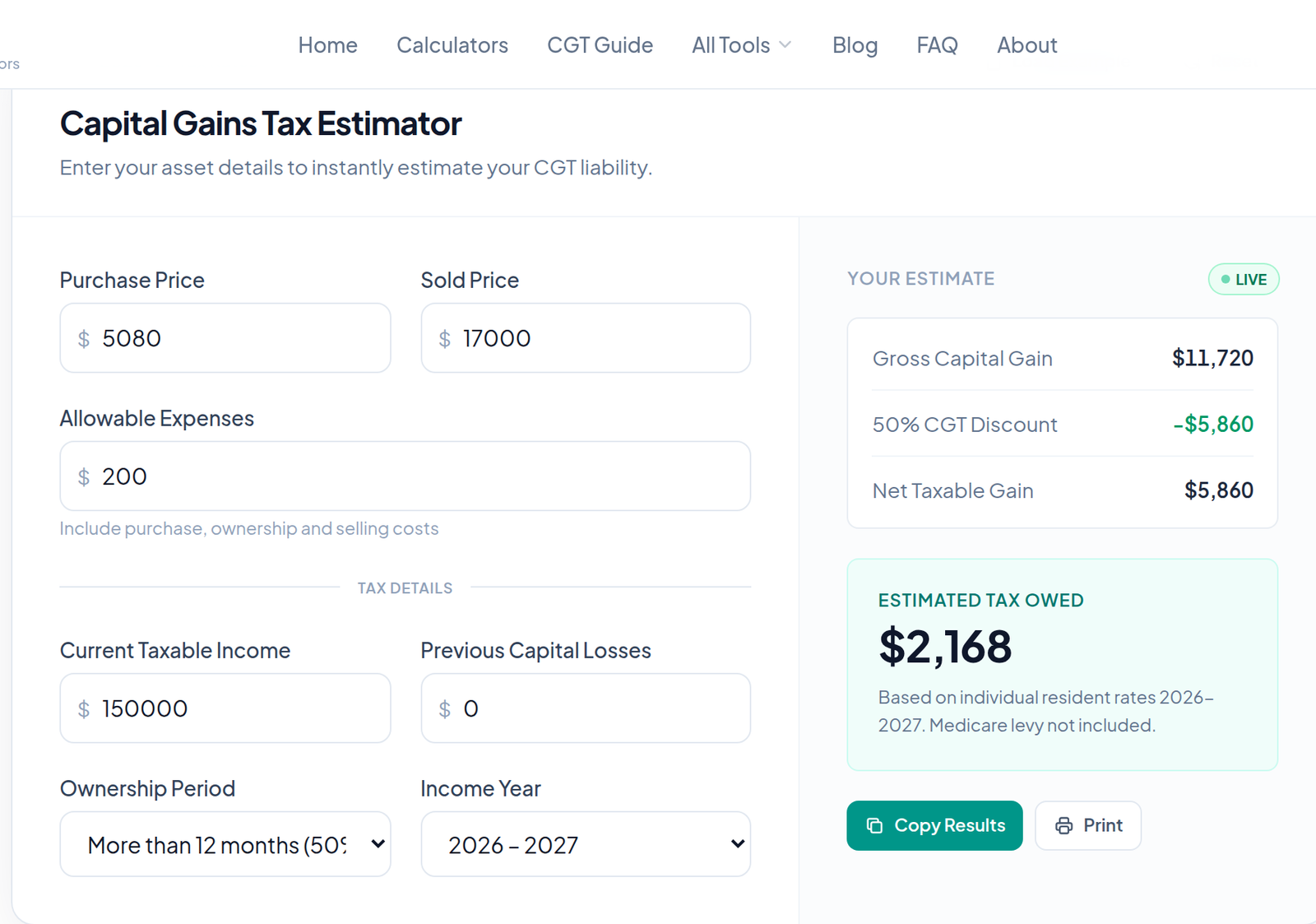
    CGT calculator showing $2,168 estimated tax on an NFT sale with the 50% discount.
    The CGT Hub calculator on Liam’s NFT sale: $5,080 cost base, $17,000 sale price, 50% discount applied — estimated tax owed $2,168.

    Worked example 1: the flip — and the hidden second gain

    Maya earns a salary of $85,000. In August 2026 she buys 2 ETH at $3,000 each — $6,000 in total. In September she uses both ETH to buy an NFT when ETH is worth $4,000. In February 2027 she sells the NFT for 3 ETH when ETH is worth $5,000. Marketplace selling fees are $150.

    Step 1 — the crypto she spent. Buying the NFT disposes of her 2 ETH. They cost $6,000 and were worth $8,000 at the trade, so she has a $2,000 capital gain on the ETH — even though she never cashed out to dollars.

    Step 2 — the NFT’s cost base. The NFT cost $8,000 (the AUD value of the 2 ETH) plus $120 in gas fees: a cost base of $8,120.

    Step 3 — the NFT sale. She receives 3 ETH worth $15,000, less $150 in fees. Capital gain = $15,000 − $150 − $8,120 = $6,730. She held the NFT for five months, so no 50% discount applies.

    Step 4 — the tax. Her total capital gains are $2,000 + $6,730 = $8,730, added to her $85,000 salary for taxable income of $93,730. Her marginal rate is 30%, so the extra tax on the gains is roughly $8,730 × 30% = $2,619 (plus the 2% Medicare levy on the additional income). The NFT “profit” most people would quote — $15,000 received for an $8,000 asset — understates her taxable gain, because the ETH gain is taxed too.

    Worked example 2: the 12-month discount

    Liam buys an NFT with Australian dollars in October 2025 for $5,000, paying $80 in gas fees. His cost base is $5,080. He sells it in December 2026 — 14 months later — for $17,000, with $200 in selling fees.

    Capital gain = $17,000 − $200 − $5,080 = $11,720. Because he held the NFT for more than 12 months, the 50% discount applies: only $5,860 is added to his assessable income. His other taxable income is $150,000, putting him in the 37% bracket, so the tax on the gain is about $5,860 × 37% = $2,168. Had he sold two months earlier, the full $11,720 would have been assessable and the tax would have roughly doubled to $4,336.

    Note the timing: the discount as described here applies to disposals before 1 July 2027. After that date, indexation and the 30% minimum tax apply instead — check the reform guide linked above before timing a sale around the 12-month mark.

    Worked example 3: the creator

    Priya is a digital artist. She mints an NFT of her artwork and sells it for $12,000. Because she created it as part of her business, the $12,000 is ordinary income, not a capital gain — no 50% discount, no cost base, and the full amount is added to her taxable income. Her smart contract also pays her a 10% royalty on resales; when the NFT later resells for $20,000, she receives $2,000. That royalty is ordinary income too — and the ATO’s own example makes the point that it stays ordinary income even if she stops carrying on the business.

    If her other income is $60,000, her taxable income becomes $74,000 and the extra $14,000 is taxed at her 30% marginal rate: about $4,200. Her NFT turnover is $14,000, well under the $75,000 GST registration threshold, so no GST. Cross $75,000 of turnover and she must register for GST and charge 10% on her sales — and if she sells through a marketplace, the platform may be responsible for GST on sales it facilitates for offshore sellers to Australian consumers.

    Worked example 4: the loss

    Tom buys an NFT for $9,000 plus $100 in gas — a cost base of $9,100. The project collapses and he sells for $4,000, paying $100 in fees. His capital loss is $4,000 − $100 − $9,100 = $5,200.

    A capital loss cannot be deducted against salary or wages. It can only offset capital gains — in the same year, or carried forward to future years indefinitely. If Tom also sold shares at a $5,200 gain that year, the loss wipes it out. If he has no gains, the loss sits on his record until he does. Keep the records: a carried-forward loss is only useful if you can prove it.

    When an NFT is a personal use asset

    In rare circumstances, an NFT can be a personal use asset — something you bought mainly to use or enjoy yourself, not to profit from. The ATO gives two examples:

    • Jo buys an NFT that gives her the right to a private viewing of a portrait in a gallery each year, and uses it to celebrate a family birthday. For Jo, the NFT is a personal use asset.
    • Jude is a gamer whose NFT cards are rewards he uses inside the game. The cards are personal use assets. Because he has no rights to the artwork on the cards, they are not collectables.

    The payoff: a capital gain on a personal use asset is disregarded if the asset cost $10,000 or less to acquire. The catch: a capital loss on a personal use asset is always disregarded, so you cannot use it. And if the NFT does carry rights to the underlying artwork, it may be a collectable instead — gains and losses on collectables acquired for $500 or less are disregarded. Most NFTs bought on a marketplace as an investment will not qualify. Do not assume yours does.

    NFTs in a business, and GST

    If you run a business that creates or trades NFTs, the tokens are trading stock or business assets, not CGT assets held as an investor. The ATO’s example: Kim, a professional artist, sells 10 NFTs of her portrait as business income, and the commissions she receives on later resales are business income too. Osman, who buys one of Kim’s NFTs to use in his art-tour business, holds it as a CGT asset of the business.

    On GST, an NFT is not a form of digital currency, so the digital-currency GST exemptions do not apply. Whether GST applies depends on whether the supply is taxable or GST-free — and if you operate an NFT marketplace as an electronic distribution platform, you are responsible for GST on sales you facilitate for offshore sellers to Australian consumers. If your enterprise turnover is under $75,000, GST registration is optional; over it, it is compulsory. Our GST guide for small business covers the registration rules.

    Airdrops, staking rewards and free NFTs

    Free is not the same as tax-free. If you receive an NFT as an airdrop and it is an established NFT with a clear market price, the market value is ordinary income when you receive it. If it is a new airdrop with no established market, you may not need to declare income — and your cost base is what you paid for it, which may be zero. Either way, the later sale is a separate CGT event measured from that cost base. The same logic applies to staking rewards and other crypto income: income when received, CGT when disposed of. See our crypto staking tax guide for the income side.

    How to report NFTs in your tax return

    In myTax, capital gains from NFT disposals go in the CGT section (item 18), and income from creating or selling NFTs as a business goes in as business or other income. The ATO expects you to keep records of every transaction for at least five years after you dispose of the asset. For each transaction, keep:

    • The date and time of the transaction
    • The Australian-dollar value at the time — of the NFT, of any crypto paid or received, and of any fees
    • What the transaction was for (purchase, sale, swap, gift, fee)
    • Exchange and marketplace records, wallet addresses and transaction hashes
    • Your calculation of each capital gain or loss

    The ATO data-matches crypto exchange data, and its 2026-27 compliance focus includes crypto and NFTs. If you are unsure whether your NFT art sales are a hobby or a business, the ATO Community answer to that exact question is worth reading — when does selling NFT artwork become taxable income? A return that omits an NFT sale the ATO already knows about is one of the fastest ways to get a please-explain letter — read our ATO data-matching guide and the audit triggers guide if that letter has already arrived.

    The 2026-27 return is due 31 October 2027 if you lodge yourself; if you use a registered tax agent, the lodgment program generally gives you until 15 May 2028.

    Common mistakes

    • “I never cashed out, so there’s no tax.” Swapping one NFT or crypto for another is a disposal. The tax event happens at the swap, not at the bank withdrawal.
    • Forgetting the crypto you spent. Paying with ETH is a disposal of the ETH. Price it in AUD at the time of the trade.
    • Leaving gas fees out of the cost base. Gas, marketplace and auction fees are part of the cost base — and part of the proceeds calculation on sale.
    • Claiming the 50% discount too early. Twelve months means twelve months. Day 364 gets nothing.
    • Using stale tax rates. The 2026-27 second bracket is 15%, not 16%. Several crypto guides still show last year’s rate.
    • Treating creator income as a capital gain. If you mint and sell as a business, it is ordinary income — no discount, and royalties keep coming.
    • No records. “The exchange shut down” is not a defence. Export your history now, and keep it for five years after disposal.
    • Ignoring the 1 July 2027 reform. The discount is going away. A sale timed for June 2027 is taxed very differently from one in July.

    Frequently asked questions

    Do I pay tax on NFTs if I only bought and never sold?

    No. Buying with Australian dollars and holding are not CGT events. You pay tax when you dispose of the NFT — by selling, swapping, gifting or donating it. If you bought with crypto, though, the crypto you spent is taxed at the time of purchase.

    Is swapping one NFT for another taxable?

    Yes. A swap is a disposal of the NFT you give up and an acquisition of the one you receive, both valued in Australian dollars at the time. Two NFTs of equal value can still produce a taxable gain if the one you gave up cost you less.

    How is an NFT different from crypto for tax?

    It isn’t, in substance. The ATO treats NFTs as crypto assets and applies the same CGT framework. The differences are practical: NFTs are unique, so valuing them is harder; they can be personal use assets or collectables in ways a Bitcoin cannot; and creators earn royalties that have no equivalent in plain crypto.

    What if my NFT was stolen or the project rugged?

    If the NFT is stolen or permanently lost, you may be able to claim a capital loss — but you need evidence: the transaction history, the wallet records, any police report or platform correspondence. A token that is simply worthless because the project failed is still yours; the loss is only realised when you dispose of it, even for a nominal amount.

    Do I need to register for GST to sell NFTs?

    Only if you are carrying on an enterprise and your GST turnover reaches $75,000. Hobby creators and one-off investors do not register. If you do register, GST applies to your sales — and marketplace rules may make the platform responsible for GST on some transactions.

    Does the 50% CGT discount apply to NFTs?

    Yes, for individuals who hold the NFT for more than 12 months and dispose of it before 1 July 2027. After that date the discount is replaced by CPI indexation of the cost base and a 30% minimum tax on the gain, with pre-1 July 2027 accrued gains keeping the old treatment.

    The bottom line

    NFT tax in Australia is ordinary CGT with a few sharp edges: the crypto you spend is taxed, the swap you forgot is a disposal, and the creator’s income is not a capital gain at all. The rules reward two habits — holding for more than 12 months while the discount still exists, and keeping a record of every transaction in Australian dollars at the time it happened. Do those two things and the NFT section of your return is a calculation, not a crisis.

    This article is general information, not personal tax advice. If your NFT activity is large, involves a business, or crosses into GST territory, speak to a registered tax agent.
  • CGT on a Holiday Home in Australia 2026-27: What You Pay

    CGT on a Holiday Home in Australia 2026-27: What You Pay


    CGT on a Holiday Home in Australia 2026-27

    Quick answer: Yes, you pay capital gains tax when you sell a holiday home in Australia — even if you never rented it out and never earned a dollar from it. Only your main residence is exempt from CGT, and you can only have one main residence at a time. If your family home gets the exemption, your holiday house gets the tax bill. The good news is that the bill is usually far smaller than people fear: the 50% discount halves the gain if you held the property for more than 12 months, and costs most owners forget — mortgage interest, council rates, insurance — can be added to your cost base and shrink the gain further. In the worked example below, those forgotten costs save nearly $25,000 in tax.

    This guide covers the 2026-27 rules for CGT on a holiday home: when the main residence exemption does and doesn’t apply, how to build your cost base line by line, three worked examples with real figures (never rented, lived in then rented, and part-year Airbnb use), the 6-year rule and why it usually doesn’t help a holiday home, what the 1 July 2027 CGT reform changes, and exactly where the gain goes on your tax return.

    Why a holiday home is never exempt (unless you live in it)

    The ATO’s rule is short. Your main residence is generally exempt from CGT if you are an Australian resident and the dwelling was your home for the whole period you owned it, was never used to produce income, and sits on land of two hectares or less. A holiday house fails the first test by definition: it was never your home. It doesn’t matter that you never rented it out, that your family used it every summer, or that it sat empty for months at a time. The ATO’s own guidance puts it plainly — if you own your home and a holiday house at the same time, you can only apply the main residence exemption to one property, and a holiday house can only be treated as your main residence if you move into the property and live in it as your main residence.

    That last clause is the one people misunderstand. Moving into your holiday house does not erase the years before you moved in. The exemption applies from the day it becomes your main residence; the gain that built up while it was a holiday home stays taxable, apportioned by the days it was your home versus the days it wasn’t. “Just move in for a few months before selling” is not a strategy — it buys you a small partial exemption at the cost of giving up the exemption on your actual home for the same period, because you can only have one main residence at a time (except for a six-month overlap when you are genuinely moving house).

    There are only three ways a holiday home escapes CGT entirely: you bought it before 20 September 1985 (pre-CGT assets are exempt), you sell it at a loss (a capital loss, not a gain — and the loss can offset other gains), or it genuinely became your main residence and stayed that way long enough that the exempt portion covers the whole gain, which in practice means living in it for essentially the whole ownership period.

    How CGT on a holiday home is calculated

    CGT is not a separate tax. The gain is added to your taxable income in the financial year you sign the contract of sale — not the year settlement happens. Sign a contract on 29 June 2026 and settle on 1 August 2026, and the gain belongs in your 2025-26 return. That timing trap catches people every year: the contract date decides the year, and the year decides your marginal rate and whether the 50% discount applies.

    The calculation has four steps:

    1. Capital proceeds — what you sold it for, less any selling costs you choose to count here (agent commission, legal fees, advertising).
    2. Cost base — what it cost you, built from five elements (below).
    3. Capital gain — proceeds minus cost base. If the number is negative, it’s a capital loss.
    4. Discount and tax — if you held the property for more than 12 months as an individual, halve the gain. Add the halved gain to your taxable income and tax it at your marginal rate, plus the 2% Medicare levy.

    The 2026-27 resident tax rates are 0% up to $18,200, 15% from $18,201 to $45,000, 30% from $45,001 to $135,000, 37% from $135,001 to $190,000, and 45% above $190,000. Because the discounted gain sits on top of your other income, it is usually taxed at your highest marginal rate. You can model the exact bill with our CGT calculator and check the rate it lands in with the income tax calculator.

    Building your cost base: the five elements

    The cost base is where most of the money is saved or lost. It has five elements, and holiday-home owners routinely miss the third one — which is also the biggest.

    Element What it covers Holiday-home example
    1. Purchase price What you paid for the property $850,000
    2. Incidental costs of buying and selling Stamp duty, conveyancing, agent commission, legal fees, advertising $33,740 stamp duty + $2,500 conveyancing + $28,000 selling costs
    3. Costs of owning Interest, rates, insurance, land tax — ONLY if you could not claim them as a deduction $105,000 over 7 years
    4. Capital improvements Renovations and additions that are not repairs $18,000 new deck
    5. Costs of defending title Legal costs to establish or defend your ownership Usually $0

    Element 3 is the one that surprises people. The ATO’s rule: you include rates, insurance, land tax, maintenance and interest on money borrowed to buy the property in the cost base if you acquired the property after 20 August 1991 and you could not claim a deduction for those costs because you did not use the property to produce assessable income — the ATO names a holiday home as the example. If you rented the place out and claimed the interest and rates as deductions, you cannot also put them in the cost base. That would be double-counting, and the ATO specifically excludes it. But if the house was purely private — your family’s beach house, never listed, never rented — every dollar of interest, rates and insurance over the whole ownership period belongs in the cost base.

    One warning on element 4: repairs are not improvements. Repainting the weatherboards or fixing a leaking roof is maintenance, and if the property was never income-producing, maintenance still counts under element 3 as a cost of owning. A new deck, an added bedroom or a new kitchen is a capital improvement under element 4. The distinction matters less for the total than for your records — keep the invoices either way, because the ATO will want to see them.

    Worked example 1: never rented, never lived in

    Sarah buys a three-bedroom house at Byron Bay in July 2019 for $850,000. She never lives in it and never rents it out — it is the family’s holiday house for seven years. She sells it in July 2026 for $1,250,000. Her salary is $120,000 a year. Here is the whole calculation.

    Cost base element Amount
    Purchase price (July 2019) $850,000
    Stamp duty (NSW, on $850,000) $33,740
    Conveyancing and legal on purchase $2,500
    New deck (capital improvement, 2022) $18,000
    Holding costs, never claimed: mortgage interest $84,000 + council rates $14,000 + insurance $7,000 $105,000
    Selling costs: agent $25,000 + legal $3,000 $28,000
    Total cost base $1,037,240

    Capital gain: $1,250,000 – $1,037,240 = $212,760. Sarah held the property for seven years, so the 50% CGT discount applies: $212,760 ÷ 2 = $106,380 added to her taxable income. Her taxable income becomes $120,000 + $106,380 = $226,380.

    The tax on the gain, worked out at 2026-27 rates on top of her $120,000 salary:

    • $15,000 of the gain falls in the 30% bracket ($120,000 to $135,000): $4,500
    • $55,000 falls in the 37% bracket ($135,000 to $190,000): $20,350
    • $36,380 falls in the 45% bracket (above $190,000): $16,371
    • Income tax on the gain: $41,221
    • Medicare levy, 2% of $106,380: $2,128
    • Total extra tax: $43,349

    Now compare that with what Sarah would have paid if she had thrown away the interest, rates and insurance records — the mistake most holiday-home owners make. Without the $105,000 of holding costs, her cost base would be $932,240, the gain $317,760, the discounted gain $158,880, and the total tax $68,024. Seven years of kept receipts saves her about $24,700. That is the whole lesson of this article in one number: the tax on a holiday home is mostly a record-keeping exercise.

    Run the same numbers with your own figures in our CGT calculator — the discount, the brackets and the Medicare levy are all built in.

    Worked example 2: lived in it first, then rented it out

    Mark buys a coastal unit for $620,000 in July 2016 and lives in it as his main residence for four years. In July 2020 he moves to Sydney for work and rents the unit out. He sells in July 2026 for $980,000. This is where the 6-year rule earns its reputation — and where its precondition matters.

    The 6-year rule lets you keep treating a former home as your main residence for up to six years after you move out, even while you rent it out. Mark rented for exactly six years, so the whole period is covered: the sale is fully exempt and he pays $0 CGT, despite six years of rental income and a $360,000 rise in value. The precondition is the part people miss — the rule only applies to a home you lived in first. A holiday home you never lived in gets no 6-year rule at all.

    If Mark had rented for eight years instead of six, the picture changes. The first six rented years stay exempt; the last two are taxable. The calculation then uses the “home first used to produce income” rule: his cost base resets to the market value when he first rented it out (say $760,000 in July 2020), plus costs since then. Gain after that date: $980,000 – $760,000 – $20,000 selling costs = $200,000. Two of the eight income-producing years fall outside the 6-year rule, so 2/8 of the gain is taxable: $50,000. Halved by the 50% discount: $25,000 added to his taxable income. Two extra years of renting turned a $0 bill into a $25,000 assessable gain — which is why the six-year anniversary is a date worth putting in your calendar. Our full guide to the rule is at 6-year rule CGT, and the exemption rules generally are covered in main residence exemption CGT.

    Worked example 3: rented on Airbnb for part of each year

    Many holiday homes sit in between: the family uses the house for eight months and lists it on Airbnb for four. The ATO apportions the gain by the income-producing use. Take a house bought for $500,000, sold ten years later for $800,000 — a $300,000 gain before the discount. If the whole house was rented for four months of every year, roughly one-third of the ownership period was income-producing, so roughly one-third of the gain is taxable: $100,000. The 50% discount halves it to $50,000 of assessable income. The other two-thirds of the gain — the private-use share — is exempt.

    If only part of the property is rented — say one bedroom of a three-bedroom house, all year — the apportionment uses floor area instead of time. Either way, the same record-keeping rule applies in reverse: holding costs for the rented periods were claimed as deductions against the rental income, so they cannot also go into the cost base. Only the private-use share of interest, rates and insurance belongs there. Keep a simple diary of rented nights and a floor plan with the rented area marked — that is the evidence the apportionment rests on. For the rental-income side of the same property, see our Airbnb tax guide.

    Common mistakes that cost holiday-home owners thousands

    • Assuming “never rented” means “no CGT”. It doesn’t. The exemption belongs to your main residence, not to any property that failed to earn income. The ATO Community forum answers this exact question regularly, and the answer is always the same: yes, CGT applies.
    • Throwing away holding-cost records. Interest, rates and insurance on a never-rented holiday home are worth real money in the cost base — about $24,700 in the example above. Keep every statement from the day you buy.
    • Counting the same cost twice. If you claimed interest or rates as a rental deduction in a year you rented the place out, those amounts cannot also sit in the cost base. The ATO matches rental schedules against cost-base claims.
    • Using the settlement date instead of the contract date. The CGT event happens when you sign the contract. A contract signed on 29 June puts the gain in the year ending 30 June, even if settlement is in August — and it can push you into a higher bracket or across the 1 July 2027 reform boundary.
    • Believing the 6-year rule applies to any second property. It applies only to a home you lived in first. A holiday house bought as a holiday house never qualifies.
    • Moving in just before selling. The exemption starts when you move in. The gain from the years before that stays taxable, and while the holiday house is your main residence your real home is not — you may be trading a small exemption on the holiday house for a large taxable gain on the family home later.
    • Forgetting the foreign-resident rule. If you are a foreign resident when you sell an Australian residential property, you generally cannot claim the main residence exemption at all, even if the property was once your home.
    • Ignoring jointly owned shares. If you own the holiday house 50/50 with a partner, each of you reports half the gain on your own return, at your own marginal rate. Splitting ownership is not a loophole, but the lower earner’s half is taxed at a lower rate — which is a genuine planning point, not a trick.

    What the 1 July 2027 CGT reform changes for holiday homes

    From 1 July 2027 the 50% CGT discount is being replaced with cost-base indexation and a 30% minimum tax on capital gains. For a holiday home, that changes only the second half of the calculation — the discount step. Gains that built up before 1 July 2027 keep the old 50% discount treatment; only growth after that date falls under the new indexation-plus-30%-floor rules. The income treatment of rent, the main residence exemption and the cost-base rules do not change. If you are weighing a sale around that boundary, the contract date matters twice over: it fixes both the income year and which discount regime applies. Our full guide to the reform, with four worked examples, is at CGT reform 1 July 2027 Australia. For the discount as it stands today, see the 50% CGT discount guide.

    Where it goes on your tax return

    Report the gain in the capital gains section of your return (myTax: “Capital gains”; paper: Item 18). The discounted gain goes into your taxable income, and you also report the gross gain and the discount separately so the ATO can follow the maths. If you are claiming any main residence exemption — a partial exemption for the years you lived in the property, for example — include it at the “CGT exemptions and rollovers” question using code I (main residence exemption, Subdivision 118-B). Keep your records for five years after the year you lodge the return that reports the sale — longer in practice, since the purchase documents may be decades old by the time you sell. The ATO’s own fact sheet on the exemption is the Capital gains tax and the main residence exemption guide, and the sale-of-property rules are at Capital gains tax on the sale of property.

    Tips before you sell

    • Rebuild the cost base before you list. Gather the purchase contract, stamp duty assessment, conveyancing invoice, every rates notice, insurance renewal and mortgage interest statement, and every improvement invoice. A missing year of interest statements is a missing slice of cost base.
    • Get a valuation if the use changed. If the property was ever your main residence and then rented, you need its market value on the day it first produced income — the “home first used to produce income” reset. A retrospective valuation is harder and more expensive than one done at the time.
    • Check the calendar, not just the price. Twelve months of ownership unlocks the 50% discount; six years of renting exhausts the 6-year rule; 30 June 2027 is the reform boundary. A few weeks either way can move the bill by tens of thousands.
    • Consider the year you sell in. Because the gain sits on top of your income, selling in a low-income year — after retirement, during a career break — taxes the same gain at a lower rate. The 2027 reform’s 30% minimum tax is aimed squarely at this strategy, so the window for it is closing.
    • Don’t let the tax drive the sale. A $43,349 tax bill on a $400,000 gain still leaves $356,651. Holding a property you no longer want, just to defer CGT, is usually the worse deal.

    FAQ

    Do I pay CGT on a holiday home if I never rented it out?

    Yes. The main residence exemption applies to your home, not to a property that never earned income. A holiday house you never rented is fully subject to CGT when you sell it — but the 50% discount still applies if you held it for more than 12 months, and your interest, rates and insurance can go into the cost base because you never claimed them.

    Can I move into my holiday house to make it CGT-free?

    Only from the day you move in. The exemption covers the period it is your main residence; the gain from the years before that stays taxable and is apportioned by days. And while it is your main residence, your other home is not — so check what that does to the exemption on your family home before you move.

    Does the 6-year rule apply to a holiday home?

    No, unless the property was your main residence first. The 6-year rule lets you keep treating a former home as your main residence for up to six years after you move out and rent it out. A holiday home you bought as a holiday home and never lived in does not qualify.

    Can I add mortgage interest and council rates to the cost base?

    Yes, if the property was acquired after 20 August 1991 and you could not claim those costs as tax deductions — which is the case for a never-rented holiday home. If you rented it out and claimed the costs, you cannot also include them in the cost base.

    What if I sell my holiday home at a loss?

    You make a capital loss, not a gain. The loss can’t reduce your salary income, but it can offset other capital gains in the same year, and any leftover loss carries forward indefinitely to offset future gains. Keep the same records — a loss is only useful if you can prove it.

    We own the holiday house jointly — who pays the CGT?

    Each owner reports their share of the gain on their own tax return, in proportion to their ownership — usually 50/50 for a couple. Each share is discounted separately and taxed at that person’s own marginal rate, so the total bill depends on both incomes.

    A holiday home is the property most Australians assume is tax-free and are most surprised to find isn’t. The tax itself is straightforward — sale price minus a properly built cost base, halved if you held it for more than 12 months, taxed at your marginal rate — and the difference between a painful bill and a manageable one is almost always the records. Start the file the day you buy, keep every statement, and when the sale comes, the numbers will do the work for you. For the general rules behind this guide, see capital gains tax on property in Australia and our guide to reducing CGT.


  • Crypto Staking Tax Australia 2026-27: Rewards, Rates & Worked Examples

    Crypto Staking Tax Australia 2026-27: Rewards, Rates & Worked Examples

    Quick answer: In Australia, crypto staking rewards are taxed as ordinary income the moment you receive them — not when you sell them. The ATO takes the Australian dollar value of the tokens on the day they land in your wallet, adds it to your taxable income at your marginal rate, and that same dollar value becomes the cost base of those tokens. If you later sell them for more, only the rise above that value is a capital gain. If they fall, the loss is a capital loss — and it can never be used to cancel out the income tax you already paid on the reward. That last point is the one that catches people out, and it’s the reason this guide exists.

    This guide covers the 2026-27 rules for staking tax in Australia: how the ATO treats your rewards, three worked examples with real figures, when rewards count as “received”, liquid staking, restaking, the investor-versus-business line, what the 1 July 2027 CGT reform changes, and exactly where it all goes on your tax return.

    How staking works, in one paragraph

    Staking is how proof-of-stake blockchains — Ethereum, Solana, Cardano and the like — keep themselves running. You lock up some of your coins to help validate transactions, and the network pays you extra coins for it. The ATO calls the people who create new blocks “forgers”, but the tax treatment is the same whether you run your own validator, delegate to a staking pool, or tap “Earn” on an exchange: the extra tokens you receive are income. The coins you staked in the first place stay yours and nothing is taxed until you dispose of them — it’s only the rewards that trigger tax on receipt.

    The ATO’s core rule

    The ATO’s position is short and has not changed in years: crypto is a CGT asset, not money, and staking rewards are ordinary income. The ATO’s own “Staking rewards and airdrops” page says the money value of the additional tokens you receive is included in your ordinary assessable income at the time you receive the tokens, and the cost base of those tokens is their market value at that time. Two consequences follow that most guides rush past:

    • The tax bill arrives before any cash does. You owe tax on the reward in the year you receive it, even if you never convert a single token to dollars. Your tax return doesn’t care that your “income” is still sitting in a wallet.
    • Every reward is its own tax event. If your exchange credits you 0.02 SOL every day, that’s roughly 365 separate income events a year, each valued in Australian dollars on its own day. Your total staking income for the year is the sum of all of them.
    What happens Tax treatment When
    Staking reward received Ordinary income at AUD market value The day you receive the tokens
    Reward tokens later sold, swapped or spent CGT event; gain = proceeds minus cost base (the receipt value) The day you dispose of them
    Reward tokens held more than 12 months, then sold 50% CGT discount on the gain (for disposals up to 30 June 2027) At disposal
    DeFi interest earned Ordinary income at AUD market value The day you receive it
    Airdrop received for goods or services Ordinary income at market value The day you receive it
    Airdrop received as a hobby or entertainment freebie Not assessable income — but cost base is still market value on receipt At later disposal

    2026-27 tax rates used in this guide

    All worked examples use the 2026-27 resident income tax rates, plus the 2% Medicare levy. The levy applies to your taxable income, so it applies to staking income too — but franking-style credits never reduce it, and the same applies here: there is no credit to offset it.

    Taxable income (2026-27) Tax on this income
    $0 – $18,200 Nil
    $18,201 – $45,000 15c for each $1 over $18,200
    $45,001 – $135,000 $4,020 plus 30c for each $1 over $45,000
    $135,001 – $190,000 $31,020 plus 37c for each $1 over $135,000
    $190,001 and over $51,370 plus 45c for each $1 over $190,000

    The examples ignore tax offsets to keep the maths visible — your actual bill may be lower if offsets apply. They also assume no Medicare levy surcharge.

    Worked example 1: Maya, the small staker

    Maya earns a $95,000 salary and stakes 100 SOL through an exchange. Over 2026-27 she receives 6.5 SOL in rewards, credited in small amounts through the year. The Australian dollar value of each credit on the day it arrived adds up to $1,820.

    Her salary already puts her in the 30% bracket, so the staking income is taxed at 30% plus the 2% Medicare levy:

    • Staking income: $1,820
    • Income tax: 30% × $1,820 = $546.00
    • Medicare levy: 2% × $1,820 = $36.40
    • Total extra tax: $582.40

    Two things worth noticing. First, Maya pays $582.40 even though she never sold a single SOL — the rewards are still sitting in her exchange account. Second, her cost base for those 6.5 SOL is $1,820. If she sells them later for $2,500, her capital gain is only $680, not $2,500. If she sells them for $1,200, she has a $620 capital loss, which can offset other capital gains but never her salary or her staking income.

    Worked example 2: the “double tax” myth, in dollars

    The most common complaint about staking tax is that the ATO taxes you twice — once when the reward arrives and again when you sell it. It feels that way, but the maths says otherwise. The two legs tax two different slices of value, never the same dollars.

    Tom earns a $150,000 salary, putting him in the 37% bracket. On 15 August 2025 he receives 0.5 ETH in staking rewards, worth $2,400 that day. He holds the 0.5 ETH and sells it on 20 September 2026 for $3,600.

    Leg one — income, August 2025 (FY2025-26):

    • Ordinary income: $2,400
    • Income tax: 37% × $2,400 = $888.00
    • Medicare levy: 2% × $2,400 = $48.00
    • Tax on the reward: $936.00

    Leg two — capital gain, September 2026 (FY2026-27):

    • Sale proceeds: $3,600; cost base: $2,400 (the receipt value)
    • Capital gain: $1,200 — and he held the tokens for 13 months, so the 50% discount applies
    • Taxable gain: $600
    • Income tax: 37% × $600 = $222.00; Medicare levy: 2% × $600 = $12.00
    • Tax on the gain: $234.00

    Tom’s total economic gain is $3,600 — he paid nothing for the reward tokens and sold them for $3,600. His total tax is $936 + $234 = $1,170, or about 32.5% of the gain. The $2,400 was taxed once as income and never again; the $1,200 rise was taxed once as a discounted capital gain. That is not double taxation. It only feels like it because the first bill arrives a year before the cash does.

    Worked example 3: the crash trap

    This is the scenario that actually hurts people, and it’s the one most guides mention in a single sentence. Read it slowly, because the asymmetry is the whole point.

    Priya earns a $95,000 salary and stakes heavily through 2026-27. Her rewards for the year total $10,000 in Australian dollar value on the days they were received. Her tax on that income:

    • Income tax: 30% × $10,000 = $3,000.00
    • Medicare levy: 2% × $10,000 = $200.00
    • Total tax on the rewards: $3,200.00

    Then the market falls. By 30 June 2027 her reward tokens are worth $3,000. She sells them all, crystallising a capital loss of $7,000 ($10,000 cost base minus $3,000 proceeds).

    Here is the trap: a capital loss can only offset capital gains. It cannot reduce her salary, and it cannot reduce the $10,000 of staking income she already declared. The $7,000 loss carries forward indefinitely until she makes a capital gain to absorb it — but it does nothing for her 2026-27 return. Her position at the end of the year:

    • Cash from selling the tokens: $3,000
    • Tax already paid on the rewards: $3,200
    • Capital loss carried forward: $7,000 (useful only against future capital gains)

    She paid more in tax than the tokens are now worth. Nothing about this is a mistake or an ATO error — it is how the rules work when income is taxed on receipt and losses are quarantined to the CGT system. The practical lesson is unglamorous but real: if you stake a meaningful amount, set aside cash for the tax on each reward as it arrives, because a later price fall does not refund it. Some stakers sell a small slice of each reward as it lands to fund the tax bill; that sale is itself a CGT event, but on a slice whose cost base equals its sale price, so the gain is near zero.

    When exactly are rewards “received”?

    The ATO taxes rewards “at the time you receive the tokens”. In practice, receipt means different things on different platforms, and the distinction matters for which financial year the income lands in.

    Exchange staking. When Binance, Coinbase, Kraken or a similar exchange credits rewards to your account — daily, weekly or monthly — that credit is receipt. Each credit is a separate income event valued in Australian dollars on that day. A year of daily credits is roughly 365 valuations, which is why almost everyone who stakes seriously uses crypto tax software to track them.

    On-chain delegation. If you delegate SOL or ADA from your own wallet, rewards typically arrive in your wallet as new tokens. Receipt is when they land in your wallet. The same per-reward valuation applies.

    Auto-compounding and restaking. Some protocols automatically restake your rewards so your stake grows without you touching anything. The rewards are still income when they are credited, even though you never held them as spendable cash and never saw a bank deposit. “I never withdrew it” is not a defence — the ATO’s test is receipt, not withdrawal.

    Locked and unbonding rewards. This is the one genuine grey area. Some networks lock rewards for days or weeks before you can move them. The ATO’s guidance says rewards are income when received, and a credit to your staking account is generally treated as receipt even if an unbonding period applies before you can sell. But if rewards are genuinely not credited to you at all until a lock expires, the receipt date is arguable. For small amounts this rarely matters; for large locked balances, get advice before you lodge rather than guessing, and keep records of both the accrual date and the unlock date.

    Liquid staking tokens: the question the ATO hasn’t answered

    Liquid staking — depositing ETH and receiving stETH, or SOL and receiving jitoSOL — is where the guidance runs out. You hand over your coins and get a receipt token that grows in value or quantity as rewards accrue. The ATO has published no specific guidance on liquid staking tokens: no ruling on whether the swap itself is a disposal, whether rebasing rewards (where your stETH balance quietly grows) are income on each rebase, or how redemption is treated.

    Until the ATO says otherwise, the practical approach most Australian tax practitioners take is to treat each rebase credit — each increase in your token balance — as ordinary income at its Australian dollar value on that day, exactly like a normal staking reward, and to treat the original swap as a CGT event if you disposed of the underlying coin. That is a defensible reading of the existing rules, not a settled one. Keep full records of every rebase and every swap, and flag it to your accountant — this is the single most likely area of staking tax to get a ruling in the next year or two.

    Airdrops: the contrast that explains the rule

    The ATO’s staking page also covers airdrops, and the distinction it draws is worth understanding because it shows how the ATO thinks. If you receive airdropped tokens as a reward for providing goods or services — promoting a project, testing a platform, doing work — the market value is ordinary income, exactly like a staking reward. But if you receive an airdrop as a hobby or entertainment freebie, with no work attached, you do not include its value in your income at all. Either way, the cost base of those tokens is their market value on the day you received them, so a later sale is still a CGT event.

    The staking rule follows the same logic: you are being paid for a service — helping secure the network — so the payment is income. There is no hobby exception for staking.

    Investor or business? The line that changes everything

    Most stakers are investors. But the ATO can treat you as carrying on a business of staking or mining if you operate at scale — running validators, holding large staked balances, with a commercial setup and a profit-making intention. The consequences are significant:

    • Investor: rewards are ordinary income; a later sale is a CGT event; the 50% discount applies if you hold the reward tokens for more than 12 months; you cannot deduct the cost of your validator hardware or electricity as a business expense (though some costs may be deductible as the cost of earning income).
    • Business: rewards are ordinary business income; the tokens are trading stock, not CGT assets; there is no 50% CGT discount at all; but validator costs, hosting, electricity and software are deductible business expenses, and losses are deductible against other income.

    There is no dollar threshold that flips you from one to the other. The ATO looks at scale, organisation, repetition and intention — the same tests it applies to share traders. If you are running multiple validators, paying for dedicated servers and treating staking as a profit-making operation, talk to an accountant before you lodge as an investor. Getting the classification wrong is the kind of error the ATO’s data-matching program is built to find.

    What the 1 July 2027 CGT reform changes — and what it doesn’t

    From 1 July 2027, the 50% CGT discount is being replaced with cost base indexation and a 30% minimum tax on capital gains. For staking, that changes only the second leg of the tax — the CGT on a later sale. The income leg does not change at all: rewards will still be ordinary income at their value on receipt.

    What it means in practice: if you received staking rewards before 1 July 2027 and sell them after that date, the gain that accrued before 1 July 2027 keeps the old 50% discount treatment, and only the gain after 1 July 2027 falls under the new indexation-plus-30%-floor rules. If you receive rewards after 1 July 2027 and later sell them, the whole gain is under the new rules. For long-term stakers this makes the 12-month holding clock less valuable than it used to be — but it does not change the basic advice: record the receipt value of every reward, because that value is your cost base under either system. Our full guide to the reform is at CGT Reform 1 July 2027 Australia.

    Records and your tax return

    The ATO’s crypto data-matching program has run since 2014-15 and now pulls transaction and account data directly from Australian exchanges. If your exchange has reported your staking rewards and your return doesn’t mention them, expect a letter. The records the ATO wants you to keep, for five years after you lodge:

    • The date of every reward, the token and amount, and its Australian dollar value that day.
    • The date and value of every disposal — sale, swap, spend or gift — and the proceeds.
    • Exchange statements, wallet addresses and transaction hashes.
    • Any fees paid, and the records behind any claim that you are carrying on a business.

    On the return itself, staking rewards go at Item 24, Other income (or as business income if you are carrying on a business). The later disposal goes in the capital gains section (Section 18), the same place as a share sale. If you use myTax, the software prompts for both; the figures you need are the total reward income for the year and, for each disposal, the proceeds minus the receipt-value cost base.

    If you receive an ATO letter about unreported crypto income, don’t ignore it — the data-matching program is the reason it arrived, and the ATO generally treats a prompt voluntary correction far better than a correction it has to chase.

    Common mistakes

    1. “I’ll declare it when I sell.” The most common error, and the most expensive. Rewards are income on receipt. Declaring them only at sale means the income year is wrong, the cost base is wrong, and the ATO’s data will disagree with your return.

    2. Valuing a year’s rewards at one price. A year’s staking income is the sum of each reward valued on its own day, not the total tokens multiplied by the price on 30 June. In a volatile year the difference can be thousands of dollars.

    3. Using the sale price as the cost base. If you sell reward tokens for $3,600, your cost base is the $2,400 they were worth when you received them — not zero, and not $3,600. A zero cost base overstates your gain; using the sale price wipes it out entirely.

    4. Assuming the 50% discount applies to the reward itself. The discount applies to the capital gain on a later sale, never to the income. A reward held for two years is still fully taxable as income in the year it was received.

    5. Treating a capital loss as a refund. As Priya’s example shows, a capital loss from crashed reward tokens cannot reduce your staking income or your salary. It can only offset capital gains, now or in a future year.

    6. Forgetting DeFi interest. Interest earned through DeFi lending and liquidity pools is ordinary income on receipt, under the same rule as staking. It is the same mistake as number one, in a different protocol.

    Tips for stakers

    • Set aside tax as rewards land. If you are in the 30% bracket, put aside roughly a third of each reward’s value for tax. A price fall later won’t refund it.
    • Use crypto tax software. Koinly, CryptoTaxCalculator and similar tools import exchange and wallet data and value each reward in Australian dollars on the day it arrived. For daily staking drips, doing it by hand is not realistic.
    • Match rewards to your marginal rate before you stake more. An extra $5,000 of rewards on a $135,000 salary is taxed at 37% plus Medicare; the same rewards on a $40,000 salary are taxed at 15% plus Medicare. The after-tax return on staking depends on your bracket.
    • Keep the receipt values forever, not just five years. Your cost base for reward tokens matters whenever you eventually sell them — which may be many years after the five-year record rule expires.
    • Check whether your exchange reports to the ATO. Australian exchanges are designated service providers under the data-matching program. Assume your staking income is already known to the ATO, and lodge accordingly.

    Frequently asked questions

    Do I pay tax on staking rewards if I never sell them?

    Yes. Rewards are ordinary income at their Australian dollar value on the day you receive them, whether or not you ever convert them to dollars. The tax bill for 2026-27 is due on the rewards you received in 2026-27, even if every token is still staked.

    Is staking taxed as income or capital gains?

    Both, at different times. The reward itself is ordinary income when received. If you later sell the reward tokens for more than their receipt value, the extra is a capital gain — discounted by 50% if you held them for more than 12 months and dispose of them before 1 July 2027.

    How do I value staking rewards in Australian dollars?

    Use the market value of the tokens in Australian dollars on the day you received them — the exchange rate or price your exchange shows for that day is the practical source. Each reward is valued on its own day, not at a year-end price.

    What if my staking rewards lose value after I receive them?

    You still pay income tax on the full value at receipt. If you then sell the tokens for less, the difference is a capital loss, which can only offset capital gains — it cannot reduce the income tax you paid on the reward. See Priya’s worked example above.

    Are liquid staking tokens like stETH taxed differently?

    There is no specific ATO guidance on liquid staking tokens yet. The practical approach is to treat each increase in your token balance as ordinary income at its Australian dollar value, and the original swap as a CGT event. Keep full records and get advice — this is the least settled corner of staking tax.

    Where do staking rewards go on my tax return?

    At Item 24, Other income, unless you are carrying on a business of staking, in which case it is business income. A later sale of the reward tokens goes in the capital gains section. Full detail is in our Crypto Tax Australia 2026-27 guide.

    The bottom line

    Staking pays you in tokens and the ATO taxes you in dollars, on the day the tokens arrive. That single rule — ordinary income at receipt value, cost base equal to that value, capital gain or loss only on the change after receipt — explains almost everything else: why daily drips are hundreds of tax events, why a crash after receipt doesn’t refund your tax, and why the “double tax” complaint doesn’t survive the arithmetic. Record every reward’s value on its day, set the tax aside as it lands, and the rest is bookkeeping. If you want the broader picture, start with our Crypto Tax Australia 2026-27 guide, our capital losses guide for what to do with a loss, and our 2026-27 income tax rates to find your bracket. You can also check what any of this means in dollars on our CGT calculator and income tax calculator.

    This article is general information, not tax advice. Staking arrangements vary — particularly liquid staking and business-scale operations — so check your position with a registered tax agent before you lodge. ATO source: ato.gov.au — Crypto asset investments.

  • How to Reduce CGT in Australia 2026-27: 10 Legal Strategies That Work

    How to Reduce CGT in Australia 2026-27: 10 Legal Strategies That Work

    Quick answer: The fastest legal ways to reduce CGT in Australia in 2026-27: hold the asset for more than 12 months (the 50% discount halves the taxable gain), offset the gain with capital losses, time the sale into a low-income year, and make a concessional super contribution in the same year. Together, these can cut a CGT bill by half or more. The 50% discount still applies to gains accruing up to 30 June 2027, but from 1 July 2027 it is replaced by cost-base indexation plus a 30% minimum tax rate — so the timing of what you buy and sell matters more than it has in 25 years.

    Ten legal strategies follow, each with a worked dollar example. Run your own numbers with our CGT calculator as you go.

    How CGT is calculated in 2026-27

    CGT is not a separate tax: the taxable part of your gain is added to your other income and taxed at your marginal rate, plus the 2% Medicare levy. Four steps: gain (sale price minus cost base), less capital losses (applied before the discount), less the 50% discount if held over 12 months, then add the rest to your taxable income.

    Here are the 2026-27 resident rates. Note the second bracket fell to 15% on 1 July 2026 — many older articles still quote 16% or 19%:

    Taxable income (2026-27)Marginal rateTax on this income
    $0 – $18,200NilNil
    $18,201 – $45,00015%15c for each $1 over $18,200
    $45,001 – $135,00030%$4,020 plus 30c for each $1 over $45,000
    $135,001 – $190,00037%$31,020 plus 37c for each $1 over $135,000
    $190,001 and over45%$51,370 plus 45c for each $1 over $190,000

    Most residents also pay the 2% Medicare levy on their taxable income, including the taxable gain — so a dollar of taxable gain really costs 32% at the 30% bracket, 39% at 37%, and 47% at the top rate. Check your bracket with our income tax calculator.

    One example to anchor everything: Sarah earns $95,000. She bought shares for $60,000 and sells them 14 months later for $110,000 — a $50,000 gain. The 50% discount cuts the taxable gain to $25,000: tax at 30% is $7,500, plus $500 Medicare levy — $8,000, versus $16,000 without the discount. One rule, $8,000 saved.

    1. Hold for 12+ months for the 50% discount

    This is the single biggest lever for individuals and trusts, and the easiest to lose: hold the asset for more than 12 months and only half the gain is taxable; sell one day early and the whole gain is taxable. In Sarah’s example, selling at 11 months instead of 14 would have doubled her bill from $8,000 to $16,000.

    It covers shares, ETFs, managed funds, property and cryptocurrency — but not companies, and not foreign residents on most assets. The 12 months runs from the day after you acquired the asset to the CGT event, which for property is usually the contract date, not settlement. It applies to gains accruing up to 30 June 2027 (see strategy 10). Read our guide to the 50% CGT discount rule.

    2. Time the sale — and split it across financial years

    The gain is taxed at your marginal rate in the year of sale, so when you sell matters as much as what you sell: a gain realised in a low-income year — between jobs, parental leave, a sabbatical, the first year of retirement — is taxed at a lower rate. Shares and ETFs also allow parcel selection: sell part this year and part next year, spreading the gain across two financial years. Property is a whole-asset disposal — you cannot sell half a house’s gain in June and half in July.

    Worked example: Tom earns $120,000 and holds $200,000 of unrealised share gains. Sell everything in one year and the discounted gain is $100,000, taking his taxable income to $220,000: $38,350 tax plus $2,000 Medicare levy — $40,350. Sell half this year and half next year instead and each year’s discounted gain is $50,000: $17,450 tax plus $1,000 levy — $18,450 a year, or $36,900 across both. Same gain, $3,450 less tax, just by waiting until July for the second parcel.

    3. Offset capital losses — including harvesting before 30 June

    Capital losses must be applied against capital gains in the same year, and any excess carries forward indefinitely. Losses are applied before the 50% discount, so every $1 of loss wipes out $1 of gain before the discount halves what’s left.

    Worked example: Priya has a $40,000 gain on shares sold in March, a losing ETF position down $5,000, and $15,000 of losses carried forward from 2023-24. Sell the ETF before 30 June and her net gain is $20,000; after the 50% discount, $10,000 is taxable — $3,700 tax plus $200 Medicare levy at 37%: $3,900, versus $7,800 without the losses.

    Three rules: a loss only counts when you actually sell. Capital losses can never offset salary, only capital gains. And do not manufacture losses: selling shares and immediately buying them back is a wash sale, and the ATO can deny the loss. See our capital loss carry-forward guide.

    4. Maximise your cost base

    Your capital gain is the sale price minus your cost base — and the cost base is much more than the purchase price: stamp duty, conveyancing and legal fees at purchase, brokerage on shares, capital improvements (a renovation, not a repair), and selling costs such as agent commission and legals. Every dollar you can document is a dollar off the gain — but costs claimed years later without paperwork are routinely disallowed, so keep every receipt for as long as you own the asset, plus five years after you sell.

    Worked example: David bought an investment property for $500,000, paid $25,000 stamp duty and $3,000 in legal fees, spent $35,000 on a kitchen renovation, and pays $15,000 in agent commission and legals when he sells for $800,000. His cost base is $578,000, so his gain is $222,000 — not $300,000. After the 50% discount, $111,000 is taxable instead of $150,000, saving $14,430 in income tax plus $780 in Medicare levy at 37%: $15,210. The kitchen alone accounts for $6,475 of it. See our cost base guide.

    5. Make a concessional super contribution to absorb the gain

    A personal concessional (tax-deductible) contribution to super in the same year as the gain reduces your taxable income dollar for dollar — and is taxed at just 15% inside the fund instead of your marginal rate. In 2026-27 the general concessional cap is $32,500 (up from $30,000 in 2025-26), including your employer’s super guarantee contributions, so check your room before contributing.

    Worked example: Sarah earns $130,000 and her employer pays $15,600 in super guarantee, leaving $16,900 of cap room. She makes a $100,000 capital gain in the same year; after the 50% discount, $50,000 is added to her taxable income. She contributes the full $16,900. It would have been taxed at 37% plus 2% Medicare ($6,591), but inside super it is taxed at 15% ($2,535). Net saving: $4,056.

    If your total super balance was under $500,000 at 30 June 2026, you may also use unused concessional cap from the previous five years — the carry-forward rule — which can make the contribution much larger than $32,500. Check your available amount in myGov and lodge a notice of intent with your fund before lodging your return. Two warnings: above $250,000 of income plus concessional contributions, Division 293 adds another 15% tax; and from 2026-27 an extra tax (Division 296) applies to very large super balances. See our carry-forward super contributions guide and the super calculator.

    6. Use the main residence exemption — and the 6-year rule

    Your main residence is fully exempt from CGT if you lived in it for the whole time you owned it — the largest exemption in the tax system. If you move out and rent it, the 6-year rule lets you keep treating it as your main residence for up to six years, provided you claim no other main residence.

    Worked example: Emma bought a house for $600,000, lived in it for three years, then moved interstate and rented it out for five years before selling for $900,000. Absent for less than six years and claiming no other main residence, the 6-year rule makes the entire $300,000 gain exempt: $0 CGT. Without it, the discounted gain of $150,000 at 37% would have cost $55,500 in tax plus $3,000 in Medicare levy — $58,500.

    Two traps: if you move back in, the six-year clock only resets once you have genuinely re-established it as your main residence. And if you first rented the property out, get a market valuation at that date — the cost base resets to that value. Full detail is in our main residence exemption guide.

    7. Small business CGT concessions — potentially zero tax

    If the asset is an active business asset, the ATO’s four small business CGT concessions can reduce the gain to zero. You qualify if aggregated turnover is under $2 million, or net CGT assets (including connected entities) are $6 million or less just before the sale. Applied in the ATO’s set order, the four are the 15-year exemption, the 50% active asset reduction, the retirement exemption (up to a $500,000 lifetime limit) and the small business rollover.

    Worked example: Michael, 58, sells his plumbing business premises and goodwill for a gain of $800,000 after owning the business for 10 years. The 50% CGT discount takes it to $400,000, the 50% active asset reduction takes it to $200,000, and the retirement exemption wipes out the remaining $200,000 (inside his $500,000 lifetime limit). Taxable gain: $0. Had he owned the asset for 15 years and been retiring, the 15-year exemption would have disregarded the whole $800,000 in one step; if under 55, the retirement-exemption amount must be paid into a complying super fund.

    These concessions are powerful but technical, and a high-attention area for the ATO — do not claim them without advice. Read our small business CGT concessions guide.

    8. Split ownership with a lower-income spouse or partner

    CGT is assessed on each owner according to their share. If a couple owns an asset jointly, the gain is split — and if one partner earns far less, the same gain is taxed at a much lower marginal rate. Plan this before you buy: transferring an asset to a spouse later is itself a CGT event at market value.

    Worked example: Alex earns $180,000 and his partner Jordan earns $40,000. They sell shares for a $120,000 gain. If Alex owned the shares alone, the discounted gain of $60,000 would be taxed at 45% plus 2% Medicare: $27,000 + $1,200 = $28,200. Owned jointly, each takes a $30,000 discounted gain. Alex pays $13,500 tax plus $600 levy ($14,100); Jordan’s taxable income rises to $70,000, so the $30,000 costs $8,250 tax plus $600 levy ($8,850). Combined bill: $22,950 — a $5,250 saving on the same sale.

    Transferring property between spouses can trigger stamp duty, so weigh the CGT saving against the transfer costs before restructuring.

    9. Donate appreciated shares to a deductible gift recipient (DGR)

    This is the least-known strategy here, and the most generous: donate listed shares to a deductible gift recipient (a registered charity with DGR status) and you get a tax deduction for the market value and pay no CGT on the gain. Sell first and donate the cash, and you pay CGT before claiming the deduction.

    Worked example: Helen bought shares for $20,000 that are now worth $80,000 — a $60,000 unrealised gain. She donates the shares directly to a DGR charity. She claims an $80,000 deduction, worth $29,600 at her 37% marginal rate, and pays no CGT at all. Had she sold first, the discounted gain of $30,000 would have cost $11,700 in tax and levy before she donated the cash — donating the shares directly leaves her $11,700 better off, for the same $80,000 gift.

    Check the charity’s DGR status on the ABN Lookup before you donate and keep the receipt showing the market value. The deduction is capped at your taxable income for the year — any excess can be carried forward for up to five years.

    10. Act before the 1 July 2027 reform boundary

    The biggest CGT change in 25 years is now law: the Treasury Laws Amendment (Tax Reform No. 1) Act 2026 passed Parliament on 25 June 2026 and received royal assent on 26 June 2026. From 1 July 2027, the 50% CGT discount for individuals, trusts and partnerships is replaced by cost-base indexation (your cost base is adjusted for inflation, so only the real gain is taxed) plus a 30% minimum tax rate on real capital gains. Gains accruing before 1 July 2027 keep the 50% discount; only gains accruing after that date fall under the new rules. Assets you already hold are treated as if disposed of and reacquired at 1 July 2027, so you will need a value at that date to split the gain.

    What this means in practice: buying an asset before 1 July 2027 locks in the old treatment for the growth that accrues before that date. Say you buy shares for $100,000 in early 2027, they are worth $130,000 at 1 July 2027, and you sell in 2030 for $180,000: the $30,000 of pre-reform growth keeps the 50% discount (only $15,000 taxable), while the $50,000 of post-reform growth is taxed under indexation plus the 30% minimum rate. Buying the same shares on 2 July 2027 would put the entire gain under the new rules. The exact apportionment formula was still in draft at the time of writing, so confirm the final rules before relying on a precise split — but the principle, that pre-1 July 2027 growth keeps the discount, is in the Act itself.

    Do not panic-sell to beat the deadline: selling early crystallises a gain you might never have realised. But if you were already planning to buy, buying before 1 July 2027 is the better side of the line. Qualifying new residential builds can still elect the 50% discount after 2027 — check the ATO guidance before relying on that exception. See our CGT reform explainer.

    Common mistakes that cost real money

    1. Selling a week before the 12-month mark. One early day costs you half the gain in extra tax.

    2. Thinking capital losses offset salary. They do not — losses only offset capital gains, though they carry forward indefinitely.

    3. Gifting an asset to a spouse to shift the gain. A gift is a CGT event at market value — the gain stays with the giver.

    4. Reinvesting the proceeds and assuming no CGT. Selling and immediately buying something else does not avoid CGT — only specific rollovers defer a gain.

    5. Wash sales. Selling at a loss and buying the same shares straight back can be denied by the ATO.

    6. Forgetting the Medicare levy and HELP. The taxable gain also increases your 2% Medicare levy and your HELP repayment. Budget for both.

    7. Losing cost-base receipts. Stamp duty, legals, improvements and selling costs only count if you can prove them. Keep the paperwork for five years after the sale.

    8. Ignoring the 1 July 2027 valuation. If you hold assets across the reform boundary, you will need a defensible value at 1 July 2027. Start keeping valuation evidence now.

    FAQ

    Do I pay CGT if I reinvest the money from a sale?

    Yes. Selling triggers CGT in the year of sale regardless of what you do with the money — reinvesting does not defer it; only specific statutory rollovers do.

    Can I use a capital loss to reduce the tax on my salary?

    No. Capital losses only offset capital gains — current-year gains first, then future gains via carry-forward. They never reduce salary, rent or business income.

    Does the 50% CGT discount apply to cryptocurrency?

    Yes, if you are an individual or trust and held the crypto for more than 12 months. Crypto is a CGT asset like shares — and crypto-to-crypto trades are CGT events too, even with no cash changing hands.

    Can I gift shares to my spouse before selling to reduce CGT?

    No — the gift itself is a CGT event at market value, so the gain is taxed in your hands anyway. Spouse splitting only works if you hold the asset jointly (or in the lower earner’s name) from the start.

    Does the 50% CGT discount still exist after 1 July 2027?

    For gains accrued before 1 July 2027, yes — that portion keeps the 50% discount even if you sell years later. For gains from 1 July 2027, no: the discount is replaced by CPI indexation plus a 30% minimum tax on real gains. Complying super funds are not affected.

    How long can I carry forward a capital loss?

    Indefinitely. Carried-forward losses sit on your tax record until you have a capital gain to apply them against — keep your own record, because they are easy to lose track of.

    The bottom line

    Reducing CGT is about sequencing the rules the ATO already gives you: hold for 12 months, match gains with losses, sell in a low-income year, document every dollar of your cost base, and use a concessional super contribution to absorb what is left. For property, the main residence exemption and the 6-year rule can take the bill to zero; for business assets, the small business concessions can do the same; for shares, donating to a DGR beats selling and donating cash every time. The deadline that changes the maths is 1 July 2027: growth before that date keeps the 50% discount, growth after it does not. Work out your position with our CGT calculator before you sell — and if the numbers are large, get a registered tax agent to check the plan before settlement, not after.

    Further reading: The 50% CGT Discount Rule · CGT Cost Base Australia · Capital Loss Carry-Forward · CGT Reform 1 July 2027 · ATO: CGT discount · ATO: Tax rates — Australian residents

  • Tax on Renting Out a Room in Your Home Australia 2026-27: CGT, Deductions & Worked Examples

    Tax on Renting Out a Room in Your Home Australia 2026-27: CGT, Deductions & Worked Examples

    The short answer

    Quick answer: Rent from a spare room is taxable income, and you can claim a share of your running costs — but only the share that matches the rented floor area. The sting most people miss comes years later, when you sell: renting out part of your home costs you part of your main residence exemption, so a slice of the capital gain becomes taxable. In 2026-27 the fix is cheap and the mistake is expensive: get a market valuation on the day the first tenant moves in, and the growth your home made before that day stays tax-free. This guide works through both taxes with real 2026-27 figures, including a full rental tax bill and a full sale calculation.

    A spare room at $280 a week is $14,560 a year — real money against a mortgage. What the flatmate ads never mention is that the Australian Taxation Office (ATO) treats that room as a small business inside your home. The rent is assessable income, the costs are partly deductible, and the capital gains tax (CGT) exemption that makes your family home tax-free on sale gets a permanent dent. None of that makes renting out a room a bad idea — the numbers in this guide still come out well ahead — but the decision deserves ten minutes of tax homework before the first tenant moves in.

    Two taxes, one decision

    Renting out a room triggers two separate tax events, and they happen years apart — which is exactly why the second one gets forgotten.

    The first is income tax, every year you collect rent. The rent goes on your tax return as rental income, and you claim a deduction for the share of your household costs that belongs to the rented part. Done properly, the tax on a typical room is a few hundred dollars a year.

    The second is CGT, when you sell. Your home is normally exempt from CGT under the main residence exemption. Once you rent out part of it, you keep most of the exemption but not all of it. The ATO apportions the gain by floor area and by time, and the taxable slice is added to your income in the year of sale — with the 50% CGT discount if you have owned the home for more than 12 months.

    Both taxes turn on the same measurement: how much of your home is income-producing, and for how long.

    Is the rent taxable? It depends who is paying

    Rent from a stranger at market rates is assessable income. Full stop. It does not matter that the money arrives in cash, that there is no lease, or that the tenant is a friend. If the arrangement is commercial — market rent, a room set aside for the tenant — the ATO expects the rent on your return, and it has the data to check: it matches bank records, online payment platforms and ads on rooms-for-rent websites against tax returns.

    There is one genuine exception, and it trips up a lot of families: the domestic arrangement. If a family member lives with you and chips in an amount that only covers their share of the household costs — food, power, water — the ATO treats that as a private family arrangement, not rent. The money is not taxable income, you cannot claim any deductions for it, and your main residence exemption stays intact. The boundary is commerciality: board that is roughly at market rent, or clearly more than the person’s share of costs, stops being a domestic arrangement and becomes assessable rent. The ATO has challenged arrangements where the “board” was plainly excessive for the costs it was meant to cover. If you are charging your adult child $150 a week and the market rent for the room is $280, keep the arrangement in writing and at cost-covering levels — or treat it as rent and declare it.

    What you can claim: the floor-area rule

    You can claim a deduction for the part of your home used to produce assessable income. The ATO works this out by floor area — and the part most people get wrong is the shared space. In the ATO’s own example, the tenant’s bedroom is 20% of the home, and the shared kitchen, living room, bathroom and laundry are 30% — split equally, so half of that 30% counts too. The deductible share is 20% + 15% = 35%: roughly a third of the home’s costs, not the fifth people assume from the bedroom alone.

    Area Share of floor area Income-producing?
    Tenant’s bedroom (exclusive use) 20% Yes — full 20%
    Kitchen, living room, bathroom, laundry (shared) 30% Yes — half, 15%
    Your bedroom, study and remaining rooms 50% No
    Total deductible share — 35%

    Work out your own percentage before the tenant moves in. Measure the rooms, or use the floor plan from your purchase documents, and write the calculation down. You will need it every year you lodge, and again when you sell.

    Once you have the percentage, it applies to the running costs of the whole home:

    • Mortgage interest — the apportioned share only. On a 35% room, 35% of the interest is deductible. You cannot claim interest on the whole loan, and you cannot claim repayments of principal at all.
    • Council rates, water rates and home insurance — apportioned by the same percentage.
    • Electricity, gas and internet — apportioned the same way, or by a reasonable usage split if you can justify it.
    • Repairs and maintenance — repairs to the rented room are fully deductible; repairs to shared areas are apportioned; repairs to your private rooms are not deductible.
    • Depreciation on furniture and fittings in the rented room — the bed, desk and curtains you bought for the tenant are deductible over their effective life. Furniture in your own rooms is not.
    • Advertising the room and cleaning between tenants — fully deductible.

    One warning from the ATO’s own guidance: the CGT test follows the interest test. If you could claim a deduction for part of the mortgage interest, that part of your home is subject to CGT when you sell — even if you never actually borrowed money or never claimed the interest. The exemption is lost by the use of the home, not by the claim. There is no way to keep the full exemption while charging market rent.

    Worked example: the yearly tax bill

    Emma earns a $95,000 salary and rents out one bedroom in her Brisbane home for $280 a week. The room is 35% of the home by the floor-area rule above. Her 2026-27 numbers:

    Item Full amount Deductible (35%)
    Rent received ($280 × 52 weeks) $14,560 —
    Mortgage interest $22,000 $7,700
    Council rates $2,400 $840
    Water rates $1,100 $385
    Home insurance $1,800 $630
    Electricity and gas $3,600 $1,260
    Internet $900 $315
    Repairs (rented room and shared areas) $1,200 $420
    Total costs $33,000 $11,550
    Net rental income — $3,010

    Emma’s net rental income is $14,560 − $11,550 = $3,010. Her salary of $95,000 puts her in the 30% tax bracket in 2026-27 (the bracket runs from $45,001 to $135,000), so each extra dollar of income costs her 30% tax plus the 2% Medicare levy — 32% in total. Tax on the room: $3,010 × 32% = $963.

    So the room puts $14,560 in her pocket, costs $11,550 in apportioned expenses she was mostly paying anyway, and adds $963 to her tax bill. Her net gain for the year is $13,597 before the CGT effect — which is where the second worked example comes in. If her costs had exceeded the rent, the loss would be deductible against her salary, because the room is a genuine rental.

    The CGT catch: your exemption shrinks by the rented share

    Your home is exempt from CGT if it has been your main residence for the whole time you owned it, it sits on 2 hectares or less, and you never used it to produce income. Renting out a room breaks the last condition, but only for the rented part. The rest of the home stays exempt. The ATO’s formula is straightforward: the taxable part of the gain is the total gain, multiplied by the income-producing floor area, multiplied (if you stopped renting before you sold) by the share of the ownership period the room was rented.

    The step that saves real money is the valuation rule — section 118-192 of the tax law. If you bought your home on or after 20 September 1985, lived in it as your main residence, and first used it to produce income after 20 August 1996, you are treated as having acquired the home at its market value on the day you first earned income from it. Every dollar of growth before that day is exempt. Every dollar after it is apportioned by floor area.

    That makes the valuation the most valuable piece of paper in this whole process. A licensed valuer’s report on the day the tenant moves in — typically a few hundred dollars — locks in the exempt growth to date. Without it, you cannot prove what the home was worth when the room was first rented, and the gain is worked out over your whole ownership period instead, with the rental years apportioned by time as well as area. The worked example below shows the difference: about $1,400 of extra tax on a modest home, and much more on a home that grew fast before the tenant arrived.

    Two more rules from the ATO’s guidance that catch people out. First, if you sell within 12 months of first renting out the room, you cannot use the 50% CGT discount on the taxable part, because for CGT purposes you are treated as having acquired the home on the day you first earned income from it. Second, the 6-year rule — the one that lets you keep treating a former home as your main residence for up to six years after you move out — does not apply to a room rental. It only applies when you move out and rent the whole property. Our guide to the 6-year rule covers that scenario in full.

    Worked example: selling the home

    Same Emma, same house. She bought her Brisbane home in March 2019 for $620,000 and lived in it as her main residence. On 1 July 2022 she started renting out one bedroom — 35% of the floor area — and on that day she got a licensed valuation: $780,000. She kept renting the room right up to the sale, and sold in June 2026 for $920,000.

    Step 1 — the gain. Under the valuation rule she is treated as having acquired the home for $780,000 on 1 July 2022, so the gain is $920,000 − $780,000 = $140,000. The $160,000 of growth between her $620,000 purchase price and the $780,000 valuation happened while the home was fully exempt, and it stays exempt.

    Step 2 — the floor area. 35% of the home was income-producing, so the taxable gain is $140,000 × 35% = $49,000.

    Step 3 — the time. She rented the room right up to the sale, so there is no time apportionment to apply.

    Step 4 — the discount. She is treated as having owned the home since 1 July 2022, more than 12 months before the June 2026 sale, so the 50% CGT discount applies: $49,000 × 50% = $24,500.

    That $24,500 is added to her taxable income in the year of sale. At her 32% marginal rate (30% + 2% Medicare levy), the tax is $24,500 × 32% = $7,840. Our CGT calculator will run the same numbers for your own home — try it with your purchase price, valuation and sale price before you list.

    Without the valuation, the gain is worked out over her whole ownership period: $920,000 − $620,000 = $300,000, apportioned by floor area (35%) and by time (about 4 of her roughly 7 years of ownership, around 55%): $300,000 × 35% × 55% ≈ $57,750, halved by the discount to about $28,875, taxed at 32% to roughly $9,240. The valuation saved her about $1,400 — and the saving grows with every dollar the home gained before the tenant moved in.

    What if you stop renting before you sell?

    Stopping the rental does not erase the CGT. It just adds a time apportionment to the calculation. The ATO’s example is a homeowner who used 40% of her home for a business for 1,370 days out of the 2,739 days between first use and sale: her $100,000 post-valuation gain was cut to $40,000 by floor area, then to $20,007 by time, then halved by the discount to $10,003.

    The practical point is that the clock for the time apportionment starts on the day you first earn income from the home and runs to the day you sell — not to the day you stop renting. A room rented for four years in a home owned for ten still leaves a taxable slice, just a smaller one. Keep the dates: the day the tenant moved in, the day the last tenant moved out, and the contract date of the sale (the ATO counts ownership days from contract dates, not settlement dates).

    Land tax, insurance and the mortgage — the checks people skip

    Land tax is state-based, so check with your state revenue office rather than assuming: in most states your principal place of residence is exempt, but renting out part of the home can affect that exemption, and some states apply a threshold or a partial exemption instead. A quick check before the tenant moves in beats an assessment arriving two years later.

    Tell your insurer. A paying tenant changes the risk profile of the home, and some policies exclude or limit cover for tenant damage or liability unless the insurer knows. Landlord insurance is built for whole rental properties, not a room in your own home, so ask what your existing policy covers and whether you need an add-on. The premium change is usually small; the cost of an uncovered claim is not.

    Tell your lender too, or at least check the loan terms. Most standard home loans allow a boarder, but some require notification. On the upside, some lenders will count part of the boarder income when you apply for a loan or a refinance — worth asking about if you are borrowing.

    Finally, know whether your tenant is a tenant, a boarder or a lodger. The distinction is state law, not tax law, but it decides their rights: a person with exclusive possession of a self-contained part of the home is usually a tenant with full tenancy rights, while someone who shares your kitchen and bathroom is usually a lodger with far fewer protections. It does not change the tax treatment, but it changes what happens if the arrangement sours. Get the arrangement in writing either way.

    How to declare it: myTax and your records

    Declaring room rent in myTax is straightforward once you have the numbers. In the rental schedule, declare the full rent received for the year — $14,560 in Emma’s example — then claim the apportioned expenses: interest, rates, insurance, utilities, repairs and depreciation, each at your floor-area percentage. Keep a one-page working for the year showing the percentage and how you applied it to each expense; if the ATO ever asks, that page is your answer.

    When you sell, the capital gain goes in the capital gains section of the return, with the 50% discount applied if you held the home for more than 12 months from the deemed acquisition date. Our CGT discount guide walks through the discount rules, and our rental income guide covers the lodgement steps for a whole rental property in more detail.

    Keep every record for five years after the sale — the CGT calculation happens then, and you will need the valuation, the floor-area working, the rent receipts and the expense records. The checklist:

    • The licensed valuation from the day the room was first rented, with the valuer’s report.
    • Your floor-area calculation, with the floor plan or measurements it is based on.
    • Rent received: bank statements, receipts or a rent book, for every year.
    • Expense records: mortgage interest statements, rates notices, insurance renewals, utility bills, repair invoices — with the apportioned percentage noted on each year’s summary.
    • The dates: when the first tenant moved in, when the last tenant moved out, the contract date of the sale.
    • Any written agreement with the tenant, boarder or family member, including board arrangements.

    One timing trap: the ATO’s data matching means the rent is visible whether you declare it or not. Online payment records, flatmate-site ads and bank deposits are all matched against returns. The penalty for undeclared rental income can reach 75% of the tax shortfall on top of the tax itself, plus interest — on Emma’s numbers, that would turn a $963 tax bill into one over $1,700.

    Common mistakes

    Not declaring cash rent. The most common and the most expensive. If the tenant pays in cash, the ATO still expects it declared, and its data matching covers electronic payments and ads even when the cash itself is invisible.

    Claiming 100% of the mortgage interest. Only the rented share is deductible. Claiming the whole loan against one room is the fastest way to attract an ATO review.

    Skipping the valuation. The single most expensive omission in this guide. Without a valuation on the day the room is first rented, you cannot use the market-value rule, and growth from before the tenant arrived becomes partly taxable. Get it done before the tenant moves in, not after.

    Assuming short stays do not count. Renting the room on Airbnb for a few weekends a year is still income-producing use, and it still dents the exemption for the periods it was rented. Our Airbnb tax guide covers short-stay hosting in full.

    Claiming deductions on family board. If the arrangement is a genuine domestic arrangement — board at cost, no deductions — you cannot also claim a share of the mortgage interest. No taxable income means no deductions.

    Thinking the 6-year rule saves a room rental. It does not. The 6-year rule applies when you move out and rent the whole home. Renting a room while you live there is a partial exemption, worked out by floor area and time.

    Five tips before the first tenant moves in

    1. Get the valuation first. Book the valuer for the week the tenant moves in. A few hundred dollars now protects tens of thousands of dollars of pre-rental growth.
    2. Measure the floor area and write it down. One page, with the room sizes and the shared-area split. Use the same percentage every year.
    3. Open a separate record of rent and expenses. A simple spreadsheet or a folder with the year’s bills, updated monthly, beats reconstructing five years of records at sale time.
    4. Charge market rent or keep it a genuine domestic arrangement. The middle ground — high board to a family member, called “costs” — is the arrangement the ATO challenges.
    5. Check the 1 July 2027 CGT reform before you sell. From 1 July 2027 the 50% CGT discount is replaced by CPI indexation plus a 30% minimum tax on gains, but gains accrued before that date keep the discount. If you are planning a sale around the change, the timing can matter — our CGT reform guide works through the new rules.

    Frequently asked questions

    Do I lose my main residence exemption if I rent out a room?
    You lose part of it, not all of it. The part of your home used to earn rent, for the period it is rented, becomes subject to CGT when you sell. The rest of the home stays exempt. The taxable slice is worked out by floor area and time, and the 50% discount applies if you have owned the home for more than 12 months.

    Is rent from a family member taxable?
    Not if it is a genuine domestic arrangement — a family member contributing an amount that only covers their share of household costs. Then it is not assessable income, you cannot claim deductions, and your exemption stays intact. If the amount is at market rent, or clearly more than their share of costs, the ATO treats it as commercial rent and it is taxable.

    Do I need to declare $200 a week in cash from a flatmate?
    Yes. Cash rent is assessable income like any other rent, and the ATO’s data matching covers flatmate-site ads and electronic payments. Declare the full amount and claim your apportioned deductions against it — on typical numbers the tax is a few hundred dollars a year.

    Can I claim mortgage interest if I rent out a room?
    Yes, but only the share that matches the rented floor area. On a 35% room, 35% of the interest is deductible. You cannot claim interest on the whole loan, and you cannot claim principal repayments.

    Do I need a valuation before renting out a room?
    Yes — if you want the market-value rule to protect the growth your home made before the tenant arrived. A licensed valuation on the day the room is first rented sets your deemed acquisition price. Without it, the gain is worked out over your whole ownership period, and you pay tax on growth that happened while the home was fully exempt.

    What if I stop renting the room before I sell?
    The CGT does not disappear; it is reduced by time apportionment — the gain is cut by floor area and by the share of the period from first rental to sale during which the room was rented. Keep both dates: the day the first tenant moved in and the sale contract date.

    The bottom line

    Renting out a spare room is still good money in 2026-27: on the worked example here, $14,560 of rent costs $963 of tax a year, and the eventual CGT on sale is $7,840 on a $300,000 gain — because the valuation protected the growth that happened before the tenant arrived. The room pays for itself many times over, as long as you declare the rent, claim only the apportioned share of costs, and get the valuation done on day one. Do those three things, keep the records for five years after the sale, and the tax side of the spare room is a solved problem rather than a surprise waiting at settlement.

    This article is general information only and is not tax advice. Tax law changes, and your circumstances may differ — speak to a registered tax agent about your own situation before acting on it.

  • Managed Funds Tax Australia 2026-27: Distributions, AMIT & CGT Explained

    Managed Funds Tax Australia 2026-27: Distributions, AMIT & CGT Explained

    The short answer

    Quick answer: A managed fund does not pay tax itself. Every year it attributes its income and realised capital gains to you, and you pay tax on those amounts in your own return — whether the money arrived in your bank account or was reinvested. In 2026-27 the most common surprise is the gap between the two numbers: you can easily be taxed on $3,200 while only $2,500 reached you. The second surprise comes years later, when you sell: tax-deferred distributions quietly shrink your cost base, so the capital gain is bigger than you expect. Both are avoidable once you know where to look on your annual statement.

    This guide walks through what a distribution actually contains, how the AMIT rules change your cost base each year, a full worked example with real 2026-27 figures, and the exact myTax steps to lodge it. It also covers the trap that catches long-term holders of property and infrastructure funds — and what the legislated 1 July 2027 CGT reform means for fund investors.

    How a managed fund is taxed: the flow-through idea

    When you buy units in a managed fund, you are buying into a trust. The trust earns interest, dividends and capital gains inside the fund, and at the end of the financial year it attributes a share of all of it to you. The fund itself pays no income tax on amounts it attributes to members. You do.

    Three consequences follow from that one idea, and most of the confusion about managed fund tax comes from missing one of them:

    • You are taxed every year, not just when you sell. The fund’s trading inside the year is attributed to you annually, whatever you did with your own units. Selling is a separate CGT event on top.
    • Reinvested distributions are taxed exactly like cash ones. If you chose a distribution reinvestment plan, the distribution was still paid to you and then used to buy more units. That is legally what happened, and the tax bill is identical. The only difference is that the reinvested amount becomes the cost base of your new units.
    • The cash you receive and the income you are taxed on are different numbers. A distribution can include amounts you are not taxed on yet (tax-deferred amounts), and it can exclude gains the fund made but kept. Your annual statement reconciles the two — if you read it.

    That last point is the one that generates the most ATO Community questions every tax time. Someone receives $2,500 in cash and finds $3,200 of fund income on their prefill. Neither number is wrong. The rest of this guide explains why.

    What is inside a distribution

    Your annual distribution statement breaks the amount into components, and each component is taxed under its own rules. Here is what to expect on a typical Australian equities or diversified fund statement:

    Component What it is How it is taxed
    Franked dividends Dividends from Australian companies, with franking credits attached Grossed up: dividend plus credit counts as income, then the credit offsets your tax
    Unfranked dividends Dividends without franking credits Assessable in full at your marginal rate
    Interest Interest earned on the fund’s cash and fixed-interest holdings Assessable in full
    Capital gains Gains the fund realised by selling assets during the year Grossed up, then your 50% CGT discount applies if the fund held the asset 12+ months
    Foreign income Income from overseas holdings Assessable, with a foreign income tax offset for tax already paid overseas
    Tax-deferred amounts Usually return of capital, or building allowances passed through from property holdings Not taxed on receipt — but reduces your cost base (see the E4 trap below)
    Tax-free and tax-exempt amounts Small components on some statements Not assessable; can reduce your reduced cost base

    The capital gains component deserves a closer look, because it trips people up. The gain reflects what the manager sold inside the fund during the year, not what happened to the unit price. Your units can fall in value and you can still be attributed a capital gain, because the fund sold winners while your units tracked the market down. And the reverse is true: a rising unit price with no internal sales produces no capital gain attribution at all.

    Franking credits work the same way they do on shares you hold directly. If your fund attributes a $1,400 fully franked dividend, the attached credit is $600 (at the 30% company tax rate: $1,400 × 30/70). You declare $2,000 of income and claim the $600 as a tax offset. Our guide to tax on dividends works through the franking maths in full.

    AMIT or not: which statement you get matters

    Most large Australian managed funds — and almost all ETFs — have elected into the Attribution Managed Investment Trust (AMIT) regime. If your fund is an AMIT, your annual statement is called an AMMA statement (Attribution MIT Member Annual statement). If it is not, you get a standard distribution statement. The distinction matters because the cost base rules are different.

    Under the AMIT rules, the trustee attributes an amount of assessable income to you, and you include the attributed amount in your return rather than the cash you received. The two amounts are then netted off, and the difference adjusts your cost base. When the income attributed to you is greater than the cash distribution, you have paid tax on income you have not received — so your cost base is increased to avoid double taxation when you sell. When the cash exceeds the attributed income, your cost base is decreased, because you received income you have not paid tax on.

    The fund does this calculation for you. It appears on your AMMA statement as the AMIT cost base net amount — a single figure, positive or negative, that you apply to the cost base of your units at the end of each income year. You do not need to derive it from the components yourself, and you should not try: the ATO’s guidance on cost base adjustments for AMIT members says the trustee calculates it. Your job is to record it and carry it forward, year after year.

    If your fund is not an AMIT, the older rules apply instead. Tax-deferred amounts reduce your cost base under CGT event E4, and if the cost base reaches zero, any further tax-deferred amounts become an immediate capital gain. The ATO’s Personal investors guide to capital gains tax, Part C: Distributions from managed funds works through both the AMIT and non-AMIT rules with its own worked examples. The AMIT equivalent is CGT event E10, triggered the same way when the AMIT cost base net amount drives your cost base to nil. Either way, the mechanism is the same: money you were not taxed on when you received it is collected later, through a bigger capital gain.

    One practical check: look at your statement. If it says AMMA, the AMIT rules and E10 apply. If it is a standard distribution statement, E4 applies. Do not assume — the same fund manager can run AMIT and non-AMIT funds side by side.

    Worked example: taxed on $3,200, received $2,500

    Sarah earns a $95,000 salary and holds $60,000 of units in an Australian equities managed fund (an AMIT). Her 2026-27 AMMA statement shows the following. Her marginal tax rate is 30% (the 2026-27 bracket for $45,001–$135,000), plus the 2% Medicare levy — 32% on each extra dollar. Figures are the fund’s attributed amounts, not the cash she received.

    AMMA component Amount Assessable
    Franked dividends $1,400 + $600 franking credits $2,000
    Unfranked dividends $300 $300
    Interest $200 $200
    Discounted capital gain (fund’s internal gains, $1,000 gross) $1,000 gross $500 after 50% discount
    Foreign income (foreign tax paid $30) $200 $200
    Tax-deferred amount $400 $0 now — reduces cost base
    Cash actually received $2,500 —
    Total assessable income — $3,200

    Now the tax bill:

    • Tax on $3,200 at 30%: $960
    • Less tax offsets: franking credits $600 + foreign income tax offset $30 = $630
    • Income tax on the distribution: $960 − $630 = $330
    • Plus Medicare levy, 2% of $3,200: $64
    • Total extra tax: $394

    Sarah received $2,500 in cash and owes $394 of tax on it — an effective rate of about 15.8% on the cash, because the franking credits did heavy lifting. If she had reinvested the whole distribution, the bill would be identical: $394, with no cash in hand to pay it from. That is the single most important planning point in this guide. Reinvested does not mean untaxed.

    Before you sell any units, model the outcome first. Our CGT calculator lets you plug in the purchase price, sale price and your marginal rate and see the tax before you commit to the sale — including the 50% discount for assets held longer than 12 months. If you want the discount rules in detail, see our 50% CGT discount guide.

    The cost base trap: tax-deferred distributions and CGT event E4

    Tax-deferred amounts feel like free money. They arrive in your distribution, they are not taxed when you receive them, and nothing on your tax return mentions them. But they are not free. Every dollar of tax-deferred distribution reduces the cost base of your units. The tax is deferred, not forgiven — and for long-term holders of property funds, infrastructure trusts and REITs, where tax-deferred components are common because of building allowances and depreciation passed through from the trust, the bill can be large.

    Here is how it plays out. Tom buys $20,000 of units in an unlisted property trust in 2021. The trust pays him $2,500 a year in tax-deferred distributions:

    Year Tax-deferred received Cost base after
    2021–22 $2,500 $17,500
    2023–24 $2,500 $12,500
    2025–26 $2,500 $7,500
    2027–28 $2,500 $2,500
    2028–29 (year 8) $2,500 $0
    2029–30 (year 9) $2,500 $0 — and a $2,500 capital gain now

    Once the cost base hits zero, the mechanism flips. In year 9 the $2,500 tax-deferred distribution is no longer a cost base reduction — there is nothing left to reduce — so it becomes an immediate capital gain under CGT event E4 (or E10 for an AMIT). Held longer than 12 months, the 50% discount halves it to $1,250, which costs Tom $400 at his 32% marginal rate. And when Tom eventually sells, the gain is calculated against a nil cost base: sell for $30,000 and the whole $30,000 is a capital gain, halved to $15,000 by the discount.

    Note what did not happen: Tom never made a capital loss from a non-assessable payment. The rules only ever reduce the cost base to zero and then convert the excess into a gain. The trap is not a loss — it is a much larger gain than expected, years after the money was spent.

    Track your cost base every year — it pays real money

    The AMIT cost base net amount is the figure most investors lose. It sits near the end of the AMMA statement, it is not part of the ATO prefill, and nothing in myTax asks you to enter it. But when you sell, it is the difference between paying tax on the right gain and paying tax on a gain you already paid tax on.

    Take Sarah’s $60,000 parcel again. Say her AMMA statements show these cost base net amounts over three years — these are illustrative figures of the kind a fund reports:

    Year AMIT cost base net amount Cost base
    Purchase — $60,000
    2026–27 +$850 $60,850
    2027–28 −$300 $60,550
    2028–29 +$1,100 $61,650

    If Sarah sells for $70,000, her capital gain is $70,000 − $61,650 = $8,350. Had she ignored the AMMA figures and used her original $60,000, the gain would be $10,000 — $1,650 more. After the 50% discount that is $825 of extra assessable income, or $264 of extra tax at her 32% rate, paid for no reason. Multiply that across a decade of statements and several funds, and the figure gets serious.

    A simple spreadsheet is enough: one row per parcel (fund, purchase date, units, purchase price), and one column per year for the AMIT cost base net amount from each AMMA statement. Keep the statements themselves — the ATO can ask for them, and your accountant will want them. If you hold the same fund in multiple parcels bought at different times, track each parcel separately; the adjustment applies per parcel, and the 12-month discount clock runs per parcel too.

    How to lodge it: myTax section 13 and question 18

    Managed fund income goes in two places in myTax, and mixing them up is the most common lodgement error:

    1. Section 13 — Managed fund distributions. This is where the income components from your AMMA or distribution statement go: the franked amount, franking credit, TFN amounts withheld, assessable foreign income, foreign income tax offset, and the capital gains attributed by the fund (split into discounted and other). Follow the labels on your statement — the fund’s tax guide maps each line to a myTax label.
    2. Question 18 — Capital gains. This is where gains from your own sale of units go, plus the fund’s attributed gains flow through here as part of your net capital gain. Enter your current-year and carried-forward capital losses first, then gross gains; myTax applies the discount to the eligible remainder. Our capital loss carry-forward guide explains how losses from earlier years reduce this figure.

    Two practical warnings. First, do not lodge the moment myTax opens. AMMA and managed fund data can be delayed into September or October — the ATO prefill is often incomplete for fund investors well after salary and bank interest have appeared. Lodging early with a missing AMMA means an amended return later. Second, prefill does not track your cost base. The ATO sees your trades and your distributions, but it cannot compute your cost base adjustments. That job is yours, and it is exactly the spreadsheet described above.

    What changes on 1 July 2027

    The 2026 Federal Budget legislated the biggest CGT change in 25 years, and it flows straight through to managed fund investors. From 1 July 2027, the 50% CGT discount ends for individuals, partnerships and trusts, and is replaced by CPI indexation of the cost base plus a 30% minimum tax on real capital gains. Gains accrued before 1 July 2027 keep the 50% discount, with assets valued at that date.

    For managed funds this matters twice over. First, the fund’s own internal gains will be calculated under the new rules for the post-1-July-2027 portion, so the capital gain component on your AMMA statement will change character from 2027-28 onwards. Second, your own gain on selling units will be indexed rather than discounted for the post-reform portion. Super funds and companies are unaffected, and your main residence remains exempt. The full detail — including four worked examples under each system — is in our CGT reform 1 July 2027 guide. Nothing in this article’s 2026-27 figures changes: for the year you are lodging now, the 50% discount still applies in full.

    Common mistakes

    • Treating the cash received as the taxable amount. The assessable amount is what the fund attributed, not what hit your account. In Sarah’s example the gap was $700.
    • Ignoring the AMIT cost base net amount. It is not in prefill and not in your return — but it decides your gain when you sell. Losing it means paying tax twice on the same income.
    • Assuming reinvested means untaxed. A distribution reinvestment plan changes nothing about the tax. It only changes whether you have cash to pay it with.
    • Entering the discounted gain instead of the gross gain. The fund attributes the gross capital gain; the discount is applied by you (or myTax) at question 18. Entering the already-discounted figure understates your gain — and the ATO’s data matching will notice.
    • Lodging before the AMMA arrives. Fund statements land late July to September, sometimes October. Lodge on salary prefill alone and the fund income is missing.
    • Selling without checking the cost base. Years of tax-deferred distributions can leave a cost base near zero. Check before you sell, not after — the E4/E10 gain cannot be undone.

    Tips that save money

    • Set money aside as distributions land. If your fund pays quarterly, put roughly a third of each distribution aside for tax — or ask your employer to vary your PAYG withholding upward so there is no lump sum at lodgement.
    • Keep one spreadsheet per fund, per parcel. Purchase date, units, price, and the AMIT cost base net amount each year. Ten minutes a year; hundreds of dollars at sale.
    • Check whether your fund is an AMIT before you assume the rules. AMMA statement means AMIT and E10; a standard statement means E4. The same manager can run both.
    • Use losses deliberately. Capital losses you carry forward can offset capital gains attributed by your fund, not just gains from shares you sold yourself. Time a sale into a year when you have losses available.
    • Read the fund’s tax guide, not just the statement. Every AMIT issues one with the AMMA statement, and it maps each line to the right myTax label. It is the single most useful document your fund sends you.

    Frequently asked questions

    I reinvested every distribution and received no cash. Do I still pay tax?

    Yes. A reinvested distribution is taxed exactly as if you received the cash and used it to buy more units — because that is what happened. The reinvested amount becomes the cost base of the new units, and the tax bill is the same as if you had taken the cash.

    Why was I taxed on more than I received?

    Because the fund attributes income to you, and the attributed amount is what counts — not the cash. The fund may have realised capital gains it kept inside the fund, or attributed income it has not yet paid out. The difference is reconciled through your cost base, so you are not taxed twice: the AMIT cost base net amount increases your cost base by the income you were taxed on but did not receive.

    Where does the AMMA cost base figure go in myTax?

    Nowhere in the return itself. It is not a label you enter. You record it in your own cost base tracking and use it when you eventually sell the units, to work out the correct capital gain at question 18. That is precisely why so many people lose it.

    Are tax-deferred distributions tax-free?

    No. They are tax-deferred, which is a different thing. They reduce your cost base dollar for dollar, so the tax arrives later as a larger capital gain — or immediately as a gain under CGT event E4 (or E10 for an AMIT) once your cost base reaches zero.

    Is a managed fund taxed differently from an ETF?

    Almost always no. Most ETFs are themselves AMITs, so the same rules apply: an AMMA statement, attributed income, and annual cost base adjustments. The difference is practical, not legal — ETFs are listed so you can see the price daily, while unlisted managed funds price less often. Our ETF tax guide covers the listed side in detail.

    What tax rate applies to my fund distributions?

    Your marginal rate. Fund income is added to your other income, so a distribution can push you into a higher bracket. In 2026-27 the resident rates are 0% to $18,200, 15% to $45,000, 30% to $135,000, 37% to $190,000 and 45% above, plus the 2% Medicare levy. See our 2026-27 income tax rates guide for the full tables and worked examples.

    Managed fund tax looks complicated from the outside, but it comes down to three habits: read the AMMA statement instead of the bank balance, record the cost base net amount every year, and check the cost base before you sell. Do those three and the fund does the rest — the tax bill holds no surprises, and the gain you declare when you sell is the gain you actually made.

  • CGT on Jointly Owned Property Australia 2026-27: Splitting the Gain, Exemptions and Worked Examples

    CGT on Jointly Owned Property Australia 2026-27: Splitting the Gain, Exemptions and Worked Examples

    When two people own a property together and sell it, the capital gain does not land on one tax return. It is split between the owners, each one pays tax on their own share at their own marginal rate, and each one gets their own 50% discount if the property was held for at least 12 months. Get the split right and a couple can save thousands compared with one person owning the lot. Get it wrong and the ATO’s data matching will catch the difference — here is how it works in 2026–27, with a worked example in real dollars.

    The short answer

    • The title decides the split, not the money. Joint tenants split everything equally; tenants in common split it in the shares on the title — 70/30, 80/20, whatever it says. Who paid the deposit or services the loan does not change it.
    • Each owner is taxed separately. Each owner takes their share of the gain, applies the 50% discount to their share if the property was held 12 months or more, adds it to their own taxable income, and pays tax at their own marginal rate plus the 2% Medicare levy.
    • The main residence exemption is per owner, not per property. If only one owner lives in the house, only their share is exempt. The other owner’s share is fully taxable.
    • Changing the split later is itself a tax event. Transferring a share to your partner is a disposal at market value for CGT, and it usually attracts stamp duty as well.
    • The gain arises on the contract date, not settlement — and a contract signed before 1 July 2027 keeps the 50% discount under the current rules.

    Want to test your own numbers before you sell? Run the figures through our capital gains tax calculator and see what each owner’s share of the gain actually costs.

    Joint tenants vs tenants in common: the split that matters

    There are only two ways to own property with someone else in Australia, and the difference decides both the tax split and what happens when one owner dies.

    Joint tenants: equal shares, automatic inheritance

    Joint tenants each own an equal, undivided share. Two owners means 50/50; three means a third each. For CGT the ATO treats joint tenants as tenants in common with equal shares, so a couple selling a jointly held investment property each declares half the gain. When one joint tenant dies, their share passes automatically to the survivor — it does not form part of their estate and cannot be left to anyone else in a will.

    Most married couples hold property as joint tenants. It is simple, and for tax it is usually the better deal when the two owners earn different amounts, because the gain is spread across two sets of tax brackets.

    Tenants in common: unequal shares, your share is yours

    Tenants in common own defined percentages that can be unequal — 70/30, 80/20, 60/40. Each owner’s share of any capital gain or loss follows their percentage exactly. A tenant in common can sell, mortgage or lease their own share without the other owner’s agreement, and when they die their share passes through their estate to whoever their will names.

    This is the structure to use when the money going in is genuinely unequal and you want the tax outcome to reflect it — a parent putting in 80% of the deposit with a child contributing 20%, for example. But be deliberate: the percentages are set at purchase, and changing them later costs tax (more on that below).

    Joint tenants Tenants in common
    Shares Always equal Can be unequal, as recorded on the title
    Gain split Equally between owners In the title percentages
    On death Share passes automatically to the survivor Share passes through the estate to the will’s beneficiary
    Can you sell your share alone? No — you own the whole property together Yes
    Typical use Married and de facto couples Siblings, friends, parents and children, business partners

    How the gain is split, step by step

    CGT on a jointly owned property is worked out in the same order as any property sale — the only difference is that the last steps happen separately for each owner.

    Step 1: Work out the total capital gain. Sale price less the cost base. The cost base is the purchase price plus purchase costs (stamp duty, legal fees), plus improvements, plus selling costs, less any capital works deductions and decline-in-value deductions claimed while the property was rented. The ATO’s own example makes this concrete: Karl and Louisa bought a rental as joint tenants for $750,000, added $30,000 purchase costs and $6,000 of improvements, deducted $35,000 of capital works and $5,000 of decline in value, and paid $10,000 to sell — a $756,000 cost base against a $900,000 sale price, a $144,000 gain. Our CGT cost base guide walks through all five elements in detail.

    Step 2: Split the gain by ownership percentage. Joint tenants halve it. Tenants in common split it by their recorded shares. A $200,000 gain on a 70/30 property is $140,000 to one owner and $60,000 to the other — regardless of who actually paid for what.

    Step 3: Apply each owner’s capital losses. Each owner offsets their own current-year and carried-forward capital losses against their own share of the gain. Losses cannot be transferred to the other owner, even a spouse. If one owner has a $30,000 loss from shares and the other has none, only the first owner’s share is reduced. Losses are applied to the gain before the discount — the ordering matters when you hold both discounted and undiscounted gains.

    Step 4: Apply the 50% discount to each owner’s share. If the property was owned for 12 months or more, each individual owner halves their remaining gain. The discount is per owner, not per property — so if one owner is a foreign resident, their share gets no discount while the resident owner’s share still does. More on that below.

    Step 5: Add it to each owner’s taxable income. Each owner reports their own net capital gain at item 18 of their tax return, and it is taxed at their own marginal rate plus the 2% Medicare levy. The 2026–27 resident rates are 0% to $18,200, 15% from $18,201 to $45,000, 30% to $135,000, 37% to $190,000 and 45% above. Our 2026–27 income tax rates guide has the full brackets.

    Worked example: a couple sells an investment property

    Sarah and Tom bought an investment unit in Brisbane as joint tenants in November 2019. They sell it in June 2027. Sarah earns $95,000 a year; Tom earns $52,000.

    Item Amount
    Purchase price (Nov 2019) $620,000
    Purchase costs (stamp duty, legal fees) $28,000
    Improvements (new kitchen, 2021) $22,000
    Selling costs (agent, legal) $12,000
    Less: capital works deductions claimed −$18,000
    Less: decline in value deductions claimed −$4,000
    Cost base $660,000
    Sale price (contract June 2027) $940,000
    Total capital gain $280,000

    They owned the property for more than 12 months, so the 50% discount applies. Each owner takes half:

    Sarah ($95,000 income) Tom ($52,000 income)
    Share of gain (50%) $140,000 $140,000
    50% CGT discount −$70,000 −$70,000
    Net capital gain added to income $70,000 $70,000
    Extra income tax $23,100 $21,000
    Extra Medicare levy (2%) $1,400 $1,400
    Total extra tax $24,500 $22,400

    Sarah’s $70,000 takes her from $95,000 to $165,000 — $12,000 at 30% plus $11,100 at 37%. Tom’s $70,000 takes him from $52,000 to $122,000, all at 30% — $21,000. Combined, the couple pays $46,900 on the gain.

    If Sarah had owned the property alone, the whole $280,000 gain would be hers: after the discount, $140,000 on top of her $95,000 income takes her to $235,000 — $52,600 in extra income tax plus $2,800 Medicare. Joint ownership saves this couple $8,500, purely because the gain is spread across two sets of brackets instead of being stacked on one high income.

    The saving is biggest when the owners earn very different amounts and smallest when both earn similar high incomes. Either way, the split is decided by the title at purchase, not by a choice at sale time.

    The trade-off nobody prices: the split costs you while you hold

    Splitting the gain is only half the story — every deduction is split the same way while you own the property, and that cuts the other direction. Take a property losing $12,000 a year. If Sarah owned it alone, the whole loss would come off her $95,000 income at 37%, saving $4,440 a year. Split 50/50, Sarah deducts $6,000 at 37% ($2,220) and Tom deducts $6,000 at 30% ($1,800) — $4,020 between them, $420 less every year.

    Over a seven-year hold that is roughly $2,940 given away against an $8,500 saving at sale. The sale usually wins for a long hold, especially if the high earner retires before selling — but for a short hold or a small expected gain, the annual cost can outweigh the saving. This is the calculation to do before you buy, not after.

    Main residence exemption when only one owner lives there

    This is the most common misunderstanding in jointly owned property. The main residence exemption is not a property-wide switch. It applies to each owner’s interest separately, based on whether that owner lived in the dwelling.

    Siblings example. Maya and her brother Ben buy a unit as tenants in common — Maya 60%, Ben 40%. Maya lives there the whole time; Ben never does. They sell for a $200,000 gain. Maya’s 60% share ($120,000) is fully exempt as her main residence. Ben’s 40% share ($80,000) is fully taxable — after the discount, $40,000 is added to his income, costing him $12,000 in tax plus $800 Medicare levy on an $80,000 salary. The ATO community confirms exactly this split: each owner is assessed on their own interest.

    Spouses with different homes. A couple can only have one main residence between them for any period. If each spouse owns a home and they nominate different ones, the exemption is split — and there is a trap: if you own 50% or less of the home you nominate, the whole period you lived apart counts as your main residence, but if you own more than 50%, only half of that period counts. The ATO’s own example (Kathy and Grahame, townhouse 70/30, beach house 50/50) shows Grahame disregarding only $40,007 of his $70,000 share of the townhouse gain because of this rule. If you and your spouse live in different homes, get advice before you sell either one. Our main residence exemption guide covers the moving-out scenarios in detail.

    Moving into a jointly owned investment property. If you move into a property you already co-own, the exemption only starts from when you move in — the rented years are taxable, the lived-in years exempt, for your share only. Your co-owner’s share stays taxable unless they move in too.

    What happens when a co-owner dies

    Death changes the ownership, and the tax treatment depends entirely on which kind of co-ownership you chose.

    Joint tenants. The deceased owner’s interest passes automatically to the survivor. For CGT it is treated as if it passed through the deceased’s estate to the survivor as beneficiary. The survivor does not get a stepped-up cost base — they inherit the deceased owner’s cost base for that share, and the 12-month clock keeps running from the original acquisition date. If the property was the deceased’s main residence, the survivor may claim the main residence exemption on the acquired interest. If the property was acquired before 20 September 1985, the survivor’s original half stays pre-CGT while the inherited half is treated as a post-CGT asset acquired at the date of death.

    Tenants in common. The deceased owner’s share becomes an asset of their estate and passes to whoever the will names — which may be someone other than the surviving co-owner. The beneficiary inherits the deceased’s cost base, and the main residence exemption can apply to that share if the property was the deceased’s main residence and the beneficiary sells within the usual two-year window. Our CGT on inherited property guide works through the two-year rule in full.

    Either way, the surviving co-owner keeps their own original share with its own original cost base. Nothing about the death resets or revalues their half.

    Foreign resident co-owners

    If one co-owner is a foreign resident, their share is taxed on different rules. The 50% CGT discount does not apply to the foreign resident’s share for the period they were a foreign resident — for property acquired after 8 May 2012, no discount at all on that share — while the resident co-owner still gets their full 50% discount on their own share. The main residence exemption is not available to foreign residents either, so a foreign resident co-owner cannot shelter their share even if they lived in the property. And on settlement, the 15% foreign resident capital gains withholding applies to the foreign resident vendor’s share when the property is worth $750,000 or more — a credit against the tax actually owed, not extra tax, but it comes straight out of the settlement funds.

    With a mixed-residency couple, the two halves of the same sale can produce wildly different tax bills. Our non-resident CGT guide covers the withholding and clearance-certificate mechanics in detail.

    Changing the ownership split later

    The question every accountant hears: “Can we change the title to 99/1 before we sell, so the gain lands on the low earner?” The answer is that the change itself is taxed.

    Transferring an interest is a CGT event, and the transferor is treated as receiving the market value of the interest — even if no money changes hands. On Sarah and Tom’s property, transferring a 49% share when the total gain is $280,000 triggers a gain of roughly $137,200 on that share (before the 50% discount), payable in the year of the transfer, plus stamp duty in most states. The tax saved at the eventual sale is usually smaller than the tax paid to get there.

    One exception: transfers between spouses on relationship breakdown can qualify for rollover relief, so no gain arises at the transfer. Our CGT on divorce guide explains the rollover rules. Outside a breakdown, restructuring ownership shortly before a sale does not work — the transfer is a disposal at market value.

    Common mistakes

    1. Declaring the gain in the proportions you paid, not the title. You put in 80% of the deposit but the title says 50/50? The ATO taxes you 50/50. The split on your return has to match the title.

    2. Claiming the whole main residence exemption when only one owner lived there. Your spouse’s share is exempt; yours is not. Each owner claims only their own share.

    3. Forgetting that deductions reduce the cost base. Every dollar of capital works and decline-in-value deductions claimed while renting comes off the cost base, which increases the gain — the ATO’s example shows $40,000 of deductions lifting the taxable gain by exactly that amount.

    4. Using the settlement date instead of the contract date. The CGT event happens when you enter into the contract, not at settlement months later — a contract signed in June 2027 is a 2026–27 gain even if settlement is in September. It also decides which discount rules apply: a contract signed before 1 July 2027 keeps the 50% discount; from 1 July 2027 the new indexation plus 30% minimum-tax rules apply. See our CGT reform 1 July 2027 guide.

    5. One owner claiming the other’s capital losses. Losses belong to the owner who made them. Your spouse’s share-market loss does nothing for your half of the property gain.

    6. Assuming the surviving owner gets a fresh cost base. When a co-owner dies, the survivor inherits the deceased’s cost base on that share. There is no step-up to market value.

    Tips for co-owners

    • Decide the split before you buy, with the sale in mind. The percentages on the title are close to permanent. Think about who will earn what in the year you expect to sell — retirement, a career break, a low-income year — not just who earns what today.
    • Keep one shared record file. Purchase contract, stamp duty receipt, improvement invoices, depreciation schedules, selling costs — each owner needs their share of every figure, and the ATO expects you to have them.
    • Check the 12-month clock per owner. If one owner bought their share later than the other, their 12 months run later — the discount applies to each share on its own timeline.
    • Model the sale before you sign the contract. A $280,000 gain split two ways cost Sarah and Tom $46,900; in one name it would have cost $55,400. Run your own figures through our CGT calculator and our income tax calculator before you commit to a price or a date.
    • If the ownership is unequal, put it in writing. Tenants in common percentages should be on the title and in a co-ownership agreement covering who pays what, who can sell, and what happens on death. It prevents both tax disputes and family ones.

    FAQ

    Do both owners pay CGT if only one owner is on the loan?

    Yes. The loan is irrelevant — what matters is the legal ownership on the title. If you are both on the title 50/50, you each declare half the gain even if only one of you borrowed the money.

    Can my spouse and I split the gain 99/1 to save tax?

    Only if the title actually says 99/1. You cannot choose a split on your tax return — it has to match the legal ownership. Changing the title to 99/1 before selling is itself a CGT event at market value, plus stamp duty, so it rarely saves money.

    My partner lives in our jointly owned house but I don’t. Is my share exempt?

    No. Only your partner’s share is exempt as their main residence. Your share is taxable on sale, though you still get the 50% discount if you held it for 12 months or more.

    What happens to CGT when my joint tenant dies?

    Their share passes to you automatically. You inherit their cost base for that share — there is no step-up to market value — and the 12-month ownership clock continues from their original purchase. If the property was their main residence, you may be entitled to the main residence exemption on the inherited share.

    Does a foreign resident co-owner lose the 50% discount?

    Yes, on their share, for the period they were a foreign resident — and for property acquired after 8 May 2012, no discount at all on that share. The resident co-owner still gets their full 50% discount. The 15% foreign resident withholding also applies to the foreign resident’s share on properties worth $750,000 or more.

    We own as tenants in common 70/30. Can we change it to 50/50 when we retire?

    You can, but the transfer of the 20% share is a disposal at market value, and stamp duty will usually apply. Work out the tax on the transfer first — in many cases it wipes out the saving you were chasing.

    Conclusion

    Joint ownership splits the tax the same way it splits the property: by the title, per owner, at each owner’s own marginal rate. That split is worth real money — $8,500 on a $280,000 gain for the couple in our example — but it cuts both ways, halving the deductions while you hold and limiting the main residence exemption to the owner who actually lives there. The percentages are set at purchase and expensive to change, so think about the tax outcome before you sign the purchase contract, not the sale contract. Check your title, model the numbers, and keep the records — the split follows the title, and it is costly when you assume it follows the money.

    Sources: ATO — CGT when selling your rental property; ATO — Co-ownership and right of survivorship; ATO — Capital gains tax and the main residence exemption. General information only — not personal financial advice.

  • CGT Contract Date vs Settlement: Which Year Counts? 2026-27

    CGT Contract Date vs Settlement: Which Year Counts? 2026-27

    The contract date decides. If you sign the sale contract for your investment property on 25 June 2027 and settlement happens on 24 August 2027, your capital gain belongs in your 2026–27 tax return — not 2027–28. The settlement date has no bearing on which financial year your capital gain or loss falls in.

    This confuses almost every first-time seller, and for good reason: the money arrives at settlement. But the ATO treats the sale as happening when you commit, not when you get paid. Get this wrong and you can report a six-figure gain in the wrong year’s return, fail the 12-month discount test, or miss a once-in-a-generation reform boundary that hinges entirely on which side of 1 July 2027 your contract falls. Here’s how the rule works, in real 2026–27 dollars.

    How CGT timing actually works (CGT event A1)

    Capital gains tax doesn’t apply when cash changes hands — it applies when a CGT event happens. For most property and share sales, that’s CGT event A1: the disposal of a CGT asset. The ATO states the timing plainly: the event happens “when the disposal contract is entered into or, if none, when the entity stops being the asset’s owner.”

    In practice, that means:

    • Property: the date the contract of sale is signed (exchange), not settlement day.
    • Shares: the trade date on your contract note — not the T+2 settlement date.
    • Crypto: the date the trade executes on the exchange, not when you withdraw to your bank.

    What about conditional contracts? If your sale is subject to finance approval or a building-and-pest inspection, the CGT event is still the contract date — the conditions don’t move it, according to ATO guidance. And when there is no contract at all (a gift, an inheritance transfer, some forced disposals), the event happens when ownership actually changes hands.

    Contract date vs settlement date: what each one decides

    What needs deciding Contract date Settlement date
    Which financial year the gain or loss is reported in ✓ Decides it — Irrelevant
    The end date for the 12-month discount test ✓ Decides it — Irrelevant
    Which year’s tax rates apply to the gain ✓ Decides it — Irrelevant
    Which CGT regime applies (pre- vs post-1 July 2027 reform) ✓ Decides it — Irrelevant
    When you actually receive the money — ✓ Decides it
    Foreign resident capital gains withholding (FRCGW) timing — ✓ Withheld and remitted here
    Agent commission and sale costs are deductible in CGT terms Added to the cost base regardless of when they’re paid

    Worked example: signed in June, settled in August (2026–27 dollars)

    Let’s make this concrete. Sarah bought an investment unit in Newcastle:

    • Purchase contract: 14 March 2024 — $520,000
    • Stamp duty: $18,940 · Conveyancing on purchase: $2,500
    • Starting cost base: $520,000 + $18,940 + $2,500 = $541,440

    Three years later she sells:

    • Sale contract signed: 25 June 2027 — $640,000
    • Settlement: 24 August 2027 (the money arrives two months later)
    • Agent commission (2%): $12,800 · Sale legal fees: $1,800

    Now the CGT calculation, step by step:

    1. Final cost base: $541,440 + $12,800 + $1,800 = $556,040. (Sale costs are added to the cost base — you don’t subtract them from the price separately.)
    2. Gross capital gain: $640,000 − $556,040 = $83,960.
    3. 50% CGT discount: she bought 14 March 2024 and the sale contract is 25 June 2027 — well over 12 months — so the discount applies. Assessable gain: $83,960 × 50% = $41,980.
    4. Which year? The contract was signed 25 June 2027, so the whole $41,980 goes into her 2026–27 tax return — even though she doesn’t see the cash until August 2027.

    What does it cost her in tax? Sarah’s other taxable income for 2026–27 is $92,000. Under the 2026–27 resident tax rates:

    • Tax on $92,000 without the gain: $4,020 + 30% × $47,000 = $18,120
    • Tax on $133,980 with the gain: $4,020 + 30% × $88,980 = $30,714
    • Extra income tax from the sale: $12,594
    • Medicare levy on the net gain: 2% × $41,980 = $839.60

    Total extra tax: about $13,434 — roughly 32% of the discounted gain. That’s the cash-flow trap: settlement money lands in August 2027, but the tax isn’t payable until her 2026–27 return is lodged and assessed (by 31 October 2027, or later if she uses a tax agent). The classic advice holds: park roughly 30% of the profit where you won’t spend it.

    Want to check your own sale? Run your numbers in our free CGT calculator — it uses current 2026–27 rates.

    The 12-month discount clock runs contract to contract

    The 50% CGT discount needs you to have owned the asset for at least 12 months before the CGT event — and the CGT event is the sale contract date. Both ends of the 12 months are contract dates, not settlement dates. For the full rules, see our guide to the 50% CGT discount and the 12-month rule.

    This is where a few days can be worth five figures. Imagine Sarah’s twin brother buys an identical unit with a purchase contract dated 20 June 2025 and signs a sale contract on 10 June 2026 — 11 months and 21 days later. No discount: the entire gain is assessable. If he’d waited just ten more days and signed on or after 20 June 2026, the 50% discount would have applied, halving the taxable gain.

    Don’t try to land exactly on day 365. Public holidays, weekends and state-based exchange conventions can shift which date the contract is legally “entered into” — give yourself a buffer of a few weeks if you can.

    When there’s no contract: fall-throughs, deposits and options

    The contract falls through — is there a CGT event?

    If the buyer defaults and the sale never settles, there is no disposal, so CGT event A1 never happens. You don’t report a gain on a sale that didn’t occur. But the deposit is a different story.

    A forfeited deposit is its own CGT event — CGT event H1 (forfeiture of a deposit, section 104-150 of the tax law) — in the year the deposit is forfeited. The agent’s and legal fees tied to the failed sale form the cost base of that event. Then there’s a twist from Taxation Ruling TR 1999/19: if the forfeiture happens as part of a “continuum of events” leading to a later successful sale of the same property, the deposit is folded into the capital proceeds of that later sale instead.

    Bottom line: a collapsed sale doesn’t mean collapsed tax. The deposit you kept is assessable in some form — either as its own H1 event or as part of the eventual sale.

    Deposit paid, but no contract signed yet

    An expression of interest, an auction-day handshake, or contracts that haven’t been exchanged yet: none of these is a CGT event. There’s no disposal contract, so nothing has happened for tax purposes. Be careful with options and call-and-put arrangements, though — granting an option is a different CGT event (D2 for the grantor) that happens on grant, not on exercise.

    Off-the-plan and long delayed settlements

    Sign an off-the-plan contract in 2026 with settlement in 2029 and the gain still belongs to the 2026 contract year — even if you won’t see a dollar for three years. (There is administrative relief in Taxation Determination TD 94/89: you generally amend the contract year’s return after settlement rather than lodging early — but the income year itself doesn’t move.) And if you on-sell the off-the-plan contract before settlement, that resale is a fresh CGT event A1 at the date of the new contract.

    The 1 July 2027 reform boundary hinges on your contract date

    This is the highest-stakes timing question in Australian tax right now. Under the CGT reform announced in the 2026–27 Budget (now law under the Treasury Laws Amendment (Tax Reform No. 1) Act 2026):

    • From 1 July 2027, the 50% CGT discount for resident individuals, trusts and partnerships is replaced with cost base indexation on gains that accrue on or after that date.
    • A 30% minimum tax will apply to certain net capital gains accruing on or after 1 July 2027.
    • Gains that arose before 1 July 2027 keep the 50% discount, with transitional rules splitting pre- and post-1 July 2027 growth for assets held across the boundary.
    • The 2027–28 tax return is the first return the changes can affect.

    Because a capital gain arises when the CGT event happens — the contract date — the boundary hinges on when you sign. Go back to Sarah: her sale contract is dated 25 June 2027, so the gain arises in 2026–27 and the 50% discount applies. If she’d signed the identical contract on 1 July 2027, the gain would arise under the new regime — indexation plus the 30% minimum tax, with transitional splitting for the growth that accrued before 1 July 2027.

    That’s one week turning a settled rule into a brand-new calculation. The ATO is still finalising detailed guidance, so treat this as a flag to get professional advice before timing a sale around the boundary — and read our full CGT reform 1 July 2027 guide with worked scenarios.

    Foreign resident withholding: a settlement-day event, not a contract-day one

    Here’s where the two dates split apart. Since 1 January 2025, foreign resident capital gains withholding (FRCGW) is 15% of the sale price with no threshold. The buyer withholds it at settlement and remits it to the ATO — it’s a credit against the vendor’s final tax bill, not a final tax.

    So on a cross-financial-year sale, you can have the gain taxed in the contract year’s return while the 15% withholding physically leaves at settlement in the next financial year. On Sarah’s $640,000 sale that would be $96,000 held back at the August settlement — claimed back as a credit when she lodges the 2026–27 return the gain belongs to.

    If you’re an Australian resident seller, avoid this entirely: give the buyer a valid ATO clearance certificate before settlement. Full mechanics are in our foreign resident CGT and withholding guide.

    Which return, and where in myTax

    The gain goes in the tax return for the financial year in which the contract was signed — never the settlement year. In myTax, go to Personalise return → Capital gains, then complete the Capital gains tax schedule. In the supplementary section (item 18), you report:

    • Label A — your net capital gain (the discounted, post-loss figure added to your taxable income)
    • Label H — your total current-year capital gains before discounts and losses

    For Sarah: label H shows $83,960 and label A shows $41,980, both in her 2026–27 return. (If you have a capital loss carried forward, apply it to the gain before the discount — never after.)

    Common mistakes

    1. Reporting in the settlement year. The most common error. Contract June, settled August — the gain belongs to the June financial year.
    2. Measuring the 12 months from settlement. Both ends of the discount test are contract dates. Settlement-to-settlement can wrongly pass or fail the test.
    3. Treating a fall-through as a non-event. No sale, no A1 — but the forfeited deposit is CGT event H1 in its own right.
    4. Using the wrong year’s tax rates. The gain is taxed at the contract year’s rates. For 2026–27 that’s 15/30/37/45 cents in the dollar plus 2% Medicare levy — the second bracket dropped from 16% to 15% on 1 July 2026, so 2025–26 calculators give wrong answers.
    5. Assuming you can defer reporting until you “have the cash.” The income year is fixed by the contract; delayed-settlement relief is an administrative path (amend after settlement), not a different year.
    6. Spending the proceeds before the bill arrives. The tax is assessed months after settlement. Set aside roughly 30% of the profit.

    Frequently asked questions

    I signed in June and settled in August — which year’s tax return?

    The contract year’s. A contract signed 25 June 2027 goes in your 2026–27 return, lodged in 2027, even though settlement and payment happened in August 2027. This is exactly the ATO’s own example: contracts exchanged 4 June 2026, settled 6 July 2026 → the gain belongs in the 2025–26 return.

    The contract fell through after 30 June — do I still report a gain?

    No gain on the sale itself, because no disposal occurred — there’s no CGT event A1. But if you kept the buyer’s deposit, that’s a separate CGT event H1 in the year it was forfeited. Check with your accountant whether it counts as its own event or folds into a later sale of the same property.

    I paid a deposit but there’s no signed contract. Any CGT event?

    Not yet. Until a disposal contract is entered into, nothing has happened for CGT purposes. (An option you granted is different — granting it can be CGT event D2 on the grant date.)

    Does the contract date decide the 12-month discount?

    Yes — both the acquisition date and the sale date used in the 12-month test are contract dates. Settlement dates are irrelevant. If your purchase contract is dated 20 June 2025, sign the sale contract on or after 20 June 2026 (with a buffer) to qualify for the 50% discount.

    Which year’s tax rates apply — contract year or settlement year?

    The contract year’s. The net capital gain is added to your assessable income for the year the contract was signed, so that year’s brackets and rates apply. For sales contracted in 2026–27, use the 2026–27 rates (15/30/37/45% + 2% Medicare) — our CGT calculator already does this.

    The buyer withheld 15% FRCGW at a July settlement, but my contract was signed in June. How does that work?

    Two different clocks. The gain is reported in the June financial year’s return; the 15% withheld at the July settlement is claimed as a credit in that same return. If the withholding exceeds your actual tax on the gain, the difference comes back as a refund.

    The date that matters is the one on the contract

    Strip away the jargon and the rule is one sentence: your capital gain belongs to the financial year you sign the sale contract — not the year you get paid. That date sets your return year, your tax rates, your 12-month discount test, and — from 1 July 2027 — which CGT regime your gain falls under. Check the contract date before you check anything else, and if a sale is hovering near 30 June or the 2027 reform boundary, model both scenarios before you sign. Our complete CGT on property guide walks through the full calculation when you’re ready.

  • CGT on Collectables & Personal Use Assets Australia 2026-27

    CGT on Collectables & Personal Use Assets Australia 2026-27

    Quick answer

    Yes — selling your art, jewellery, coins, stamps or even a boat can trigger capital gains tax in Australia. The rules hinge on two numbers most people have never heard of. If you paid more than $500 for a collectable (artwork, jewellery, antiques, coins, rare books, stamps), any gain is taxable. If you paid more than $10,000 for a personal use asset (a boat, furniture, electrical goods kept mainly for your own enjoyment), any gain is taxable too. Below those thresholds, the gain is ignored completely. But the traps run the other way: a loss on a personal use asset gives you no tax relief at all, and a loss on a collectable can only ever offset gains from other collectables — never your shares or property. This guide works through both sets of rules with real 2026-27 dollar examples, including the stamp-set trap that catches collectors out every year.

    What counts as a collectable?

    Under tax law, a collectable is an asset you use or keep mainly for your personal use or enjoyment, and it must fall into one of these specific categories:

    • Artwork — paintings, sculptures, drawings, engravings, photographs
    • Jewellery
    • Antiques
    • Coins or medallions
    • Rare folios, manuscripts or books
    • Postage stamps or first day covers

    That list is exhaustive. A vintage guitar is not a collectable under this definition (it is a personal use asset). A rare comic book is not on the list either, unless it qualifies as a rare folio or manuscript — a genuinely grey area where the ATO looks at what the item actually is, not what collectors call it. The “mainly for personal use or enjoyment” test matters too: a gallery that buys paintings as trading stock is not holding collectables at all — its profit is ordinary business income, which we cover below.

    What counts as a personal use asset?

    A personal use asset is any CGT asset — other than a collectable — that you use or keep mainly for your personal use or enjoyment. The ATO’s examples are boats, furniture, electrical goods and household items. It also includes an option or right to acquire such an asset, and certain private debts. Three things are expressly not personal use assets, and the distinction matters:

    • Collectables — they get their own, stricter rules (the $500 threshold, not $10,000).
    • Your main residence — governed by the main residence exemption, not these rules. See our main residence exemption guide.
    • Cars — a motor vehicle designed to carry a load of less than one tonne and fewer than nine passengers is exempt from CGT entirely. Yes, that includes the classic car that triples in value. Our cost base guide covers the car exemption in more detail.

    Land and buildings are never personal use assets either. And cryptocurrency is only a personal use asset if it is kept or used mainly to purchase items for personal use or consumption — a narrow exception. Crypto you bought as an investment is an ordinary CGT asset, as explained in our crypto tax guide.

    The two thresholds at a glance

    Asset typeGain taxable if acquired for…Loss treatment
    Collectable (art, jewellery, coins, stamps…)More than $500Quarantined — only offsets collectable gains
    Personal use asset (boat, furniture, electrical goods…)More than $10,000Disregarded — no relief at all
    Car (under 1 tonne, under 9 passengers)Never taxableDisregarded
    Other CGT assets (shares, property, crypto)Any amountOffsets any capital gains

    Both thresholds test the cost of acquisition — what you paid to get the asset — not what you sell it for. A $400 painting that sells for $40,000 is CGT-free as a collectable. A $600 painting that sells for $650 is taxable on the $50 gain (before the discount, if eligible). That asymmetry surprises people, but it is exactly how the law is written.

    The $500 collectables rule — and the set trap

    A collectable you acquired for $500 or less is disregarded for CGT: no tax on the gain, no loss to claim. But the ATO saw the obvious abuse coming — splitting a valuable set into individually cheap pieces — and wrote a set rule to stop it. If you dispose of collectables individually that would usually be disposed of as a set, the $500 test applies to the cost of the whole set, not to each piece.

    Here is the trap in real numbers. Say you buy a set of six rare stamps for $2,400 — $400 per stamp. Each stamp on its own is under $500, so you assume you are safe. You are not. Because the set cost $2,400, every stamp in it is a collectable. Now you sell two of the stamps for $1,800 each, $3,600 total. Your cost base for the two stamps is apportioned from the set: 2/6 x $2,400 = $800. Your gain is $3,600 − $800 = $2,800. You held them for more than 12 months, so the 50% CGT discount applies (for CGT events before 1 July 2027 — see the reform section below), leaving $1,400 assessable. If your marginal rate is 30% plus the 2% Medicare levy, that is $448 in tax on two stamps you thought were exempt.

    The same set rule applies to personal use assets at the $10,000 threshold: a dining suite bought as a set for $12,000 and sold chair by chair is tested against the $12,000 set cost, not the per-chair price. And one historical wrinkle: an interest in a collectable acquired before 16 December 1995 is exempt if you acquired it for less than $500, regardless of the set rule. For anything acquired after that date, the set test applies.

    The $10,000 personal use asset rule — gains taxed, losses wasted

    For personal use assets, a gain is disregarded if you acquired the asset for $10,000 or less. Above that, the gain is taxable like any other capital gain. But the loss side is brutal: every capital loss on a personal use asset is disregarded, whatever you paid. There is no quarantine, no carry-forward — the loss simply does not exist for tax purposes.

    Worked pair — the same boat, two outcomes. You buy a boat for $15,000 and use it on weekends for two years.

    • Win: you sell for $22,000. Gain: $7,000. Held more than 12 months, so the discount halves it to $3,500 assessable. On a $150,000 salary your marginal rate is 37% plus 2% Medicare = 39%, so the tax is $1,365.
    • Loss: you sell for $9,000. Loss: $6,000. Tax relief: $0. You cannot use that $6,000 against a gain on shares, property, or anything else, and you cannot carry it forward.

    This is the mirror image of ordinary CGT assets, where losses are genuinely useful — see our capital losses guide. It is also why the $10,000 test matters so much: a $9,500 jet ski sold at a profit is tax-free, but a $10,500 jet ski sold at a profit is not, and neither jet ski’s loss would ever help you.

    Working out the gain: cost base for collectables

    Once an asset is taxable, the gain is capital proceeds minus cost base, using the same five elements as any other CGT asset (our cost base guide walks through all five). For collectables, the elements that usually matter are:

    • Element 1 — acquisition cost: what you paid, including buyer premiums at auction.
    • Element 2 — incidental costs: auction house commissions on sale, valuation fees, delivery and insurance on purchase, legal costs.
    • Element 3 — ownership costs: for assets acquired after 20 August 1991, costs of owning the asset such as insurance premiums can form part of the cost base — keep the receipts and get advice on what qualifies for your asset.

    Worked example — the painting. In 2022 you buy a painting at auction for $4,000 and pay a $400 buyer premium, so your starting cost base is $4,400. Over three years you pay $300 for a written valuation (needed for insurance) — that goes into the cost base too, bringing it to $4,700. In 2026 you sell through the same auction house for $18,500, less $1,100 seller commission, so your capital proceeds are $17,400. Gain: $17,400 − $4,700 = $12,700. Held more than 12 months, so the 50% discount applies: $6,350 assessable. At a 30% marginal rate plus 2% Medicare levy (32% combined), the tax is $2,032. Without the discount it would have been $4,064 — the discount is worth $2,032 on this one sale, which is why the 12-month holding test deserves your attention.

    One timing point: for most assets the CGT event happens on the contract date, not when the money lands. Auction sales are usually straightforward (the fall of the hammer), but a private sale with a contract signed in June and settlement in July is a June CGT event — it belongs in the earlier financial year.

    How the 50% discount applies to collectables

    Collectables and personal use assets held for at least 12 months by an individual qualify for the 50% CGT discount, just like shares or property. The 12 months are counted excluding both the acquisition day and the disposal day, so buying on 1 July 2025 and selling on 1 July 2026 is not 12 months — you need to sell on 2 July 2026 or later. Companies cannot claim the discount, and neither can non-residents for the period they were non-residents. Our 50% discount guide works through the holding-period traps in full.

    That discount is also the headline casualty of the 1 July 2027 reform — see the reform section below. If you hold valuable collectables, the next nine months are the last window in which the discount works the way it has for 25 years.

    The loss quarantine: collectable losses only offset collectable gains

    Collectable losses are better than personal-use losses — they exist — but they live in a fenced-off yard. A capital loss on a collectable can only be applied against capital gains from other collectables. It cannot reduce a gain on shares, property, crypto or anything else, and it cannot reduce your salary income.

    Worked example — the quarantine in action. In 2026-27 you make a $20,000 gain selling shares you held for two years. In the same year you sell a coin collection at a $5,000 loss. Your instinct is to net them: $20,000 − $5,000 = $15,000. The ATO says no. The share gain stands at $20,000 (discounted to $10,000 assessable after the 50% discount), and the $5,000 coin loss sits quarantined. Two years later you sell an artwork for an $8,000 gain. Now the coin loss gets used: $8,000 − $5,000 = $3,000 net collectable gain, discounted to $1,500 assessable. The loss was not wasted — but it waited years for another collectable gain, and it never touched the share gain. If you never make another collectable gain, the loss never helps you.

    Practical consequence: before you sell a collectable at a loss, ask whether you have (or realistically will have) collectable gains to absorb it. And when you lodge, the ATO wants collectables, personal use assets and other assets reported in separate buckets — mixing them up is one of the most common reasons the ATO’s data-matching flags a return for review.

    Collector or trader? The boundary that changes everything

    Everything above assumes you are a collector or investor. If you buy and sell collectables as a business — or even as a profit-making undertaking — CGT steps aside and the profit is ordinary income, taxed in full with no 50% discount and no $500 threshold. The ATO looks at repetition, scale, organisation and profit motive: one person selling a inherited stamp album is a collector; someone buying at auctions weekly, running a store or online shop, advertising and turning stock is trading. The CGT vs income tax guide explains this investor-vs-trader boundary across all asset types.

    Trading also drags in GST if you are carrying on an enterprise with turnover of $75,000 or more — you may need to register, charge GST and lodge BAS returns. And the “I am just a hobbyist” defence fails if your behaviour looks like a business: regular buying and selling, dedicated bank accounts, marketing and a profit system all point the other way. If you are in doubt, the safe move is to treat the activity as a business from the start and get advice, rather than having the ATO recharacterise years of sales.

    Inherited collectables: the character survives you

    Inherited jewellery, art and antiques keep their character as collectables in the beneficiary’s hands — inheriting does not wash them clean. The cost base rules depend on when the deceased acquired them. If the deceased acquired the collectable after 19 September 1985 (a post-CGT asset), you generally inherit their cost base and their acquisition date — which is good news, because the 12-month discount clock may already have run. If the deceased acquired it before 20 September 1985 (pre-CGT), your cost base is its market value at the date of death.

    Two traps here. First, the pre-CGT exemption is about acquisition date, not inheritance date: a painting bought in 1980 and inherited in 2020 is still pre-CGT in your hands if the market-value-at-death rule gives you a stepped-up cost base — but a painting bought in 1990 and inherited in 2020 carries the deceased’s 1990 cost base, and the whole gain since 1990 is taxable when you sell. Second, do not confuse collectables with dwellings: the special two-year rules for inherited homes do not apply to collectables. Our inherited property guide covers the dwelling side separately.

    Collectables inside an SMSF: strict rules, real penalties

    Self-managed super funds can hold collectables, but the rules are deliberately restrictive. A fund’s artwork cannot hang in a member’s lounge room or be worn, displayed or used by a member or related party. It must be stored away from the member’s residence (unless a documented storage decision says otherwise and the item genuinely is not on display), insured in the fund’s name, and independently valued. Breaches are a compliance headache: the auditor must report them, and the ATO can impose penalties and disqualify trustees. The super rules treat collectables as a compliance risk precisely because they are so easy to enjoy privately while claiming they are fund investments. If your SMSF holds art or wine, make sure the storage, insurance and valuation paperwork is current before the audit, not after.

    What changes on 1 July 2027

    From 1 July 2027, the 50% CGT discount is replaced for resident individuals and trusts by cost base indexation plus a 30% minimum tax on net capital gains (companies and super funds have their own settings). Collectables are not exempt from this change. Gains accrued before 1 July 2027 keep the old treatment, and later gains fall under the new system — which means collectables held across the boundary will need a market value at 30 June 2027 (or the apportionment method) to split the gain between the two regimes. For the full dollar-for-dollar comparison, see our CGT reform guide.

    Practical takeaway: if you own valuable collectables with large unrealised gains, get a defensible valuation as at 30 June 2027 — auction house appraisals, dealer valuations or comparable-sale evidence — while the evidence is fresh. A valuation obtained in 2029 for a 2027 date is worth far less than one obtained in 2027. And if you were planning to sell a long-held collectable anyway, the timing of the contract date around 30 June 2027 now has a direct dollar value.

    Common mistakes

    • “It cost under $500, so it is tax-free.” True for a single collectable — but not for a piece of a set that cost more than $500 in total.
    • “I lost money on the boat, so I can claim it.” No — personal use asset losses are always disregarded.
    • “My coin loss offsets my share gain.” No — collectable losses only offset collectable gains.
    • “Cars are personal use assets, so a $15,000 car gain is taxable.” No — cars are exempt from CGT entirely.
    • “I inherited it, so there is no CGT.” Inheriting does not reset a collectable’s character; the deceased’s cost base (or market value at death for pre-CGT items) follows it.
    • “Crypto for spending is a personal use asset.” Only if it was kept and used mainly to buy things for personal use — investment crypto never qualifies just because it could be spent.
    • “I will just not declare it.” Auction houses, dealers and online marketplaces increasingly report to the ATO, and the set and quarantine rules make collectables one of the easiest areas for data-matching to catch.

    Records checklist: what to keep

    Keep records for five years after you lodge the return that reports the disposal — longer if the asset is still held. For each collectable or personal use asset, keep: the purchase receipt or auction invoice (including buyer premiums), sale contracts and commission statements, valuation reports, insurance schedules, photographs, and any correspondence about provenance or authenticity. If you inherited the item, keep the probate valuation and the deceased’s records if you can get them. A $2,032 tax bill on a painting becomes much harder to defend if you cannot prove the $4,700 cost base — without receipts, the ATO can treat the whole proceeds as gain.

    FAQ

    Do I pay CGT when I sell my wedding ring?

    If the ring is jewellery you acquired for more than $500 and you sell it at a gain, yes — it is a collectable. If you bought it for $500 or less, the gain is disregarded. Note the $500 test uses what you paid, not what it is worth now.

    Is my car really CGT-free even if it appreciates?

    Yes. A motor vehicle designed to carry under one tonne and fewer than nine passengers is exempt from CGT regardless of when you bought it or how much it gains. The record-breaking classic car sale is still tax-free.

    Can I offset a loss on my stamp collection against a gain on my investment property?

    No. Collectable losses can only offset collectable gains. They cannot reduce property, share or crypto gains, and they cannot reduce your salary income.

    What if I sell furniture at a profit?

    Furniture is a personal use asset. If you acquired the piece (or set) for $10,000 or less, the gain is disregarded. Above $10,000, the gain is taxable — and if you sell at a loss, the loss is disregarded either way.

    Do I need to declare a gain below the thresholds?

    No — if the gain is disregarded under the $500 or $10,000 rules, there is nothing to declare. But keep the records proving the acquisition cost, because the exemption depends on it.

    What happens if I sell collectables regularly on an online marketplace?

    Regular, organised selling for profit can make you a trader rather than a collector — the profit becomes ordinary income with no discount and no thresholds, and GST may apply above $75,000 turnover. Get advice before the ATO recharacterises your sales.

    The bottom line

    Collectables and personal use assets sit in their own corner of the CGT system, with their own thresholds, their own loss rules and their own traps. Remember the four numbers: $500 for collectables, $10,000 for personal use assets, 12 months for the discount, and 30 June 2027 for the reform valuation. Test the set, not the piece. Never bank on a personal-use loss. And before you sell a long-held collectable, run the numbers — a few hundred dollars of timing or valuation work can save thousands in tax. Try the CGT calculator to model your own sale before you list it.

  • CGT Reform 1 July 2027 Australia: New Rules, Real Numbers

    CGT Reform 1 July 2027 Australia: New Rules, Real Numbers

    The short version

    From 1 July 2027, the 50% CGT discount that individuals, trusts and partnerships have relied on since 1999 is gone. In its place: your cost base is adjusted for inflation (CPI indexation) so you’re only taxed on the real gain — but a 30% minimum tax applies to that gain, so it can no longer be realised at a very low marginal rate.

    Who it hits: anyone holding shares, ETFs, crypto or investment property outside super. Who it doesn’t touch: your family home, your super fund, companies, affordable housing investors, and small businesses using the Division 152 concessions. Gains that built up before 1 July 2027 keep the old 50% discount treatment — the change is prospective, not retrospective.

    This is law, not a proposal. The reform passed Parliament on 25 June 2026 and received royal assent the next day. If you hold CGT assets, the to-do list in this article starts now.

    What the current rules are

    Since September 1999, the deal has been simple. An individual or trust that holds a CGT asset for more than 12 months gets a 50% discount on the nominal capital gain. A $200,000 gain becomes $100,000 of assessable income, taxed at your marginal rate. Sell before the 12-month mark and you get no discount at all — the full nominal gain is taxable.

    The discount was introduced as a simplification: halve the gain, skip the inflation maths. But it created two well-documented distortions. It over-rewards short holding periods — an asset held for 12 months and a day gets the same 50% cut as one held for 30 years, even though inflation has eaten far more of the long-term holder’s gain. And it taxes phantom gains — in high-inflation years, investors paid tax on “gains” that were entirely inflation, while in low-inflation years the 50% cut was far more generous than inflation justified.

    It also created the most popular tax-deferral strategy in the country: hold your winners, then realise them in a low-income year — after retirement, during a career break, or by distributing trust gains to a low-income beneficiary. A large gain realised in a near-zero-income year could be taxed at single-digit effective rates after the discount. The 2027 reform is aimed squarely at that strategy.

    If you need a refresher on how the existing discount works, see our 50% CGT discount guide — the rules in it still apply in full to any disposal before 1 July 2027.

    Exactly what changes on 1 July 2027

    The reform has three moving parts, and five different dates. Here they are in one place.

    The three pillars

    Until 30 June 2027 From 1 July 2027
    Discount on nominal gain 50% for individuals, trusts, partnerships (asset held 12+ months) Abolished for these taxpayers
    Indexation Frozen since 1999 (only pre-September-1999 assets still use it) Cost base indexed for CPI each quarter while held 12+ months — you pay tax on the real gain only
    Minimum tax None — a gain realised in a low-income year is taxed at whatever your marginal rate is 30% minimum tax on the real (indexed) gain, regardless of income level

    The five dates that matter

    Date What it means
    25 June 2026 Reform passes Parliament (Treasury Laws Amendment (Tax Reform No. 1) Act 2026)
    26 June 2026 Royal assent — the change is law
    30 June 2027 Deemed disposal/reacquisition date: assets you already hold are re-valued at market value; the pre-July gain keeps the old 50% discount treatment
    1 July 2027 New rules apply to disposals from this date
    2027–28 Small-business 50% active-asset reduction turnover threshold rises from $2 million to $10 million

    The change is prospective, not retrospective. You are deemed to have disposed of and reacquired your assets at market value on 30 June 2027 (no tax is payable on that deemed event). The gain built up to that point is quarantined and keeps the old 50% discount treatment when you eventually sell; only the gain that accrues from 1 July 2027 falls under indexation plus the 30% floor.

    How cost base indexation actually works

    Indexation is the old pre-1999 system, brought back with modern plumbing. While you hold the asset for 12 months or more, its cost base is adjusted each quarter by CPI. Sell, and your taxable gain is the sale price minus the indexed cost base — the gain after inflation.

    The fine print matters:

    • No indexation under 12 months — sell before the 12-month mark and the full nominal gain is taxable, exactly as today.
    • Indexation stops at the quarter of disposal — the final quarter’s inflation is not counted.
    • Only certain cost-base elements are indexed — the purchase price and incidental costs (stamp duty, legal fees) are indexed. The third element (ownership costs like rates and insurance that were never claimed as deductions) is not indexed.
    • Losses are never indexed — a capital loss stays a nominal loss.

    Our CGT cost base guide covers the five cost-base elements in detail — the same elements drive the indexation calculation.

    The 30% minimum tax, explained properly

    The 30% floor is the design target of the whole reform. Under the old rules, the combination of the 50% discount and a low-income year could produce single-digit effective tax rates on large gains — the strategy of realising gains after retirement or distributing trust gains to a low-income beneficiary. From 1 July 2027, the real (indexed) gain is taxed at the higher of your marginal rate or 30%.

    Two consequences follow. First, the old “realise it in a zero-income year” playbook dies: a $300,000 real gain now costs at least $90,000 in tax even if you earn nothing else that year. Second, at the top 45% marginal rate plus 2% Medicare levy, the new system taxes the full real gain at 47% where the old system taxed half the nominal gain — meaning fast-growing assets held by high earners can pay more under the new rules, not less.

    But there is a flip side nobody is talking about. For slow-growing assets held a long time, indexation can beat the old 50% discount outright: if inflation erodes most of the nominal gain, you’re taxed on a much smaller real gain at 30%, which can be cheaper than half the nominal gain at 45%. Example 2 below works this out in dollars.

    Worked examples: the same assets, old rules vs new rules

    All examples use the 2026–27 resident marginal rates (0% to $18,200; 15% to $45,000; 30% to $135,000; 37% to $190,000; 45% above $190,000, plus 2% Medicare levy) and assume the asset was bought after 1 July 2027 so the transition rules don’t apply. Figures are rounded for readability.

    Example 1: Fast-growing property at the top rate — the new rules cost more

    Priya buys an investment unit for $600,000 in July 2028 and sells for $900,000 ten years later. Nominal gain: $300,000. CPI over the decade: roughly 28%, so the indexed cost base is about $768,000 and the real gain is about $132,000.

    • Old rules: $300,000 × 50% = $150,000 added to income; at 45% + 2% Medicare levy, tax ≈ $70,500.
    • New rules: $132,000 real gain × 47% (her marginal rate exceeds the 30% floor) = $62,040.

    Wait — less? On a 50% price rise over ten years, inflation does real work: the taxable gain shrinks from $150,000 to $132,000 even at the same rate. Now change the facts: suppose the unit doubles instead — sold for $1,200,000. Nominal gain $600,000; indexed cost base $768,000; real gain $432,000. Old rules: $300,000 × 47% = $141,000. New rules: $432,000 × 47% = $203,040. The crossover point is roughly where the nominal gain is more than about 2.1 times the inflation-adjusted gain — i.e. genuinely fast growers at high marginal rates pay more. That is the policy intent: the old discount subsidised fast capital growth; the new system taxes the real return.

    Example 2: Slow-growing ETF — the new rules cost less

    Marco buys $100,000 of ETFs and sells fifteen years later for $160,000. Nominal gain: $60,000. CPI over fifteen years: roughly 45%, so the indexed cost base is about $145,000 and the real gain is only $15,000.

    • Old rules: $60,000 × 50% = $30,000 × 47% = $14,100.
    • New rules: $15,000 × 47% = $7,050.

    Half the tax bill. The rule of thumb: the slower the real growth and the longer the hold, the better indexation looks versus the old discount. Long-held, modest-growth assets are the quiet winners of this reform.

    Example 3: Trust distribution to a low-income beneficiary — the floor bites

    The Nguyen family trust sells shares for a $200,000 real gain (already indexed) and distributes it to their university-student daughter, who earns $15,000 a year from part-time work.

    • Old rules: $200,000 × 50% = $100,000 added to her income. On $115,000 total, the marginal tax on the gain works out to roughly $30,000–$33,000 — an effective rate in the low teens on the full gain.
    • New rules: 30% minimum tax on $200,000 = $60,000, even though her marginal rate on the income is far lower.

    This is the exact strategy the reform was built to kill. Distributing gains to low-income beneficiaries no longer washes the tax down to single digits — the floor travels with the gain.

    Example 4: Property bought before 2027 — the split transition treatment

    Aisha bought an investment property in 2020 for $500,000. On 30 June 2027 it is valued at $750,000; she sells in 2030 for $850,000.

    • Pre-2027 gain: $250,000, keeps the old 50% discount — $125,000 added to income in the year of sale.
    • Post-2027 gain: $100,000 nominal, indexed cost base from the $750,000 revaluation — only the real portion above inflation is taxed, subject to the 30% floor.

    The deemed disposal at 30 June 2027 triggers no tax — it’s a valuation exercise, not a sale. You establish the 30 June 2027 market value with a formal valuation or the ATO’s apportionment formula. Get this number right: it locks in the boundary between discounted old gain and indexed new gain.

    Who is NOT affected

    • Your family home — the main residence exemption is completely untouched.
    • Super funds — the 33.33% CGT discount for complying super funds stays as is.
    • Companies — companies never had the 50% discount; nothing changes.
    • Affordable housing investors — the 60% CGT discount for eligible affordable housing is unchanged.
    • Pre-September-1985 assets — gains accrued before 20 September 1985 remain exempt.
    • Gains realised before 1 July 2027 — sell before the date and the old 50% discount applies in full.

    The small-business carve-outs (and the $10M figure, explained)

    Small business gets its own deal, and this is where a popular misconception lives. The four Division 152 small-business CGT concessions — the 15-year exemption, the 50% active-asset reduction, the retirement exemption, and the rollover — are all unchanged. A qualifying small business can still reduce or eliminate CGT under rules that sit on top of the new system.

    What did change: from 2027–28, the turnover threshold for the 50% active-asset reduction rises from $2 million to $10 million, pulling far more businesses into the concession. That $10 million is a small-business turnover threshold — it is not a general CGT threshold, and there is no $10 million cap or carve-out for individuals’ gains in the new law. If you’ve seen “$10M CGT threshold” in search results or social posts, it refers to this small-business change, not your personal CGT.

    See our small business CGT concessions guide for the four concessions in full.

    What to do before 1 July 2027 — the action checklist

    1. Inventory every CGT asset held outside super: shares, ETFs, managed funds, crypto, investment property, collectables. You need a 30 June 2027 value for each.
    2. Get valuations sorted early — formal valuations for property; for listed assets, the 30 June 2027 closing price is your evidence. The ATO’s apportionment formula is the fallback.
    3. Check your cost-base records — stamp duty, legal fees, and unclaimed ownership costs feed the indexation calculation. Our cost base guide lists the five elements.
    4. Model sell-before vs sell-after — for assets you’d sell anyway in the next few years, run the old-rules number (sell before 1 July 2027) against the new-rules number. Fast growers at high marginal rates usually favour selling before; slow growers favour waiting.
    5. Review trust distribution strategies — the low-income-beneficiary playbook expires. Talk to your accountant about deed flexibility before the 2026–27 distribution minutes are done.
    6. New residential builds get a choice — investors in new builds can elect to keep the 50% discount or use indexation plus the minimum tax. Model both.
    7. Don’t panic-sell quality assets — the old discount rewards realising gains; the new system rewards real gains. For genuinely long-held, slow-growth assets, waiting is often cheaper.

    Contract-date boundary traps

    For property, the disposal date is the contract date, not settlement. Sign a sale contract on 30 June 2027 and the old rules apply; sign on 1 July 2027 and the new ones do — even if settlement is months later. For shares and crypto, it’s the trade date. If you’re planning a pre-deadline sale, leave a buffer: a delayed contract can push you into the new regime.

    Common mistakes that cost real money

    • Assuming the family home is affected — it isn’t. The main residence exemption is untouched.
    • Skipping the 30 June 2027 valuation — without it, you can’t split the pre-2027 discounted gain from the post-2027 indexed gain, and the whole gain may be treated under the new rules.
    • Indexing the wrong cost-base elements — third-element ownership costs are never indexed; losses are never indexed.
    • Forgetting the 12-month rule still exists — indexation only starts after 12 months of ownership; sell earlier and the full nominal gain is taxable.
    • Confusing the $10M small-business threshold with a personal CGT threshold — there is no $10M carve-out for individuals.
    • Ignoring state taxes in the “sell before” decision — stamp duty and land tax don’t change, but they affect the net benefit of an early sale.

    Tips for the transition

    • Run your own numbers on our CGT calculator — model the sale under current rules first, then adjust for indexation manually.
    • If you hold shares and ETFs, your broker’s 30 June 2027 statements are your valuation evidence — download and keep them.
    • Crypto holders: export complete transaction histories now — see our crypto tax guide for record-keeping rules.
    • Super remains the most CGT-efficient vehicle: the 15% earnings tax environment is untouched by this reform — our super withdrawal tax guide covers the exit side.
    • Property investors should re-read the negative gearing rules — the reform changes the CGT side of the property equation, not the rental-loss side.

    FAQ

    Is my family home affected by the CGT reform?

    No. The main residence exemption is completely unchanged — sell your home and the gain is still fully exempt (subject to the usual 6-year rule and partial-exemption provisions). The reform only touches assets that were already subject to CGT.

    Do gains that built up before 1 July 2027 get grandfathered?

    Effectively yes, but mechanically it’s a split, not a grandfathering. You’re deemed to dispose of and reacquire each asset at market value on 30 June 2027 (no tax payable). The pre-2027 gain keeps the old 50% discount when you eventually sell; the post-2027 gain uses indexation plus the 30% floor.

    Does it apply to shares and crypto, or just property?

    All CGT assets held by individuals, trusts and partnerships: shares, ETFs, managed funds, crypto, investment property, collectables, and business assets outside the Division 152 concessions. Companies and super funds are unaffected.

    Do I actually need a valuation of everything I own at 1 July 2027?

    You need a defensible 30 June 2027 market value for each asset you hold — that’s the line between old-rule gain and new-rule gain. For listed shares and ETFs, the closing price on 30 June 2027 suffices. For property and unlisted assets, get a formal valuation or use the ATO’s apportionment formula.

    Will the 30% minimum tax hit me if I’m on a low income?

    Yes — that’s the point. The 30% floor applies to the real gain regardless of your other income. A $200,000 real gain costs at least $60,000 in tax even in a zero-income year. The old strategy of realising gains in low-income years no longer works.

    Should I rush to sell before 1 July 2027?

    Not automatically. Selling before the deadline locks in the 50% discount on the whole gain — but you pay tax now, lose future growth, and may trigger stamp duty and selling costs on a replacement asset. For fast-growing assets at high marginal rates, selling before usually wins; for slow-growing, long-held assets, indexation under the new rules is often cheaper. Model both before deciding.

    Wrapping up

    The 2027 CGT reform is the biggest change to capital gains tax in a generation: the 50% discount ends, inflation-adjusted gains replace nominal ones, and a 30% floor ends the low-income-year playbook. The winners are patient holders of slow-growing assets; the losers are fast-growth realisers who relied on the discount plus low marginal rates. Your move before 1 July 2027 is unglamorous but valuable: value everything, fix your cost-base records, and model the sell-before versus sell-after numbers. The maths, not the headlines, decides.