Blog

  • How Much Tax on a $145k Salary in Australia? 2026-27 Guide

    How Much Tax on a $145k Salary in Australia? 2026-27 Guide

    How Much Tax on a $145k Salary in Australia? 2026-27 Guide

    The short answer

    On a $145,000 salary in 2026-27, you pay $34,720 in income tax plus a $2,900 Medicare levy — $37,620 in total — and take home $107,380 a year. That’s $8,948.33 a month, $4,130.00 a fortnight or $2,065.00 a week. Your effective tax rate is 25.9%, and your marginal rate is 37% (39% once the levy is counted). On a 38-hour week, $145,000 is $73.38 an hour before tax and $54.34 an hour after it.

    What makes $145,000 interesting is not the headline — it is where the number sits. This is the second rung fully inside the 37% bracket: a full $10,000 of your salary is taxed at 37%, and the $5,000 step that lands you here keeps just $3,050 — the second $3,050 step in a row, after $140,000 did exactly the same. From $135,000 all the way to $190,000, every $5,000 step keeps the same $3,050, because every dollar in that stretch is taxed at 37% plus the 2% levy. Your Low Income Tax Offset is long gone — it phases out completely by $66,667 — and your HELP repayment is now $11,626.11, because you sit $15,283 into the 17-cent repayment band. And the surcharge, which was $1,750 at $140,000, is now $1,812.50 a year if you hold no hospital cover. Every figure below is worked from the ATO’s own 2026-27 tables, and four independent calculators agree with the headline to the dollar.

    Your situationExtra taken outTake-home pay
    Headline — no HELP debt, hospital cover held—$107,380
    With a HELP debt$11,626.11$95,753.89
    No hospital cover (1.25% surcharge)$1,812.50$105,567.50
    With HELP debt and no hospital cover$13,438.61$93,941.39
    Claiming the $1,000 standard deduction−$390$107,770
    Standard deduction + HELP debt−$560$96,313.89
    Salary sacrifice $10,000 into super−$2,400 net$107,380 + $8,500 in super

    How the tax on $145,000 is worked out

    Australia taxes income in slices, not all at one rate. Only the dollars inside each bracket are taxed at that bracket’s rate — nothing reaches back and re-taxes the dollars you earned below the threshold. On $145,000 the slices stack like this:

    Slice of your salaryRateTax on that slice
    $0 – $18,200 (tax-free threshold)0%$0
    $18,201 – $45,00015%$4,020
    $45,001 – $135,00030%$27,000
    $135,001 – $145,00037%$3,700
    Total income tax$34,720

    The last row is the one that matters. Only $10,000 of your salary is taxed at 37% — the other $135,000 is taxed exactly as it was at the rungs below. That is why your effective rate is 25.9% even though your marginal rate is 37%: the marginal rate describes the next dollar, not the whole salary. Add the 2% Medicare levy — $2,900 on the full $145,000 — and the total is $37,620, leaving $107,380.

    The 15% second bracket is new this year: it was 16% in 2025-26, and the one-point cut is worth $268 a year to everyone earning $45,000 or more. It drops again to 14% from 1 July 2027. The cut is already baked into the $34,720 above — last year’s tax on the same salary was $34,988.

    If you want to check the arithmetic against your own circumstances — a different HELP balance, a partner’s income, salary packaging — run the numbers through our income tax calculator. Note it still uses 2025-26 rates, so treat its headline as last year’s answer and use the figures in this article for 2026-27.

    Official 2026-27 tax rates for residents

    These are the ATO’s resident rates for 2026-27, for someone claiming the full tax-free threshold. They do not include the 2% Medicare levy.

    Taxable incomeTax on this income
    $0 – $18,200Nil
    $18,201 – $45,00015c for each $1 over $18,200
    $45,001 – $135,000$4,020 plus 30c for each $1 over $45,000
    $135,001 – $190,000$31,020 plus 37c for each $1 over $135,000
    $190,001 and over$51,370 plus 45c for each $1 over $190,000

    Source: ATO — Tax rates, Australian residents. For the full picture across every salary level, see our income tax rates 2026-27 guide.

    Two things in that table deserve a second look. First, $145,000 sits $10,000 inside the 37% bracket — the bracket runs all the way to $190,000, so you have $45,000 of headroom before the 45% rate appears. Second, the jump from 30% to 37% is the biggest single step in the resident table. There is no gradual ramp: at $135,000 your next dollar costs 30c in tax, at $135,001 it costs 37c. Add the levy and the step is 32c to 39c — and $145,000 is the first rung where a full $5,000 step sits entirely on the expensive side of that jump.

    With a HELP debt: minus $11,626.11 — 17 cents on the $15,283 above the line

    If you still owe a HELP debt (HECS-HELP, FEE-HELP or a VET Student Loan), your compulsory repayment on $145,000 of repayment income is $11,626.11, leaving $95,753.89. The repayment is collected through the tax system — your employer withholds it during the year and it is settled at tax time — so it never appears as a separate bill, but it is real money out of your pay.

    Since 1 July 2025, HELP repayments are marginal, like income tax brackets: the rate applies only to the income above each threshold, not to your whole income. For 2026-27 the bands are:

    Repayment incomeCompulsory repayment
    $0 – $69,528Nil
    $69,529 – $129,71715c for each $1 over $69,528
    $129,718 – $186,050$9,028 plus 17c for each $1 over $129,717
    $186,051 and over10% of total repayment income

    Source: ATO — Study and training support loans rates and repayment thresholds. For the full explainer, see our HECS-HELP repayment guide.

    On $145,000 the maths is $9,028 plus 17 cents on the $15,283 above $129,717 — $9,028 + $2,598.11 = $11,626.11. Two things follow. First, the ladder’s HELP steps are now clean: $9,926.11 at $135,000, $10,776.11 at $140,000, $11,626.11 here — three rungs, three identical $850 rises, because every $5,000 step in this stretch is taxed at the same 17 cents. Second, your marginal dollar is now expensive: 37c of income tax plus 2c of Medicare plus 17c of HELP means 56 cents of every extra dollar goes to the ATO before you see it. A $5,000 pay rise from $140,000 keeps only $2,200 once HELP is counted — 44% of the rise.

    Repayment income is not quite the same as taxable income: it adds back reportable fringe benefits, reportable super contributions and net investment losses. That matters for the salary sacrifice section below — sacrificing into super does not shrink your HELP repayment, because the sacrificed amount is added straight back.

    No hospital cover: the surcharge is $1,812.50 — and you are in Tier 2, not Tier 3

    The Medicare levy surcharge is charged on top of the 2% levy when your income for surcharge purposes passes $105,000 for singles and you do not hold appropriate private hospital cover. On $145,000 the surcharge is 1.25% of your whole income — $1,812.50 — leaving $105,567.50. With a HELP debt as well, the combined take-home is $93,941.39.

    The tier that trips people up is the boundary. The 2026-27 singles tiers are:

    TierSingle incomeSurcharge rate
    Base tier$105,000 or less0%
    Tier 1$105,001 – $123,0001%
    Tier 2$123,001 – $164,0001.25%
    Tier 3$164,001 or more1.5%

    Source: ATO — Medicare levy surcharge income, thresholds and rates. Our Medicare levy surcharge guide covers the family thresholds and the hospital-cover test in full.

    Several guides still quote last year’s boundaries — in 2025-26 Tier 3 started at $158,001, and some pages still show it. For 2026-27, Tier 2 runs all the way to $164,000, so $145,000 is comfortably inside it at 1.25%, not 1.5%. The difference is $362.50 a year on this salary — worth checking before you budget for the surcharge. The cliff that does bite is lower down: at $123,000 the surcharge is $1,230 (Tier 1), and at $123,001 it jumps to $1,537.51 (Tier 2) — $307.51 more for one extra dollar of income, because the rate applies to your whole income, not just the dollars above the line.

    Whether hospital cover is worth it at $145,000 is a dollars-and-cents question, not a reflex. The surcharge is $1,812.50 and buys you nothing. A basic complying hospital policy costs less than that for many singles once the Tier 2 private health insurance rebate (8.038% for under-65s from 1 July 2026) is applied — and it also gives you actual cover. Compare the net premium of the cheapest policy that meets the ATO’s “appropriate level of cover” test against $1,812.50; if the premium is lower, cover wins twice over. Just remember the surcharge is charged per day without cover, so a policy taken out mid-year only shelters the days it was held.

    The $140,000 to $145,000 step: $3,050 kept, again

    Here is the ladder around this rung, before HELP and the surcharge:

    SalaryTotal tax + levyTake-homeStep keeps
    $130,000$32,120$97,880—
    $135,000$33,720$101,280$3,400
    $140,000$35,670$104,330$3,050
    $145,000$37,620$107,380$3,050
    $150,000$39,570$110,430$3,050

    Read the last column and the pattern is obvious: the $130,000-to-$135,000 step kept $3,400, because the top $5,000 of that step was still taxed at 30%. Every step after that keeps exactly $3,050, because every dollar is taxed at 37% plus the 2% levy — 39% gone, 61% kept. That holds all the way to $190,000. So if you are negotiating a raise from $145,000, the honest framing is that a $5,000 rise is worth $3,050 in your bank account, $2,200 if you carry a HELP debt, and $2,137.50 if you also hold no hospital cover. The raise is still worth taking — a higher bracket never leaves you with less take-home pay — but the number that lands is smaller than the number on the offer letter.

    For the full ladder, see our guides to tax on a $135k salary and tax on a $140k salary.

    Your pay, week by week

    On $145,000 the year breaks down like this, before HELP and the surcharge:

    Pay periodGross payTax + Medicare levyTake-home
    Weekly$2,788.46$723.46$2,065.00
    Fortnightly$5,576.92$1,446.92$4,130.00
    Monthly$12,083.33$3,135.00$8,948.33
    Annually$145,000.00$37,620.00$107,380.00

    One detail worth noting: your employer withholds $1,446.92 a fortnight, and $37,620 divided by 26 fortnights is exactly $1,446.92. Your payslip and your tax assessment agree to the dollar on this rung — no refund, no bill, assuming a single job, no deductions and no HELP debt. With a HELP debt, the withholding rises by $447.16 a fortnight ($11,626.11 ÷ 26), and your fortnightly take-home drops to $3,682.84.

    The $1,000 standard deduction is worth $390 here — its best value yet in the ladder

    From 2026-27 you can claim a $1,000 standard deduction for work-related expenses without keeping receipts, instead of itemising. On $145,000 it is worth more than on any lower rung, because the $1,000 comes off the top of your income — the part taxed at 37%:

    Your situationWhat the $1,000 saves youTake-home with the deduction
    No HELP debt, hospital cover held$390 ($370 tax + $20 Medicare)$107,770
    With a HELP debt$560 ($390 + $170 HELP)$96,313.89
    With HELP debt and no hospital cover$572.50 ($560 + $12.50 surcharge)$94,513.89

    The HELP leg is the one people miss: the deduction cuts your repayment income by $1,000 too, so your HELP repayment falls by 17% of $1,000 — $170. And the surcharge leg is the smallest: 1.25% of $1,000 is $12.50. Two warnings. First, the deduction replaces itemised work-related claims up to $1,000 — if your real deductions are higher, itemise instead; donations, union fees and other non-work deductions can still be claimed on top. Second, the deduction belongs to the 2026-27 return you lodge from July 2027. Claiming it on the 2025-26 return you are lodging now is one of the ATO’s named audit triggers this year — see our ATO audit triggers guide — so do not reach for it early. Our standard $1,000 deduction guide covers the rules in full.

    Salary sacrifice: the first rung where $10,000 saves the full $2,400

    Salary sacrifice into super is the most powerful lever at $145,000, and this is the first rung where it works at full strength. Sacrificing $10,000 of salary into super cuts your taxable income to $135,000. The $10,000 escapes 37% income tax and the 2% levy — $3,900 saved — and is taxed at 15% inside the fund instead, costing $1,500. Net gain: $2,400. At $140,000 the same $10,000 saved only $2,050, because part of it fell in the 30% bracket; here the whole $10,000 sits above $135,000, so every dollar is saved at the top rate.

    The cash picture, with a HELP debt, is worth spelling out honestly. Your take-home cash falls from $95,753.89 to $89,653.89 — down $6,100 — while $8,500 lands in your super after the fund’s 15% tax. You are $2,400 ahead overall, but $6,100 worse off in the bank account. Do not sacrifice money you need for rent or a mortgage this year; the gain is real, but it is locked in super until preservation age.

    How much room do you have? Your employer already contributes 12% super guarantee on $145,000 — $17,400 a year on top of your pay, taking your total package to $162,400. The concessional contributions cap for 2026-27 is $32,500, so your headroom is $15,100. Sacrificing the full $15,100 saves $3,267 net: the top $10,000 is saved at 37% and the remaining $5,100 at 30%, so the tax and levy saving is $5,532 and the fund tax is $2,265. Cash falls $9,568, super rises $12,835 after fund tax. Unused cap from earlier years can be carried forward for up to five years if your total super balance was under $500,000 at the previous 30 June — worth checking in myGov before you max out the cap.

    Two traps. First, salary sacrifice does not cut your HELP repayment: reportable super contributions are added back to repayment income, so your HELP bill stays $11,626.11. If you assumed it fell to the $135,000 figure of $9,926.11, you would overstate the benefit by $1,700. Second, it does not cut the surcharge either, for the same reason — reportable super is added to income for surcharge purposes, so the $1,812.50 stands. Division 293 is not a concern here: your income for surcharge purposes plus concessional contributions is $162,400, well under the $250,000 threshold. Our salary sacrifice guide and super calculator walk through the numbers for your own balance.

    Not an Australian resident? $100,800 — and no tax-free threshold

    Foreign residents pay tax at different rates: no $18,200 tax-free threshold, no Medicare levy, no Low Income Tax Offset. On $145,000 a non-resident pays 30% on the first $135,000 ($40,500) plus 37% on the remaining $10,000 ($3,700) — $44,200 in total, leaving $100,800. That is $6,580 less take-home than a resident, and the gap is entirely the missing tax-free threshold: the first $18,200 costs a non-resident $5,460 while a resident pays nothing on it.

    Working holiday makers are taxed on the same scale as non-residents for their Australian income: 15% to $45,000, 30% to $135,000, 37% to $190,000. On $145,000 a working holiday maker pays $6,750 + $27,000 + $3,700 = $37,450, leaving $107,550 — $170 more than the resident’s $107,380. That is a genuine crossover: the lines tied at exactly $136,500, and from there the working holiday maker pulls ahead, because the resident’s $2,900 Medicare levy now outweighs the working holiday maker’s higher income tax. At $135,000 the resident was still ahead; at $145,000 the backpacker rate wins, and the gap widens by $100 for every further $5,000 step. Note the working holiday maker rate applies to the visa, not to tax residency — an employer must apply it regardless of how long you have lived in Australia.

    Super on $145,000: $17,400 from your employer

    Super guarantee is 12% of ordinary time earnings in 2026-27, so your employer pays $17,400 into your fund on top of your $145,000 salary. It is not part of your take-home pay and it is not taxed in your hands — it is taxed at 15% inside the fund. Your total package is $162,400, and the $17,400 counts toward your $32,500 concessional cap, leaving the $15,100 of headroom above. If your salary rises during the year, check the guarantee keeps pace: it is calculated on what you are actually paid, not on your contracted annual salary, so a mid-year raise lifts the guarantee too.

    Last year, this year, next year

    Three years, same salary, three different answers:

    Income yearIncome taxMedicare levyTotalTake-home
    2025-26$34,988$2,900$37,888$107,112
    2026-27$34,720$2,900$37,620$107,380
    2027-28$34,452$2,900$37,352$107,648

    The 2026-27 improvement over last year is exactly $268 — the one-point cut in the second bracket from 16% to 15%. The 2027-28 improvement is another $268, when the rate falls to 14%. On top of that, the $250 Working Australians Tax Offset starts in 2027-28. It is enacted law — Schedule 3 of the Treasury Laws Amendment (Tax Reform No. 1) Act 2026 — and it is worth the lesser of $250 and the tax on your net labour income. At $145,000 your labour-income tax is far above $250, so the full $250 applies, taking the 2027-28 take-home to $107,898 — up to $518 better than this year. HELP thresholds will also index again on 1 July 2027, which will trim the repayment further, but the ATO has not published the 2027-28 figures yet, so no dollar amount is claimed here.

    Common mistakes on a $145,000 salary

    Using last year’s 16% rate. Some calculators and guides still show 16% for the $18,201–$45,000 bracket. That adds $268 of phantom tax to your estimate. The 2026-27 rate is 15%, and it falls to 14% next year.

    Thinking 37% applies to the whole salary. Only $10,000 of your pay is taxed at 37%. Your effective rate is 25.9%, and your average dollar is taxed at roughly half your marginal rate. Anyone quoting “37% tax on $145k” as $53,650 has misunderstood how brackets work.

    Reading the surcharge off last year’s tiers. In 2025-26, Tier 3 started at $158,001. In 2026-27 it starts at $164,001. On $145,000 you are in Tier 2 at 1.25%, not Tier 3 at 1.5% — a $362.50-a-year difference.

    Treating HELP as a flat percentage of total income. That was the old system. Since 1 July 2025 the repayment is marginal: 17 cents only on the dollars above $129,717. Your repayment is $11,626.11, not 17% of $145,000 (which would be $24,650).

    Claiming the $1,000 standard deduction a year early. It applies to the 2026-27 return, lodged from July 2027. Claiming it on the 2025-26 return is a named ATO audit trigger this year.

    Assuming salary sacrifice cuts HELP or the surcharge. It cuts neither — reportable super contributions are added back to both calculations. The sacrifice is still worth $2,400 net, but the benefit is the tax saving alone.

    Forgetting the super. $145,000 is your salary, not your package. Add the $17,400 guarantee and your employer is paying $162,400 for you. When you compare offers, compare packages.

    Frequently asked questions

    How much tax do I pay on $145,000 in Australia?
    $37,620 in 2026-27 — $34,720 of income tax plus the $2,900 Medicare levy — leaving $107,380. With a HELP debt the total taken out is $49,246.11 and the take-home is $95,753.89; without hospital cover, add the $1,812.50 surcharge.

    What is the take-home pay on $145k a fortnight?
    $4,130.00 a fortnight, $2,065.00 a week, or $8,948.33 a month, before HELP and the surcharge. With a HELP debt the fortnightly take-home is $3,682.84.

    How much HELP do I repay on a $145,000 salary?
    $11,626.11 in 2026-27 — $9,028 plus 17 cents on the $15,283 of repayment income above $129,717. It is collected through the tax system, so your employer withholds an extra $447.16 a fortnight.

    Do I pay the Medicare levy surcharge on $145,000?
    Yes, if you do not hold appropriate private hospital cover: 1.25% of your income, or $1,812.50, because $145,000 sits in Tier 2 ($123,001–$164,000). Holding complying hospital cover for the full year removes it entirely.

    Is $145,000 a good salary in Australia?
    It is roughly 60% above median full-time earnings (about $90,532) and about a third above average weekly ordinary time earnings (about $108,352 a year). After tax it leaves $107,380 — $8,948 a month — before HELP and the surcharge. Whether that feels comfortable depends on where you live and what you owe, but by the national numbers it is a strong salary.

    How much super do I get on $145,000?
    Your employer pays 12%, or $17,400 a year, on top of your salary. It counts toward your $32,500 concessional cap, leaving $15,100 of headroom for salary sacrifice or personal deductible contributions.

    What will I take home on $145k in 2027-28?
    $107,648 on the legislated 14% second-bracket rate, or $107,898 once the $250 Working Australians Tax Offset is included — up to $518 more than in 2026-27. HELP thresholds will also index, but the ATO has not published those figures yet.

    The bottom line

    On $145,000 in 2026-27, the ATO takes $37,620 and you keep $107,380 — $4,130.00 a fortnight, every fortnight, with your payslip matching your assessment to the dollar. The number that defines this rung is $3,050: the amount each $5,000 step keeps from here to $190,000, because every dollar in that stretch is taxed at 37% plus the levy. Add a HELP debt and the step keeps $2,200; add no hospital cover and it keeps $2,137.50. The two levers that actually move the outcome are the $1,000 standard deduction, worth $390 to $572.50 depending on your HELP and cover position, and salary sacrifice, which saves a full $2,400 per $10,000 for the first time in the ladder. Use both, check your tier before you budget for the surcharge, and remember the 2027-28 changes — a 14% second bracket and the $250 offset — will hand you up to $518 next year without you lifting a finger.

    This article is general information, not personal tax advice. Your result depends on your deductions, offsets, HELP balance, private health cover and residency — check the ATO pages linked above or speak to a registered tax agent before acting on your own figures.
  • How Much Tax on a $140k Salary in Australia? 2026-27 Guide

    How Much Tax on a $140k Salary in Australia? 2026-27 Guide

    The short answer

    On a $140,000 salary in 2026-27, you pay $32,870 in income tax plus a $2,800 Medicare levy — $35,670 in total — and take home $104,330 a year. That’s $8,694.17 a month, $4,012.69 a fortnight or $2,006.35 a week. Your effective tax rate is 25.5%, and your marginal rate is 37% (39% once the levy is counted). On a 38-hour week, $140,000 is $70.85 an hour before tax and $52.80 an hour after it.

    What makes $140,000 interesting is not the headline — it is where the number sits. This is the first rung inside the 37% bracket: $5,000 of your salary is taxed at 37%, and the $5,000 step that lands you here is the first step in the whole ladder that keeps less than $3,400 with hospital cover — it keeps $3,050. At $135,000 you were still on the last dollar taxed at 30%; one dollar past $135,000, your marginal rate jumps 7 points. Your Low Income Tax Offset is long gone — it phases out completely by $66,667 — and your HELP repayment is now $10,776.11, because you sit $10,283 into the 17-cent repayment band. And the surcharge, which was $1,687.50 at $135,000, is now $1,750 a year if you hold no hospital cover. Every figure below is worked from the ATO’s own 2026-27 tables, and four independent calculators agree with the headline to the dollar.

    Your situation Extra taken out Take-home pay
    Headline — no HELP debt, hospital cover held — $104,330
    With a HELP debt $10,776.11 $93,553.89
    No hospital cover (1.25% surcharge) $1,750 $102,580
    With HELP debt and no hospital cover $12,526.11 $91,803.89
    Claiming the $1,000 standard deduction −$390 $104,720
    Standard deduction + HELP debt −$560 $94,113.89
    Salary sacrifice $10,000 into super −$2,050 net $104,330 + $8,500 in super

    How the tax on $140,000 is worked out

    Australia taxes income in slices, not all at one rate. Only the dollars inside each bracket are taxed at that bracket’s rate — nothing reaches back and re-taxes the dollars you earned below the threshold. On $140,000 the slices stack like this:

    Slice of your salary Rate Tax on that slice
    $0 – $18,200 (tax-free threshold) 0% $0
    $18,201 – $45,000 15% $4,020
    $45,001 – $135,000 30% $27,000
    $135,001 – $140,000 37% $1,850
    Total income tax $32,870

    The last row is the one that matters. Only $5,000 of your salary is taxed at 37% — the other $135,000 is taxed exactly as it was at the rung below. That is why your effective rate is 25.5% even though your marginal rate is 37%: the marginal rate describes the next dollar, not the whole salary. Add the 2% Medicare levy — $2,800 on the full $140,000 — and the total is $35,670, leaving $104,330.

    The 15% second bracket is new this year: it was 16% in 2025-26, and the one-point cut is worth $268 a year to everyone earning $45,000 or more. It drops again to 14% from 1 July 2027. The cut is already baked into the $32,870 above — last year’s tax on the same salary was $33,138.

    If you want to check the arithmetic against your own circumstances — a different HELP balance, a partner’s income, salary packaging — run the numbers through our income tax calculator. Note it still uses 2025-26 rates, so treat its headline as last year’s answer and use the figures in this article for 2026-27.

    Official 2026-27 tax rates for residents

    These are the ATO’s resident rates for 2026-27, for someone claiming the full tax-free threshold. They do not include the 2% Medicare levy.

    Taxable income Tax on this income
    $0 – $18,200 Nil
    $18,201 – $45,000 15c for each $1 over $18,200
    $45,001 – $135,000 $4,020 plus 30c for each $1 over $45,000
    $135,001 – $190,000 $31,020 plus 37c for each $1 over $135,000
    $190,001 and over $51,370 plus 45c for each $1 over $190,000

    Source: ATO — Tax rates, Australian residents. For the full picture across every salary level, see our income tax rates 2026-27 guide.

    Two things in that table deserve a second look. First, $140,000 sits just $5,000 inside the 37% bracket — the bracket runs all the way to $190,000, so you have $50,000 of headroom before the 45% rate appears. Second, the jump from 30% to 37% is the biggest single step in the resident table. There is no gradual ramp: at $135,000 your next dollar costs 30c in tax, at $135,001 it costs 37c. Add the levy and the step is 32c to 39c.

    With a HELP debt: minus $10,776.11 — 17 cents on the $10,283 above the line

    If you carry a HELP (formerly HECS) debt, the repayment is deducted from your pay on top of income tax and the levy. The 2026-27 repayment thresholds work on a marginal basis — you only repay on the income above each threshold, not on your whole salary:

    Repayment income Repayment
    Up to $69,528 Nil
    $69,529 – $129,717 15c for each $1 over $69,528
    $129,718 – $186,050 $9,028 plus 17c for each $1 over $129,717
    Over $186,050 10% of total repayment income

    At $140,000 you sit $10,283 into the 17-cent band, so the repayment is $9,028 + 17% × $10,283 = $10,776.11. Your take-home with a HELP debt is $104,330 − $10,776.11 = $93,553.89 — $3,598.22 a fortnight.

    The step from $135,000 is worth noticing: the HELP repayment rose by exactly $850.00 (17% × $5,000). That is the second clean step in a row — at $130,000 the repayment was $9,076.11, at $135,000 it was $9,926.11, and now $10,776.11. Every $5,000 step in this part of the ladder adds a flat $850 to the repayment, because the whole step sits inside the same 17-cent band. The step stays clean until $186,050, where the 10%-of-total-income rule takes over.

    Two traps catch people here. First, the repayment is based on repayment income, not taxable income — reportable super contributions and net investment losses count, so salary sacrificing into super does not cut your HELP repayment (more on that below). Second, the repayment is not extra tax: it comes off your HELP balance. You are paying down a debt, not losing the money — but it still comes out of this year’s take-home pay, so budget on $93,553.89, not $104,330. Source: ATO — Study and training support loans rates and repayment thresholds. Full detail, including how the ATO calculates repayment income, is in our HELP repayment 2026-27 guide.

    The Low Income Tax Offset: $0 — gone by $66,667

    The Low Income Tax Offset (LITO) is worth up to $700, paid in full on taxable incomes up to $37,500, then tapered away in two stages until it reaches zero at $66,667. At $140,000 it is $0 — it has been gone for a long time, and nothing in the 2026-27 changes brings it back.

    That matters because several calculators still show a LITO line in their breakdowns. If a calculator shows you a LITO amount on a $140,000 salary, it is using stale rules — the offset is $0 at this income, and the $32,870 tax figure above already reflects that. The offset that does matter at $140,000 is the new $1,000 standard deduction, covered below.

    Medicare levy surcharge: $1,750 — still Tier 2, but the boundary is behind you

    The Medicare levy itself is a flat 2% — $2,800 on $140,000, already counted in the headline. The surcharge is separate: an extra 1% to 1.5% if you earn over the threshold and do not hold an appropriate level of private hospital cover. For singles in 2026-27 the tiers are:

    Income for surcharge purposes (single) Surcharge rate
    $105,000 or less 0%
    $105,001 – $123,000 (Tier 1) 1%
    $123,001 – $164,000 (Tier 2) 1.25%
    $164,001 and over (Tier 3) 1.5%

    At $140,000 you are in Tier 2, so the surcharge is 1.25% × $140,000 = $1,750 a year with no hospital cover, taking your pay to $102,580. With a HELP debt and no cover, it is $104,330 − $10,776.11 − $1,750 = $91,803.89.

    The step from $135,000 added just $62.50 to the surcharge ($1,687.50 → $1,750) — the rate did not change, only the income it applies to. You stay in Tier 2 until $164,000, so the surcharge grows by $62.50 for every $5,000 step from here. At $150,000 it will be $1,875. The surcharge is also the cheapest problem in this article to fix: a basic hospital policy that costs less than $1,750 a year and meets the ATO’s requirements wipes the whole surcharge out, and the policy itself is a separate expense, not a tax. Source: ATO — Medicare levy surcharge thresholds and rates. Our Medicare levy surcharge guide works through the tiers and the hospital-cover test in full.

    One warning: surcharge income is not the same as taxable income. Reportable fringe benefits, reportable super contributions and net investment losses are added back, so salary sacrificing can push your surcharge income up even while your taxable income falls. If you sit near a tier boundary, check the surcharge income definition before you sacrifice.

    Take-home pay by pay period

    The annual figure is $104,330. Here is what that looks like in the pay cycles people actually live on — before HELP and the surcharge, with hospital cover held:

    Pay period Gross pay Tax + levy withheld Take-home pay
    Annual $140,000.00 $35,670.00 $104,330.00
    Monthly $11,666.67 $2,972.50 $8,694.17
    Fortnightly $5,384.62 $1,371.92 $4,012.69
    Weekly $2,692.31 $685.96 $2,006.35
    Daily (260 working days) $538.46 $137.19 $401.27
    Hourly (38-hour week) $70.85 $18.05 $52.80

    With a HELP debt, the fortnightly figure falls to $3,598.22. With no hospital cover, it falls to $3,945.38. With both, it is $3,531.07. Those are the numbers to budget on — the headline $4,012.69 only applies if neither deduction touches you.

    The first step inside the 37% bracket: $135,000 to $140,000 keeps $3,050

    This is the section that explains why $140,000 feels different from $135,000 even though the pay rise is only $5,000. Every $5,000 step in the ladder from $105,000 to $135,000 kept exactly $3,400 with hospital cover, because every dollar in those steps was taxed at 30% plus the 2% levy. The step to $140,000 breaks the pattern:

    Step Extra tax + levy You keep
    $130,000 → $135,000 $1,600 $3,400
    $135,000 → $140,000 $1,950 $3,050
    $140,000 → $145,000 $1,950 $3,050
    $140,000 → $150,000 $3,900 $6,100

    The extra $350 of tax on the step is the 7-point jump applied to the full $5,000 (7% × $5,000 = $350). From here, every $5,000 step keeps $3,050 until $190,000, where the 45% rate cuts it to $2,650. The $140,000 rung is also where the “your pay rise is mostly tax” feeling starts to have real numbers behind it: with a HELP debt, the $135,000 → $140,000 step keeps only $2,200 ($3,050 − $850 HELP); without hospital cover and with HELP, it keeps $2,137.50. A $5,000 pay rise that lands $2,137.50 in your bank account is still a pay rise — but it is worth knowing before you negotiate, not after.

    For the rung you came from, see our tax on a $135k salary guide; for the next rung up, see tax on a $150k salary.

    Two legal ways to keep more of your $140,000

    1. The $1,000 standard deduction — worth $390, more than at any rung below

    From 2026-27, most taxpayers can claim a $1,000 standard deduction instead of itemising work-related expenses — no receipts, no logbook, just the flat $1,000. On a $140,000 salary it cuts your taxable income to $139,000, so the tax falls to $32,500 and the levy to $2,780. Total tax becomes $35,280 and take-home rises to $104,720 — the deduction is worth $390.

    That $390 is $70 more than the same deduction was worth at $135,000, and the reason is the bracket you just entered: at $135,000 the top $1,000 of income was taxed at 30%, so the deduction saved $300 of tax; at $140,000 the top $1,000 is taxed at 37%, so it saves $370 of tax plus $20 of levy. The higher your marginal rate, the more a deduction is worth — and $140,000 is the first rung where the standard deduction shelters 37% dollars.

    With a HELP debt, the deduction is worth $560: the $390 above plus $170, because the lower repayment income cuts the HELP repayment from $10,776.11 to $10,606.11, taking take-home to $94,113.89. With HELP and no hospital cover it is worth $572.50 — the surcharge also trims $12.50, to $1,737.50, and take-home reaches $92,376.39.

    Do not claim it twice: if you claim the $1,000 standard deduction you cannot also claim the individual work-related expenses it replaces. If your real deductible expenses are above $1,000, itemising still wins. Our standard deduction guide works through the trade-off. And do not claim it on a 2025-26 return — it starts in 2026-27, and premature claims are one of the ATO’s audit triggers this year.

    2. Salary sacrifice $10,000 into super — worth $2,050 net, $350 more than at $135,000

    Sacrificing $10,000 of salary into super cuts your taxable income to $130,000. The tax falls to $29,520 and the levy to $2,600 — a gross saving of $3,550. Less the 15% contributions tax on the $10,000 ($1,500), the net saving is $2,050, and $8,500 lands in your super fund. Your take-home stays $104,330 on paper, but you have $8,500 more in super and you paid $2,050 less tax overall.

    The net figure is $350 higher than at $135,000, where the same sacrifice was worth $1,700 net. The reason is again the bracket: $5,000 of the sacrificed amount escapes the 37% rate and $5,000 escapes the 30% rate, so the gross saving is $3,550 instead of $3,200. Salary sacrifice gets more valuable the moment you cross into the 37% bracket — it is the one lever in this article that improves at $140,000 instead of worsening.

    There is plenty of room to use it. Your employer already pays 12% super guarantee — $16,800 on $140,000 — and the concessional contributions cap for 2026-27 is $32,500, leaving $15,700 of headroom before you hit the cap. A $10,000 sacrifice fits comfortably inside it. Two warnings, though. First, sacrificing does not cut your HELP repayment or your surcharge: reportable super contributions count in both repayment income and surcharge income, so HELP stays $10,776.11 and the surcharge stays $1,750. Second, sacrificed money is locked in super until preservation age — it is a retirement decision, not a pay-rise decision. Run the numbers on our super calculator and read our salary sacrifice guide before you sign the form.

    PAYG vs assessed: why your payslip and your assessment disagree

    Your employer withholds tax every pay cycle using the ATO’s PAYG tables — roughly $1,371.92 a fortnight on $140,000, or $35,670 across the year. That matches the assessed total of $35,670 almost exactly, so for a plain salary with no other income the assessment and the payslip should agree to the dollar.

    They diverge when something else is in play: a HELP debt (withheld separately and reconciled at lodgement), the surcharge (not withheld by your employer at all — it lands on your assessment), investment income, a second job, or the standard deduction (applied at lodgement, not in your payslips). If your assessment shows a bill, the usual cause at this income is the surcharge: $1,750 that was never withheld during the year. If it shows a refund, the usual cause is the standard deduction — $390 that your employer never gave you during the year.

    If you are not a resident: $97,650, not $104,330 — and the working holiday maker is $70 ahead of you

    Residency changes everything at $140,000. A foreign resident pays no Medicare levy, but also gets no tax-free threshold — and the 37% band applies above $135,000 just as it does for residents. The tax is 30% × $135,000 + 37% × $5,000 = $42,350, leaving $97,650 — $6,680 less than a resident keeps.

    Do not use a flat 30% on the whole amount: that gives $42,000 and $98,000, which is wrong by $350. The 37% slice applies to non-residents too.

    The working holiday maker is the surprise. On the same $140,000, a WHM pays 15% × $45,000 + 30% × $90,000 + 37% × $5,000 = $35,600 and keeps $104,400 — $70 more than a resident. At $135,000 the resident was still $30 ahead ($101,280 vs $101,250); the two lines tie at exactly $136,500, where both keep $102,195. $140,000 is the first rung in the ladder where the working holiday maker comes out in front, because the resident’s 2% levy now outweighs the WHM’s missing tax-free threshold. The gap widens from here: by $150,000 the WHM is $230 ahead. Full detail is in our tax residency guide.

    2025-26 vs 2026-27 vs 2027-28

    Year Income tax Medicare levy Total Take-home With HELP
    2025-26 (16% bracket) $33,138 $2,800 $35,938 $104,062 $92,812
    2026-27 (15% bracket) $32,870 $2,800 $35,670 $104,330 $93,553.89
    2027-28 (14% bracket) $32,602 $2,800 $35,402 $104,598 —

    2026-27 is $268 better than 2025-26 — the one-point cut in the second bracket, worth 1% × $26,800. With a HELP debt the improvement is $741.89: the $268 bracket saving plus $473.89 from the higher HELP thresholds (the 2025-26 repayment at $140,000 was $11,250; the 2026-27 repayment is $10,776.11). The surcharge was $1,750 in both years — $140,000 was already in Tier 2 in 2025-26.

    From 1 July 2027 the second bracket drops to 14%, worth another $268, taking take-home to $104,598. The legislated $250 Working Australians Tax Offset would add up to $250 more on top, so 2027-28 could be up to $518 better than this year. Both are legislated, not promised — but keep an eye on the offset, which is the part most likely to move before it starts.

    Common mistakes that cost real money

    Thinking the 37% rate applies to your whole salary. It applies to $5,000 of it. Your effective rate is 25.5%, and turning down a pay rise because it “pushes you into a higher bracket” is the most expensive misunderstanding in Australian tax — moving into a higher bracket can never leave you with less take-home pay.

    Claiming the $1,000 standard deduction on a 2025-26 return. It starts in 2026-27. Early claims are one of the ATO’s audit triggers this year, and the fix is an amended return plus interest.

    Claiming the standard deduction and itemising the same expenses. It is one or the other. If your real work expenses top $1,000, itemise — the standard deduction is the floor, not a bonus on top.

    Assuming salary sacrifice cuts your HELP repayment. It does not. Reportable super contributions are added back into repayment income, so the $10,776.11 stays exactly where it is. The same applies to the surcharge.

    Forgetting the surcharge until assessment time. Your employer does not withhold it. If you hold no hospital cover, $1,750 arrives as a bill at lodgement — budget for it monthly ($145.83) or buy cover that costs less than the surcharge.

    Using a flat 30% for a non-resident or WHM calculation. Both pay 37% on the slice above $135,000. A flat-rate shortcut overstates a non-resident’s take-home by $350 and understates the WHM’s tax by $350.

    Budgeting on $104,330 when you have a HELP debt. Your real take-home is $93,553.89 — $10,776.11 a year, or $414.47 a fortnight, never reaches your bank account. Budget on the smaller number.

    FAQ

    How much tax do I pay on a $140,000 salary in Australia?
    $35,670 in 2026-27: $32,870 income tax plus the $2,800 Medicare levy. You take home $104,330 a year, $8,694.17 a month or $4,012.69 a fortnight, before any HELP repayment or surcharge.

    What is the take-home pay on $140,000 a year after tax?
    $104,330 a year with hospital cover and no HELP debt. With a HELP debt it is $93,553.89; with no hospital cover it is $102,580; with both it is $91,803.89.

    What tax bracket is $140,000 in Australia?
    The 37% marginal bracket — but only the $5,000 above $135,000 is taxed at 37%. The rest is taxed at 0%, 15% and 30%, which is why the effective rate is 25.5%.

    How much HELP do I repay on $140,000?
    $10,776.11 in 2026-27: $9,028 plus 17 cents on the $10,283 above the $129,717 threshold. The repayment comes off your HELP balance — it is not extra tax.

    Is $140,000 a good salary in Australia?
    It is roughly double the full-time median, and it puts you in the top slice of earners. After tax it is $8,694 a month before HELP and the surcharge — comfortable in most of the country, tighter in Sydney and Melbourne once housing is counted. Whether it feels good depends mostly on the HELP debt and the mortgage, not the tax.

    How much super do I get on a $140,000 salary?
    $16,800 a year at the 12% super guarantee, paid by your employer on top of your salary — it does not come out of your take-home pay. The concessional cap is $32,500, so you have $15,700 of headroom for salary sacrifice before the cap bites.

    Wrapping up

    On $140,000 in 2026-27 you take home $104,330 — $8,694.17 a month, $4,012.69 a fortnight, $2,006.35 a week. The number that defines the rung is not the headline but the crossing: $5,000 of your salary is now taxed at 37%, the $5,000 step that got you here keeps $3,050 instead of $3,400, and every extra $1,000 from here keeps $610 with cover, $440 with a HELP debt. The standard deduction is worth $390 here — $70 more than a rung lower — and salary sacrifice is worth $2,050 net, $350 more, because both now shelter 37% dollars. The working holiday maker has just overtaken you by $70, and the resident’s advantage that held all the way up the ladder is gone. Check your own numbers against the tables above, budget on the take-home figure that matches your situation — $93,553.89 with HELP, $102,580 without cover, $91,803.89 with both — and if a pay rise to $145,000 is on the table, it keeps $3,050 of the $5,000. That is the deal from here to $190,000.

  • Are Centrelink Payments Taxable in Australia? 2026-27 Guide

    Are Centrelink Payments Taxable in Australia? 2026-27 Guide


    Are Centrelink Payments Taxable in Australia? 2026-27 Guide


    The short answer

    Yes — most Centrelink payments are taxable income in 2026-27. JobSeeker, Youth Allowance, Austudy, the Age Pension, Parenting Payment and Parental Leave Pay all have to be declared on your tax return. But “taxable” does not mean you will actually pay tax. A full year of JobSeeker is $21,676.20, and after the $18,200 tax-free threshold and the low income tax offset the tax on that is exactly $0.

    The people who get caught out are the ones with a second source of income. A taxable Centrelink payment stacks on top of your wages, and because Centrelink does not automatically withhold tax from your payment, the combination can leave you with a bill at tax time. This guide lists every payment, shows the real 2026-27 rates, and works through three examples in dollars — including the JobSeeker-plus-part-time-work case that produces an $881.85 bill most people never see coming.

    Which Centrelink payments are taxable?

    Services Australia publishes the full list, and it is longer than most people expect. If you receive any of these, you will get a Centrelink payment summary and the amount is taxable income:

    Taxable payment Notes
    JobSeeker Payment The main working-age payment; taxable in full
    Youth Allowance Taxable if you are 16 or older
    Austudy Taxable in full
    ABSTUDY Living Allowance Taxable if you are 16 or older
    Age Pension Taxable in full — but SAPTO usually wipes the bill (see below)
    Parenting Payment Taxable in full
    Parental Leave Pay Taxable when paid by Services Australia
    Special Benefit Taxable in full
    Farm Household Allowance Taxable in full
    Disaster Recovery Allowance Taxable — unlike the one-off Disaster Recovery Payment (see below)
    Dad and Partner Pay Taxable in full

    Two payments on the list come with a condition that trips people up, so they get their own section below: the Disability Support Pension and Carer Payment are only taxable once someone involved reaches Age Pension age.

    Which payments are NOT taxable?

    Not everything Centrelink pays you counts as income. These are tax-free, and you leave them off your return entirely:

    Tax-free payment Why it is not taxed
    Family Tax Benefit (Part A and Part B) Family assistance, not income support
    Child Care Subsidy Paid to reduce childcare costs, not as income
    Additional Child Care Subsidy Same treatment as the Child Care Subsidy
    Carer Allowance A fortnightly supplement, not income support — different from Carer Payment
    Rent Assistance Not counted as taxable income and not shown in the taxable amount on your payment summary
    Child support Money from another parent is not taxable income

    The distinction is simple once you see it: payments that replace wages are taxable, and payments that help with the cost of children or housing generally are not. The one exception to watch is the Disaster Recovery Payment — the one-off lump sum of $1,000 per adult and $400 per child after a declared disaster is tax-free and does not even need to be reported, while the Disaster Recovery Allowance, the short-term income support paid for up to 13 weeks after the same disaster, is taxable. Same disaster, two payments, opposite tax treatment.

    The two “it depends” payments: DSP and Carer Payment

    The Disability Support Pension and Carer Payment sit on both sides of the line, and the deciding factor is age:

    • Disability Support Pension: taxable only once you reach Age Pension age (67). Before that, it is tax-free. This surprises a lot of younger DSP recipients who assume a pension is automatically taxable — it is not, until 67.
    • Carer Payment: taxable only if you or the person you care for is Age Pension age. If both of you are under 67, the payment is tax-free.

    If your situation changes during the year — you turn 67 in March, for example — the payment becomes taxable from that point, and your payment summary will show the taxable portion. You do not need to work this out yourself: the payment summary splits it for you, and the amount pre-fills into your return.

    Why “taxable” often still means $0 tax

    Three layers sit between a taxable Centrelink payment and an actual tax bill, and for most recipients the three layers absorb the whole amount:

    1. The $18,200 tax-free threshold. No income tax is payable on the first $18,200 of taxable income. A full year of JobSeeker at the current rate is $21,676.20 — only $3,476.20 above the threshold.

    2. The low income tax offset (LITO). Worth up to $700 in 2026-27, LITO wipes out the tax on the first slice of income above the threshold. Combined with the threshold, no income tax is actually payable until your taxable income reaches about $22,867.

    3. The beneficiary tax offset or SAPTO. If you receive an allowance such as JobSeeker, Youth Allowance or Austudy, the ATO applies the beneficiary tax offset automatically — you do not apply for it and you do not calculate it. The ATO’s own rule is blunt: if a qualifying payment is your only income, you pay no tax for the year. If you also receive a pension such as the Age Pension, the seniors and pensioners tax offset (SAPTO) does the same job instead — up to $2,230 for a single person in 2026-27. If you qualify for both offsets, the ATO applies whichever is higher.

    The Medicare levy works the same way. The levy is 2% of taxable income, but in 2026-27 a single person pays nothing below $28,011, and it only phases in at 10 cents per dollar above that until $35,013. A single pensioner eligible for SAPTO pays no levy below $44,268. A full year of JobSeeker ($21,676.20) attracts no Medicare levy at all.

    2026-27 rates: what the payments are actually worth

    Centrelink rates are indexed every 20 March and 20 September. These are the maximum fortnightly rates from 20 September 2026, current until the next indexation on 20 March 2027:

    Payment (single) Per fortnight Per year (26 fortnights)
    JobSeeker Payment, no children $833.70 $21,676.20
    JobSeeker Payment, with children $892.80 $23,212.80
    Age Pension $1,237.70 $32,180.20
    Parenting Payment (single) $1,068.20 $27,773.20

    The JobSeeker figure is the basic rate of $824.90 plus the $8.80 Energy Supplement. The Age Pension figure includes the Pension Supplement and Energy Supplement. Your actual payment may be lower — these are maximums, before the income and assets tests reduce them.

    A note on the worked examples below: they apply the current rate across the full year to keep the maths followable. Your real annual total will differ slightly, because rates rise at each indexation and the 20 March 2027 rise has not been announced yet. The conclusions — whether the tax is $0, and roughly how big the bill is — do not change.

    And the tax rates those amounts are taxed at, for Australian residents in 2026-27:

    Taxable income Tax on this income
    $0 – $18,200 Nil
    $18,201 – $45,000 15c for each $1 over $18,200
    $45,001 – $135,000 $4,020 plus 30c for each $1 over $45,000
    $135,001 – $190,000 $31,020 plus 37c for each $1 over $135,000
    $190,001 and over $51,370 plus 45c for each $1 over $190,000

    The 15% second-bracket rate is new: it fell from 16% on 1 July 2026. Older guides still quoting 16% are showing last year’s rates, and on a $45,000 income that stale figure overstates the tax by $268.

    Worked example 1: JobSeeker only, full year

    Sarah is single, has no children, and receives JobSeeker for the whole 2026-27 year. She does not work.

    Step Amount
    JobSeeker for the year: $833.70 × 26 fortnights $21,676.20
    Taxable income $21,676.20
    Income tax: 15% × ($21,676.20 − $18,200) $521.43
    Less low income tax offset (up to $700) −$521.43
    Income tax payable $0
    Medicare levy ($21,676.20 is below the $28,011 threshold) $0
    Total tax $0

    Sarah’s payment is taxable, she declares $21,676.20 on her return — and she pays nothing. The LITO alone absorbs the $521.43, and the beneficiary tax offset the ATO applies automatically would do the same job on its own. But she still has to lodge a return: her taxable income of $21,676.20 is above the $18,200 threshold, so a return is required even though the bill is zero. This is the mistake that catches people — “no tax to pay” is not the same as “no return to lodge”.

    Worked example 2: JobSeeker plus part-time work — the $881.85 bill

    Now Sarah picks up a part-time retail job paying $400 a fortnight, and keeps it all year. Two things happen at once: her JobSeeker payment drops, and her tax bill appears.

    First, the payment. JobSeeker has an income test: the first $150 a fortnight is free, then the payment falls by 50 cents for each dollar between $150 and $256, and by 60 cents for each dollar above $256. On $400 a fortnight of wages:

    • 50c × ($256 − $150) = $53.00
    • 60c × ($400 − $256) = $86.40
    • Total reduction: $139.40 a fortnight, so her payment becomes $833.70 − $139.40 = $694.30 a fortnight
    Step Amount
    JobSeeker for the year: $694.30 × 26 fortnights $18,051.80
    Wages for the year: $400 × 26 fortnights $10,400.00
    Taxable income $28,451.80
    Income tax: 15% × ($28,451.80 − $18,200) $1,537.77
    Less low income tax offset −$700.00
    Income tax after LITO $837.77
    Medicare levy: 10% × ($28,451.80 − $28,011) — shade-in range $44.08
    Total tax $881.85

    That $881.85 is the figure before the beneficiary tax offset, which the ATO works out automatically when it processes the return and which can only reduce it — check your exact amount with the ATO’s beneficiary tax offset calculator. But the shape of the problem is what matters: her employer withholds tax from the $10,400 of wages, which comes off the total — but nothing at all is withheld from the Centrelink payment itself, because Centrelink does not withhold tax unless you ask it to. The part of the bill that nobody collected during the year is what lands as a lump sum at tax time.

    Work out your own figure the same way: add up every source of taxable income for the year — payment plus wages — then apply the rates and offsets in the tables above. If you only count your wages, the estimate will be far too low.

    Worked example 3: single Age Pensioner

    Margaret is single, 68, and receives the full Age Pension for the whole year. She has no other income.

    Step Amount
    Age Pension for the year: $1,237.70 × 26 fortnights $32,180.20
    Taxable income $32,180.20
    Income tax: 15% × ($32,180.20 − $18,200) $2,097.03
    Less low income tax offset −$700.00
    Less SAPTO (full $2,230 — her rebate income of $32,180 is below the $36,034 shade-out threshold) −$1,397.03
    Income tax payable $0
    Medicare levy ($32,180.20 is below the $44,268 SAPTO levy threshold) $0
    Total tax $0

    The Age Pension is taxable, and at $32,180.20 it produces $2,097.03 of tax before offsets — then LITO and SAPTO absorb every dollar of it. The offsets are non-refundable, so they stop at zero; they cannot produce a refund. SAPTO is the reason a single senior can earn up to about $36,960 in 2026-27 before paying any income tax at all. Margaret still has to lodge, because her taxable income is above $18,200 — but the return shows a nil assessment.

    Common mistakes

    1. Not lodging because the bill is $0. If your taxable income is above $18,200 you generally need to lodge a return, even when the offsets bring the bill to zero. A full year of JobSeeker is $21,676.20 — above the line. The only people who can safely skip lodging are those whose only income is tax-free payments such as Family Tax Benefit, or whose total taxable income stays under the threshold.

    2. Claiming the tax-free threshold twice. If you receive JobSeeker, Youth Allowance or Austudy, you are usually already claiming the tax-free threshold from that payment. Claiming it again from your employer double-claims it: too little tax is withheld from your wages during the year, and the shortfall arrives as a bill. If your total income for the year will stay under $18,200 you can claim it from both — otherwise, claim it from one payer only.

    3. Declaring Family Tax Benefit. FTB is not taxable and does not go on your return. It also does not appear on your Centrelink payment summary, which is the easiest check: if it is not on the summary, do not add it.

    4. Forgetting the Disaster Recovery Allowance top-up. The regular DRA appears on your payment summary and pre-fills into your return, but the DRA top-up does not — you have to enter it manually. The ATO is explicit about this, and it is the easiest amount to miss after a disaster.

    5. Assuming the DSP or Carer Payment is always tax-free (or always taxable). Both flip at Age Pension age. If you turned 67 during the year, part of the year’s payment is taxable and part is not — your payment summary splits it, so use the summary figure rather than guessing.

    6. Ignoring HELP. Your Centrelink payment counts in your repayment income for a HELP or student loan debt. At JobSeeker-only levels ($21,676) you are far below the $54,000 repayment threshold for 2026-27, so nothing is repayable — but if your combined income from work and payments passes $54,000, HELP repayments start at 1% and the ATO collects them through your return.

    How to avoid the end-of-year bill

    Ask Centrelink to withhold tax. You can ask Services Australia to deduct tax from an eligible taxable payment, through myGov or by calling them. You choose the rate. If you work part-time alongside JobSeeker, having even 15% withheld from the payment spreads the cost across the year instead of landing it in one lump sum. This is the single most useful thing in this guide for anyone combining a payment with wages.

    Check your payment summary early. It is available in your Centrelink online account through myGov, and the figures pre-fill into myTax from late July. Check it before you lodge: if a payment you received is missing, or a figure looks wrong, fix it with Services Australia first rather than lodging with the wrong number.

    Keep your records for five years. The ATO expects you to keep records for five years from the date you lodge. Your payment summary, any letters about overpayments, and your bank statements showing the payment amounts are enough.

    Use the $1,000 standard deduction if you worked. From 2026-27 you can claim a $1,000 standard deduction instead of itemising work-related expenses. It does not change the tax on your Centrelink payment itself, but if you worked part-time it is often worth more than adding up small receipts — and it is one line on the return instead of a shoebox of dockets.

    Frequently asked questions

    Is JobSeeker Payment taxable?
    Yes. JobSeeker is taxable income and must be declared on your tax return. Centrelink does not automatically withhold tax from it, so if it is your only income you will usually owe nothing thanks to the tax-free threshold and offsets — but if you also worked, the combination can produce a bill.

    Is the Age Pension taxable?
    Yes, the Age Pension is taxable income. A single pensioner on the full rate ($32,180.20 a year) pays no tax in 2026-27 because the low income tax offset and SAPTO absorb the whole amount — but the pension still has to be declared, and a return still has to be lodged.

    Is Family Tax Benefit taxable?
    No. Family Tax Benefit (Part A and Part B) is not taxable, does not appear on your Centrelink payment summary, and should not be included on your tax return.

    Do I need to lodge a tax return if I only received JobSeeker?
    Usually yes. A full year of JobSeeker is $21,676.20, which is above the $18,200 tax-free threshold, so a return is required even though the tax bill is normally $0. If you received the payment for only part of the year and your total taxable income stayed under $18,200, use the ATO’s “Do I need to lodge a tax return?” tool to check.

    Does Centrelink take tax out of my payment automatically?
    No. Tax is not withheld from Centrelink payments unless you ask Services Australia to deduct it. That is the main reason people on a payment plus part-time work get an unexpected bill — the wages had tax withheld, the payment did not.

    Is the Disability Support Pension taxable?
    Only once you reach Age Pension age (67). Before that, the DSP is tax-free. The same age rule applies to Carer Payment: it is taxable only if you or the person you care for is Age Pension age.

    The bottom line

    Most Centrelink payments are taxable, and that sentence alone causes more worry than it should. For a full year on JobSeeker or the Age Pension, the tax-free threshold and the offsets mean the bill is $0 — the payment is declared, the return is lodged, and nothing is owed. The bill only appears when a taxable payment is combined with other income, because the payment itself has no tax withheld from it. If that is your situation, ask Services Australia to withhold tax from the payment now, check your payment summary when it lands in myGov, and work through your total income — payment plus wages — against the tables above before July so the number at tax time is not a surprise.

    This guide is general information for the 2026-27 income year, not personal tax advice. Payment rates are the maximums from 20 September 2026. Confirm your own position with the ATO or a registered tax agent before lodging.

    Related reading: Tax-Free Threshold Australia 2026-27: $18,200 Explained · Income Tax Rates Australia 2026-27: Brackets, Cuts & Worked Examples · How to Lodge Your Tax Return in Australia: myTax Guide & Deadlines · Medicare Levy Australia Explained · The $1,000 Standard Tax Deduction Australia 2026-27 · How Much Tax on a $50k Salary in Australia? 2026-27 Guide

    Sources: Services Australia — Taxable Centrelink payments · ATO — myTax 2026: Australian Government allowances and payments · ATO — Reporting natural disaster payments and grants


  • NFT Tax Australia 2026-27: CGT Rules, Rates & Examples

    NFT Tax Australia 2026-27: CGT Rules, Rates & Examples

    The short answer

    Yes, NFTs are taxable in Australia. For most people who buy an NFT hoping it goes up in value, it is a capital gains tax (CGT) asset — sell it, swap it or give it away and you have a CGT event. Hold it for more than 12 months and the 50% CGT discount can halve the taxable gain. If you create and sell NFTs as a business, the money is ordinary income instead, and royalties keep coming in as income even after you stop.

    The trap most people miss is the purchase itself. Buy an NFT with Ethereum or another cryptocurrency and you trigger CGT on the crypto you spent — before the NFT has done anything at all. One purchase, two tax events. This guide works through the ATO’s rules for investors, creators and gamers, with worked examples in Australian dollars at real 2026-27 rates.

    What is an NFT, for tax purposes?

    A non-fungible token is a unique digital token on a blockchain. Unlike a Bitcoin, which is interchangeable with any other Bitcoin, each NFT is one of a kind. NFTs typically record ownership of digital pictures or artworks, video clips, memes and items used in online games — but the ATO notes an NFT can represent an ownership interest in any tangible or intangible asset, even where the asset itself is stored outside a digital ledger.

    The ATO updated its NFT guidance on 12 June 2026 (QC66097), and its position is simple: there are no special tax rules for NFTs. The tax treatment depends on your circumstances, the way you use the NFT and your reasons for holding it. The same NFT can be taxed three different ways in three different hands.

    How NFTs are taxed: the three treatments

    How you hold the NFTTax treatmentWhen tax bites
    Investor — bought to hold and sell for a profitCGT assetOn disposal: sale, swap, gift or donation
    Creator or business — minting and selling NFTs, or trading them as stockOrdinary income / trading stockWhen you receive payment, including royalties
    Personal use — bought to use yourself (rare)Personal use assetOften no tax at all — see below

    Most readers of this guide are in the first row. The rest of this article is written for investors first, then covers creators, gamers and the edge cases.

    When does CGT apply to an NFT?

    A CGT event happens when you dispose of the NFT. Disposal is broader than selling. Any of these triggers it:

    • Selling the NFT for Australian dollars or another cryptocurrency
    • Swapping one NFT for another NFT, or for crypto
    • Gifting the NFT — treated as a disposal at market value, even though you received nothing
    • Donating it
    • Losing it — if the NFT is stolen or permanently lost, you may be able to claim a capital loss (with evidence)

    These do not trigger CGT:

    • Buying an NFT with Australian dollars — no disposal, no gain
    • Holding an NFT while its price moves — unrealised gains are not taxed
    • Moving an NFT between wallets you own — no change of ownership, no disposal. But watch the fee: if the network fee is taken out of your crypto holding, that slice is a disposal of the fee amount, with capital gain consequences

    The double tax event nobody warns you about

    Pay for an NFT with crypto and the ATO sees two separate disposals. First, you dispose of the crypto you spent — if that crypto has gone up since you bought it, the gain is taxable right there. Second, you acquire the NFT, and its cost base is the Australian-dollar value of the crypto at the moment of the trade, plus gas and marketplace fees. The worked example below puts real numbers on this: Maya’s single NFT purchase creates a $2,000 gain on her Ethereum before she has even owned the NFT for a day.

    Working out your capital gain or loss

    The formula is the same as for shares or property:

    Capital gain (or loss) = capital proceeds − cost base

    Capital proceeds are what you receive — or the market value of what you receive — in Australian dollars at the time of disposal. The cost base is what it cost you to acquire and dispose of the NFT:

    • The purchase price in Australian dollars (the AUD value of any crypto you paid, at the time of the trade)
    • Gas fees, marketplace fees and auction fees paid to buy it
    • Fees paid to sell it
    • Incidental costs such as legal or valuation fees, if any

    Every figure must be converted to Australian dollars at the time of each transaction. A record that says “sold for 3 ETH” is not enough — you need the AUD value on the day. Keep the exchange or marketplace record; if the platform is gone, a reputable price source for that date will do.

    The 50% CGT discount

    Individuals who hold a CGT asset for more than 12 months before disposing of it can discount the capital gain by 50% — only half the gain counts as assessable income. The 12 months are measured from acquisition to disposal, day for day. Sell on day 364 and you get nothing; sell on day 366 and you halve the gain. Companies do not get the discount, and super funds get a one-third discount instead.

    One warning for long-term holders: from 1 July 2027 the 50% discount is abolished for individuals and replaced with CPI indexation of the cost base plus a 30% minimum tax on the gain. Gains that accrued before 1 July 2027 keep the old discount treatment — the change is prospective, not retrospective. If you are sitting on an NFT with a large unrealised gain, the timing of your sale now matters more than it used to. We cover the reform in full in our CGT reform 1 July 2027 guide.

    2026-27 tax rates used in these examples

    Australian resident rates for 2026-27 (excluding the 2% Medicare levy):

    Taxable incomeTax rateTax on this bracket
    $0 – $18,2000%Nil
    $18,201 – $45,00015%15c per $1 over $18,200
    $45,001 – $135,00030%$4,020 + 30c per $1 over $45,000
    $135,001 – $190,00037%$31,020 + 37c per $1 over $135,000
    $190,001 and over45%$51,370 + 45c per $1 over $190,000

    Source: ATO individual income tax rates. The second bracket dropped from 16% to 15% on 1 July 2026 — several crypto tax guides still quote the old 16%, so check the year on anything you read. Capital gains are not taxed at a separate rate; the gain is added to your other taxable income and taxed at your marginal rate. That is why the same NFT sale can cost one person 15% and another 45%.

    Try the numbers on your own sale with our CGT calculator — it applies the discount and your marginal rate automatically.

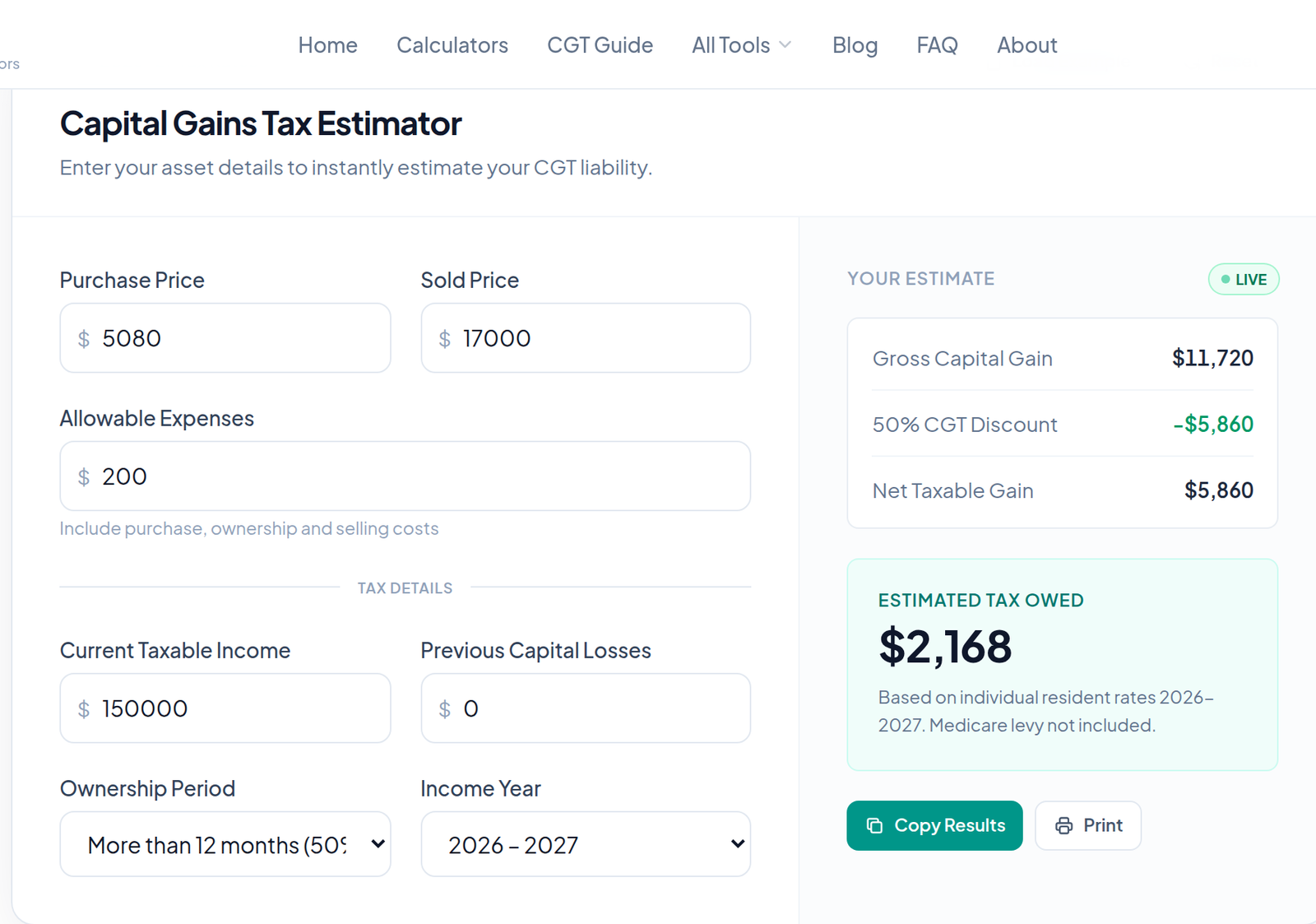
    CGT calculator showing $2,168 estimated tax on an NFT sale with the 50% discount.
    The CGT Hub calculator on Liam’s NFT sale: $5,080 cost base, $17,000 sale price, 50% discount applied — estimated tax owed $2,168.

    Worked example 1: the flip — and the hidden second gain

    Maya earns a salary of $85,000. In August 2026 she buys 2 ETH at $3,000 each — $6,000 in total. In September she uses both ETH to buy an NFT when ETH is worth $4,000. In February 2027 she sells the NFT for 3 ETH when ETH is worth $5,000. Marketplace selling fees are $150.

    Step 1 — the crypto she spent. Buying the NFT disposes of her 2 ETH. They cost $6,000 and were worth $8,000 at the trade, so she has a $2,000 capital gain on the ETH — even though she never cashed out to dollars.

    Step 2 — the NFT’s cost base. The NFT cost $8,000 (the AUD value of the 2 ETH) plus $120 in gas fees: a cost base of $8,120.

    Step 3 — the NFT sale. She receives 3 ETH worth $15,000, less $150 in fees. Capital gain = $15,000 − $150 − $8,120 = $6,730. She held the NFT for five months, so no 50% discount applies.

    Step 4 — the tax. Her total capital gains are $2,000 + $6,730 = $8,730, added to her $85,000 salary for taxable income of $93,730. Her marginal rate is 30%, so the extra tax on the gains is roughly $8,730 × 30% = $2,619 (plus the 2% Medicare levy on the additional income). The NFT “profit” most people would quote — $15,000 received for an $8,000 asset — understates her taxable gain, because the ETH gain is taxed too.

    Worked example 2: the 12-month discount

    Liam buys an NFT with Australian dollars in October 2025 for $5,000, paying $80 in gas fees. His cost base is $5,080. He sells it in December 2026 — 14 months later — for $17,000, with $200 in selling fees.

    Capital gain = $17,000 − $200 − $5,080 = $11,720. Because he held the NFT for more than 12 months, the 50% discount applies: only $5,860 is added to his assessable income. His other taxable income is $150,000, putting him in the 37% bracket, so the tax on the gain is about $5,860 × 37% = $2,168. Had he sold two months earlier, the full $11,720 would have been assessable and the tax would have roughly doubled to $4,336.

    Note the timing: the discount as described here applies to disposals before 1 July 2027. After that date, indexation and the 30% minimum tax apply instead — check the reform guide linked above before timing a sale around the 12-month mark.

    Worked example 3: the creator

    Priya is a digital artist. She mints an NFT of her artwork and sells it for $12,000. Because she created it as part of her business, the $12,000 is ordinary income, not a capital gain — no 50% discount, no cost base, and the full amount is added to her taxable income. Her smart contract also pays her a 10% royalty on resales; when the NFT later resells for $20,000, she receives $2,000. That royalty is ordinary income too — and the ATO’s own example makes the point that it stays ordinary income even if she stops carrying on the business.

    If her other income is $60,000, her taxable income becomes $74,000 and the extra $14,000 is taxed at her 30% marginal rate: about $4,200. Her NFT turnover is $14,000, well under the $75,000 GST registration threshold, so no GST. Cross $75,000 of turnover and she must register for GST and charge 10% on her sales — and if she sells through a marketplace, the platform may be responsible for GST on sales it facilitates for offshore sellers to Australian consumers.

    Worked example 4: the loss

    Tom buys an NFT for $9,000 plus $100 in gas — a cost base of $9,100. The project collapses and he sells for $4,000, paying $100 in fees. His capital loss is $4,000 − $100 − $9,100 = $5,200.

    A capital loss cannot be deducted against salary or wages. It can only offset capital gains — in the same year, or carried forward to future years indefinitely. If Tom also sold shares at a $5,200 gain that year, the loss wipes it out. If he has no gains, the loss sits on his record until he does. Keep the records: a carried-forward loss is only useful if you can prove it.

    When an NFT is a personal use asset

    In rare circumstances, an NFT can be a personal use asset — something you bought mainly to use or enjoy yourself, not to profit from. The ATO gives two examples:

    • Jo buys an NFT that gives her the right to a private viewing of a portrait in a gallery each year, and uses it to celebrate a family birthday. For Jo, the NFT is a personal use asset.
    • Jude is a gamer whose NFT cards are rewards he uses inside the game. The cards are personal use assets. Because he has no rights to the artwork on the cards, they are not collectables.

    The payoff: a capital gain on a personal use asset is disregarded if the asset cost $10,000 or less to acquire. The catch: a capital loss on a personal use asset is always disregarded, so you cannot use it. And if the NFT does carry rights to the underlying artwork, it may be a collectable instead — gains and losses on collectables acquired for $500 or less are disregarded. Most NFTs bought on a marketplace as an investment will not qualify. Do not assume yours does.

    NFTs in a business, and GST

    If you run a business that creates or trades NFTs, the tokens are trading stock or business assets, not CGT assets held as an investor. The ATO’s example: Kim, a professional artist, sells 10 NFTs of her portrait as business income, and the commissions she receives on later resales are business income too. Osman, who buys one of Kim’s NFTs to use in his art-tour business, holds it as a CGT asset of the business.

    On GST, an NFT is not a form of digital currency, so the digital-currency GST exemptions do not apply. Whether GST applies depends on whether the supply is taxable or GST-free — and if you operate an NFT marketplace as an electronic distribution platform, you are responsible for GST on sales you facilitate for offshore sellers to Australian consumers. If your enterprise turnover is under $75,000, GST registration is optional; over it, it is compulsory. Our GST guide for small business covers the registration rules.

    Airdrops, staking rewards and free NFTs

    Free is not the same as tax-free. If you receive an NFT as an airdrop and it is an established NFT with a clear market price, the market value is ordinary income when you receive it. If it is a new airdrop with no established market, you may not need to declare income — and your cost base is what you paid for it, which may be zero. Either way, the later sale is a separate CGT event measured from that cost base. The same logic applies to staking rewards and other crypto income: income when received, CGT when disposed of. See our crypto staking tax guide for the income side.

    How to report NFTs in your tax return

    In myTax, capital gains from NFT disposals go in the CGT section (item 18), and income from creating or selling NFTs as a business goes in as business or other income. The ATO expects you to keep records of every transaction for at least five years after you dispose of the asset. For each transaction, keep:

    • The date and time of the transaction
    • The Australian-dollar value at the time — of the NFT, of any crypto paid or received, and of any fees
    • What the transaction was for (purchase, sale, swap, gift, fee)
    • Exchange and marketplace records, wallet addresses and transaction hashes
    • Your calculation of each capital gain or loss

    The ATO data-matches crypto exchange data, and its 2026-27 compliance focus includes crypto and NFTs. If you are unsure whether your NFT art sales are a hobby or a business, the ATO Community answer to that exact question is worth reading — when does selling NFT artwork become taxable income? A return that omits an NFT sale the ATO already knows about is one of the fastest ways to get a please-explain letter — read our ATO data-matching guide and the audit triggers guide if that letter has already arrived.

    The 2026-27 return is due 31 October 2027 if you lodge yourself; if you use a registered tax agent, the lodgment program generally gives you until 15 May 2028.

    Common mistakes

    • “I never cashed out, so there’s no tax.” Swapping one NFT or crypto for another is a disposal. The tax event happens at the swap, not at the bank withdrawal.
    • Forgetting the crypto you spent. Paying with ETH is a disposal of the ETH. Price it in AUD at the time of the trade.
    • Leaving gas fees out of the cost base. Gas, marketplace and auction fees are part of the cost base — and part of the proceeds calculation on sale.
    • Claiming the 50% discount too early. Twelve months means twelve months. Day 364 gets nothing.
    • Using stale tax rates. The 2026-27 second bracket is 15%, not 16%. Several crypto guides still show last year’s rate.
    • Treating creator income as a capital gain. If you mint and sell as a business, it is ordinary income — no discount, and royalties keep coming.
    • No records. “The exchange shut down” is not a defence. Export your history now, and keep it for five years after disposal.
    • Ignoring the 1 July 2027 reform. The discount is going away. A sale timed for June 2027 is taxed very differently from one in July.

    Frequently asked questions

    Do I pay tax on NFTs if I only bought and never sold?

    No. Buying with Australian dollars and holding are not CGT events. You pay tax when you dispose of the NFT — by selling, swapping, gifting or donating it. If you bought with crypto, though, the crypto you spent is taxed at the time of purchase.

    Is swapping one NFT for another taxable?

    Yes. A swap is a disposal of the NFT you give up and an acquisition of the one you receive, both valued in Australian dollars at the time. Two NFTs of equal value can still produce a taxable gain if the one you gave up cost you less.

    How is an NFT different from crypto for tax?

    It isn’t, in substance. The ATO treats NFTs as crypto assets and applies the same CGT framework. The differences are practical: NFTs are unique, so valuing them is harder; they can be personal use assets or collectables in ways a Bitcoin cannot; and creators earn royalties that have no equivalent in plain crypto.

    What if my NFT was stolen or the project rugged?

    If the NFT is stolen or permanently lost, you may be able to claim a capital loss — but you need evidence: the transaction history, the wallet records, any police report or platform correspondence. A token that is simply worthless because the project failed is still yours; the loss is only realised when you dispose of it, even for a nominal amount.

    Do I need to register for GST to sell NFTs?

    Only if you are carrying on an enterprise and your GST turnover reaches $75,000. Hobby creators and one-off investors do not register. If you do register, GST applies to your sales — and marketplace rules may make the platform responsible for GST on some transactions.

    Does the 50% CGT discount apply to NFTs?

    Yes, for individuals who hold the NFT for more than 12 months and dispose of it before 1 July 2027. After that date the discount is replaced by CPI indexation of the cost base and a 30% minimum tax on the gain, with pre-1 July 2027 accrued gains keeping the old treatment.

    The bottom line

    NFT tax in Australia is ordinary CGT with a few sharp edges: the crypto you spend is taxed, the swap you forgot is a disposal, and the creator’s income is not a capital gain at all. The rules reward two habits — holding for more than 12 months while the discount still exists, and keeping a record of every transaction in Australian dollars at the time it happened. Do those two things and the NFT section of your return is a calculation, not a crisis.

    This article is general information, not personal tax advice. If your NFT activity is large, involves a business, or crosses into GST territory, speak to a registered tax agent.

  • ATO Audit Triggers Australia 2026-27: 10 Red Flags to Avoid

    ATO Audit Triggers Australia 2026-27: 10 Red Flags to Avoid


    ATO Audit Triggers Australia 2026-27: 10 Red Flags to Avoid

    The short answer

    Most ATO audits are not random. The Tax Office’s data-matching systems compare your return against information it already holds — from your employer, your bank, share registries, crypto exchanges, Airbnb and Uber — and flag the returns that don’t add up. In 2024-25, ATO data matching led to more than 595,000 individual returns being adjusted for missing income, overstated deductions and other discrepancies.

    For 2026-27, the ATO’s stated focus areas are work-related deductions, working-from-home claims, rental property and holiday-home deductions, omitted income and side hustles, and cryptocurrency. If your return touches one of those areas and the numbers look off, you are in the risk pool. The good news: every trigger below is avoidable, and a mistake found early costs far less than one the ATO finds first.

    Audit, review or nudge — they’re not the same thing

    Not every letter from the ATO is an audit, and knowing which one you’ve received changes what you do next.

    Contact type What it means What to do
    Nudge letter / myTax prompt An automated message flagging something that looks odd — a deduction well above your occupation’s average, income the ATO holds that you haven’t declared. No formal investigation yet. Check the item, correct it if it’s wrong, and lodge an amendment if needed. This is the cheapest stage to fix a mistake.
    Review An ATO officer looks at a specific item on your return and asks for records — a diary, receipts, a logbook. Narrow in scope. Respond within the timeframe given (usually 28 days) with the records requested. Most reviews end here.
    Audit A formal, wider examination of your tax affairs, often across multiple years and multiple tax types. The ATO can request bank statements, contracts, invoices and diaries. Get a registered tax agent involved, gather everything, and respond in full. Do not ignore it — silence makes it worse.

    One thing first, every time: verify the contact is genuinely from the ATO. Scammers impersonate the Tax Office constantly. Check your myGov inbox, or call the ATO on 1800 008 540 to confirm. The ATO will never ask you to pay a tax debt with gift cards or cryptocurrency, and it will never threaten arrest in a text message.

    The 10 audit triggers for 2026-27

    1. Income that doesn’t match what the ATO already holds

    This is the single most common trigger, and it’s almost entirely automated. Before you lodge, the ATO already has your salary and super from your employer, interest from your bank, dividends from share registries, and payments from government agencies — all sitting in pre-fill. If the income on your return is lower than the income in the ATO’s data, the mismatch is flagged, often before your return is even processed.

    The fix is boring but effective: wait until your pre-fill is marked “Tax ready” (usually mid-August), reconcile every pre-filled line against your own records, and never delete a pre-filled item you can’t explain. If pre-fill is wrong, your own records win — but you need the evidence to back that up.

    2. Work-related deductions well above your occupation’s average

    The ATO benchmarks deductions by occupation. It knows, roughly, what a nurse, a teacher, an electrician and a retail manager typically claim. If your work-related expenses sit far outside that range, your return gets a closer look. An electrician claiming $9,800 a year in vehicle and tool deductions when the occupation average is closer to $3,500 is the classic example — the claim might be legitimate, but it will be asked about.

    The rule is simple: claim what you actually spent, keep the receipt, and make sure the expense genuinely relates to earning your income. Our tax deductions checklist walks through what’s claimable and what isn’t.

    3. Working-from-home claims without a diary

    Work-from-home deductions are the ATO’s number one focus area for 2026. The 70-cent fixed rate looks easy — and it is — but it still requires a record of the hours you actually worked from home. Claiming the maximum (70 cents × every weekday of the year) with no diary, or claiming the fixed rate and the same costs again as separate items, are the two mistakes that get flagged most.

    From 1 July 2026 the old $300 no-receipts rule and the $150 laundry limit no longer apply — they were replaced by the new $1,000 standard deduction, which only starts in the 2026-27 year. Claiming it on your 2025-26 return is itself a trigger; see trigger 9.

    4. Rental property errors — especially holiday homes

    Rental properties generate some of the highest adjustment rates in ATO reviews, and a large share of the errors are genuine mistakes rather than dishonesty. The three that cost landlords most:

    • Claiming initial repairs as immediate deductions. Fixing damage that existed when you bought the property is a capital cost, not a repair. It goes into the cost base or is depreciated — it is not deductible in full in year one.
    • Claiming the full interest on a loan with a private component. If you redrew on the mortgage for a car or a holiday, only the investment portion of the interest is deductible.
    • Claiming a holiday home as if it were fully rented. Under the ATO’s ruling TR 2026/1, from 1 July 2026 a property must pass a “mainly” test: if it is mainly a holiday home for you and your family, ownership expenses are denied entirely — not just apportioned. A property listed on Airbnb for two peak weeks a year while the family uses it for the other fifty does not pass.

    See our guides to rental income tax and CGT on a holiday home for the full mechanics.

    5. Undeclared side hustle and gig income

    Under the Sharing Economy Reporting Regime, more than 50 platforms — Uber, Airbnb, Menulog, eBay, Etsy, Airtasker, Hireup — report transactions directly to the ATO. Ride-share and food-delivery income, marketplace sales and short-term rental income all arrive at the ATO without you doing anything. Declaring $1,500 when the platform reported $2,000 is an automatic mismatch.

    It isn’t only the platforms. Bank data, payment providers and the taxable payments reporting system for building and construction all feed the same matching engine. Cash income is not invisible either: regular cash deposits that don’t match declared income are exactly the pattern the ATO’s risk models are built to spot.

    6. Crypto gains left off the return

    Crypto remains firmly on the ATO’s compliance radar. Australian exchanges report account details and transaction history, and the ATO cross-references that against returns. The misunderstandings that catch people out: swapping one crypto for another is a disposal even though no Australian dollars ever touched your bank account; staking rewards are assessable income when received; and moving crypto to an overseas exchange does not remove it from the ATO’s view — the ATO also receives data through international exchange-of-information agreements.

    Our crypto tax guide covers what counts as a disposal and how the 12-month discount applies.

    7. Losses year after year

    A business that loses money every year will be asked whether it is genuinely a business or a hobby with deductions attached. The same logic applies to rental properties with persistent large losses and to share portfolios that never seem to make a gain. One bad year is normal. Five in a row, with no credible path to profit, is a pattern — and patterns are what risk models detect.

    For businesses, the ATO also compares your margins against industry benchmarks: a café reporting half the average income of similar cafés in the same postcode stands out whether or not anything is wrong.

    8. Large or unusual transactions

    A single large deposit does not trigger an audit on its own. Repeated unexplained deposits, a sudden large GST refund claim, or a lifestyle that doesn’t match declared income do. The ATO cross-references property purchases, car registrations, school fees and overseas travel against reported income — the “lifestyle vs income” mismatch is one of its standard checks. A taxpayer declaring $65,000 of income while buying a $1.2 million property in cash will be asked where the money came from, and “savings” without a paper trail is not an answer.

    9. Claiming the $1,000 standard deduction a year early

    The new $1,000 standard deduction for work-related expenses applies from the 2026-27 income year — the return you lodge in 2027. It does not apply to the 2025-26 return. The ATO has named premature claims as a specific 2026 trigger, and eTax lists it among the top five red flags for the year. If you lodge your 2025-26 return and claim the $1,000 flat deduction, expect a nudge at best.

    When it does apply, the mechanics matter too: the $1,000 is reduced dollar for dollar by any work-related expenses you claim separately. Claiming $450 of expenses doesn’t give you $1,450 — it gives you $450 plus a $550 standard deduction. Our $1,000 standard deduction guide works through the maths.

    10. Super and payroll problems — including Payday Super

    Single Touch Payroll gives the ATO a live view of wages, PAYG withholding and super contributions, so late or missing super guarantee payments are visible immediately. From 1 July 2026, Payday Super requires employers to pay the super guarantee at the same time as wages rather than quarterly — employers still running quarterly cycles will be flagged. Company directors should also watch Division 7A: loans from a company to a director or shareholder that aren’t documented and repaid on time are a standing audit trigger.

    What the ATO already knows about you

    The reason these triggers work so well is the sheer volume of data behind them. More than 600 million transactions are reported to the ATO each year under its data-matching programs, each running under a published protocol. The main feeds:

    Source What the ATO receives What it catches
    Employers (Single Touch Payroll) Salary, PAYG withholding, super contributions Understated wages, unpaid super
    Banks and financial institutions Interest, account data Undeclared interest, unexplained deposits
    Share registries and exchanges Dividends, share sales, CGT events Undeclared dividends and capital gains
    Crypto exchanges Account details, transaction history Undeclared crypto gains and swaps
    Sharing economy platforms Ride-share, delivery, rental and marketplace income Undeclared gig income
    Rental bond authorities Rental addresses and bond lodgements Undeclared rental income
    State revenue offices and title offices Property transactions, stamp duty Undeclared property sales, CGT events
    Government agencies and AUSTRAC Payments, overseas transfers, treaty-partner data Foreign income, unexplained wealth

    The ATO does not log into your bank account. It doesn’t need to — the data arrives in bulk, and the matching is done by machine. Our ATO data matching guide explains each program in detail.

    What getting caught actually costs — three worked examples

    An audit finding is not just the tax you should have paid. The bill is a stack: the shortfall tax, a shortfall penalty, and general interest charge (GIC) compounding daily on the unpaid amount. The penalty depends on behaviour — 25% for failure to take reasonable care, 50% for recklessness, 75% for intentional disregard. GIC for the October–December 2026 quarter is 11.51% a year, and since 1 July 2025 it is no longer tax deductible. The examples below use the 2026-27 rates (30% marginal rate plus 2% Medicare levy = 32%) and assume the 25% penalty band; GIC is simplified to a full year at 11.51%.

    Example 1: the landlord who claimed too much

    Sarah earns $95,000 a year. She forgets $3,600 of rent from a tenant who paid late, and claims $4,800 of initial repairs on a property she bought with a damaged bathroom. The ATO disallows the repairs and adds the missing rent — $8,400 of understated income.

    • Extra tax: $8,400 × 32% = $2,688
    • Penalty (25%): $2,688 × 25% = $672
    • GIC (11.51% for a year): $2,688 × 11.51% = $309
    • Total bill: $3,669 — on top of the $8,400 she already had to account for.

    Example 2: the crypto trader who didn’t declare a swap

    Tom swaps $12,000 of one crypto for another and doesn’t report it, because no dollars hit his bank account. A swap is a disposal. He held the crypto for less than 12 months, so no 50% discount applies.

    • Extra tax: $12,000 × 32% = $3,840
    • Penalty (25%): $3,840 × 25% = $960
    • GIC (11.51% for a year): $3,840 × 11.51% = $442
    • Total bill: $5,242.

    Example 3: the work-from-home claim with no diary

    James claims $2,400 of home-office costs with no diary and no records. The ATO disallows the full amount.

    • Extra tax: $2,400 × 32% = $768
    • Penalty (25%): $768 × 25% = $192
    • GIC (11.51% for a year): $768 × 11.51% = $88
    • Total bill: $1,048 — for a claim that saved him $768 in the first place.

    And those are the cheap outcomes. At the 50% recklessness band, Tom’s bill rises to $6,202; at 75%, $7,162. Add a failure-to-lodge penalty — $364 per 28 days, capped at $1,820 — if the return was also late. If the ATO suspects fraud or evasion, the two-year review limit disappears entirely and it can go back as far as it likes.

    A letter arrived — what to do, step by step

    1. Verify it. Check your myGov inbox and call the ATO on 1800 008 540 if anything looks off. Never click a link in a text message claiming to be from the ATO.

    2. Read it properly. The letter says exactly what the ATO wants and by when — usually 28 days. A nudge letter asks you to check something; a review asks for specific records; an audit notice is formal and wider. Respond to the thing that was actually asked.

    3. Gather your records before you reply. Bank statements, receipts, diaries, logbooks, contracts, invoices. If you can’t substantiate a claim, say so — guessing or inventing records is far worse than admitting a gap.

    4. Amend first if you find a mistake. If your own check turns up an error, lodge an amendment before the ATO raises it. A voluntary disclosure made before the ATO notifies you of an audit can cut the shortfall penalty by up to 80% — on Sarah’s example above, that takes the $672 penalty down to about $134. Waiting costs real money.

    5. Get professional help for a full audit. A registered tax agent knows the process, the deadlines and the penalty framework, and can negotiate the outcome. Tax audit insurance — a policy that covers your accountant’s fees during an audit, not the tax bill itself — is worth considering if you run a business or hold rental property.

    6. Don’t ignore it. The ATO escalates silence. A missed deadline turns a review into an audit, and an audit with no response turns into an assessment based on the ATO’s data alone — which is never in your favour.

    Common mistakes that look like audit triggers

    • Lodging in early July before pre-fill is complete, then never checking when the rest of the data arrives. Wait for “Tax ready” — usually mid-August.
    • Deleting pre-filled items you don’t recognise instead of checking them. The ATO can adjust pre-fill back where it is confident in its data.
    • Claiming the same expense twice — the fixed-rate home-office claim plus the same internet and electricity bills as separate items, or the $1,000 standard deduction plus the expenses it already covers.
    • Round numbers everywhere. Exactly $5,000 of work expenses, exactly $1,000 of laundry, exactly 52 weeks of home office — round figures are an estimation pattern, and estimation is what the benchmarks are designed to catch.
    • Mixing private and business spending in one account with no apportionment, then claiming the lot. Apportion it, or don’t claim it.
    • Forgetting the small stuff. Bank interest of $180, a $300 eBay sale, a one-off Airtasker job — there is no de minimis. Small amounts are matched the same way as large ones.

    How to stay out of the risk pool

    • Keep records as you go — a photo of the receipt, a diary note, a logbook entry. Five years is the ATO’s record-keeping requirement for individuals.
    • Reconcile pre-fill line by line before lodging, and lodge after “Tax ready”.
    • Check your claims against your occupation’s norms. If yours are far above average, make sure you can prove every dollar.
    • Declare all income, including the small amounts and the platform income you assume the ATO can’t see. It can.
    • Amend promptly when you find a mistake — voluntary disclosure is the cheapest penalty outcome available.
    • If your affairs are complex — trusts, companies, foreign income, multiple properties — use a registered tax agent. The fee is deductible, and the audit risk is lower.

    FAQ

    Does the ATO audit randomly?

    Mostly no. The overwhelming majority of audits and reviews are risk-based — data-matching mismatches, occupation-benchmark outliers and targeted compliance programs. A small number are selected randomly, and anyone can be reviewed as part of a targeted program for their industry or deduction type. Being selected does not mean you did anything wrong.

    How far back can the ATO audit me?

    For individuals, the ATO can generally amend an assessment within two years of the notice of assessment. For businesses and more complex taxpayers it is generally four years. If the ATO suspects fraud or evasion, there is no time limit at all.

    I got a letter from the ATO. Am I being audited?

    Probably not — most ATO contact is a nudge letter, an advisory letter or a review of one item. Read the letter: it will say what it is and what the ATO wants. Respond within the timeframe given, usually 28 days, and amend if you find a mistake. A full audit is a formal process and the notice will say so.

    Can the ATO see my bank account?

    The ATO does not log into your bank account. It receives bulk data from banks — interest earned, and account information under its data-matching programs — and matches it against your return. It can also request bank statements during a review or audit, and it cross-references property purchases, car registrations and travel against declared income.

    I only forgot a small amount. Surely the ATO doesn’t care?

    There is no minimum threshold. Small mismatches are matched by the same automated systems as large ones — the ATO has sent letters over a $20 crypto purchase. A small error usually means a small adjustment, but it still means an adjustment, and repeated small errors build a pattern.

    I made a mistake on a return I already lodged. What should I do?

    Amend it yourself, now, before the ATO contacts you. A voluntary disclosure made before the ATO notifies you of a review or audit can reduce the shortfall penalty by up to 80%. You can amend online through myTax or ask your tax agent to do it. The two-year amendment window for individuals runs from the day after your notice of assessment.

    The ATO’s systems get smarter every year, and the gap between what it knows and what you declare is where audits live. The triggers in this guide are all visible in advance: match your income to pre-fill, keep your deductions inside your occupation’s norms, keep records, declare the small amounts, and fix your own mistakes before the ATO finds them. Do that, and the letter that lands in your myGov inbox is far more likely to be a refund notice than an audit. For the numbers behind the matching engine, read our ATO data matching guide, and for the interest that accrues on any shortfall, our GIC and payment plan guide. External source: ATO — Standard deduction for work-related expenses.


  • How Much Tax on a $135k Salary in Australia? 2026-27 Guide

    How Much Tax on a $135k Salary in Australia? 2026-27 Guide

    The short answer

    On a $135,000 salary in 2026-27, you pay $31,020 in income tax plus a $2,700 Medicare levy — $33,720 in total — and take home $101,280 a year. That’s $8,440.00 a month, $3,895.38 a fortnight or $1,947.69 a week. Your effective tax rate is 25.0%, and your marginal rate is 30% (32% once the levy is counted). On a 38-hour week, $135,000 is $68.32 an hour before tax and $51.26 an hour after it.

    What makes $135,000 interesting is not the headline — it is where the number sits. This is the last dollar taxed at 30%: $135,000 is the top of the third bracket, and at $135,001 the marginal rate jumps to 37%. The $5,000 step that lands you here is the last $5,000 step in the whole ladder that keeps the full $3,400 with hospital cover; the next step, to $140,000, keeps only $3,050. Your Low Income Tax Offset is long gone — it phases out completely by $66,667 — and your HELP repayment is now $9,926.11, because you sit $5,283 into the 17-cent repayment band. And the surcharge, which was $1,625 at $130,000, is now $1,687.50 a year if you hold no hospital cover. Every figure below is worked from the ATO’s own 2026-27 tables, and three independent calculators agree with the headline to the dollar.

    Your situation Extra taken out Take-home pay
    Headline — no HELP debt, hospital cover held — $101,280
    With a HELP debt $9,926.11 $91,353.89
    No hospital cover (1.25% surcharge) $1,687.50 $99,592.50
    With HELP debt and no hospital cover $11,613.61 $89,666.39
    Claiming the $1,000 standard deduction −$320 $101,600

    Read the table as a warning about the last two rows. A HELP debt costs $9,926.11 here — not a round number, and not a percentage of your whole salary, because the repayment is marginal: $9,028 plus 17 cents on the $5,283 above the $129,717 band line. The surcharge is the quieter one: $1,687.50 is 1.25% of your whole income, charged because you sit in Tier 2. And the fifth row is the one to watch — the $1,000 standard deduction takes you to a round $101,600, worth exactly $320, and it lands as a refund at tax time, not in your payslip. Every figure here is worked from the ATO’s own 2026-27 tables, and three independent calculators agree with the headline to the dollar.

    One warning before the detail: several guides still show 16% as the second-bracket rate for 2026-27. That rate was correct last year; from 1 July 2026 it is 15% — worth $268 in your pocket. If a calculator shows 16% for this year, its headline is $268 too low. Others still quote the old $30,000 concessional super cap. The correct 2026-27 cap is $32,500, and it matters for the salary-sacrifice maths below.

    How the tax on $135,000 is worked out

    Australia taxes income in slices. Only the slice inside each bracket pays that bracket’s rate — your whole salary is never taxed at your marginal rate. For 2026-27 the resident brackets are 0% to $18,200, 15% from $18,201 to $45,000, 30% from $45,001 to $135,000, 37% from $135,001 to $190,000 and 45% above $190,000.

    Slice of your $135,000 Rate Tax
    $0 – $18,200 (tax-free threshold) 0% $0
    $18,201 – $45,000 15% $4,020
    $45,001 – $135,000 30% $27,000
    Gross income tax $31,020
    Less Low Income Tax Offset −$0
    Net income tax $31,020
    Medicare levy (2% of $135,000) 2% $2,700
    Total tax $33,720
    Take-home pay $101,280

    The maths is short because only two slices are taxed. The first $18,200 costs nothing, the next $26,800 costs 15% ($4,020) and the remaining $90,000 costs 30% ($27,000). There is no offset left to subtract — the Low Income Tax Offset is $0 at this income, as the next section explains — so the net income tax is the full $31,020. Add the 2% Medicare levy on the full $135,000 ($2,700) and you get $33,720 — an effective rate of 25.0%, which means you keep 75 cents of every dollar on average.

    Your employer’s super sits outside this calculation. At the 12% Superannuation Guarantee rate your employer pays $16,200 a year into your super on top of your salary, so your total package is $151,200 — worth remembering when comparing job offers. For the full bracket table, see our income tax rates guide. To run your own numbers, use cgthub.au’s income tax calculator.

    Official 2026-27 tax rates for residents

    Taxable income Tax on this income
    $0 – $18,200 Nil
    $18,201 – $45,000 15c for each $1 over $18,200
    $45,001 – $135,000 $4,020 plus 30c for each $1 over $45,000
    $135,001 – $190,000 $31,020 plus 37c for each $1 over $135,000
    $190,001 and over $51,370 plus 45c for each $1 over $190,000

    These are the ATO’s 2026-27 resident rates, and the 15% second-bracket rate is the change that matters this year. It was 16% in 2025-26 and falls to 14% from 1 July 2027. Each one-point cut is worth $268 a year on a $135,000 salary, because the whole $26,800 slice between $18,200 and $45,000 moves by one cent per dollar. The Medicare levy stays at 2% across all three years.

    With a HELP debt: minus $9,926.11 — 17 cents on the $5,283 above the line

    Your HELP repayment is not a percentage of your salary. Since 1 July 2025 it is marginal: you pay nothing on the first $69,528 of repayment income, then 15 cents on each dollar above it, up to $129,717 — and then 17 cents on each dollar above that. At $135,000 you are $5,283 into the 17-cent band, so the repayment is $9,028 + 17% × $5,283 = $9,926.11 a year, or $381.77 a fortnight. Your take-home with a HELP debt is $91,353.89.

    2026-27 repayment income Compulsory repayment
    $0 – $69,528 Nil
    $69,529 – $129,717 15c for each $1 over $69,528
    $129,718 – $186,050 $9,028 plus 17c for each $1 over $129,717
    $186,051 and over 10% of your total repayment income

    Two things about that table catch people out. First, the old system charged a percentage of your whole income once you crossed the threshold — under the new marginal system you only ever pay on the slices above each line, which is why the repayment at $135,000 is $9,926.11 and not the $13,500 a flat 10% would give. Second, “repayment income” is wider than taxable income: it adds back net investment losses, reportable fringe benefits, reportable super contributions and exempt foreign income. That matters for the salary-sacrifice maths below — sacrificing $10,000 into super does not cut your HELP repayment by a cent, because the sacrificed amount is added straight back into the test. For the full thresholds and the 20% debt reduction that applied on 1 June 2025, see our HECS-HELP repayment guide.

    One detail worth noticing: $130,000 was already $283 into the 17-cent band, so the $130,000-to-$135,000 step is the cleanest HELP step in the ladder — the repayment rises exactly $850.00, which is 17% of the whole $5,000 rise, with no band-crossing distortion. Compare the ladder: at $70,000 the repayment is only $70.80, at $80,000 $1,571, at $90,000 $3,071, at $100,000 $4,571, at $110,000 $6,070.80, at $120,000 $7,570.80, at $130,000 $9,076.11 — and at $135,000 $9,926.11. The $120,000-to-$130,000 step added $1,505.31, not $1,500, because $283 of it crossed the band line; this step adds a round $850.00.

    The $1,000 standard deduction is the one lever that does move HELP. It cuts your taxable income to $134,000, and because repayment income follows taxable income down, the repayment falls to $9,028 + 17% × $4,283 = $9,756.11 — $170 less. So with a HELP debt the deduction is worth $490, not $320: $300 of income tax, $20 of Medicare levy and $170 of HELP. Take-home with HELP and the deduction is $91,843.89.

    The Low Income Tax Offset: $0 — gone by $66,667

    The Low Income Tax Offset is worth up to $700, but it phases out in two stages and is completely gone by $66,667. At $135,000 you are $68,333 past the cut-off, so the offset is $0 and your income tax is the full $31,020. There is nothing to claim and nothing to miss — the offset simply does not exist at this income.

    It is worth knowing how it disappears, because it explains the ladder below. From $37,500 the offset shrinks by 5 cents per dollar until $45,000 (where $325 remains), then by 1.5 cents per dollar until it hits zero at $66,667. That second taper is why the marginal rate between $45,000 and $66,667 was 33.5% — 30% tax, 2% levy and 1.5% of vanishing offset. Above $66,667 the offset is gone and the marginal rate drops to a clean 32%. Your $135,000 sits in that clean zone, which is exactly why the pay-rise steps below are so regular — right up until the bracket boundary at the top of it.

    Medicare levy surcharge: $1,687.50 — still Tier 2, but the boundary is behind you

    The surcharge is the tax most $135,000 earners discover late. It applies on top of the 2% Medicare levy if you earn over $105,000 as a single and do not hold hospital cover. The 2026-27 tiers for singles are: $105,000 or less 0%; $105,001–$123,000 1%; $123,001–$164,000 1.25%; $164,001 and over 1.5%. At $135,000 you are in Tier 2, so the surcharge is 1.25% × $135,000 = $1,687.50 a year with no hospital cover — and your take-home falls to $99,592.50. Hold appropriate hospital cover and the surcharge is $0.

    Three facts about the surcharge are worth more than the number itself. First, it is charged on your whole income for surcharge purposes, not just the slice above $105,000 — which produces the sharpest single-dollar jump in the Australian tax system. At $123,000 the surcharge is 1% × $123,000 = $1,230; at $123,001 it is 1.25% × $123,001 = $1,537.51. One dollar more income, $307.51 more surcharge — a boundary you crossed $12,000 ago, on the step from $120,000 to $125,000. Second, “income for surcharge purposes” is wider than taxable income: reportable fringe benefits and reportable super contributions are added back, so a packaged car or sacrificed super can push you over the line even when your payslip says you are under it. Third, the surcharge is what bends the ladder: with hospital cover, every $5,000 step up to this rung keeps exactly $3,400; without it, the $130,000-to-$135,000 step keeps $3,337.50, because the surcharge rises $62.50 inside Tier 2. For the full thresholds and the family tiers, see our Medicare levy surcharge guide.

    The practical question is whether hospital cover is worth it. At $135,000 the surcharge is $1,687.50 a year, every year, with nothing to show for it — so a basic hospital policy that costs less than $1,687.50 leaves you ahead and gives you cover on top. That is exactly what the surcharge is designed to do. Note the timing: the surcharge is assessed at tax time on the whole year’s income, so starting cover part-way through the year only pro-rates the exemption. And if your income is heading toward $164,000 — $29,001 away — the rate steps up to 1.5%, so the cover decision gets more valuable the closer you get to Tier 3.

    Take-home pay by pay period

    Pay period Gross Take-home (no HELP, cover held)
    Yearly $135,000 $101,280
    Monthly $11,250.00 $8,440.00
    Fortnightly $5,192.31 $3,895.38
    Weekly $2,596.15 $1,947.69
    Daily (260 working days) $519.23 $389.54
    Hourly (38-hour week) $68.32 $51.26

    With a HELP debt, subtract $381.77 a fortnight ($9,926.11 a year) — monthly take-home becomes $7,612.82. With no hospital cover, subtract a further $64.90 a fortnight ($1,687.50 a year) — monthly take-home becomes $8,299.38. With both, monthly take-home is $7,472.20. The fortnightly figure is the one to check against your payslip: your employer withholds roughly $1,296.92 a fortnight in PAYG, which across 26 pays is $33,720 — exactly the assessed total, so there should be no surprise either way at tax time.

    The last flat step: $130,000 to $135,000 keeps $3,400 — the next keeps only $3,050

    Salary Take-home Extra kept on a $5,000 rise
    $105,000 $80,880 —
    $110,000 $84,280 $3,400
    $115,000 $87,680 $3,400
    $120,000 $91,080 $3,400
    $125,000 $94,480 $3,400
    $130,000 $97,880 $3,400
    $135,000 $101,280 $3,400
    $140,000 $104,330 $3,050
    $150,000 $110,430 $6,100 on $10,000

    Six $5,000 steps, six identical $3,400 keeps — with hospital cover. That is not a coincidence — it is the arithmetic of a flat marginal rate. Between $66,667 and $135,000 the offset is gone, the bracket is a flat 30% and the levy is a flat 2%, so every extra dollar costs 32 cents and keeps 68 cents. A $5,000 rise keeps $3,400 whether it takes you from $105,000 to $110,000 or from $130,000 to $135,000. And then the pattern breaks: the $135,000-to-$140,000 step keeps only $3,050, because the top $5,000 crosses into the 37% bracket and costs 39 cents on the dollar. The whole stretch from $70,000 to $135,000 behaves this way — it is the flattest part of the Australian tax system, and $135,000 is where it ends.

    Two conditions hide inside that sentence. First, it assumes hospital cover is held: without it, the surcharge bends the ladder — the $130,000-to-$135,000 step keeps $3,337.50 without cover, and the $135,000-to-$140,000 step keeps only $2,987.50, because the surcharge rises another $62.50 inside Tier 2. Second, it assumes no HELP debt: with a HELP debt, 17 cents of each extra dollar goes to the repayment as well, so the marginal rate becomes 49% with cover (30 + 2 + 17) and 50.25% with no cover (30 + 2 + 17 + 1.25) — each extra $1,000 leaves $510 with cover, $497.50 without. For the $130,000 and $150,000 rungs, see our tax on $130k and tax on $150k guides.

    Two legal ways to keep more of your $135,000

    The $1,000 standard deduction — worth $320, or $490 with a HELP debt, or $502.50 with a HELP debt and no hospital cover. From 2026-27, a $1,000 standard work-related deduction is legislated — no receipts, no diary, just $1,000 off your taxable income at lodgement. On $135,000 it cuts taxable income to $134,000: income tax falls $300 (30% × $1,000) and the levy falls $20 (2% × $1,000), so the total tax is $33,400 and take-home is a round $101,600. With a HELP debt it is worth $490, because the repayment also falls $170, to $9,756.11 — the biggest HELP leg of the deduction anywhere in the ladder so far, because the whole $1,000 sits in the 17-cent band. And with no hospital cover there is a third leg: the surcharge falls $12.50, to $1,675, so the deduction is worth $502.50 in total and take-home with HELP and no cover is $90,168.89. The catch is timing: the deduction does not change your PAYG withholding during the year, so it arrives as a refund when you lodge, not as extra money in your fortnightly pay. And it replaces itemised work deductions, not adds to them — if your real work expenses are above $1,000, claim the real ones instead. For the full rules, see our standard deduction guide.

    Salary sacrifice $10,000 into super — worth $1,700 net, plus $8,500 in super. Sacrificing $10,000 cuts your taxable income to $125,000: income tax falls to $28,020 and the levy to $2,500, a gross saving of $3,200. The super fund then pays 15% contributions tax on the $10,000 — $1,500 — leaving a net saving of $1,700 and $8,500 extra in your super. The headroom is comfortable: the 2026-27 concessional cap is $32,500, your employer already contributes $16,200 at 12%, so you have $16,300 of cap left before the cap binds. Two traps to know: sacrificing does not cut your HELP repayment or your surcharge, because reportable super contributions are added back into both tests — the $9,926.11 HELP bill and the $1,687.50 surcharge stay exactly where they are. And sacrificing cannot drop you back into a lower bracket for the marginal rate either — the sacrifice is calculated on your pre-sacrifice income for the surcharge test, and your next dollar is still taxed at 30% either way. For the full mechanics, see our salary sacrifice guide and run the numbers on cgthub.au’s super calculator.

    PAYG vs assessed: why your payslip and your assessment disagree

    Your employer withholds tax using the ATO’s PAYG schedule, which is built from the same brackets — so on a plain $135,000 salary with no deductions, the withholding and the assessment agree to the dollar: about $1,296.92 a fortnight, $33,720 across the year. If they disagree, one of four things is happening. Your employer may be withholding on a different annualised figure because you started mid-year. You may have claimed the tax-free threshold with two employers. You may have a HELP debt — the employer withholds extra for it, but the withholding tables estimate the repayment from your pay, so a bonus or overtime can leave a small gap. Or you claimed the $1,000 standard deduction, which your employer cannot see — in that case you will get roughly $320 back at lodgement, and the payslip was never wrong. A gap of a few dollars is normal; a gap of hundreds means one of those four.

    If you are not a resident: $94,500, not $101,280 — and the working holiday maker is $30 behind you

    Non-residents pay 30% from the first dollar — no tax-free threshold, no Low Income Tax Offset, and generally no Medicare levy. On $135,000 that is 30% × $135,000 = $40,500, leaving $94,500 — $6,780 less than a resident keeps. Working holiday makers pay 15% on the first $45,000 and 30% above it: $6,750 + $27,000 = $33,750, leaving $101,250 — just $30 less than a resident.

    That $30 is the narrowest resident-versus-working-holiday-maker gap in the whole ladder, and it is no accident. A working holiday maker pays $2,730 more income tax than a resident at this rung — the price of having no tax-free threshold — and the resident pays $2,700 of Medicare levy, which the working holiday maker does not. The two almost exactly cancel. At $130,000 the gap was $130 in the resident’s favour; at $135,000 it is $30. The lines cross at $136,500: above that income, the levy grows faster than the threshold advantage, and the working holiday maker keeps more. $135,000 is the last rung where a resident is still ahead. Residency is a facts test, not a visa label, and getting it wrong is the most expensive mistake on this page — for the full test, see our tax residency guide.

    2025-26 vs 2026-27 vs 2027-28

    Year Income tax Medicare levy Total tax Take-home
    2025-26 (16% bracket) $31,288 $2,700 $33,988 $101,012
    2026-27 (15% bracket) $31,020 $2,700 $33,720 $101,280
    2027-28 (14% bracket) $30,752 $2,700 $33,452 $101,548

    The 2026-27 year is $268 better than 2025-26 — the whole of the 16%-to-15% cut on the $26,800 second-bracket slice — and 2027-28 is another $268 better when the rate falls to 14%. With a HELP debt the improvement is bigger: the 2025-26 repayment at $135,000 was $10,400 ($8,700 plus 17% on the $10,000 above $125,000), so take-home with HELP was $90,612 — 2026-27 is $741.89 better with HELP ($268 from the bracket cut plus $473.89 from the threshold and band changes). From 1 July 2027 a legislated $250 Working Australians Tax Offset also begins, so the 2027-28 year could be up to $518 better than this one. The surcharge, by contrast, does not move: it was $1,687.50 in 2025-26 too, because $135,000 was already in Tier 2 then.

    Common mistakes that cost real money

    Using last year’s 16% rate. The second bracket is 15% from 1 July 2026. Any calculator or guide still showing 16% understates your take-home by $268.

    Assuming the surcharge is still 1%. At $135,000 you are in Tier 2, not Tier 1 — the surcharge is $1,687.50 a year with no hospital cover, $64.90 a fortnight, and it is assessed on your whole income for surcharge purposes, not just the slice above $105,000. It is the single biggest surprise in this guide, and the calculator pages that give you the $101,280 headline do not mention it.

    Assuming salary sacrifice cuts HELP or the surcharge. It cuts income tax and the levy, not the repayment or the surcharge — reportable super contributions are added back into both tests. Sacrificing $10,000 saves $1,700 net and leaves the $9,926.11 HELP bill and the $1,687.50 surcharge untouched.

    Treating HELP as a percentage of your whole salary. It is $9,028 plus 17 cents only on the $5,283 above $129,717. Anyone quoting “10% of your income” for HELP is describing the top band above $186,050, not your band.

    Using the old $30,000 concessional cap. The 2026-27 cap is $32,500. Planning a sacrifice on $30,000 leaves $2,500 of cap — and about $425 of net saving — on the table.

    Thinking 37% applies to your whole salary once you pass $135,000. It applies only to the slice above $135,000. At $135,000 itself, not one dollar is taxed at 37% — which is exactly why the $135,000-to-$140,000 step keeps $3,050 instead of $3,400, and not less. The same confusion makes people turn down overtime or a pay rise because they think the extra income will be “taxed away”. It will not: a $1,000 rise from $135,000 to $136,000 still leaves you $610 better off.

    Expecting the $1,000 standard deduction in your payslip. It is a lodgement deduction. Your employer withholds on the full $135,000, and the $320 arrives as a refund — $490 if you have a HELP debt, $502.50 if you also hold no hospital cover. If your real work deductions exceed $1,000, claim the real ones instead; you cannot claim both.

    FAQ

    How much tax do I pay on a $135,000 salary in Australia?

    $33,720 in 2026-27: $31,020 income tax plus a $2,700 Medicare levy. That is an effective rate of 25.0%, leaving $101,280 take-home pay — before any HELP repayment ($9,926.11) or Medicare levy surcharge ($1,687.50 with no hospital cover).

    How much is $135,000 a month after tax?

    $8,440.00 a month, or $3,895.38 a fortnight and $1,947.69 a week, assuming you are a resident with hospital cover and no HELP debt. With a HELP debt it is $7,612.82 a month; with no hospital cover it is $8,299.38 a month; with both it is $7,472.20 a month.

    What is my marginal tax rate on $135,000?

    30% for income tax, 32% including the 2% Medicare levy. That is the rate on your next dollar — each extra $1,000 you earn leaves $680 after tax and levy, until your income passes $135,000, where it leaves $610. With a HELP debt and no hospital cover, the next dollar costs 50.25% in total (30 + 2 + 17 + 1.25), so each extra $1,000 leaves $497.50.

    Do I pay HECS-HELP on a $135,000 salary?

    Yes. The 2026-27 repayment threshold is $69,528, and $135,000 sits $5,283 into the 17-cent band — so the compulsory repayment is $9,028 plus 17% × $5,283 = $9,926.11 a year, or $381.77 a fortnight. Your take-home with a HELP debt is $91,353.89.

    Do I pay the Medicare levy surcharge on $135,000?

    Yes, if you do not hold hospital cover: you are in Tier 2 ($123,001–$164,000), so the surcharge is 1.25% of your income, $1,687.50 a year, and your take-home falls to $99,592.50. With appropriate hospital cover the surcharge is $0. A $5,000 pay rise to $140,000 would lift the surcharge to $1,750 — and the next tier, 1.5% at $164,001, is $29,001 away.

    Is $135,000 a good salary in Australia?

    It is around $44,500 above the full-time median of roughly $90,500, so it sits comfortably above the middle of full-time pay — with a 25.0% effective rate, $16,300 of super concessional cap headroom to use, and the last flat marginal rate in the system: every extra $1,000 you earn keeps $680, right up until $135,001. The two numbers to watch are the $1,687.50 surcharge if you hold no hospital cover and the $9,926.11 HELP repayment if you carry a student debt.

    Wrapping up

    A $135,000 salary in 2026-27 is $101,280 in your pocket — $8,440.00 a month — once income tax and the Medicare levy are done. It is the rung where the flat part of the tax system ends: the $5,000 rise that lands you here is the last one that keeps the full $3,400, and the next one keeps only $3,050, because at $135,001 the marginal rate jumps from 30% to 37%. Know which side of the $129,717 HELP band line and the $123,000 surcharge boundary you sit on, claim the $1,000 standard deduction at lodgement, and the figures will finally agree with your bank account.

    Sources: ATO — Tax rates for Australian residents; ATO — Study and training support loans rates and repayment thresholds; ATO — Medicare levy surcharge income, thresholds and rates. This article is general information, not personal tax advice.

  • How Much Tax on a $125k Salary in Australia? 2026-27 Guide

    How Much Tax on a $125k Salary in Australia? 2026-27 Guide


    The short answer

    On a $125,000 salary in 2026-27, you pay $28,020 in income tax plus a $2,500 Medicare levy — $30,520 in total — and take home $94,480 a year. That’s $7,873.33 a month, $3,633.85 a fortnight or $1,816.92 a week. Your effective tax rate is 24.4%, and your marginal rate is 30% (32% once the levy is counted). On a 38-hour week, $125,000 is $63.26 an hour before tax and $47.81 an hour after it.

    What makes $125,000 interesting is not the headline — it is where the number sits. This is the first rung of the salary ladder in the Medicare levy surcharge’s second tier: $120,000 pays 1% and $125,000 pays 1.25%, so the $5,000 step between them crosses the $123,000 boundary and is the worst $5,000 step in the whole ladder without hospital cover. Your Low Income Tax Offset is long gone — it phases out completely by $66,667 — and your HELP repayment is now $8,320.80, because you sit $55,472 above the repayment threshold. And the surcharge, which was $1,200 at $120,000, is now $1,562.50 a year if you hold no hospital cover. Every figure below is worked from the ATO’s own 2026-27 tables, and three independent calculators agree with the headline to the dollar.

    Your situation Extra taken out Take-home pay
    Headline — no HELP debt, hospital cover held — $94,480
    With a HELP debt $8,320.80 $86,159.20
    No hospital cover (1.25% surcharge) $1,562.50 $92,917.50
    With HELP debt and no hospital cover $9,883.30 $84,596.70
    Claiming the $1,000 standard deduction −$320 $94,800

    Read the table as a warning about the last two rows. A HELP debt costs $8,320.80 here — not a round number, and not a percentage of your whole salary, because the repayment is marginal: 15 cents on the $55,472 above the $69,528 threshold. The surcharge is the quieter one: $1,562.50 is 1.25% of your whole income, charged because you crossed $123,000 into Tier 2. And the fifth row is the one to watch — the $1,000 standard deduction takes you to a round $94,800, worth exactly $320, and it lands as a refund at tax time, not in your payslip. Every figure here is worked from the ATO’s own 2026-27 tables, and three independent calculators agree with the headline to the dollar.

    One warning before the detail: several guides still show 16% as the second-bracket rate for 2026-27. That rate was correct last year; from 1 July 2026 it is 15% — worth $268 in your pocket. If a calculator shows 16% for this year, its headline is $268 too low. Others still quote the old $30,000 concessional super cap. The correct 2026-27 cap is $32,500, and it matters for the salary-sacrifice maths below.

    How the tax on $125,000 is worked out

    Australia taxes income in slices. Only the slice inside each bracket pays that bracket’s rate — your whole salary is never taxed at your marginal rate. For 2026-27 the resident brackets are 0% to $18,200, 15% from $18,201 to $45,000, 30% from $45,001 to $135,000, 37% from $135,001 to $190,000 and 45% above $190,000.

    Slice of your $125,000 Rate Tax
    $0 – $18,200 (tax-free threshold) 0% $0
    $18,201 – $45,000 15% $4,020
    $45,001 – $125,000 30% $24,000
    Gross income tax $28,020
    Less Low Income Tax Offset −$0
    Net income tax $28,020
    Medicare levy (2% of $125,000) 2% $2,500
    Total tax $30,520
    Take-home pay $94,480

    The maths is short because only two slices are taxed. The first $18,200 costs nothing, the next $26,800 costs 15% ($4,020) and the remaining $80,000 costs 30% ($24,000). There is no offset left to subtract — the Low Income Tax Offset is $0 at this income, as the next section explains — so the net income tax is the full $28,020. Add the 2% Medicare levy on the full $125,000 ($2,500) and you get $30,520 — an effective rate of 24.4%, which means you keep 75.6 cents of every dollar on average.

    Your employer’s super sits outside this calculation. At the 12% Superannuation Guarantee rate your employer pays $15,000 a year into your super on top of your salary, so your total package is $140,000 — worth remembering when comparing job offers. For the full bracket table, see our income tax rates guide. To run your own numbers, use cgthub.au’s income tax calculator.

    Official 2026-27 tax rates for residents

    Taxable income Tax on this income
    $0 – $18,200 Nil
    $18,201 – $45,000 15c for each $1 over $18,200
    $45,001 – $135,000 $4,020 plus 30c for each $1 over $45,000
    $135,001 – $190,000 $31,020 plus 37c for each $1 over $135,000
    $190,001 and over $51,370 plus 45c for each $1 over $190,000

    These are the ATO’s 2026-27 resident rates, and the 15% second-bracket rate is the change that matters this year. It was 16% in 2025-26 and falls to 14% from 1 July 2027. Each one-point cut is worth $268 a year on a $125,000 salary, because the whole $26,800 slice between $18,200 and $45,000 moves by one cent per dollar. The Medicare levy stays at 2% across all three years.

    With a HELP debt: minus $8,320.80 — 15 cents on the $55,472 above the line

    Your HELP repayment is not a percentage of your salary. Since 1 July 2025 it is marginal: you pay nothing on the first $69,528 of repayment income, then 15 cents on each dollar above it, up to $129,717. At $125,000 that is 15% × ($125,000 − $69,528) = 15% × $55,472 = $8,320.80 a year, or $320.03 a fortnight. Your take-home with a HELP debt is $86,159.20.

    2026-27 repayment income Compulsory repayment
    $0 – $69,528 Nil
    $69,529 – $129,717 15c for each $1 over $69,528
    $129,718 – $186,050 $9,028 plus 17c for each $1 over $129,717
    $186,051 and over 10% of your total repayment income

    Two things about that table catch people out. First, the old system charged a percentage of your whole income once you crossed the threshold — under the new marginal system you only ever pay on the slice above $69,528, which is why the repayment at $125,000 is $8,320.80 and not the $12,500 a flat 10% would give. Second, “repayment income” is wider than taxable income: it adds back net investment losses, reportable fringe benefits, reportable super contributions and exempt foreign income. That matters for the salary-sacrifice maths below — sacrificing $10,000 into super does not cut your HELP repayment by a cent, because the sacrificed amount is added straight back into the test. For the full thresholds and the 20% debt reduction that applied on 1 June 2025, see our HECS-HELP repayment guide.

    The $1,000 standard deduction is the one lever that does move HELP. It cuts your taxable income to $124,000, and because repayment income follows taxable income down, the repayment falls to 15% × $54,472 = $8,170.80 — $150 less. So with a HELP debt the deduction is worth $470, not $320: $300 of income tax, $20 of Medicare levy and $150 of HELP. Take-home with HELP and the deduction is $86,629.20.

    The Low Income Tax Offset: $0 — gone by $66,667

    The Low Income Tax Offset is worth up to $700, but it phases out in two stages and is completely gone by $66,667. At $125,000 you are $58,333 past the cut-off, so the offset is $0 and your income tax is the full $28,020. There is nothing to claim and nothing to miss — the offset simply does not exist at this income.

    It is worth knowing how it disappears, because it explains the ladder below. From $37,500 the offset shrinks by 5 cents per dollar until $45,000 (where $325 remains), then by 1.5 cents per dollar until it hits zero at $66,667. That second taper is why the marginal rate between $45,000 and $66,667 was 33.5% — 30% tax, 2% levy and 1.5% of vanishing offset. Above $66,667 the offset is gone and the marginal rate drops to a clean 32%. Your $125,000 sits in that clean zone, which is exactly why the pay-rise steps below are so regular.

    Medicare levy surcharge: $1,562.50 — the first rung in Tier 2

    The surcharge is the tax most $125,000 earners discover late. It applies on top of the 2% Medicare levy if you earn over $105,000 as a single and do not hold hospital cover. The 2026-27 tiers for singles are: $105,000 or less 0%; $105,001–$123,000 1%; $123,001–$164,000 1.25%; $164,001 and over 1.5%. At $125,000 you are in Tier 2, so the surcharge is 1.25% × $125,000 = $1,562.50 a year with no hospital cover — and your take-home falls to $92,917.50. Hold appropriate hospital cover and the surcharge is $0.

    Three facts about the surcharge are worth more than the number itself. First, it is charged on your whole income for surcharge purposes, not just the slice above $105,000 — which produces the sharpest single-dollar jump in the Australian tax system. At $123,000 the surcharge is 1% × $123,000 = $1,230; at $123,001 it is 1.25% × $123,001 = $1,537.51. One dollar more income, $307.51 more surcharge. Second, “income for surcharge purposes” is wider than taxable income: reportable fringe benefits and reportable super contributions are added back, so a packaged car or sacrificed super can push you over the line even when your payslip says you are under it. Third, the surcharge is what bends the ladder: with hospital cover, every $5,000 step in this stretch keeps exactly $3,400; without cover, the $120,000-to-$125,000 step keeps only $3,037.50, because the surcharge itself rises $362.50 on the same $5,000 — the step crosses the Tier 2 boundary at $123,000. For the full thresholds and the family tiers, see our Medicare levy surcharge guide.

    The practical question is whether hospital cover is worth it. At $125,000 the surcharge is $1,562.50 a year, every year, with nothing to show for it — so a basic hospital policy that costs less than $1,562.50 leaves you ahead and gives you cover on top. That is exactly what the surcharge is designed to do. Note the timing: the surcharge is assessed at tax time on the whole year’s income, so starting cover part-way through the year only pro-rates the exemption. And if your income is heading toward $164,000 — $39,000 away — the rate steps up to 1.5%, so the cover decision gets more valuable the closer you get to Tier 3.

    Take-home pay by pay period

    Pay period Gross Take-home (no HELP, cover held)
    Yearly $125,000 $94,480
    Monthly $10,416.67 $7,873.33
    Fortnightly $4,807.69 $3,633.85
    Weekly $2,403.85 $1,816.92
    Daily (260 working days) $480.77 $363.38
    Hourly (38-hour week) $63.26 $47.81

    With a HELP debt, subtract $320.03 a fortnight ($8,320.80 a year) — monthly take-home becomes $7,179.93. With no hospital cover, subtract a further $60.10 a fortnight ($1,562.50 a year) — monthly take-home becomes $7,743.13. With both, monthly take-home is $7,049.73. The fortnightly figure is the one to check against your payslip: your employer withholds roughly $1,173.85 a fortnight in PAYG, which across 26 pays is $30,520 — exactly the assessed total, so there should be no surprise either way at tax time.

    The step that bends twice: $120,000 to $125,000 keeps only $3,037.50 without cover

    Salary Take-home Extra kept on a $5,000 rise
    $105,000 $80,880 —
    $110,000 $84,280 $3,400
    $115,000 $87,680 $3,400
    $120,000 $91,080 $3,400
    $125,000 $94,480 $3,400
    $130,000 $97,880 $3,400
    $150,000 $110,430 $12,550 on $20,000

    Five $5,000 steps, five identical $3,400 keeps — with hospital cover. That is not a coincidence — it is the arithmetic of a flat marginal rate. Between $66,667 and $135,000 the offset is gone, the bracket is a flat 30% and the levy is a flat 2%, so every extra dollar costs 32 cents and keeps 68 cents. A $5,000 rise keeps $3,400 whether it takes you from $105,000 to $110,000 or from $120,000 to $125,000, and a $20,000 rise to $150,000 keeps $12,550 — the first $5,000 of it at 32%, the rest at 39% once the 37% bracket starts at $135,000. The whole stretch from $70,000 to $135,000 behaves this way — it is the flattest part of the Australian tax system, and the only place where a pay rise is perfectly predictable.

    Two conditions hide inside that sentence. First, it assumes hospital cover is held: without it, the surcharge bends the ladder — and it bends hardest on the step into this rung. The $120,000-to-$125,000 step crosses the Tier 2 boundary at $123,000, so the surcharge jumps $1,200 to $1,562.50 on a $5,000 rise, and the step keeps only $3,037.50 instead of $3,400. The next step, $125,000 to $130,000, keeps $3,337.50 without cover, because the surcharge only rises $62.50 inside Tier 2. No other $5,000 step in the ladder loses as much to the surcharge as the one that lands on $125,000. Second, it assumes no HELP debt: with a HELP debt, 15 cents of each extra dollar goes to the repayment as well, so the marginal rate becomes 47% with cover (30 + 2 + 15) and 48.25% with no cover (30 + 2 + 15 + 1.25) — each extra $1,000 leaves $530 with cover, $517.50 without. For the $120,000 and $130,000 rungs, see our tax on $120k and tax on $130k guides.

    Two legal ways to keep more of your $125,000

    The $1,000 standard deduction — worth $320, or $470 with a HELP debt, or $482.50 with a HELP debt and no hospital cover. From 2026-27, a $1,000 standard work-related deduction is legislated — no receipts, no diary, just $1,000 off your taxable income at lodgement. On $125,000 it cuts taxable income to $124,000: income tax falls $300 (30% × $1,000) and the levy falls $20 (2% × $1,000), so the total tax is $30,200 and take-home is a round $94,800. With a HELP debt it is worth $470, because the repayment also falls $150, to $8,170.80. And with no hospital cover there is a third leg: the surcharge falls $12.50, to $1,550, so the deduction is worth $482.50 in total and take-home with HELP and no cover is $85,079.20. The catch is timing: the deduction does not change your PAYG withholding during the year, so it arrives as a refund when you lodge, not as extra money in your fortnightly pay. And it replaces itemised work deductions, not adds to them — if your real work expenses are above $1,000, claim the real ones instead. For the full rules, see our standard deduction guide.

    Salary sacrifice $10,000 into super — worth $1,700 net, plus $8,500 in super. Sacrificing $10,000 cuts your taxable income to $115,000: income tax falls to $25,020 and the levy to $2,300, a gross saving of $3,200. The super fund then pays 15% contributions tax on the $10,000 — $1,500 — leaving a net saving of $1,700 and $8,500 extra in your super. The headroom is comfortable: the 2026-27 concessional cap is $32,500, your employer already contributes $15,000 at 12%, so you have $17,500 of cap left before the cap binds. Two traps to know: sacrificing does not cut your HELP repayment or your surcharge, because reportable super contributions are added back into both tests — the $8,320.80 HELP bill and the $1,562.50 surcharge stay exactly where they are. And sacrificing cannot drop you back into Tier 1 either — the surcharge test uses your pre-sacrifice income, so there is no way to sacrifice your way under the $123,000 boundary. For the full mechanics, see our salary sacrifice guide and run the numbers on cgthub.au’s super calculator.

    PAYG vs assessed: why your payslip and your assessment disagree

    Your employer withholds tax using the ATO’s PAYG schedule, which is built from the same brackets — so on a plain $125,000 salary with no deductions, the withholding and the assessment agree to the dollar: about $1,173.85 a fortnight, $30,520 across the year. If they disagree, one of four things is happening. Your employer may be withholding on a different annualised figure because you started mid-year. You may have claimed the tax-free threshold with two employers. You may have a HELP debt — the employer withholds extra for it, but the withholding tables estimate the repayment from your pay, so a bonus or overtime can leave a small gap. Or you claimed the $1,000 standard deduction, which your employer cannot see — in that case you will get roughly $320 back at lodgement, and the payslip was never wrong. A gap of a few dollars is normal; a gap of hundreds means one of those four.

    If you are not a resident: $87,500, not $94,480

    Non-residents pay 30% from the first dollar — no tax-free threshold, no Low Income Tax Offset, and generally no Medicare levy. On $125,000 that is 30% × $125,000 = $37,500, leaving $87,500 — $6,980 less than a resident keeps. Working holiday makers pay 15% on the first $45,000 and 30% above it: $6,750 + $24,000 = $30,750, leaving $94,250 — $230 less than a resident, because the tax-free threshold is the one thing a working holiday maker does not get. Residency is a facts test, not a visa label, and getting it wrong is the most expensive mistake on this page — for the full test, see our tax residency guide.

    2025-26 vs 2026-27 vs 2027-28

    Year Income tax Medicare levy Total tax Take-home
    2025-26 (16% bracket) $28,288 $2,500 $30,788 $94,212
    2026-27 (15% bracket) $28,020 $2,500 $30,520 $94,480
    2027-28 (14% bracket) $27,752 $2,500 $30,252 $94,748

    The 2026-27 year is $268 better than 2025-26 — the whole of the 16%-to-15% cut on the $26,800 second-bracket slice — and 2027-28 is another $268 better when the rate falls to 14%. With a HELP debt the improvement is bigger: the 2025-26 repayment threshold was $67,000, so the repayment then was $8,700 and take-home with HELP was $85,512 — 2026-27 is $647.20 better with HELP ($268 from the bracket cut plus $379.20 from the threshold rising to $69,528). From 1 July 2027 a legislated $250 Working Australians Tax Offset also begins, so the 2027-28 year could be up to $518 better than this one. The surcharge, by contrast, does not move: it was $1,562.50 in 2025-26 too, because $125,000 was already in Tier 2 then ($118,001–$158,000).

    Common mistakes that cost real money

    Using last year’s 16% rate. The second bracket is 15% from 1 July 2026. Any calculator or guide still showing 16% understates your take-home by $268.

    Assuming the surcharge is still 1%. At $125,000 you are in Tier 2, not Tier 1 — the surcharge is $1,562.50 a year with no hospital cover, $60.10 a fortnight, and it is assessed on your whole income for surcharge purposes, not just the slice above $105,000. It is the single biggest surprise in this guide, and the calculator pages that give you the $94,480 headline do not mention it.

    Assuming salary sacrifice cuts HELP or the surcharge. It cuts income tax and the levy, not the repayment or the surcharge — reportable super contributions are added back into both tests. Sacrificing $10,000 saves $1,700 net and leaves the $8,320.80 HELP bill and the $1,562.50 surcharge untouched, and it cannot drop you back into Tier 1.

    Treating HELP as a percentage of your whole salary. It is 15 cents only on the $55,472 above $69,528. Anyone quoting “10% of your income” for HELP is describing the top band above $186,050, not your band.

    Using the old $30,000 concessional cap. The 2026-27 cap is $32,500. Planning a sacrifice on $30,000 leaves $2,500 of cap — and about $425 of net saving — on the table.

    Expecting the $1,000 standard deduction in your payslip. It is a lodgement deduction. Your employer withholds on the full $125,000, and the $320 arrives as a refund — $470 if you have a HELP debt, $482.50 if you also hold no hospital cover. If your real work deductions exceed $1,000, claim the real ones instead; you cannot claim both.

    FAQ

    How much tax do I pay on a $125,000 salary in Australia?

    $30,520 in 2026-27: $28,020 income tax plus a $2,500 Medicare levy. That is an effective rate of 24.4%, leaving $94,480 take-home pay — before any HELP repayment ($8,320.80) or Medicare levy surcharge ($1,562.50 with no hospital cover).

    How much is $125,000 a month after tax?

    $7,873.33 a month, or $3,633.85 a fortnight and $1,816.92 a week, assuming you are a resident with hospital cover and no HELP debt. With a HELP debt it is $7,179.93 a month; with no hospital cover it is $7,743.13 a month; with both it is $7,049.73 a month.

    What is my marginal tax rate on $125,000?

    30% for income tax, 32% including the 2% Medicare levy. That is the rate on your next dollar — each extra $1,000 you earn leaves $680 after tax and levy, until your income passes $135,000, where it leaves $610. With a HELP debt and no hospital cover, the next dollar costs 48.25% in total (30 + 2 + 15 + 1.25), so each extra $1,000 leaves $517.50.

    Do I pay HECS-HELP on a $125,000 salary?

    Yes. The 2026-27 repayment threshold is $69,528, so a $125,000 salary is $55,472 above the line and the compulsory repayment is 15% × $55,472 = $8,320.80 a year, or $320.03 a fortnight. Your take-home with a HELP debt is $86,159.20.

    Do I pay the Medicare levy surcharge on $125,000?

    Yes, if you do not hold hospital cover: you are in Tier 2 ($123,001–$164,000), so the surcharge is 1.25% of your income, $1,562.50 a year, and your take-home falls to $92,917.50. With appropriate hospital cover the surcharge is $0. A $5,000 pay rise to $130,000 would lift the surcharge to $1,625 — and watch the $123,001 boundary: one dollar over $123,000 lifts the surcharge by $307.51 in a single step.

    Is $125,000 a good salary in Australia?

    It is around $34,500 above the full-time median of roughly $90,500, so it sits comfortably above the middle of full-time pay — with a 24.4% effective rate, $17,500 of super concessional cap headroom to use, and the flattest marginal rate in the system: every extra $1,000 you earn keeps $680. The two numbers to watch are the $1,562.50 surcharge if you hold no hospital cover and the $8,320.80 HELP repayment if you carry a student debt.

    Wrapping up

    A $125,000 salary in 2026-27 is $94,480 in your pocket — $7,873.33 a month — once income tax and the Medicare levy are done. It is the rung where the answer stops being a straight line: the surcharge steps up to Tier 2 at $123,000, so the $5,000 rise that lands you here keeps only $3,037.50 without hospital cover, and one dollar over the boundary costs $307.51 in surcharge. Know which side of the $69,528 HELP threshold and the $123,000 surcharge boundary you sit on, claim the $1,000 standard deduction at lodgement, and the figures will finally agree with your bank account.

    Sources: ATO — Tax rates for Australian residents; ATO — Study and training support loans rates and repayment thresholds; ATO — Medicare levy surcharge income, thresholds and rates. This article is general information, not personal tax advice.


  • How Much Tax on a $115k Salary in Australia? 2026-27 Guide

    How Much Tax on a $115k Salary in Australia? 2026-27 Guide

    The short answer

    On a $115,000 salary in 2026-27, you pay $25,020 in income tax plus a $2,300 Medicare levy — $27,320 in total — and take home $87,680 a year. That’s $7,306.67 a month, $3,372.31 a fortnight or $1,686.15 a week. Your effective tax rate is 23.8%, and your marginal rate is 30% (32% once the levy is counted). On a 38-hour week, $115,000 is $58.20 an hour before tax and $44.37 an hour after it.

    What makes $115,000 interesting is not the headline — it is where the number sits. This is the middle rung between $110,000 and $120,000, and it is the only stretch of the salary ladder where three $5,000 pay-rise steps in a row keep exactly the same amount: $3,400 each. Your Low Income Tax Offset is long gone — it phases out completely by $66,667 — and your HELP repayment is now $6,820.80, because you sit $45,472 above the repayment threshold. And the Medicare levy surcharge, which was $0 all the way up to $105,000, is now $1,150 a year if you hold no hospital cover. Every figure below is worked from the ATO’s own 2026-27 tables, and an independent calculator agrees with the headline to the dollar.

    Your situation Extra taken out Take-home pay
    Headline — no HELP debt, hospital cover held — $87,680
    With a HELP debt $6,820.80 $80,859.20
    No hospital cover (1% surcharge) $1,150 $86,530
    With HELP debt and no hospital cover $7,970.80 $79,709.20
    Claiming the $1,000 standard deduction −$320 $88,000

    Read the table as a warning about the last two rows. A HELP debt costs $6,820.80 here — not a round number, and not a percentage of your whole salary, because the repayment is marginal: 15 cents on the $45,472 above the $69,528 threshold. The surcharge is the quieter one: $1,150 is 1% of your whole income, charged because you crossed $105,000. And the fifth row is the one to watch — the $1,000 standard deduction takes you to a round $88,000, worth exactly $320, and it lands as a refund at tax time, not in your payslip. Every figure here is worked from the ATO’s own 2026-27 tables, and an independent calculator agrees with the headline to the dollar.

    One warning before the detail: several guides still show 16% as the second-bracket rate for 2026-27. That rate was correct last year; from 1 July 2026 it is 15% — worth $268 in your pocket. If a calculator shows 16% for this year, its headline is $268 too low. Others still quote the old $30,000 concessional super cap. The correct 2026-27 cap is $32,500, and it matters for the salary-sacrifice maths below.

    How the tax on $115,000 is worked out

    Australia taxes income in slices. Only the slice inside each bracket pays that bracket’s rate — your whole salary is never taxed at your marginal rate. For 2026-27 the resident brackets are 0% to $18,200, 15% from $18,201 to $45,000, 30% from $45,001 to $135,000, 37% from $135,001 to $190,000 and 45% above $190,000.

    Slice of your $115,000 Rate Tax
    $0 – $18,200 (tax-free threshold) 0% $0
    $18,201 – $45,000 15% $4,020
    $45,001 – $115,000 30% $21,000
    Gross income tax $25,020
    Less Low Income Tax Offset −$0
    Net income tax $25,020
    Medicare levy (2% of $115,000) 2% $2,300
    Total tax $27,320
    Take-home pay $87,680

    The maths is short because only two slices are taxed. The first $18,200 costs nothing, the next $26,800 costs 15% ($4,020) and the remaining $70,000 costs 30% ($21,000). There is no offset left to subtract — the Low Income Tax Offset is $0 at this income, as the next section explains — so the net income tax is the full $25,020. Add the 2% Medicare levy on the full $115,000 ($2,300) and you get $27,320 — an effective rate of 23.8%, which means you keep 76.2 cents of every dollar on average.

    Your employer’s super sits outside this calculation. At the 12% Superannuation Guarantee rate your employer pays $13,800 a year into your super on top of your salary, so your total package is $128,800 — worth remembering when comparing job offers. For the full bracket table, see our income tax rates guide. To run your own numbers, use cgthub.au’s income tax calculator.

    Official 2026-27 tax rates for residents

    Taxable income Tax on this income
    $0 – $18,200 Nil
    $18,201 – $45,000 15c for each $1 over $18,200
    $45,001 – $135,000 $4,020 plus 30c for each $1 over $45,000
    $135,001 – $190,000 $31,020 plus 37c for each $1 over $135,000
    $190,001 and over $51,370 plus 45c for each $1 over $190,000

    These are the ATO’s 2026-27 resident rates, and the 15% second-bracket rate is the change that matters this year. It was 16% in 2025-26 and falls to 14% from 1 July 2027. Each one-point cut is worth $268 a year on a $115,000 salary, because the whole $26,800 slice between $18,200 and $45,000 moves by one cent per dollar. The Medicare levy stays at 2% across all three years.

    With a HELP debt: minus $6,820.80 — 15 cents on the $45,472 above the line

    Your HELP repayment is not a percentage of your salary. Since 1 July 2025 it is marginal: you pay nothing on the first $69,528 of repayment income, then 15 cents on each dollar above it, up to $129,717. At $115,000 that is 15% × ($115,000 − $69,528) = 15% × $45,472 = $6,820.80 a year, or $262.34 a fortnight. Your take-home with a HELP debt is $80,859.20.

    2026-27 repayment income Compulsory repayment
    $0 – $69,528 Nil
    $69,529 – $129,717 15c for each $1 over $69,528
    $129,718 – $186,050 $9,028 plus 17c for each $1 over $129,717
    $186,051 and over 10% of your total repayment income

    Two things about that table catch people out. First, the old system charged a percentage of your whole income once you crossed the threshold — under the new marginal system you only ever pay on the slice above $69,528, which is why the repayment at $115,000 is $6,820.80 and not the $11,500 a flat 10% would give. Second, “repayment income” is wider than taxable income: it adds back net investment losses, reportable fringe benefits, reportable super contributions and exempt foreign income. That matters for the salary-sacrifice maths below — sacrificing $10,000 into super does not cut your HELP repayment by a cent, because the sacrificed amount is added straight back into the test. For the full thresholds and the 20% debt reduction that applied on 1 June 2025, see our HECS-HELP repayment guide.

    The $1,000 standard deduction is the one lever that does move HELP. It cuts your taxable income to $114,000, and because repayment income follows taxable income down, the repayment falls to 15% × $44,472 = $6,670.80 — $150 less. So with a HELP debt the deduction is worth $470, not $320: $300 of income tax, $20 of Medicare levy and $150 of HELP. Take-home with HELP and the deduction is $81,329.20.

    The Low Income Tax Offset: $0 — gone by $66,667

    The Low Income Tax Offset is worth up to $700, but it phases out in two stages and is completely gone by $66,667. At $115,000 you are $48,333 past the cut-off, so the offset is $0 and your income tax is the full $25,020. There is nothing to claim and nothing to miss — the offset simply does not exist at this income.

    It is worth knowing how it disappears, because it explains the ladder below. From $37,500 the offset shrinks by 5 cents per dollar until $45,000 (where $325 remains), then by 1.5 cents per dollar until it hits zero at $66,667. That second taper is why the marginal rate between $45,000 and $66,667 was 33.5% — 30% tax, 2% levy and 1.5% of vanishing offset. Above $66,667 the offset is gone and the marginal rate drops to a clean 32%. Your $115,000 sits in that clean zone, which is exactly why the pay-rise steps below are so regular.

    Medicare levy surcharge: $1,150 — and the $50 bend in the ladder

    The surcharge is the tax most $115,000 earners discover late. It applies on top of the 2% Medicare levy if you earn over $105,000 as a single and do not hold hospital cover. The 2026-27 tiers for singles are: $105,000 or less 0%; $105,001–$123,000 1%; $123,001–$164,000 1.25%; $164,001 and over 1.5%. At $115,000 you are in Tier 1, so the surcharge is 1% × $115,000 = $1,150 a year with no hospital cover — and your take-home falls to $86,530. Hold appropriate hospital cover and the surcharge is $0.

    Three facts about the surcharge are worth more than the number itself. First, it is charged on your whole income for surcharge purposes, not just the slice above $105,000 — crossing the threshold by one dollar triggers 1% on everything, which is why the $105,000 rung in this series pays $0 and the $110,000 rung pays $1,100. Second, “income for surcharge purposes” is wider than taxable income: reportable fringe benefits and reportable super contributions are added back, so a packaged car or sacrificed super can push you over the line even when your payslip says you are under it. Third, the surcharge is what bends the ladder: with hospital cover, every $5,000 step in Tier 1 keeps exactly $3,400; without cover, each step keeps $3,350, because the surcharge itself rises $50 on the same $5,000. For the full thresholds and the family tiers, see our Medicare levy surcharge guide.

    The practical question is whether hospital cover is worth it. At $115,000 the surcharge is $1,150 a year, every year, with nothing to show for it — so a basic hospital policy that costs less than $1,150 leaves you ahead and gives you cover on top. That is exactly what the surcharge is designed to do. Note the timing: the surcharge is assessed at tax time on the whole year’s income, so starting cover part-way through the year only pro-rates the exemption. And if your income is heading toward $123,000 — $8,000 away — the rate steps up to 1.25%, so the cover decision gets more valuable the closer you get to Tier 2.

    Take-home pay by pay period

    Pay period Gross Take-home (no HELP, cover held)
    Yearly $115,000 $87,680
    Monthly $9,583.33 $7,306.67
    Fortnightly $4,423.08 $3,372.31
    Weekly $2,211.54 $1,686.15
    Daily (260 working days) $442.31 $337.23
    Hourly (38-hour week) $58.20 $44.37

    With a HELP debt, subtract $262.34 a fortnight ($6,820.80 a year) — monthly take-home becomes $6,738.27. With no hospital cover, subtract a further $44.23 a fortnight ($1,150 a year) — monthly take-home becomes $7,210.83. With both, monthly take-home is $6,642.43. The fortnightly figure is the one to check against your payslip: your employer withholds roughly $1,050.77 a fortnight in PAYG, which across 26 pays is $27,320 — exactly the assessed total, so there should be no surprise either way at tax time.

    The identical $3,400 steps: $105,000 to $120,000 keeps the same amount three times

    Salary Take-home Extra kept on a $5,000 rise
    $105,000 $80,880 —
    $110,000 $84,280 $3,400
    $115,000 $87,680 $3,400
    $120,000 $91,080 $3,400
    $130,000 $97,880 $6,800 on $10,000

    Three $5,000 steps, three identical $3,400 keeps. That is not a coincidence — it is the arithmetic of a flat marginal rate. Between $66,667 and $135,000 the offset is gone, the bracket is a flat 30% and the levy is a flat 2%, so every extra dollar costs 32 cents and keeps 68 cents. A $5,000 rise keeps $3,400 whether it takes you from $105,000 to $110,000 or from $115,000 to $120,000, and a $10,000 rise to $130,000 keeps $6,800. The whole stretch from $70,000 to $135,000 behaves this way — it is the flattest part of the Australian tax system, and the only place where a pay rise is perfectly predictable.

    Two conditions hide inside that sentence. First, it assumes hospital cover is held: without it, the surcharge rises $50 on each $5,000 step inside Tier 1, so each step keeps $3,350, not $3,400. Second, it assumes no HELP debt: with a HELP debt, 15 cents of each extra dollar goes to the repayment as well, so the marginal rate becomes 47% with cover (30 + 2 + 15) and 48% with no cover (30 + 2 + 15 + 1) — each extra $1,000 leaves $530 with cover, $520 without. And the $105,000-to-$110,000 step is the exception that proves the rule: without cover it keeps only $2,300, because the surcharge jumps from $0 to $1,100 in one step. For the $110,000 and $120,000 rungs, see our tax on $110k and tax on $120k guides.

    Two legal ways to keep more of your $115,000

    The $1,000 standard deduction — worth $320, or $470 with a HELP debt. From 2026-27, a $1,000 standard work-related deduction is legislated — no receipts, no diary, just $1,000 off your taxable income at lodgement. On $115,000 it cuts taxable income to $114,000: income tax falls $300 (30% × $1,000) and the levy falls $20 (2% × $1,000), so the total tax is $27,000 and take-home is a round $88,000. With a HELP debt it is worth $470, because the repayment also falls $150, to $6,670.80. The catch is timing: the deduction does not change your PAYG withholding during the year, so it arrives as a refund when you lodge, not as extra money in your fortnightly pay. And it replaces itemised work deductions, not adds to them — if your real work expenses are above $1,000, claim the real ones instead. For the full rules, see our standard deduction guide.

    Salary sacrifice $10,000 into super — worth $1,700 net, plus $8,500 in super. Sacrificing $10,000 cuts your taxable income to $105,000: income tax falls to $22,020 and the levy to $2,100, a gross saving of $3,200. The super fund then pays 15% contributions tax on the $10,000 — $1,500 — leaving a net saving of $1,700 and $8,500 extra in your super. The headroom is comfortable: the 2026-27 concessional cap is $32,500, your employer already contributes $13,800 at 12%, so you have $18,700 of cap left before the cap binds. Two traps to know: sacrificing does not cut your HELP repayment or your surcharge, because reportable super contributions are added back into both tests — the $6,820.80 HELP bill and the $1,150 surcharge stay exactly where they are. And sacrificing below $105,000 of taxable income does not help either — the surcharge test uses your pre-sacrifice income, so there is no way to sacrifice your way under the $105,000 threshold. For the full mechanics, see our salary sacrifice guide and run the numbers on cgthub.au’s super calculator.

    PAYG vs assessed: why your payslip and your assessment disagree

    Your employer withholds tax using the ATO’s PAYG schedule, which is built from the same brackets — so on a plain $115,000 salary with no deductions, the withholding and the assessment agree to the dollar: about $1,050.77 a fortnight, $27,320 across the year. If they disagree, one of four things is happening. Your employer may be withholding on a different annualised figure because you started mid-year. You may have claimed the tax-free threshold with two employers. You may have a HELP debt — the employer withholds extra for it, but the withholding tables estimate the repayment from your pay, so a bonus or overtime can leave a small gap. Or you claimed the $1,000 standard deduction, which your employer cannot see — in that case you will get roughly $320 back at lodgement, and the payslip was never wrong. A gap of a few dollars is normal; a gap of hundreds means one of those four.

    If you are not a resident: $80,500, not $87,680

    Non-residents pay 30% from the first dollar — no tax-free threshold, no Low Income Tax Offset, and generally no Medicare levy. On $115,000 that is 30% × $115,000 = $34,500, leaving $80,500 — $7,180 less than a resident keeps. Working holiday makers pay 15% on the first $45,000 and 30% above it: $6,750 + $21,000 = $27,750, leaving $87,250 — $430 less than a resident, because the tax-free threshold is the one thing a working holiday maker does not get. Residency is a facts test, not a visa label, and getting it wrong is the most expensive mistake on this page — for the full test, see our tax residency guide.

    2025-26 vs 2026-27 vs 2027-28

    Year Income tax Medicare levy Total tax Take-home
    2025-26 (16% bracket) $25,288 $2,300 $27,588 $87,412
    2026-27 (15% bracket) $25,020 $2,300 $27,320 $87,680
    2027-28 (14% bracket) $24,752 $2,300 $27,052 $87,948

    The 2026-27 year is $268 better than 2025-26 — the whole of the 16%-to-15% cut on the $26,800 second-bracket slice — and 2027-28 is another $268 better when the rate falls to 14%. With a HELP debt the improvement is bigger: the 2025-26 repayment threshold was $67,000, so the repayment then was $7,200 and take-home with HELP was $80,212 — 2026-27 is $647.20 better with HELP ($268 from the bracket cut plus $379.20 from the threshold rising to $69,528). From 1 July 2027 a legislated $250 Working Australians Tax Offset also begins, so the 2027-28 year could be up to $518 better than this one. The surcharge, by contrast, does not move: it was $1,150 in 2025-26 too, because the base tier then was $101,000 and $115,000 was already in Tier 1.

    Common mistakes that cost real money

    Using last year’s 16% rate. The second bracket is 15% from 1 July 2026. Any calculator or guide still showing 16% understates your take-home by $268.

    Forgetting the surcharge entirely. At $115,000 the surcharge is $1,150 a year with no hospital cover — $44.23 a fortnight — and it is assessed on your whole income for surcharge purposes, not just the slice above $105,000. It is the single biggest surprise in this guide, and the calculator pages that give you the $87,680 headline do not mention it.

    Assuming salary sacrifice cuts HELP or the surcharge. It cuts income tax and the levy, not the repayment or the surcharge — reportable super contributions are added back into both tests. Sacrificing $10,000 saves $1,700 net and leaves the $6,820.80 HELP bill and the $1,150 surcharge untouched.

    Treating HELP as a percentage of your whole salary. It is 15 cents only on the $45,472 above $69,528. Anyone quoting “10% of your income” for HELP is describing the top band above $186,050, not your band.

    Using the old $30,000 concessional cap. The 2026-27 cap is $32,500. Planning a sacrifice on $30,000 leaves $2,500 of cap — and about $425 of net saving — on the table.

    Expecting the $1,000 standard deduction in your payslip. It is a lodgement deduction. Your employer withholds on the full $115,000, and the $320 arrives as a refund — $470 if you have a HELP debt. If your real work deductions exceed $1,000, claim the real ones instead; you cannot claim both.

    FAQ

    How much tax do I pay on a $115,000 salary in Australia?

    $27,320 in 2026-27: $25,020 income tax plus a $2,300 Medicare levy. That is an effective rate of 23.8%, leaving $87,680 take-home pay — before any HELP repayment ($6,820.80) or Medicare levy surcharge ($1,150 with no hospital cover).

    How much is $115,000 a month after tax?

    $7,306.67 a month, or $3,372.31 a fortnight and $1,686.15 a week, assuming you are a resident with hospital cover and no HELP debt. With a HELP debt it is $6,738.27 a month; with no hospital cover it is $7,210.83 a month; with both it is $6,642.43 a month.

    What is my marginal tax rate on $115,000?

    30% for income tax, 32% including the 2% Medicare levy. That is the rate on your next dollar — each extra $1,000 you earn leaves $680 after tax and levy, until your income passes $135,000, where it leaves $610. With a HELP debt and no hospital cover, the next dollar costs 48% in total (30 + 2 + 15 + 1), so each extra $1,000 leaves $520.

    Do I pay HECS-HELP on a $115,000 salary?

    Yes. The 2026-27 repayment threshold is $69,528, so a $115,000 salary is $45,472 above the line and the compulsory repayment is 15% × $45,472 = $6,820.80 a year, or $262.34 a fortnight. Your take-home with a HELP debt is $80,859.20.

    Do I pay the Medicare levy surcharge on $115,000?

    Yes, if you do not hold hospital cover: you are in Tier 1 ($105,001–$123,000), so the surcharge is 1% of your income, $1,150 a year, and your take-home falls to $86,530. With appropriate hospital cover the surcharge is $0. A $5,000 pay rise to $120,000 would lift the surcharge to $1,200.

    Is $115,000 a good salary in Australia?

    It is around $24,500 above the full-time median of roughly $90,500, so it sits comfortably above the middle of full-time pay — with a 23.8% effective rate, $18,700 of super concessional cap headroom to use, and the flattest marginal rate in the system: every extra $1,000 you earn keeps $680. The two numbers to watch are the $1,150 surcharge if you hold no hospital cover and the $6,820.80 HELP repayment if you carry a student debt.

    Wrapping up

    A $115,000 salary in 2026-27 is $87,680 in your pocket — $7,306.67 a month — once income tax and the Medicare levy are done. It is the middle rung where the answer is at its most predictable: no offset left to phase out, a flat 32% marginal rate, and three $5,000 steps in a row keeping exactly the same $3,400 — provided you hold hospital cover, because without it the surcharge bends each step down by $50. Know which side of the $69,528 HELP threshold and the $105,000 surcharge threshold you sit on, claim the $1,000 standard deduction at lodgement, and the figures will finally agree with your bank account.

    Sources: ATO — Tax rates for Australian residents; ATO — Study and training support loans rates and repayment thresholds; ATO — Medicare levy surcharge income, thresholds and rates. This article is general information, not personal tax advice.

  • How Much Tax on a $55k Salary in Australia? 2026-27 Guide

    How Much Tax on a $55k Salary in Australia? 2026-27 Guide

    The short answer

    On a $55,000 salary in 2026-27, you pay $6,845 in income tax plus a $1,100 Medicare levy — $7,945 in total — and take home $47,055 a year. That’s $3,921.25 a month, $1,810.19 a fortnight or $905.10 a week. Your effective tax rate is 14.4%, and your marginal rate is 30% (33.5% once the levy and a shrinking offset are counted). On a 38-hour week, $55,000 is $27.89 an hour before tax and $23.81 an hour after it.

    What makes $55,000 interesting is not the headline — it is where the number sits. This is the exact middle rung between $50,000 and $60,000, and it is the only place in the salary ladder where the two pay-rise steps on either side keep exactly the same amount: $3,325 each. The Low Income Tax Offset is exactly a quarter of its maximum here — $175 of $700 — and your HELP repayment is $0, with $14,528 of headroom before it starts. Every figure below is worked from the ATO’s own 2026-27 tables, and two independent calculators agree with the headline to the dollar.

    Your situationExtra taken outTake-home pay
    Headline — no HELP debt, hospital cover held—$47,055
    With a HELP debt$0$47,055
    Claiming the $1,000 standard deduction−$335$47,390

    Yes, the first two rows are the same number — and that is the point. At $55,000 you sit $14,528 below the HELP repayment threshold of $69,528, so a HELP debt costs you nothing this year. The third row is the one to watch: the $1,000 standard deduction is worth $335 here, not the $320 most calculators quote, for a reason nobody mentions. Every figure here is worked from the ATO’s own 2026-27 tables, and two independent calculators agree with the headline to the dollar.

    One warning before the detail: one popular calculator still shows $47,712 as the take-home on $55,000 — $657 too high — because it has not updated its rates and skips the offset entirely. Others still show 16% as the second-bracket rate for 2026-27. That rate was correct last year; from 1 July 2026 it is 15% — worth $268 in your pocket. If a calculator shows 16% for this year, its headline is $268 too low.

    How the tax on $55,000 is worked out

    Australia taxes income in slices. Only the slice inside each bracket pays that bracket’s rate — your whole salary is never taxed at your marginal rate. For 2026-27 the resident brackets are 0% to $18,200, 15% from $18,201 to $45,000, 30% from $45,001 to $135,000, 37% from $135,001 to $190,000 and 45% above $190,000.

    Slice of your $55,000RateTax
    $0 – $18,200 (tax-free threshold)0%$0
    $18,201 – $45,00015%$4,020
    $45,001 – $55,00030%$3,000
    Gross income tax$7,020
    Less Low Income Tax Offset−$175
    Net income tax$6,845
    Medicare levy (2% of $55,000)2%$1,100
    Total tax$7,945
    Take-home pay$47,055

    The maths is short because only two slices are taxed. The first $18,200 costs nothing, the next $26,800 costs 15% ($4,020) and the remaining $10,000 costs 30% ($3,000). The Low Income Tax Offset then knocks $175 off the bill — exactly a quarter of its $700 maximum, as the next section explains — leaving $6,845. Add the 2% Medicare levy on the full $55,000 ($1,100) and you get $7,945 — an effective rate of 14.4%, which means you keep 85.6 cents of every dollar on average.

    Your employer’s super sits outside this calculation. At the 12% Superannuation Guarantee rate your employer pays $6,600 a year into your super on top of your salary, so your total package is $61,600 — worth remembering when comparing job offers. For the full bracket table, see our income tax rates guide. To run your own numbers, use cgthub.au’s income tax calculator.

    Official 2026-27 tax rates for residents

    Taxable incomeTax on this income
    $0 – $18,200Nil
    $18,201 – $45,00015c for each $1 over $18,200
    $45,001 – $135,000$4,020 plus 30c for each $1 over $45,000
    $135,001 – $190,000$31,020 plus 37c for each $1 over $135,000
    $190,001 and over$51,370 plus 45c for each $1 over $190,000

    These are the ATO’s 2026-27 resident rates, and the 15% second-bracket rate is the change that matters this year. It was 16% in 2025-26 and falls to 14% from 1 July 2027. Each one-point cut is worth $268 a year on a $55,000 salary, because the whole $26,800 slice between $18,200 and $45,000 moves by one cent per dollar. The Medicare levy stays at 2% across all three years.

    With a HELP debt: minus $0 — you are $14,528 under the line

    If you have a HELP (HECS) debt, you pay $0 in compulsory repayments on a $55,000 salary. Your take-home stays $47,055, the same as someone with no student debt at all.

    That surprises people, because the number everyone remembers — $54,435 — is out of date. Since 2025-26 the repayment system is marginal, like income tax: you only repay a percentage of the income above each threshold, not a flat percentage of your whole salary. And the ATO’s 2026-27 minimum repayment income is $69,528. The bands are:

    Repayment incomeRepayment on this income
    $0 – $69,528Nil
    $69,529 – $129,71715c for each $1 over $69,528
    $129,718 – $186,050$9,028 plus 17c for each $1 over $129,717
    $186,051 and over10% of your total repayment income

    At $55,000 you are $14,528 below the threshold — the furthest below it of any rung in this series above $50,000, which is why this is the cleanest HELP example of the lot. The flat-percentage trap is starkest at exactly this income: 15% of $55,000 is $8,250, and some calculators and explainers still quote a figure near it. The real repayment is $0 — an $8,250 difference, not a rounding error.

    But the threshold is close enough to plan around. A pay rise to $70,000 — just $472 over the line — triggers a repayment of $70.80 a year (15% × $472). A rise to $80,000 triggers $1,571. And the first dollar over $69,528 is the most expensive dollar you will ever earn: 30c of income tax, 2c of Medicare levy and 15c of HELP — 47c in total, leaving 53c. The repayment is withheld through PAYG, fortnight by fortnight, so you never see a separate HELP bill — you just notice the pay rise was smaller than expected. See our HECS-HELP repayment guide for the full bands and the 20% debt reduction that landed on 1 June 2026.

    The Low Income Tax Offset: $175 — exactly a quarter of the maximum

    The Low Income Tax Offset (LITO) is worth $175 at $55,000 — and it is exactly a quarter of the way through disappearing. The maximum offset is $700, paid in full up to $37,500 of taxable income. Above that it phases out in two stages: 5 cents per dollar until $45,000, then 1.5 cents per dollar until it reaches zero at $66,667.

    At $55,000 the maths is: $700 − (5c × $7,500) − (1.5c × $10,000) = $700 − $375 − $150 = $175.

    That $175 is the reason calculators disagree about your salary. One popular calculator shows $47,712 — it skips the LITO entirely and taxes you on the full $7,020, then gets the levy wrong as well. The ATO’s table gives $175, and $175 is what lands in your refund. The offset also explains why your marginal rate is higher than it looks: between $45,000 and $66,667, every extra dollar costs 30c of income tax, 2c of Medicare levy and 1.5c of lost offset — 33.5c in total. Once your income passes $66,667 the offset is gone and the marginal rate drops back to 32%.

    There is a quieter point hiding in the offset, too. Because the LITO is worth $700 at its maximum, a full-year resident pays no income tax at all until their taxable income passes about $22,867 — the $18,200 threshold plus the $4,667 of income the $700 offset covers at the 15% rate. The $18,200 figure gets all the attention, but the real tax-free point is $4,667 higher.

    Medicare levy surcharge: $0 — and $50,000 of headroom

    The Medicare levy surcharge does not apply to you at $55,000. For 2026-27 the surcharge only starts when a single person’s income for surcharge purposes passes $105,000 and they hold no appropriate private hospital cover. You are $50,000 below that line — the most headroom of any salary in this series above $50,000.

    TierSingle incomeSurcharge
    Base$105,000 or less0%
    Tier 1$105,001 – $123,0001%
    Tier 2$123,001 – $164,0001.25%
    Tier 3$164,001 or more1.5%

    Watch out for the stale $93,000 figure. Some calculators and older guides still quote $93,000 as the surcharge threshold — that was the base threshold in earlier years. For 2026-27 the ATO’s base tier ends at $105,000. A calculator using $93,000 would wrongly start worrying about the surcharge $12,000 too early.

    The levy itself is a different charge and you do pay it: 2% of your full taxable income, $1,100. The levy only phases in at low incomes — no levy below about $28,011 of taxable income, then a 10% shade-in until it reaches the full 2% at about $35,014 — but $55,000 is well past the shade-in, so the full 2% applies. See our Medicare levy surcharge guide for the break-even maths on hospital cover.

    Take-home pay by pay period

    Pay periodGrossTax + levyTake-home
    Year$55,000$7,945$47,055
    Month$4,583.33$662.08$3,921.25
    Fortnight$2,115.38$305.19$1,810.19
    Week$1,057.69$152.59$905.10
    Day (260 working days)$211.54$30.56$180.98
    Hour (38-hour week)$27.89$4.02$23.81

    One number that matters more than the rest: your marginal rate is 33.5% including the levy and the LITO phase-out. Every extra $1,000 you earn leaves $665 in your pocket — until your income passes $66,667, when it leaves $680. That is the rate to use when you weigh overtime, a second job, or a pay rise — not the 14.4% effective rate, which is just an average across all your slices.

    The identical-twin steps: $50,000 to $60,000 keeps the same $3,325 twice

    $55,000 sits in the flattest stretch of the ladder, and the steps around it tell a story no other rung can. The $5,000 step up from $50,000 keeps $3,325. The $5,000 step up to $60,000 keeps exactly $3,325 again. Two identical steps, back to back — the only place in the whole ladder where that happens.

    SalaryIncome taxMedicare levyTake-home payKept of the step
    $40,000$2,695$800$36,505—
    $50,000$5,270$1,000$43,730$7,225
    $55,000$6,845$1,100$47,055$3,325
    $60,000$8,420$1,200$50,380$3,325
    $70,000$11,520$1,400$57,080$3,375
    $80,000$14,520$1,600$63,880$6,800
    $90,000$17,520$1,800$70,680$6,800
    $100,000$20,520$2,000$77,480$6,800

    All figures are for a resident with no HELP debt and no surcharge; LITO is included where it applies ($575 at $40,000, $250 at $50,000, $175 at $55,000, $100 at $60,000, $0 from $70,000). The reason the two steps match is that nothing changes between $45,000 and $66,667: every dollar in that stretch costs 30c of tax, 2c of levy and 1.5c of lost offset — 33.5c, flat. The $40,000 to $50,000 step keeps $7,225 of $10,000 because the first $5,000 of it is still taxed at only 15%. The $60,000 to $70,000 step keeps $3,375 — slightly better — because the offset runs out part-way through and stops biting. From $70,000 on, every $10,000 step keeps exactly $6,800: 30% tax plus 2% levy, nothing else. The pattern only breaks again when a step crosses the $105,000 surcharge line or the $135,000 bracket boundary. The detailed breakdowns are in our tax on $50k, tax on $60k and tax on $70k guides. Our marginal tax rate guide explains why the marginal and effective rates answer different questions.

    Two legal ways to keep more of your $55,000

    1. Salary-sacrifice into super — worth $1,850 net per $10,000. Sacrificing $10,000 drops your taxable income to $45,000. Your income tax falls from $6,845 to $3,695 — a $3,150 saving, because the $10,000 you gave up was taxed at 30% and the lower income lifts your LITO from $175 to $325. The Medicare levy falls $200 too, so the gross saving is $3,350. Less the 15% contributions tax on the sacrificed $10,000 ($1,500), the net saving is $1,850 — plus $8,500 extra in your super. Your concessional cap is $32,500 and your employer’s 12% super already uses $6,600 of it, leaving $25,900 of headroom. It will not cut any future HELP repayment: sacrificed super is a reportable super contribution, so it still counts in your repayment income — and at $55,000 you are below the threshold anyway. See our salary sacrifice guide and run the numbers on cgthub.au’s super calculator.

    2. Claim the $1,000 standard deduction — at lodgement, not on your payslip. From 2026-27 you can claim a $1,000 standard deduction instead of itemising work-related expenses. At $55,000 it cuts your taxable income to $54,000, saving $300 of income tax and $20 of Medicare levy — plus $15 more, because the lower income lifts your LITO from $175 to $190. Total: $335, taking your real take-home to $47,390. But it does not show up on your payslip: the ATO applies it when you lodge your return, so your fortnightly pay stays at $1,810.19 and the $335 arrives as a bigger refund (or a smaller bill). If your actual work deductions are more than $1,000, claim those instead — the standard deduction replaces itemising, it does not stack on top. Our $1,000 standard deduction guide covers who wins and who loses.

    PAYG vs assessed: why your payslip and your assessment disagree by a dollar

    Your employer withholds tax every pay using the ATO’s tax tables, not by dividing your annual bill by 26. On $55,000 that works out to about $306 a fortnight — roughly $263 of income tax plus $42 of Medicare levy — about $7,946 across the year, against an assessed bill of $7,945. The difference at lodgement is about $1 either way: a tiny refund or a tiny bill, depending on rounding in the fortnightly tables and whether your pay varies through the year. If your refund is hundreds of dollars, something else is going on — usually deductions you claimed at lodgement, a second job, or a pay rise mid-year that the tables handled unevenly. The withholding itself is not the problem; it is designed to land within a few dollars of the assessment.

    If you are not a resident: $38,500, not $47,055

    Foreign residents do not get the tax-free threshold, the LITO, or the Medicare levy. On $55,000 that means a flat 30% on the whole amount — $16,500 of tax — and $38,500 take-home, which is $8,555 less than a resident keeps. The gap is biggest at this income precisely because the resident’s tax-free threshold and $175 offset are worth the most relative to the salary. Working holiday makers sit in between: 15% on the first $45,000 and 30% above it gives $9,750 of tax and $45,250 take-home — $1,805 less than a resident, with no offset and no levy either way. Residency is decided by the ATO’s tests, not by your visa label — see our tax residency guide.

    2025-26 vs 2026-27 vs 2027-28

    YearSecond-bracket rateIncome taxTotal tax + levyTake-home
    2025-2616%$7,113$8,213$46,787
    2026-2715%$6,845$7,945$47,055
    2027-2814%$6,577$7,677$47,323

    The 2026-27 cut saves you $268 over last year on the same salary, and the legislated 2027-28 cut saves another $268 — $536 in total over two years, with nothing you need to do to get it. The cuts are small because only the $26,800 slice between $18,200 and $45,000 moves; the 30% rate on the bulk of your salary does not change. A new $250 Working Australians Tax Offset is also legislated to start in 2027-28, which would take the total improvement to $518 from this year. If a calculator shows your 2026-27 take-home as $46,787, it is using last year’s 16% rate. If it shows $47,323, it has jumped a year ahead to the 14% rate. And if it shows $47,712, it has not updated its rates at all — and it is skipping your offset.

    Common mistakes that cost real money

    Trusting a calculator that shows $47,712. One popular salary calculator still shows $47,712 take-home on $55,000 — $657 too high. It is using stale rates and skipping the LITO entirely. If your budget is built on that number, you are $25 a fortnight short before the year even starts. Two calculators that agree with the ATO tables to the dollar show $47,055; use one of those.

    Assuming a HELP debt costs you money at $55,000. It does not. The repayment is $0 until $69,528, and the only thing that changes at $55,000 is that the line is $14,528 away. Do not let a calculator with the old flat-rate system tell you 15% of your whole salary — that would be $8,250, and it has not been how HELP works since 2025-26.

    Assuming the offset is gone at $55,000. It is a quarter of its maximum — $175 — and it is the reason the $1,000 standard deduction is worth $335 here instead of $320. Tax software will work this out, but if you are estimating by hand, do not write the offset off a rung early. It does not disappear until $66,667.

    Assuming salary sacrifice cuts your HELP. Sacrificed super is added back to repayment income, so the sacrifice never moves your HELP figure. At $55,000 that changes nothing — but it matters the moment your salary crosses $69,528, where the sacrifice is still worth $1,850 per $10,000, just not for the reason people think.

    Using last year’s 16% rate. A calculator that has not updated for 2026-27 is $268 out on the headline figure. If it also uses the old $67,000 HELP threshold, it wrongly starts charging HELP at $67,000 — $2,528 too early.

    Comparing gross to gross on job offers. A $55,000 salary carries $6,600 of super on top. A $60,000 offer with no super above the minimum is not $5,000 better — after tax it is $3,325 better without HELP, and the same $3,325 with it, because neither rung pays HELP. Do the take-home maths first.

    Forgetting the surcharge test adds things back. Reportable fringe benefits and reportable super contributions count toward the $105,000 MLS threshold. At $55,000 you are $50,000 clear, but a packaged car plus sacrificed super can close that gap faster than the payslip suggests.

    FAQ

    How much tax do I pay on a $55,000 salary in Australia?

    $7,945 in 2026-27: $6,845 income tax (after the $175 Low Income Tax Offset) plus a $1,100 Medicare levy. That is an effective rate of 14.4%, leaving $47,055 take-home pay — before any HELP repayment, which is $0 at this income.

    How much is $55,000 a month after tax?

    $3,921.25 a month, or $1,810.19 a fortnight and $905.10 a week, assuming you are a resident with no surcharge. With a HELP debt it is the same $3,921.25 a month, because the repayment is $0 at $55,000.

    What is my marginal tax rate on $55,000?

    30% for income tax, 33.5% including the 2% Medicare levy and the 1.5c LITO phase-out. That is the rate on your next dollar — each extra $1,000 you earn leaves $665 after tax and levy, until your income passes $66,667, where it leaves $680.

    Do I pay HECS-HELP on a $55,000 salary?

    No. The 2026-27 repayment threshold is $69,528, so a $55,000 salary is $14,528 below the line and the compulsory repayment is $0. A $15,000 raise to $70,000 would start a $70.80 repayment.

    Do I pay the Medicare levy surcharge on $55,000?

    No. The surcharge for singles starts at $105,001, so you are $50,000 below the threshold and pay $0 surcharge whether or not you hold hospital cover.

    Is $55,000 a good salary in Australia?

    It is around $35,500 below the full-time median of roughly $90,500, so it sits below the middle of full-time pay — but it is comfortably above the level where the tax system bites hardest, with a 14.4% effective rate, no HELP repayment, $175 of offset still in play and $25,900 of super concessional cap headroom to use.

    Wrapping up

    A $55,000 salary in 2026-27 is $47,055 in your pocket — $3,921.25 a month — once income tax and the Medicare levy are done. It is the middle rung where the answer is at its flattest: no HELP repayment, because you sit $14,528 under the threshold, $175 of the Low Income Tax Offset still in your favour, and the two $5,000 steps on either side keeping exactly the same $3,325. The brackets are on your side this year — the 15% second-bracket rate saves you $268 over last year, and another $268 comes from 1 July 2027. Know which side of the $69,528 HELP threshold and the $66,667 LITO cut-off you sit on, and the figures will finally agree with your bank account.

    Sources: ATO — Tax rates for Australian residents; ATO — Study and training support loans rates and repayment thresholds; ATO — Medicare levy surcharge income, thresholds and rates. This article is general information, not personal tax advice.

  • How Much Tax on a $65k Salary in Australia? 2026-27 Guide

    How Much Tax on a $65k Salary in Australia? 2026-27 Guide

    The short answer

    On a $65,000 salary in 2026-27, you pay $9,995 in income tax plus a $1,300 Medicare levy — $11,295 in total — and take home $53,705 a year. That’s $4,475.42 a month, $2,065.58 a fortnight or $1,032.79 a week. Your effective tax rate is 17.4%, and your marginal rate is 30% (32% once the levy is counted). On a 38-hour week, $65,000 is $32.89 an hour before tax and $27.18 an hour after it.

    What makes $65,000 interesting is not the headline — it is where the number sits. This is the last rung of the salary ladder where two things are still true at once: your HELP repayment is $0, and the Low Income Tax Offset still pays you something. Both are about to disappear, and the figures below show exactly how much each one is worth before it goes.

    Your situation Extra taken out Take-home pay
    Headline — no HELP debt, hospital cover held — $53,705
    With a HELP debt $0 $53,705
    Claiming the $1,000 standard deduction −$335 $54,040

    Yes, the first two rows are the same number — and that is the point. At $65,000 you sit $4,528 below the HELP repayment threshold of $69,528, so a HELP debt costs you nothing this year. The third row is the one to watch: the $1,000 standard deduction is worth $335 here, not the $320 most calculators quote, for a reason nobody mentions. Every figure here is worked from the ATO’s own 2026-27 tables, and three independent calculators agree with the headline to the dollar.

    One warning before the detail: some calculators still show 16% as the second-bracket rate for 2026-27. That rate was correct last year; from 1 July 2026 it is 15% — worth $268 in your pocket. If a calculator shows 16% for this year, its headline is $268 too low. Others still show the old $93,000 Medicare levy surcharge threshold; for 2026-27 it is $105,000 for singles.

    How the tax on $65,000 is worked out

    Australia taxes income in slices. Only the slice inside each bracket pays that bracket’s rate — your whole salary is never taxed at your marginal rate. For 2026-27 the resident brackets are 0% to $18,200, 15% from $18,201 to $45,000, 30% from $45,001 to $135,000, 37% from $135,001 to $190,000 and 45% above $190,000.

    Slice of your $65,000 Rate Tax
    $0 – $18,200 (tax-free threshold) 0% $0
    $18,201 – $45,000 15% $4,020
    $45,001 – $65,000 30% $6,000
    Gross income tax $10,020
    Less Low Income Tax Offset −$25
    Net income tax $9,995
    Medicare levy (2% of $65,000) 2% $1,300
    Total tax $11,295
    Take-home pay $53,705

    The maths is short because only two slices are taxed. The first $18,200 costs nothing, the next $26,800 costs 15% ($4,020) and the remaining $20,000 costs 30% ($6,000). The Low Income Tax Offset then knocks $25 off the bill — the last $25 of a $700 offset, as the next section explains — leaving $9,995. Add the 2% Medicare levy on the full $65,000 ($1,300) and you get $11,295 — an effective rate of 17.4%, which means you keep 82.6 cents of every dollar on average.

    Your employer’s super sits outside this calculation. At the 12% Superannuation Guarantee rate your employer pays $7,800 a year into your super on top of your salary, so your total package is $72,800 — worth remembering when comparing job offers. For the full bracket table, see our income tax rates guide. To run your own numbers, use cgthub.au’s income tax calculator.

    Official 2026-27 tax rates for residents

    Taxable income Tax on this income
    $0 – $18,200 Nil
    $18,201 – $45,000 15c for each $1 over $18,200
    $45,001 – $135,000 $4,020 plus 30c for each $1 over $45,000
    $135,001 – $190,000 $31,020 plus 37c for each $1 over $135,000
    $190,001 and over $51,370 plus 45c for each $1 over $190,000

    These are the ATO’s 2026-27 resident rates, and the 15% second-bracket rate is the change that matters this year. It was 16% in 2025-26 and falls to 14% from 1 July 2027. Each one-point cut is worth $268 a year on a $65,000 salary, because the whole $26,800 slice between $18,200 and $45,000 moves by one cent per dollar. The Medicare levy stays at 2% across all three years.

    With a HELP debt: minus $0 — you are $4,528 under the line

    If you have a HELP (HECS) debt, compulsory repayments are withheld on top of income tax. At $65,000 the repayment is $0, and your take-home stays $53,705 — $4,475.42 a month or $2,065.58 a fortnight, HELP debt or not. You sit $4,528 below the line where repayments start, which makes this the last rung of the ladder where the question “do I pay HECS on this salary?” has a one-word answer.

    Since 2025-26 the repayment system is marginal, like income tax: you only repay a percentage of the income above each threshold, not a flat percentage of your whole salary. The ATO’s 2026-27 bands are:

    Repayment income Rate
    $0 – $69,528 Nil
    $69,529 – $129,717 15c for each $1 over $69,528
    $129,718 – $186,050 $9,028 plus 17c for each $1 over $129,717
    $186,051 and over 10% of your total repayment income

    At $65,000 you are inside the nil band with $4,528 to spare. But that spare room is smaller than it looks. A $5,000 pay rise takes you to $70,000, where the repayment is $70.80 — and a $10,000 rise to $75,000 takes it to $820.80, because $5,472 above the threshold at 15% is $820.80. The step from $65,000 to $70,000 keeps $3,375 without a HELP debt, but only $3,304.20 with one — and the step from $70,000 to $75,000 keeps $3,400 without one and $2,650 with one, because the HELP repayment grows by $750 along the way.

    Just above $65,000 your marginal rate is 30% income tax plus 2% Medicare levy — 32 cents in the dollar. But the moment your income crosses $69,528, the HELP rate joins in: your next dollar costs 47 cents (30% tax + 2% levy + 15% HELP) until your income passes $129,717. That is the most expensive dollar in the ladder, and at $65,000 it is only $4,528 away. If you are negotiating a raise from $65,000, know that the first $4,528 of it keeps 68 cents in the dollar, and every dollar after that keeps 53 cents until the HELP band changes. For the full HELP picture, see our HECS-HELP repayment guide.

    The Low Income Tax Offset’s last $25

    The Low Income Tax Offset (LITO) is worth up to $700, but it phases out in two stages and disappears completely once taxable income reaches $66,667. At $65,000 you get $25 — the final $25 of the offset, and the last rung of the ladder where it pays anything at all.

    Taxable income LITO
    Up to $37,500 $700
    $37,501 – $45,000 $700, less 5c for each $1 over $37,500
    $45,001 – $66,667 $325, less 1.5c for each $1 over $45,000
    Over $66,667 Nil

    At $65,000 the second stage has nearly run its course: $325 less 1.5 cents on the $20,000 above $45,000 is $325 − $300 = $25. Compare the neighbouring rungs: at $60,000 the offset is $100, at $65,000 it is $25, and at $70,000 it is $0. That is why the step from $60,000 to $65,000 keeps only $3,325 of the $5,000 raise — $5,000 less 32% tax and levy ($1,600) less the $75 of LITO that evaporates along the way. And it is why the step from $65,000 to $70,000 keeps only $3,375: the last $25 of LITO goes, and the HELP repayment starts. If a calculator shows a LITO amount on a $70,000 salary, or shows $0 on a $65,000 one, it has the phase-out wrong.

    Medicare levy surcharge: $0, with $40,000 of headroom

    The Medicare levy surcharge is separate from the 2% levy, and it does not touch you at $65,000. For 2026-27 the surcharge starts at $105,001 for singles ($210,001 for families), so you have $40,000 of headroom and pay $0 surcharge whether or not you hold private hospital cover. Do not let a stale calculator tell you otherwise — several still show the old $93,000 threshold. The surcharge test uses income for MLS purposes, which adds back reportable fringe benefits and reportable super contributions, so a salary-sacrificed car or extra super can move the number even when your payslip does not. At $65,000 you are far enough clear that none of that matters yet, but the headroom shrinks faster than the payslip suggests once packaging starts. See our Medicare levy surcharge guide for the tiers.

    Salary sacrifice: $1,850 better per $10,000 — the best rung in the ladder for it

    Sacrificing $10,000 of salary into super is worth $1,850 at this income — $150 more than the same sacrifice is worth at $70,000, and the best return of any rung on the ladder. The maths:

    No sacrifice Sacrifice $10,000
    Taxable income $65,000 $55,000
    Income tax $10,020 $7,020
    Less LITO −$25 −$175
    Net income tax $9,995 $6,845
    Medicare levy (2%) $1,300 $1,100
    Total tax $11,295 $7,945
    Tax saved $3,350
    Less 15% contributions tax on the $10,000 −$1,500
    Net gain $1,850

    Your cash pay falls by $6,650 — the $10,000 sacrificed less the $3,350 of tax saved — and $8,500 lands in your super after the 15% contributions tax. The $1,850 gain is $3,200 of tax and levy saved, plus $150 of extra LITO (sacrificing drops your taxable income to $55,000, where the offset is $175 instead of $25), less the $1,500 contributions tax. At $70,000 the same sacrifice is worth $1,700, because there is no LITO left to lift. That $150 is small money, but it is the only rung where salary sacrifice gets a bonus from the offset system — and it is exactly the kind of detail a headline calculator never shows.

    There is plenty of room to do it. The concessional contributions cap is $32,500 for 2026-27 and your employer’s 12% Super Guarantee on $65,000 is $7,800, leaving $24,700 of headroom before you hit the cap. Sacrificing $10,000 uses less than half of it. One thing sacrificing does not do: it does not reduce your HELP repayment. Your repayment income is taxable income plus reportable super contributions, and salary-sacrificed super is a reportable super contribution — so it is added straight back. At $65,000 that changes nothing, because your repayment is $0 either way. But if your salary rises past $69,528, do not expect the sacrifice to pull you back under the line. See our salary sacrifice guide for the full worked examples.

    The $1,000 standard deduction is worth $335 here — not $320

    From 2026-27, a standard $1,000 deduction is available at lodgement for work-related expenses, no receipts required. At a 32% marginal rate (30% tax plus 2% levy) it is worth $320 — except at $65,000, where it is worth $335.

    The reason is the LITO again. Claiming the deduction drops your taxable income to $64,000, where the offset is $40 instead of $25 — the deduction lifts your LITO by $15 as well as cutting your tax. Tax on $64,000 is $9,720, the levy is $1,280, LITO is $40: $10,960 in total, leaving $54,040 in your pocket. That is $335 more than the $53,705 you keep without the deduction — $320 of tax and levy plus the $15 LITO uplift. It is the mirror image of the $70,000 rung, where the same deduction is worth $390.80 because it pulls the taxpayer back under the HELP threshold. At $65,000 there is no HELP to pull back from, but the offset still pays you for claiming. See our $1,000 standard deduction guide for who can claim it.

    PAYG vs assessed: why your payslip and your assessment disagree by a few dollars

    Your employer withholds tax every pay using the ATO’s tax tables, not by dividing your annual bill by 52. On $65,000 that works out to about $435 a fortnight — $385 of income tax plus $50 of Medicare levy — roughly $11,310 across the year, against an assessed bill of $11,295. The difference at lodgement is about $15 either way: a tiny refund or a tiny bill, depending on rounding in the fortnightly tables and whether your pay varies through the year. If your refund is hundreds of dollars, something else is going on — usually deductions you claimed at lodgement, a second job, or a pay rise mid-year that the tables handled unevenly. The withholding itself is not the problem; it is designed to land within a few dollars of the assessment.

    If you are not a resident: $45,500

    Foreign residents do not get the tax-free threshold, the LITO, or the Medicare levy. On $65,000 that means a flat 30% on the whole amount — $19,500 of tax — and $45,500 take-home, which is $8,205 less than a resident keeps. Working holiday makers are taxed differently again: 15% on the first $45,000 ($6,750) plus 30% on the remaining $20,000 ($6,000) is $12,750 of tax, leaving $52,250. If you arrived or left part-way through the year, the residency rules — not the rates — are what decide which of these three answers is yours.

    The $40,000–$100,000 ladder

    $65,000 sits in the tightest stretch of the ladder, and the steps around it tell the story of the offset running out and the HELP repayment starting:

    Salary Income tax Medicare levy Take-home pay Kept of the step
    $40,000 $2,695 $800 $36,505 —
    $50,000 $5,270 $1,000 $43,730 $7,225
    $60,000 $8,420 $1,200 $50,380 $6,650
    $65,000 $9,995 $1,300 $53,705 $3,325
    $70,000 $11,520 $1,400 $57,080 $3,375
    $80,000 $14,520 $1,600 $63,880 $6,800
    $90,000 $17,520 $1,800 $70,680 $6,800
    $100,000 $20,520 $2,000 $77,480 $6,800

    All figures are for a resident with no HELP debt and no surcharge; LITO is included where it applies ($575 at $40,000, $250 at $50,000, $100 at $60,000, $25 at $65,000, $0 from $70,000). The two $5,000 steps around $65,000 keep only $3,325 and $3,375 — the tightest squeeze in the ladder — because the offset is dying through the first step and the HELP repayment starts through the second. Once both are done with, every $10,000 step keeps exactly $6,800 — 68 cents of every extra dollar — until the 37% bracket. Compare the neighbouring rungs in our tax on $60k and tax on $70k guides.

    Last year, this year, next year

    In 2025-26 the second bracket was 16%, so the same $65,000 salary cost $10,288 in income tax — $268 more than this year — and the HELP threshold was $67,000, which still left a $65,000 earner with a $0 repayment. Take-home last year was $53,437; this year it is $53,705. That is $268 better, and all of it is the bracket cut — there was no HELP saving to add, because there was no HELP repayment in either year.

    From 1 July 2027 the second bracket falls again, to 14%, which saves another $268 on a $65,000 salary — 1% of the $26,800 slice between $18,200 and $45,000. A new $250 Working Australians Tax Offset is also legislated to start in 2027-28, which would take the total improvement to $518. The Medicare levy stays at 2%, and the HELP thresholds will be re-indexed — which, if the pattern holds, pushes the $69,528 line a little further away from $65,000. If you are budgeting a pay rise for next year, the 2027-28 changes are worth knowing about before you negotiate: $65,000 in 2027-28 keeps $268 more than the same salary does today, before the offset.

    Common mistakes

    Assuming a HELP debt costs you money at $65,000. It does not. The repayment is $0 until $69,528, and the only thing that changes at $65,000 is that the line is $4,528 away. Do not let a calculator with the old flat-rate system tell you 15% of your whole salary — that would be $9,750, and it has not been how HELP works since 2025-26.

    Claiming LITO is gone at $65,000. It is nearly gone — but $25 is still $25, and it is the reason the $1,000 standard deduction is worth $335 here instead of $320. Tax software will work this out, but if you are estimating by hand, do not write the offset off a rung early.

    Assuming salary sacrifice cuts your HELP. Sacrificed super is added back to repayment income, so the sacrifice never moves your HELP figure. At $65,000 that changes nothing — but it matters the moment your salary crosses $69,528, where the sacrifice is still worth $1,700 per $10,000, just not for the reason people think.

    Using last year’s 16% rate. A calculator that has not updated for 2026-27 is $268 out on the headline figure. If it also uses the old $67,000 HELP threshold, it wrongly starts charging HELP at $67,000 — $2,528 too early.

    Comparing gross to gross on job offers. A $65,000 salary carries $7,800 of super on top. A $70,000 offer with no super above the minimum is not $5,000 better — after tax it is $3,375 better without HELP, and $3,304.20 with it. Do the take-home maths first.

    Forgetting the surcharge test adds things back. Reportable fringe benefits and reportable super contributions count toward the $105,000 MLS threshold. At $65,000 you are $40,000 clear, but a packaged car plus sacrificed super can close that gap faster than the payslip suggests.

    FAQ

    How much tax do I pay on a $65,000 salary in Australia?

    $11,295 in 2026-27: $9,995 income tax (after the $25 Low Income Tax Offset) plus a $1,300 Medicare levy. That is an effective rate of 17.4%, leaving $53,705 take-home pay — before any HELP repayment, which is $0 at this income.

    How much is $65,000 a month after tax?

    $4,475.42 a month, or $2,065.58 a fortnight and $1,032.79 a week, assuming you are a resident with no surcharge. With a HELP debt it is the same $4,475.42 a month, because the repayment is $0 at $65,000.

    What is my marginal tax rate on $65,000?

    30% for income tax, 32% including the 2% Medicare levy. That is the rate on your next dollar — each extra $1,000 you earn leaves $680 after tax and levy, until your income passes $69,528, where the HELP rate adds 15% and each extra $1,000 leaves $530.

    Do I pay HECS-HELP on a $65,000 salary?

    No. The 2026-27 repayment threshold is $69,528, so a $65,000 salary is $4,528 below the line and the compulsory repayment is $0. A $5,000 raise to $70,000 would start a $70.80 repayment.

    Do I pay the Medicare levy surcharge on $65,000?

    No. The surcharge for singles starts at $105,001, so you are $40,000 below the threshold and pay $0 surcharge whether or not you hold hospital cover.

    Is $65,000 a good salary in Australia?

    It is around $25,500 below the full-time median of roughly $90,532, so it sits below the middle of full-time pay — but it is comfortably above the level where the tax system bites hardest, with a 17.4% effective rate, no HELP repayment and $24,700 of super concessional cap headroom to use.

    Wrapping up

    A $65,000 salary in 2026-27 is $53,705 in your pocket — $4,475.42 a month — once income tax and the Medicare levy are done. It is the last rung where the answer is this clean: no HELP repayment, because you sit $4,528 under the threshold, and the final $25 of the Low Income Tax Offset still in your favour. The brackets are on your side this year — the 15% second-bracket rate saves you $268 over last year, and another $268 comes from 1 July 2027. Know which side of the $69,528 HELP threshold and the $66,667 LITO cut-off you sit on, and the figures will finally agree with your bank account.

    Sources: ATO — Tax rates for Australian residents; ATO — Study and training support loans rates and repayment thresholds; ATO — Medicare levy surcharge income, thresholds and rates. This article is general information, not personal tax advice.