Blog

  • CGT Contract Date vs Settlement: Which Year Counts? 2026-27

    CGT Contract Date vs Settlement: Which Year Counts? 2026-27

    The contract date decides. If you sign the sale contract for your investment property on 25 June 2027 and settlement happens on 24 August 2027, your capital gain belongs in your 2026–27 tax return — not 2027–28. The settlement date has no bearing on which financial year your capital gain or loss falls in.

    This confuses almost every first-time seller, and for good reason: the money arrives at settlement. But the ATO treats the sale as happening when you commit, not when you get paid. Get this wrong and you can report a six-figure gain in the wrong year’s return, fail the 12-month discount test, or miss a once-in-a-generation reform boundary that hinges entirely on which side of 1 July 2027 your contract falls. Here’s how the rule works, in real 2026–27 dollars.

    How CGT timing actually works (CGT event A1)

    Capital gains tax doesn’t apply when cash changes hands — it applies when a CGT event happens. For most property and share sales, that’s CGT event A1: the disposal of a CGT asset. The ATO states the timing plainly: the event happens “when the disposal contract is entered into or, if none, when the entity stops being the asset’s owner.”

    In practice, that means:

    • Property: the date the contract of sale is signed (exchange), not settlement day.
    • Shares: the trade date on your contract note — not the T+2 settlement date.
    • Crypto: the date the trade executes on the exchange, not when you withdraw to your bank.

    What about conditional contracts? If your sale is subject to finance approval or a building-and-pest inspection, the CGT event is still the contract date — the conditions don’t move it, according to ATO guidance. And when there is no contract at all (a gift, an inheritance transfer, some forced disposals), the event happens when ownership actually changes hands.

    Contract date vs settlement date: what each one decides

    What needs deciding Contract date Settlement date
    Which financial year the gain or loss is reported in ✓ Decides it — Irrelevant
    The end date for the 12-month discount test ✓ Decides it — Irrelevant
    Which year’s tax rates apply to the gain ✓ Decides it — Irrelevant
    Which CGT regime applies (pre- vs post-1 July 2027 reform) ✓ Decides it — Irrelevant
    When you actually receive the money — ✓ Decides it
    Foreign resident capital gains withholding (FRCGW) timing — ✓ Withheld and remitted here
    Agent commission and sale costs are deductible in CGT terms Added to the cost base regardless of when they’re paid

    Worked example: signed in June, settled in August (2026–27 dollars)

    Let’s make this concrete. Sarah bought an investment unit in Newcastle:

    • Purchase contract: 14 March 2024 — $520,000
    • Stamp duty: $18,940 · Conveyancing on purchase: $2,500
    • Starting cost base: $520,000 + $18,940 + $2,500 = $541,440

    Three years later she sells:

    • Sale contract signed: 25 June 2027 — $640,000
    • Settlement: 24 August 2027 (the money arrives two months later)
    • Agent commission (2%): $12,800 · Sale legal fees: $1,800

    Now the CGT calculation, step by step:

    1. Final cost base: $541,440 + $12,800 + $1,800 = $556,040. (Sale costs are added to the cost base — you don’t subtract them from the price separately.)
    2. Gross capital gain: $640,000 − $556,040 = $83,960.
    3. 50% CGT discount: she bought 14 March 2024 and the sale contract is 25 June 2027 — well over 12 months — so the discount applies. Assessable gain: $83,960 × 50% = $41,980.
    4. Which year? The contract was signed 25 June 2027, so the whole $41,980 goes into her 2026–27 tax return — even though she doesn’t see the cash until August 2027.

    What does it cost her in tax? Sarah’s other taxable income for 2026–27 is $92,000. Under the 2026–27 resident tax rates:

    • Tax on $92,000 without the gain: $4,020 + 30% × $47,000 = $18,120
    • Tax on $133,980 with the gain: $4,020 + 30% × $88,980 = $30,714
    • Extra income tax from the sale: $12,594
    • Medicare levy on the net gain: 2% × $41,980 = $839.60

    Total extra tax: about $13,434 — roughly 32% of the discounted gain. That’s the cash-flow trap: settlement money lands in August 2027, but the tax isn’t payable until her 2026–27 return is lodged and assessed (by 31 October 2027, or later if she uses a tax agent). The classic advice holds: park roughly 30% of the profit where you won’t spend it.

    Want to check your own sale? Run your numbers in our free CGT calculator — it uses current 2026–27 rates.

    The 12-month discount clock runs contract to contract

    The 50% CGT discount needs you to have owned the asset for at least 12 months before the CGT event — and the CGT event is the sale contract date. Both ends of the 12 months are contract dates, not settlement dates. For the full rules, see our guide to the 50% CGT discount and the 12-month rule.

    This is where a few days can be worth five figures. Imagine Sarah’s twin brother buys an identical unit with a purchase contract dated 20 June 2025 and signs a sale contract on 10 June 2026 — 11 months and 21 days later. No discount: the entire gain is assessable. If he’d waited just ten more days and signed on or after 20 June 2026, the 50% discount would have applied, halving the taxable gain.

    Don’t try to land exactly on day 365. Public holidays, weekends and state-based exchange conventions can shift which date the contract is legally “entered into” — give yourself a buffer of a few weeks if you can.

    When there’s no contract: fall-throughs, deposits and options

    The contract falls through — is there a CGT event?

    If the buyer defaults and the sale never settles, there is no disposal, so CGT event A1 never happens. You don’t report a gain on a sale that didn’t occur. But the deposit is a different story.

    A forfeited deposit is its own CGT event — CGT event H1 (forfeiture of a deposit, section 104-150 of the tax law) — in the year the deposit is forfeited. The agent’s and legal fees tied to the failed sale form the cost base of that event. Then there’s a twist from Taxation Ruling TR 1999/19: if the forfeiture happens as part of a “continuum of events” leading to a later successful sale of the same property, the deposit is folded into the capital proceeds of that later sale instead.

    Bottom line: a collapsed sale doesn’t mean collapsed tax. The deposit you kept is assessable in some form — either as its own H1 event or as part of the eventual sale.

    Deposit paid, but no contract signed yet

    An expression of interest, an auction-day handshake, or contracts that haven’t been exchanged yet: none of these is a CGT event. There’s no disposal contract, so nothing has happened for tax purposes. Be careful with options and call-and-put arrangements, though — granting an option is a different CGT event (D2 for the grantor) that happens on grant, not on exercise.

    Off-the-plan and long delayed settlements

    Sign an off-the-plan contract in 2026 with settlement in 2029 and the gain still belongs to the 2026 contract year — even if you won’t see a dollar for three years. (There is administrative relief in Taxation Determination TD 94/89: you generally amend the contract year’s return after settlement rather than lodging early — but the income year itself doesn’t move.) And if you on-sell the off-the-plan contract before settlement, that resale is a fresh CGT event A1 at the date of the new contract.

    The 1 July 2027 reform boundary hinges on your contract date

    This is the highest-stakes timing question in Australian tax right now. Under the CGT reform announced in the 2026–27 Budget (now law under the Treasury Laws Amendment (Tax Reform No. 1) Act 2026):

    • From 1 July 2027, the 50% CGT discount for resident individuals, trusts and partnerships is replaced with cost base indexation on gains that accrue on or after that date.
    • A 30% minimum tax will apply to certain net capital gains accruing on or after 1 July 2027.
    • Gains that arose before 1 July 2027 keep the 50% discount, with transitional rules splitting pre- and post-1 July 2027 growth for assets held across the boundary.
    • The 2027–28 tax return is the first return the changes can affect.

    Because a capital gain arises when the CGT event happens — the contract date — the boundary hinges on when you sign. Go back to Sarah: her sale contract is dated 25 June 2027, so the gain arises in 2026–27 and the 50% discount applies. If she’d signed the identical contract on 1 July 2027, the gain would arise under the new regime — indexation plus the 30% minimum tax, with transitional splitting for the growth that accrued before 1 July 2027.

    That’s one week turning a settled rule into a brand-new calculation. The ATO is still finalising detailed guidance, so treat this as a flag to get professional advice before timing a sale around the boundary — and read our full CGT reform 1 July 2027 guide with worked scenarios.

    Foreign resident withholding: a settlement-day event, not a contract-day one

    Here’s where the two dates split apart. Since 1 January 2025, foreign resident capital gains withholding (FRCGW) is 15% of the sale price with no threshold. The buyer withholds it at settlement and remits it to the ATO — it’s a credit against the vendor’s final tax bill, not a final tax.

    So on a cross-financial-year sale, you can have the gain taxed in the contract year’s return while the 15% withholding physically leaves at settlement in the next financial year. On Sarah’s $640,000 sale that would be $96,000 held back at the August settlement — claimed back as a credit when she lodges the 2026–27 return the gain belongs to.

    If you’re an Australian resident seller, avoid this entirely: give the buyer a valid ATO clearance certificate before settlement. Full mechanics are in our foreign resident CGT and withholding guide.

    Which return, and where in myTax

    The gain goes in the tax return for the financial year in which the contract was signed — never the settlement year. In myTax, go to Personalise return → Capital gains, then complete the Capital gains tax schedule. In the supplementary section (item 18), you report:

    • Label A — your net capital gain (the discounted, post-loss figure added to your taxable income)
    • Label H — your total current-year capital gains before discounts and losses

    For Sarah: label H shows $83,960 and label A shows $41,980, both in her 2026–27 return. (If you have a capital loss carried forward, apply it to the gain before the discount — never after.)

    Common mistakes

    1. Reporting in the settlement year. The most common error. Contract June, settled August — the gain belongs to the June financial year.
    2. Measuring the 12 months from settlement. Both ends of the discount test are contract dates. Settlement-to-settlement can wrongly pass or fail the test.
    3. Treating a fall-through as a non-event. No sale, no A1 — but the forfeited deposit is CGT event H1 in its own right.
    4. Using the wrong year’s tax rates. The gain is taxed at the contract year’s rates. For 2026–27 that’s 15/30/37/45 cents in the dollar plus 2% Medicare levy — the second bracket dropped from 16% to 15% on 1 July 2026, so 2025–26 calculators give wrong answers.
    5. Assuming you can defer reporting until you “have the cash.” The income year is fixed by the contract; delayed-settlement relief is an administrative path (amend after settlement), not a different year.
    6. Spending the proceeds before the bill arrives. The tax is assessed months after settlement. Set aside roughly 30% of the profit.

    Frequently asked questions

    I signed in June and settled in August — which year’s tax return?

    The contract year’s. A contract signed 25 June 2027 goes in your 2026–27 return, lodged in 2027, even though settlement and payment happened in August 2027. This is exactly the ATO’s own example: contracts exchanged 4 June 2026, settled 6 July 2026 → the gain belongs in the 2025–26 return.

    The contract fell through after 30 June — do I still report a gain?

    No gain on the sale itself, because no disposal occurred — there’s no CGT event A1. But if you kept the buyer’s deposit, that’s a separate CGT event H1 in the year it was forfeited. Check with your accountant whether it counts as its own event or folds into a later sale of the same property.

    I paid a deposit but there’s no signed contract. Any CGT event?

    Not yet. Until a disposal contract is entered into, nothing has happened for CGT purposes. (An option you granted is different — granting it can be CGT event D2 on the grant date.)

    Does the contract date decide the 12-month discount?

    Yes — both the acquisition date and the sale date used in the 12-month test are contract dates. Settlement dates are irrelevant. If your purchase contract is dated 20 June 2025, sign the sale contract on or after 20 June 2026 (with a buffer) to qualify for the 50% discount.

    Which year’s tax rates apply — contract year or settlement year?

    The contract year’s. The net capital gain is added to your assessable income for the year the contract was signed, so that year’s brackets and rates apply. For sales contracted in 2026–27, use the 2026–27 rates (15/30/37/45% + 2% Medicare) — our CGT calculator already does this.

    The buyer withheld 15% FRCGW at a July settlement, but my contract was signed in June. How does that work?

    Two different clocks. The gain is reported in the June financial year’s return; the 15% withheld at the July settlement is claimed as a credit in that same return. If the withholding exceeds your actual tax on the gain, the difference comes back as a refund.

    The date that matters is the one on the contract

    Strip away the jargon and the rule is one sentence: your capital gain belongs to the financial year you sign the sale contract — not the year you get paid. That date sets your return year, your tax rates, your 12-month discount test, and — from 1 July 2027 — which CGT regime your gain falls under. Check the contract date before you check anything else, and if a sale is hovering near 30 June or the 2027 reform boundary, model both scenarios before you sign. Our complete CGT on property guide walks through the full calculation when you’re ready.
  • SAPTO: Seniors and Pensioners Tax Offset Explained 2026-27

    SAPTO: Seniors and Pensioners Tax Offset Explained 2026-27

    If you’re 67 or older, the Australian tax system has a quiet little gift waiting for you: the Seniors and Pensioners Tax Offset, better known as SAPTO. It can wipe your income tax bill to zero on up to $36,963 of income in 2026-27 — nearly double the standard $18,200 tax-free threshold. The catch? It’s riddled with misunderstandings: people assume you must receive the Age Pension (you don’t), that the leftover comes back as a refund (it doesn’t), and that it applies to the Medicare levy (it doesn’t). Here’s exactly how SAPTO works in 2026-27, who qualifies, the official thresholds, and the couple rules nobody explains properly.

    How SAPTO works

    SAPTO is a tax offset, not a tax deduction. A deduction shrinks your taxable income before tax is worked out; an offset shrinks the tax itself after it’s calculated. Every dollar of SAPTO knocks a full dollar off your tax bill, which makes it unusually powerful for people on modest incomes.

    Three things define it:

    • It’s non-refundable. It can reduce your tax payable to zero, but never below. If your tax bill is $1,500 and your SAPTO is $2,230, you pay $0 — the spare $730 isn’t refunded. (Excess franking credits, by contrast, are refundable, which is a distinction worth understanding — more on that below.)
    • It’s automatic. There is no application form. When you lodge your return and complete the Seniors and pensioners section (question T1 on the paper return, the equivalent section in myTax), the ATO works out your entitlement and applies it. Miss the section, miss the offset.
    • It’s income-tested on “rebate income”, not just taxable income. Rebate income is a broader measure that adds certain amounts back — and it’s where most eligibility surprises live.

    SAPTO sits alongside the broader set of Australian tax offsets for 2026-27, but it only exists for older Australians — everyone else gets the Low Income Tax Offset (LITO) at best.

    SAPTO rates and thresholds for 2026-27

    The maximum offset amounts don’t change from year to year (they’re not indexed), but the income thresholds do — and 2026-27 is a bigger move than usual. As part of the 2025-26 Federal Budget (now law), the 16% bracket rate fell to 15% from 1 July 2026, which pushed the SAPTO shade-out thresholds up. Here’s the ATO’s official 2026-27 table:

    Your situation Maximum offset Full offset below (shading-out threshold) No offset above (cut-out threshold)
    Single $2,230 $36,034 $53,874
    Each partner of a couple (living together) $1,602 $31,847 $44,663
    Each partner, illness-separated couple $2,040 $34,767 $51,087

    Below the shading-out threshold you get the full offset. Above it, the offset shrinks by 12.5 cents for every dollar of rebate income until it hits zero at the cut-out threshold. So a single person with $40,000 of rebate income loses ($40,000 − $36,034) × 12.5% = $495.75 of the offset, keeping $2,230 − $496 = $1,734.

    For context, the 2026-27 resident tax rates that sit underneath all of this are: nil to $18,200; 15% from $18,201–$45,000; 30% from $45,001–$135,000; 37% from $135,001–$190,000; and 45% above $190,000.

    What counts as income: rebate income

    This is the figure that decides both your eligibility and your offset amount, and it’s deliberately broader than taxable income. The ATO builds it from this worksheet:

    Row What to include
    a Your taxable income (0 if it’s a loss)
    b Reportable employer super contributions (salary-sacrificed amounts above compulsory SG)
    c Deductible personal super contributions
    d Net financial investment loss (investment deductions exceeding investment income)
    e Net rental property loss
    f Adjusted fringe benefits total (with the 0.53 gross-up factor for exempt employers)

    Add rows a to f and you have your rebate income. Two traps hide here. First, a negatively geared rental property reduces your taxable income but the loss gets added back — so your rebate income can be thousands higher than the taxable income on your return. Second, generous salary sacrificing adds back too (rows b and c), which can quietly push a working senior over the shading-out threshold on an apparently modest taxable income.

    One thing that does not count: a tax-free super income stream from a taxed fund once you’re over 60. That money is tax-free and stays out of rebate income. The ATO’s income tests page has the full worksheet if you want to work yours out precisely.

    Who qualifies: the two conditions

    Eligibility is a two-gate test, and you must pass both.

    Condition 1 — the age or pension condition

    You meet this if, at any point during the income year:

    • You received a qualifying Australian Government payment — the Age Pension, Carer Payment, Disability Support Pension (if you’re of age-pension age), Parenting Payment (Single), or certain DVA pensions such as the age service pension or income support supplement; or
    • You reached Age Pension age (67 — you must have turned 67 by 30 June of the income year) and would have been eligible for the Age Pension even though you never claimed it, or were knocked out only by the income or assets test. This is the clause that lets self-funded retirees qualify without ever touching Centrelink — provided you also meet the 10-year Australian residency rules; or
    • You met the DVA veteran pension age test (generally 60 with eligible service) and were eligible for a veterans’ pension, allowance or benefit.

    And one blunt exclusion: you can’t claim SAPTO if you were in prison for the whole income year.

    Condition 2 — the income condition

    Your rebate income must sit below the relevant cut-out threshold:

    • Single: below $53,874
    • Couple living together: combined rebate income below $89,326
    • Couple separated by illness: combined rebate income below $102,174

    Note the couple figures are combined — the ATO tests the total of both partners’ rebate income for the eligibility gate, then works out each partner’s actual offset amount on their individual rebate income. The ATO’s T1 instructions spell out both steps, and it’s the interaction of the two that confuses most couples.

    The couples rules: the part nobody explains

    This is where SAPTO gets genuinely tricky, so let’s take it slowly.

    Step one — the combined gate. If you have a spouse, the ATO first looks at your combined rebate income. For a couple living together, if it’s under $89,326 in 2026-27, you’re through the gate. If it’s over, neither partner gets SAPTO — even if one partner’s own income is tiny.

    Step two — individual amounts. Once through the gate, each partner’s offset is calculated on their own rebate income against the couple thresholds ($1,602 max, shading out from $31,847, gone at $44,663). A couple with the same combined income can end up with different offsets depending on how the income is split.

    Step three — the transfer. If both partners are eligible and one can’t use all of their offset (because their tax bill is smaller than the offset), the unused portion transfers automatically to the other partner when you lodge. The ATO explicitly ignores the spouse’s other credits and offsets when working out what’s “unused”. You don’t claim the transfer — you just need to complete the spouse details section of the return so the ATO can see both sides.

    Worked example: the transfer in action

    Paul and Joanne are both 68 and live together. Paul’s rebate income is $42,000; Joanne’s is $25,000. Combined: $67,000 — under the $89,326 gate, so both are eligible.

    Joanne ($25,000): tax = ($25,000 − $18,200) × 15% = $1,020. LITO ($700) brings it to $320. Her SAPTO is the full $1,602 ($25,000 is below the $31,847 shading-out threshold). She uses $320 and has $1,282 unused — which transfers to Paul automatically.

    Paul ($42,000): tax = ($42,000 − $18,200) × 15% = $3,570. LITO: $700 − ($42,000 − $37,500) × 5% = $475, bringing tax to $3,095. His SAPTO: $42,000 is above the $31,847 shading-out threshold, so $1,602 − (($42,000 − $31,847) × 12.5%) = $1,602 − $1,269 = $333. Then Joanne’s transferred $1,282 lands on top: $3,095 − $333 − $1,282 = $1,480 tax payable.

    Without the transfer, Paul would have paid $2,762. The transfer rule is worth real money — and it’s the step most couples leave on the table.

    Couples separated by illness get their own, more generous figures ($2,040 each, combined gate $102,174), recognising the cost of running two households — for example when one partner is in a nursing home.

    SAPTO plus LITO plus the Medicare levy: the full picture

    SAPTO doesn’t work alone. The Low Income Tax Offset (LITO, up to $700, available to all residents) applies first, then SAPTO. Together they create an effective tax-free threshold far above the standard $18,200:

    Your situation Income with zero income tax (2026-27)
    Not eligible for SAPTO or LITO $18,200
    LITO only $22,866
    SAPTO + LITO, single $36,963
    SAPTO + LITO, each partner of a couple $32,776

    The tax-free threshold guide covers the mechanics of the standard threshold for everyone else — but as the table shows, eligible seniors get a materially better deal.

    Now the part people miss: SAPTO does not reduce the Medicare levy. The 2% levy is a separate calculation. The good news is that seniors who receive at least $1 of SAPTO get their own higher Medicare levy thresholds — for 2026-27, a single senior pays no Medicare levy up to $44,268 of taxable income, phasing in to the full 2% at $55,335 (the standard single threshold is $28,011/$35,013). So a single senior on $36,963 pays zero income tax and zero Medicare levy. See our Medicare levy explainer for the phase-in math.

    Worked examples: two singles, two outcomes

    Jenny, 68, single — full offset, zero tax

    Jenny’s rebate income and taxable income are both $35,000.

    • Tax on $35,000: ($35,000 − $18,200) × 15% = $2,520
    • LITO ($700, since $35,000 ≤ $37,500): $2,520 − $700 = $1,820
    • SAPTO: $35,000 is below the $36,034 shading-out threshold, so the full $2,230 applies: $1,820 − $2,230 = −$410

    Result: Jenny pays $0 income tax. Without SAPTO she would have paid $1,820.

    Simon, 69, single — shaded-out offset, reduced bill

    Simon’s rebate income is $45,000.

    • Tax on $45,000: ($45,000 − $18,200) × 15% = $4,020
    • LITO: $700 − ($45,000 − $37,500) × 5% = $700 − $375 = $325 → tax after LITO: $3,695
    • SAPTO: ($45,000 − $36,034) = $8,966 over the threshold × 12.5% = $1,121 reduction → $2,230 − $1,121 = $1,109

    Result: Simon pays $3,695 − $1,109 = $2,586. Without SAPTO he’d have paid $3,695 — the offset still saves him over a thousand dollars, even shaded out.

    Want to sanity-check your own numbers first? Run them through the income tax calculator to see your tax before offsets, then apply SAPTO on top.

    Common mistakes seniors make with SAPTO

    • Assuming you must receive the Age Pension. The single most common error. If you’re 67+ and meet the residency rules, “eligible but didn’t claim” is enough. Self-funded retirees walk away from thousands because nobody told them.
    • Treating it like a refund. SAPTO can only take your liability to zero. If your tax is already nil, the offset is worth nothing to you — except the part that can transfer to your spouse.
    • Forgetting rebate income exists. Salary-sacrificed super and negatively geared property losses get added back. Check rebate income, not just taxable income, before assuming you’re safely under the threshold.
    • Skipping the spouse details section. The transfer of unused SAPTO is automatic, but only if the ATO can see your spouse’s details and eligibility on the return. Leave it blank and the transfer doesn’t happen.
    • Not lodging at all. If SAPTO and LITO take you to zero you might think you can ignore tax time — but if the ATO expects a return from you, lodge a non-lodgement advice instead of going silent.

    Tips to get the full benefit

    • Model your rebate income before 30 June. If you’re salary sacrificing heavily, the add-back can cost you SAPTO. Run the numbers and consider whether the super contribution is worth more than the offset you’d lose.
    • Split income where you can. Because each partner’s offset is calculated on individual rebate income, shifting investment income to the lower-earning partner can unlock a bigger combined offset — and the transfer rule catches whatever’s left.
    • Don’t confuse SAPTO with franking credits. Excess franking credits come back to you as cash even when your tax is zero; unused SAPTO doesn’t. For retirees with large franked share portfolios, the credits are often the bigger prize.
    • Use the ATO’s SAPTO calculator linked from the ATO’s T1 instructions to estimate your entitlement before you lodge — especially in a year your income or relationship status changed.

    Frequently asked questions

    Do I have to apply for SAPTO?

    No. It’s calculated automatically from your tax return — but you must complete the Seniors and pensioners section (question T1) and, if relevant, the spouse details. On the paper return you also select a code letter (A–E) describing your situation.

    I’m a self-funded retiree who never claimed the Age Pension. Can I still get SAPTO?

    Yes, if you turned 67 by 30 June, meet the Australian residency requirements, and your rebate income is under the cut-out threshold. Being eligible for the Age Pension is enough — you don’t have to receive a dollar of it.

    Does my super pension count toward rebate income?

    A tax-free super income stream from a taxed fund (once you’re over 60) doesn’t add to rebate income. But reportable employer super contributions (salary sacrifice above compulsory SG) and deductible personal contributions do get added back — this is the trap that catches working seniors.

    Will I get the unused part of SAPTO as a refund?

    No — SAPTO is non-refundable and can’t take your liability below zero. The one exception is the spouse transfer: if both partners are eligible, unused SAPTO moves automatically to the other partner’s bill.

    My spouse is under 67. Do we still qualify?

    Possibly. Each partner is assessed on their own eligibility and their own rebate income, and only the eligible partner can receive the offset. But the combined rebate-income gate still applies to the household — if the combined total is over $89,326 (living together), neither of you gets it.

    Does SAPTO reduce the Medicare levy or the Medicare levy surcharge?

    No. The levy and surcharge are calculated separately. However, seniors who receive at least $1 of SAPTO get higher Medicare levy low-income thresholds ($44,268/$55,335 for singles in 2026-27) — a related but distinct concession. The Medicare levy surcharge still applies to high earners without private hospital cover, SAPTO or not.

    The bottom line

    SAPTO is one of the most valuable — and most misunderstood — concessions in the Australian tax system. For 2026-27, a single senior can earn $36,963 with zero income tax, a partnered senior $32,776 each, and the thresholds are higher this year because the 16%-to-15% rate cut is now law. The three things to get right: check your rebate income (not just taxable income), make sure the Seniors section of your return is completed, and if you’re part of a couple, make sure the spouse details are there so any unused offset transfers automatically. Get those three right and the ATO does the rest.

  • CGT Indexation Method Australia 2026-27: When It Beats the 50% Discount

    CGT Indexation Method Australia 2026-27: When It Beats the 50% Discount

    CGT Indexation Method Australia 2026-27: When It Beats the 50% Discount

    Short answer: The CGT indexation method is still available in 2026-27 for assets you bought before 21 September 1999 and held for at least 12 months. It lets you inflate each cost by CPI growth up to September 1999 (frozen at the September 1999 quarter’s CPI of 68.7) before working out your gain. It beats the 50% CGT discount only when inflation makes up more than half of your nominal gain — typically very old assets that grew slowly. For everything else, the discount wins. Here’s exactly how to work out which one suits you.

    How the indexation method works

    Indexation is the original way Australia taxed capital gains, before the 50% discount arrived on 21 September 1999. The idea is simple: you shouldn’t pay tax on the part of your gain that is just inflation. So you adjust (index) your cost base upward for inflation, and only pay tax on the real gain above that.

    There is one catch that trips up almost everyone: indexation is frozen. You can only index for inflation up to 30 September 1999 — not a day later. If you bought an asset in 1990, you get nine years of CPI. If you bought it in 1997, you get barely two years of CPI. Everything after September 1999 simply doesn’t count.

    The formula (per ATO’s guide to the indexation method) is:

    Indexation factor = 68.7 ÷ CPI for the quarter you incurred the cost

    68.7 is the CPI for the September 1999 quarter. Work the factor out to three decimal places, rounding up when the fourth decimal place is 5 or more. You then multiply each cost by its factor. And note: each cost can have a different factor — the CPI quarter you use is the quarter you incurred that cost, so brokerage, legal fees or a stamp duty bill paid in a different quarter from the purchase gets its own factor, taken from the ATO’s CPI table.

    Eligibility: who can actually use indexation

    Rule Detail
    Acquisition date Asset (and each cost you index) acquired before 11:45am ACT time, 21 September 1999. Costs incurred after that time can’t be indexed.
    Holding period Owned for 12 months or more before the CGT event.
    Individuals You may choose indexation. If you don’t actively choose it, the discount method applies by default.
    Companies You must use indexation when eligible — companies never get the 50% discount.
    No discount combined You can’t apply the 50% CGT discount as well — one method or the other.
    Ownership costs excluded Third-element costs (interest, rates, insurance, repairs) can go in your cost base, but can never be indexed (Div 114, ITAA 1997).
    No loss creation Indexation can’t create a capital loss or make an existing loss bigger. If the indexed cost base exceeds your proceeds, use the other method instead.

    The “companies must use it” rule is one people rarely know, and it matters: a company selling pre-1999 assets gets no choice at all. And the default rule catches individuals out — indexation is not automatic. You choose it in your tax return; silence means the discount method.

    Indexation vs the 50% discount: the exact decision rule

    Competitor articles usually stop at “compare both and pick the lower gain.” That’s correct, but you can predict the winner in about ten seconds with a simple rule:

    Indexation beats the discount when inflation accounts for more than half of your nominal gain.

    Why? The discount cuts your whole gain in half. Indexation removes only the inflation component. So indexation wins precisely when the inflation component is bigger than half the gain.

    In practical terms, the test is: work out your indexation factor (68.7 ÷ your purchase-quarter CPI). Indexation wins if sale price ÷ cost base < (2 × factor) − 1. Or, in words, if your gain is smaller than twice the inflation uplift. The table below does it for the quarters most readers will need:

    Bought (September quarter) CPI Indexation factor Indexation wins when your gain is less than…
    1985 39.7 1.730 146% of your cost
    1988 50.2 1.369 73.8% of your cost
    1990 57.5 1.195 39.0% of your cost
    1993 61.1 1.124 24.8% of your cost
    1995 65.5 1.049 9.8% of your cost
    1996 66.9 1.027 5.4% of your cost
    1997 66.6 1.032 6.4% of your cost
    1999 (before 21 Sept) 68.7 1.000 Never — indexation can’t beat the discount

    Read it like this: shares bought in 1990 only beat the discount if they’ve less than doubled in real-ish terms since then. Anything bought after about 1995? Indexation is almost decorative — the factor is so close to 1.0 that the discount wins by a landslide. This is why the 50% discount remains the right answer for nearly every eligible asset — but “nearly” is doing a lot of work, as the worked examples show.

    Step-by-step calculation

    Follow the ATO’s own order:

    1. List every eligible cost. The purchase price plus any cost-base amounts incurred before 21 September 1999 (deposit, stamp duty, brokerage, legal fees). Costs of ownership (interest, rates, insurance) stay unindexed — you add them after.
    2. Find the CPI for the quarter each cost was incurred using the ATO CPI table.
    3. Calculate each indexation factor: 68.7 ÷ that quarter’s CPI, to three decimal places (round up if the fourth decimal is 5+).
    4. Multiply each cost by its factor.
    5. Add up the indexed costs plus any unindexed ownership costs — that’s your indexed cost base.
    6. Subtract the indexed cost base from your capital proceeds. That’s your capital gain. No discount is applied on top.

    Then do the same sum under the discount method, apply your marginal tax rate to the difference, and you’ve got your answer in dollars. Running the numbers through a capital gains tax calculator that applies the best method automatically is the fastest sanity check.

    Worked example 1: shares bought 1996 — the discount crushes it

    You bought $50,000 of shares in the September 1996 quarter (CPI 66.9) and sell them in February 2027 for $400,000. Assume you’re on a 30% marginal rate (2026-27 resident rates).

    Indexation method:

    • Factor = 68.7 ÷ 66.9 = 1.027
    • Indexed cost base = $50,000 × 1.027 = $51,350
    • Capital gain = $400,000 − $51,350 = $348,650
    • Tax at 30% = $104,595

    Discount method:

    • Gain = $400,000 − $50,000 = $350,000
    • Taxable gain = $350,000 ÷ 2 = $175,000
    • Tax at 30% = $52,500

    The discount wins by $52,095 in tax. The table above told us this in advance: a 1996 asset only beats the discount if its gain is under 5.4% of cost — these shares gained 700%. Indexation barely moved the needle because almost no indexable inflation happened between 1996 and 1999.

    Worked example 2: when indexation actually wins

    You bought $50,000 of shares in the September 1985 quarter (CPI 39.7) and sell in 2027 for $115,000. Same 30% marginal rate.

    Indexation method:

    • Factor = 68.7 ÷ 39.7 = 1.730
    • Indexed cost base = $50,000 × 1.730 = $86,500
    • Capital gain = $115,000 − $86,500 = $28,500
    • Tax at 30% = $8,550

    Discount method:

    • Gain = $115,000 − $50,000 = $65,000
    • Taxable gain = $65,000 ÷ 2 = $32,500
    • Tax at 30% = $9,750

    Indexation wins — $1,200 less tax on this sale. The gain was only 130% of cost, under the 146% threshold for a 1985 asset, and inflation (a 73% uplift of the cost base) made up more than half the nominal gain. This is the profile where indexation earns its keep: very old assets with modest growth. If you’re sitting on pre-1990s holdings that underperformed, don’t assume the discount is best — run both.

    Common mistakes

    • Using today’s CPI. The most frequent error. Indexation stops at the September 1999 quarter (68.7). A quarter-century of post-1999 inflation is irrelevant to this method.
    • Trying it on post-September-1999 assets. Bought in 2005? Indexation isn’t available at all — it’s the discount (held 12+ months) or nothing.
    • Indexing ownership costs. Interest, council rates, land tax and insurance can sit in your cost base, but Div 114 expressly excludes the third element from indexation.
    • One factor for everything. Each cost element gets its own factor from the quarter it was incurred — the purchase, the stamp duty paid months later, the broker fee. They can differ.
    • Creating a loss with indexation. If your indexed cost base ends up higher than the sale price, you can’t book the difference as a capital loss. Drop indexation and use the other method — your loss is then proceeds minus the unindexed cost base. (Losses, when genuine, can be carried forward.)
    • Forgetting to choose. Individuals must actively elect indexation. If you do nothing, the discount method applies — which is usually fine, but on an eligible asset it’s your money to lose.
    • Mixing it up with the 2027 reform. From 1 July 2027, a different indexation system replaces the discount for most gains — that one isn’t frozen. Don’t conflate the two (see our 2027 CGT reform guide).

    Tips

    • Always run both methods on any pre-September-1999 asset — it takes two minutes and the answer isn’t always the discount, especially for older, slower-growing holdings.
    • Dig out the original records. You need the quarter each cost was incurred, not just the purchase date. Old contract dates, settlement statements and broker confirmations are gold here.
    • Remember companies have no choice. If you’re selling through a company structure, indexation is mandatory when eligible — factor it into disposal planning early.
    • Trust beneficiaries, take note. The trustee makes the indexation-vs-discount choice for the trust. One practical upside of indexation for beneficiaries: an indexed gain flows through at full value with no “gross-up” — the gross-up only applies to discounted trust gains you must double back up before applying your own losses. Confirm the mechanics with your accountant at distribution time.
    • Watch the 1 July 2027 line. Sell before 1 July 2027 and the old rules — discount or frozen indexation, your choice — apply in full. After that date the new system takes over.

    FAQ

    Is the indexation method still available in 2026-27?

    Yes. Nothing changes until 30 June 2027. If you dispose of an asset bought before 21 September 1999 (and held 12+ months) during the 2026-27 income year, you can choose between the 50% discount and the frozen indexation method, exactly as before.

    Can companies use the indexation method?

    They must, when eligible. Companies (other than listed investment companies) never get the 50% CGT discount, so for a pre-21-September-1999 asset held 12+ months, indexation is the only method available to them.

    How does the 1 July 2027 CGT reform affect indexed assets?

    For disposals before 1 July 2027, the current choice stands. From 1 July 2027, the 50% discount is replaced by a new, ongoing (not frozen) cost-base indexation system for individuals and trusts. The pre-1999 frozen method and the new system are separate mechanisms — our 2027 reform guide covers the transition in detail.

    Can indexation create a capital loss?

    No. Indexation can never create a capital loss or increase an existing one. If indexing pushes your cost base above your sale proceeds, don’t use it — calculate the gain or loss with the other method (proceeds minus unindexed cost base) instead.

    Which CPI quarter do I use — the purchase quarter or something else?

    The quarter in which you incurred each cost. For the purchase price that’s usually the purchase quarter, but costs paid later (a second stamp duty instalment, deferred brokerage) use their own quarter’s CPI from the ATO’s table.

    Can I use indexation and the CGT discount together?

    No — it’s one or the other, and for individuals the discount is the default. If you want indexation, you must choose it when you lodge. For a quick comparison, run your figures through the CGT calculator first.

    Indexation is a niche tool, but on the right asset — bought decades ago, grown modestly — it quietly beats the famous 50% discount. The rule is worth taping to your wall: if inflation is more than half your gain, index; otherwise, discount. And with the 2027 reform making indexation the default method for everyone, understanding it now puts you ahead of the curve.

  • Share Trader vs Investor Tax in Australia: 2026-27 Guide

    Share Trader vs Investor Tax in Australia: 2026-27 Guide

    If you buy and sell shares in Australia, the tax system puts you in one of two boxes — share trader or share investor — and the box you land in changes everything. Traders pay tax on profits as ordinary income with no CGT discount, ever. Investors get capital gains treatment, including the 50% CGT discount on assets held longer than 12 months. On an $80,000 gain, the difference is $15,250 in extra tax — real money, worked out below at 2026-27 rates. Here’s how the ATO decides which box you’re in, and the mistakes that cost people thousands.

    How the ATO decides: trader or investor?

    There is no single test, and you can’t just pick the label that suits you. Whether you’re carrying on a business of share trading is a question of fact — the ATO weighs up the whole picture, and no one indicator is decisive on its own (the courts have said as much in FCT v Radnor and Smith v FCT). The factors the ATO looks at, drawn from Taxation Ruling TR 97/11 and share-trading case law, include:

    • Repetition and regularity — are you buying and selling repeatedly and systematically, or sporadically?
    • Profit-making purpose — is your dominant intention to profit from price movements, or to earn dividends and long-term growth?
    • Organisation — do you operate to a plan, set budgets and targets, and keep proper records?
    • Volume and scale — the number of transactions, total turnover, and the amount of capital employed.
    • Business-like manner — the complexity and sophistication of your approach: research, trading techniques, dedicated systems or an office.
    • Discernible pattern of trading — does your profit or loss arise from a recognisable trading pattern?
    • Whether you have another full-time occupation — trading around a full-time job points towards investing, though it’s not conclusive.
    • Your own characterisation — how you describe your activity counts, but it’s not determinative.

    One thing worth sitting with: the ATO’s position is that most people who buy and sell shares are investors, regardless of how they see themselves. Day-trading from your phone a few times a week doesn’t automatically make you a trader. And crucially, the classification can change from year to year — if your activity ramps up into a genuine business one year and drops off the next, the tax treatment follows the facts each year.

    Trader vs investor: the tax treatment side by side

    Share investor Share trader
    What profits are Capital gain (CGT) Ordinary business income
    50% CGT discount Yes — if shares held 12+ months (use our CGT calculator to model it) Never — trading stock sits outside the CGT system
    Losses Capital losses: can only offset capital gains, carried forward indefinitely Revenue losses: deductible in the year incurred; can offset salary if the non-commercial loss rules are satisfied
    Share purchase costs Added to the CGT cost base (recognised on sale) — see how cost base works Deductible as a trading-stock cost in the year incurred
    Brokerage, data, computer, subscriptions Added to cost base (or claimed where they relate to dividend income) Immediately deductible as business expenses
    Dividends Assessable income Assessable income
    Franking credits Subject to the 45-day holding rule Subject to the 45-day holding rule — fast flips usually fail it
    Year-end holdings Nothing happens until you sell Unsold shares revalued as closing trading stock — unrealised moves can be taxable
    GST N/A Share dealing is an input-taxed financial supply — generally no GST charged, no GST credits, and it doesn’t count toward the $75,000 GST registration threshold
    Where it goes on the return Capital gains schedule (item 18) Business income schedule (item 15)

    The $15,250 question: the same $80,000 gain, two tax bills

    This is the comparison no one puts numbers on, so let’s do it properly. Meet Sarah: salary of $90,000, Australian resident, who makes an $80,000 profit on shares she’s held for 15 months. All figures below use the verified 2026-27 resident brackets (15% on $18,201–$45,000; 30% on $45,001–$135,000; 37% on $135,001–$190,000; 45% above $190,000) plus the 2% Medicare levy.

    As an investor

    • Gross capital gain: $80,000
    • 50% CGT discount (held > 12 months): −$40,000
    • Net capital gain added to income: $40,000
    • Taxable income: $130,000 → income tax $29,520 + Medicare levy $2,600 = $32,120 total

    The gain itself costs her $12,000 in income tax (30% × $40,000) plus $800 Medicare — $12,800 extra tax on the $80,000 profit.

    As a share trader

    • $80,000 taxed as ordinary business income — no discount
    • Taxable income: $170,000 → income tax $43,970 + Medicare levy $3,400 = $47,370 total

    The gain itself costs her $13,500 (30% on the slice from $90,000 to $135,000) + $12,950 (37% on the slice from $135,000 to $170,000) + $1,600 Medicare — $28,050 extra tax on the same $80,000 profit.

    The classification gap: $15,250. Same shares, same profit, same year — the trader pays more than twice the tax on the gain. That’s the price of losing the CGT discount and pushing income into higher brackets.

    But the sword cuts both ways. Flip the scenario: if Sarah had lost $80,000, the trader could generally deduct it against her salary this year (subject to the non-commercial loss rules below), while the investor’s $80,000 capital loss would be quarantined — usable only against future capital gains, possibly sitting unused for years. Work out your own marginal rate with our income tax calculator to see which side of the fence you’re on.

    The 7 mistakes that cost share investors and traders the most

    1. Electing yourself a trader to harvest a loss

    This is the classic. You’ve had a bad year on the market, so you decide you’re “a trader” and claim the loss against your salary. The ATO decides based on the facts, not your declaration. If your activity is sporadic and investment-like, the loss stays a capital loss — and the amended assessment comes with interest.

    2. Switching labels with the market cycle

    Trader in the crash years, investor in the boom years. The ATO specifically watches for this. Your classification follows your actual activity each year — you can’t adopt whatever label produces the better number.

    3. Thinking trade frequency alone decides it

    Frequency is one factor among many. Fifty small trades a year with no plan, no records and a full-time job is usually still investing. The ATO looks at organisation, scale, commercial character and intent together.

    4. Traders ignoring the 30 June trading-stock valuation

    This one genuinely shocks people. A trader’s unsold shares are trading stock, which must be accounted for at year end — opening stock plus purchases minus closing stock feeds into your taxable profit. Even if you bought and sold nothing all year, a rise in the market value of your holdings can create taxable income (and a fall can create a deduction), depending on the valuation method you choose. An investor, by contrast, has no tax event until they sell.

    5. Losing franking credits on fast flips

    To claim franking credits you generally must hold the shares “at risk” for at least 45 days — not counting the day you buy or sell (the ATO’s holding period rule). Traders who buy just before ex-dividend and dump days later routinely fail this test, and the franking credits are denied. There’s a small-shareholder exemption if your total franking credit entitlements for the year are under $5,000 — but a serious trader blows past that quickly.

    6. Investors trying to deduct the cost of their shares

    As an investor, the purchase price of shares is never a tax deduction — it forms part of your CGT cost base and is recognised when you sell. Claiming it as a deduction in the year you buy is a straight error the ATO’s data matching picks up fast.

    7. Mixing your trading and investing in one account

    You can run both — a long-term portfolio and an active trading book — but only if they’re genuinely separate. Same brokerage account, same spreadsheet, no documented distinction of intent per parcel, and the ATO will treat the whole activity as one thing on audit. Separation is what makes the dual position defensible.

    Practical tips: protecting whichever position you’re in

    • Document your intent at purchase. A dated note — even one line in a trade journal — saying “buying BHP for 5-year dividend growth” vs “buying for a 3-week breakout trade” is the single best evidence of which account a parcel belongs on.
    • Keep trading and investing physically separate. Different brokerage accounts (or at minimum a clearly labelled ledger) for trading parcels and investment parcels. Co-mingling is the most common way investors accidentally look like traders, and vice versa.
    • Keep records for five years. Contract notes, dividend statements, brokerage, your trading plan, and your intent notes. The ATO expects a trader’s records to look business-like; an investor needs them to prove cost base and the 12-month holding period.
    • Review your classification every year. It follows the facts, not your history. Ramping up to full-time systematic trading mid-year can change the treatment of everything you touch from that point — and the reverse applies too.
    • If you’re borderline, consider a private ruling. You don’t need one to be a trader, but if your activity sits in the grey zone, an ATO private ruling gives you a binding answer for your facts before you lodge.
    • Understand the transition mechanics. Moving from investor to trader means your shares become trading stock — you elect to bring them in at cost or market value at the changeover date. Unused capital losses stay capital losses forever; they can never convert into revenue losses. Going the other way, shares are treated as sold at cost and immediately repurchased.

    Frequently asked questions

    If I never hold shares longer than 12 months, does trader vs investor even matter?

    Yes. Even without the discount in play, the treatments differ: a trader deducts losses against salary this year (subject to the non-commercial loss rules), while an investor’s losses are quarantined to capital gains. Traders also face the year-end trading-stock valuation, and their expenses are deductible immediately rather than folded into cost base.

    Can I be a trader in loss years and an investor in profit years?

    Not by choice. The classification follows your actual activity each year — repetition, organisation, scale, intent. Deliberately adopting whichever label produces the better tax outcome is exactly the pattern the ATO looks for on review. Consistency with the facts is your protection.

    I day-trade but also hold ETFs for the long term — which am I?

    Potentially both. The ATO assesses the character of each activity. The practical answer is separation: run the trading through its own account with its own records and strategy, keep the long-term holdings clearly documented as investments, and don’t blur the two. One undifferentiated account makes it very hard to defend either position cleanly.

    Do I need an ATO private ruling to be treated as a share trader?

    No. If your activity is clearly a business of share trading, you report it as such. A private ruling is optional — useful when your facts are borderline and you want certainty before lodging. It binds the ATO to your specific facts; it doesn’t change the general rules for anyone else.

    As a trader, do I get the 50% CGT discount on shares I held for two years?

    No. Trading stock sits entirely outside the CGT system, so the discount can never apply — even to parcels held for years. This is why long-hold traders sometimes deliberately carve out a separate investment portfolio: the discount is too valuable to forfeit. Our 50% CGT discount guide walks through how the discount works for investors.

    Can a share trader claim their computer, data subscriptions and brokerage?

    Generally yes — costs incurred in running the trading business are deductible in the year they’re incurred, including brokerage on both buys and sells, market data, and equipment used for trading. An investor gets a narrower deal: brokerage forms part of the CGT cost base, and subscriptions are only deductible to the extent they relate to earning dividend income. And if you’ve also got property in the mix, the same CGT principles apply — see our capital gains tax on property guide.

    The label the ATO puts on your share activity isn’t paperwork — it’s a $15,250 swing on an $80,000 gain. Most Australians dabbling in shares are investors and should protect that status with long holding periods, clean records, and separate accounts for anything speculative. If you’re genuinely running a trading business, organise it like one: plan, records, and a clear-eyed view of what the year-end stock valuation will do to your tax bill. When in doubt, the ATO’s own share trader vs share investor guidance is the starting point — and a good accountant is the finishing one.

  • Kids’ Unearned Income Tax Australia 2026-27: Division 6AA

    Kids’ Unearned Income Tax Australia 2026-27: Division 6AA

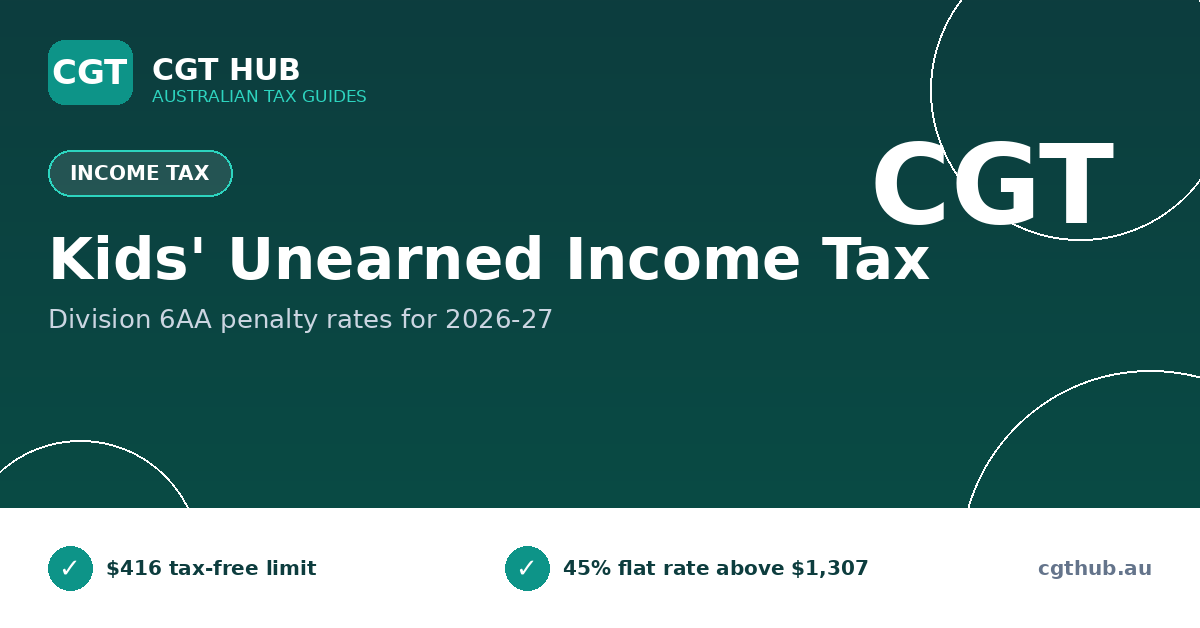
    The short version: If your child is under 18 at 30 June and earns unearned income — bank interest, dividends, rent, or a family trust distribution — Division 6AA punishes it in 2026-27: nothing on the first $416, then 66% on every dollar from $417 to $1,307, then a flat 45% on the whole amount above $1,307. A $2,000 trust distribution to a 15-year-old costs $900 in tax. But income your child actually earns — a part-time job, their own business — is taxed at normal adult rates with the full $18,200 tax-free threshold.

    Why the ATO taxes kids’ investment income so harshly

    Division 6AA exists for one reason: to stop parents splitting income with their children. Without it, a parent on the 45% marginal rate could park shares in each child’s name and have the dividends taxed at next to nothing. The law’s answer is brutal by design — penalty rates so high that income-splitting through minors isn’t worth it.

    The definitions are narrow, and they matter:

    • Minor means under 18 at 30 June of the income year — not when the income was earned. A child who turns 18 in May is taxed as an adult for the whole year.
    • Eligible (unearned) income is investment and passive income: bank interest, dividends, rent, royalties, most family trust distributions.
    • Excepted income is taxed at ordinary adult rates — the escape hatch.
    • Excepted person is a minor who escapes Division 6AA entirely — e.g. a full-time young worker, or a child with a disability.

    One surprise: when a minor is presently entitled to trust income, it’s generally the trustee who is assessed and pays the tax on the child’s behalf (section 98). The bill lands with the trustee, not with a tax return in the child’s name.

    The 2026-27 penalty rates (resident minors)

    These are the Division 6AA rates for 2026-27, verified against the ATO’s trust tax return instructions. They apply to a child’s eligible (unearned) income only:

    Unearned income Tax rate
    $0 – $416 Nil
    $417 – $1,307 Nil + 66 cents for every dollar over $416
    $1,308 and above 45 cents in the dollar on the entire amount

    Two things to notice. First, the low income tax offset (LITO) cannot be used to reduce tax on a minor’s unearned income — the effective tax-free limit really is $416. Second, above $1,307 the 45% applies to the entire amount, not just the slice over the threshold — which is what makes the examples below so stark.

    A note on a number you’ll see floating around: some older articles quote 47% as the penalty rate. That’s a leftover from the 2014–2017 Temporary Budget Repair Levy years, when the top marginal rate was temporarily 47% and Division 6AA tracked it. The 2026-27 rate is 45%. (Separately, 47% is also the rate banks withhold on interest when no TFN is provided — which is where a lot of the confusion comes from.)

    The other rate table: excepted income

    Excepted income is taxed at ordinary adult rates — the full $18,200 tax-free threshold, the normal marginal brackets, and access to offsets like LITO. For 2026-27 that means:

    Taxable (excepted) income Tax rate
    $0 – $18,200 Nil
    $18,201 – $45,000 16c for each $1 over $18,200
    $45,001 – $135,000 $4,288 + 30c for each $1 over $45,000
    $135,001 – $190,000 $31,288 + 37c for each $1 over $135,000
    $190,001 and over $51,638 + 45c for each $1 over $190,000

    So the same child can face two completely different tax treatments in the same year: their Saturday job taxed like an adult’s, their savings-account interest punished at 66% or 45%. Getting the classification right is everything.

    Who counts as an “excepted person”?

    An excepted person skips Division 6AA entirely — all of their income, including unearned income, is taxed at adult rates. A minor qualifies if, broadly, they:

    • work full-time (or worked full-time for at least three months during the year and intend to keep working full-time rather than return to full-time study);
    • receive a disability support pension or rehabilitation allowance, or someone receives a carer allowance to look after them;
    • are permanently blind, or have a disability likely to last permanently or for an extended period;
    • receive a double orphan pension with little or no financial support from relatives; or
    • are unable to work full-time because of a permanent mental or physical disability, with little or no family support.

    For most families, the full-time-worker category is the relevant one: a 17-year-old who left school and works full-time is taxed as an adult on everything. A full-time student with a casual job is not — the job income is excepted, but their investment income still cops penalty rates.

    What counts as excepted income?

    Even if your child isn’t an excepted person, individual types of income can still be excepted and taxed at adult rates. The list is specific:

    • Employment and business income — wages, salary, and income from the child’s own business or an active partnership. This is the big one: your teenager’s part-time job is safe.
    • Taxable pensions and payments from Centrelink or the Department of Veterans’ Affairs.
    • Compensation, superannuation and pension fund benefits — including workers compensation and payouts for personal injury.
    • Income from a deceased person’s estate — including distributions from a testamentary trust, provided the income comes from genuine estate assets (see the 2020 reform warning below).
    • Income from property transferred because of someone’s death or a family breakdown, and damages for personal injury the child suffered.
    • Net capital gains from disposing of any of the property above, and income from investing any of the amounts above.

    The pattern is clear: income the child genuinely earned, or received because of death, disability, injury or family breakdown, gets adult treatment. Income that smells like a parent parking investments in a child’s name gets punished.

    Worked example 1: $2,000 trust distribution to a 15-year-old

    This is the scenario family-trust owners ask about most. The trustee distributes $2,000 of ordinary trust income to a 15-year-old — a standard discretionary distribution, so it’s eligible (unearned) income:

    1. Eligible income: $2,000 — above $1,307, so 45% applies to the entire amount.
    2. Tax = 0.45 × $2,000 = $900.

    The trustee is assessed and pays the $900 on the child’s behalf. The child keeps $1,100 of the $2,000.

    Compare: the same $2,000 to a parent on the 30% marginal rate costs $600 in tax. Distributing to the minor cost an extra $300. (Our earlier family trust guide used an indicative “~$914” for this scenario — the verified 2026-27 figure is exactly $900.) Income-splitting with minors doesn’t just fail to save tax; it destroys it.

    Worked example 2: $8,000 bank interest to a 12-year-old

    Grandparents put a large sum in a savings account in 12-year-old Mia’s name, and it earns $8,000 interest in 2026-27. Bank interest is unearned income, and Mia isn’t an excepted person: tax = 0.45 × $8,000 = $3,600. Mia keeps $4,400 of her $8,000 — nearly half the return vanishes. In a parent’s account on the 30% rate, the tax would have been $2,400. (See our bank interest tax guide for the adult side.)

    A smaller version of the same trap: $1,000 of bank interest. The first $416 is tax-free, the remaining $584 taxed at 66%: 0.66 × $584 = $385.44.

    Worked example 3: the part-time job that’s perfectly safe

    Sixteen-year-old Jack earns $5,000 from his weekend retail job and $600 interest on savings. The wages are excepted income — under the $18,200 threshold, tax is nil. The $600 interest is eligible income: ($600 − $416) × 66% = $121.44. Total tax: about $121.

    This is the answer to the most common parent worry: no, your teenager’s part-time job does not get taxed at 66%. Employment income is excepted. Only the investment income is punished.

    Worked example 4: the $416 sweet spot

    Here’s the one piece of genuinely good news. Because the first $416 of unearned income is tax-free, many trustees distribute exactly $416 per minor child each year. Watch what it does to a $10,000 trust distribution when the alternative is a parent on the 30% marginal rate:

    • All $10,000 to the parent: 0.30 × $10,000 = $3,000 tax.
    • $416 to the child + $9,584 to the parent: $0 on the child’s share + 0.30 × $9,584 = $2,875.20 tax.

    Total saving: about $125, completely legally. It’s not life-changing, but across several children and several years it adds up — and it’s the one minor-distribution strategy the law permits. Make sure the distribution is real: properly documented, and the child genuinely receives it.

    The “cliff” at $1,307 is basically a myth

    Parents sometimes stress about the jump between the 66% band and the 45%-of-everything band. At $1,307, tax is 0.66 × ($1,307 − $416) = $588.06. At $1,308, it’s 0.45 × $1,308 = $588.60. The “cliff” is 54 cents — the bands were designed to join smoothly.

    Testamentary trusts: the exception with a 2020 sting in the tail

    Distributions from a testamentary trust (created under someone’s will) are the big exception: income a minor receives is excepted trust income, taxed at adult rates with the full $18,200 threshold. A $20,000 distribution to a 14-year-old grandchild from a genuine estate trust means ($20,000 − $18,200) × 16% = $288, and the low income tax offset (up to $700) wipes that out — $0 tax. The same $20,000 from a family trust would cost $9,000.

    But a 2020 law change closed the loophole people were driving trucks through. Since 1 July 2019, only income from genuine estate assets (or assets representing them) counts as excepted trust income. If the trustee injects new, unrelated assets to manufacture more “excepted” income for the kids, Division 6AA catches it at penalty rates. Testamentary trusts still work beautifully — you just can’t top them up with non-estate wealth and expect the concession.

    Common mistakes parents make

    1. Assuming the $18,200 tax-free threshold applies to everything. It only applies to excepted income (and excepted persons). For unearned income, the real threshold is $416.

    2. Distributing big trust amounts to minors to “split” income. As Example 1 showed, $2,000 to a 15-year-old costs $900 versus $600 to a 30%-rate adult. Above $416, splitting with kids almost always loses.

    3. Quoting the 47% rate. It’s 45% in 2026-27. The 47% figure is either a decade-old leftover or confusion with the 47% TFN withholding rate.

    4. Forgetting who pays. For trust distributions, the trustee is assessed under section 98 and pays the Div 6AA tax. Don’t wait for a bill addressed to your child.

    5. Topping up testamentary trusts with non-estate assets. Post-2020, injected assets don’t generate excepted income. Get advice before adding property to a testamentary trust.

    6. Not giving the bank the child’s TFN or date of birth. For under-16s: interest under $120 a year — no withholding; $120 to $420 — no withholding if the bank has the child’s TFN or date of birth; $420 or more with no TFN — the bank withholds 47%. For 16 and 17-year-olds the $120 threshold applies. Joint accounts with a parent lose the concessional under-16 thresholds entirely.

    7. Expecting the low income tax offset to help. LITO can’t reduce tax on a minor’s unearned income — the $416 limit is hard.

    Practical tips

    • Use the $416 rule deliberately. If your family trust has minor beneficiaries, a $416 annual distribution each is the tax-free sweet spot — document it properly.
    • Model before you distribute. Run the trustee’s distribution scenarios through our income tax calculator before 30 June — a five-minute check can save hundreds per child.
    • Encourage actual work. A teenager’s wages are excepted income with the full adult threshold. Shifting a child’s savings into… well, a job, is the best tax shelter going.
    • Think about super for working teens. A child with genuine employment income may be eligible for the government’s super co-contribution — up to $500 a year. See our super co-contribution guide.
    • Keep the paperwork. If the ATO queries whether income was excepted, contemporaneous records (payslips, estate documents, trust resolutions) decide it.
    • Lodge when required. If a child’s unearned income exceeds $416, or tax was withheld because no TFN was given, lodge a return for the child — you can claim back over-withheld amounts and franking credits.

    Frequently asked questions

    Is the penalty rate 45% or 47%?

    45% in 2026-27. The 47% figure dates from the 2014–2017 Temporary Budget Repair Levy era, when the top marginal rate (and therefore the Division 6AA rate) was temporarily 47%. The other 47% you’ll meet is the TFN withholding rate banks apply when no TFN is quoted — a different rule.

    Does my teenager’s part-time job get taxed at 66%?

    No. Employment income is excepted income, taxed at normal adult rates with the full $18,200 tax-free threshold. A teen earning $8,000 from a casual job pays no tax on it. Only unearned income — interest, dividends, trust distributions — faces penalty rates.

    Do I need to lodge a tax return for my child?

    It depends. On a family trust distribution, the trustee is generally assessed and pays — no child return needed. If the child directly earned over $416 in unearned income, or had tax withheld because no TFN was provided, lodge a return in the child’s name (there’s no minimum age for a TFN) to square it up and claim any refund.

    Can I distribute $416 to each of my kids every year?

    Yes — the standard, legitimate strategy. The first $416 of a minor’s unearned income is tax-free each year. Make it genuine: a proper trustee resolution before 30 June, and the money must actually go to (or be genuinely held for) the child.

    My child turns 18 during the year — do the penalty rates still apply?

    No. A “minor” for Division 6AA is someone under 18 at 30 June. Turn 18 in March and you’re taxed at adult rates for the whole year.

    Does a testamentary trust really let my grandkids use the $18,200 threshold?

    Yes — for income from genuine estate assets. Each minor beneficiary is taxed at adult rates on excepted trust income, so the $18,200 threshold applies per child. But since the 2020 reform, assets injected into the trust that are unrelated to the deceased estate don’t get this treatment.

    Bringing it together

    Division 6AA is one of the few places in Australian tax law where the punishment so obviously fits the crime: $416 tax-free, then 66%, then 45% on the lot. The practical rules are simple. Don’t park investments in your children’s names and expect adult tax treatment. Don’t distribute meaningful trust amounts to minors and call it splitting. Do use the $416 annual distribution, do get your working teenager’s wages classified correctly, and do understand the testamentary trust exception — with its post-2020 limits — if estate planning is on the table. And model the distribution before 30 June, because once the trustee’s resolution is signed, the $900 on that $2,000 is locked in.

  • GST on Property Sales Australia 2026-27: Margin Scheme & Rules

    GST on Property Sales Australia 2026-27: Margin Scheme & Rules

    Quick answer: do you pay GST when selling property?

    If you’re selling your own established home or an investment property you’ve held for years, the answer is almost always no — those sales are “input taxed,” which means no GST is charged and no GST credits can be claimed. But if you’re a developer, builder, substantial renovator, or subdivider selling in the course of a property enterprise, GST very likely applies — and getting the margin scheme right can be worth tens of thousands of dollars.

    The rules catch more people than you’d think. A single mum-and-dad flip, a knockdown-rebuild, or a backyard subdivision can drag you into the GST net even if you don’t think of yourself as a developer. Here’s how it actually works, with real 2026-27 numbers.

    The three ways GST treats a property sale

    Every property sale falls into one of three GST buckets. Knowing which bucket you’re in decides everything else.

    Sale type GST treatment What it means
    Established home or investment property Input taxed No GST on the sale; no GST credits on sale costs
    Residential rent (long-term) Input taxed No GST on rent; no credits on rental expenses
    New residential premises, sold by the creator Taxable — 10% GST GST included in the sale price, reported on your BAS
    Commercial property (sale or lease) Taxable — 10% GST GST on the price; buyer may claim a credit
    Tenanted business sold as a going concern GST-free No GST at all, if the strict conditions are met
    Vacant land sold in a property enterprise Taxable — 10% GST Never “residential premises,” so never input taxed
    Farmland (conditions met) GST-free Farmed 5+ years and buyer keeps farming

    The most important row for ordinary owners is the first one: sell your established house, pay no GST. But watch the fine print — who is selling matters just as much as what is being sold.

    First question: are you “carrying on an enterprise”?

    GST only applies to sales made in the course of an enterprise by a GST-registered entity. A private homeowner selling the family home is not carrying on an enterprise, whatever the price.

    The trap is that even a single transaction can be an enterprise if it’s a profit-making undertaking. Buy an old house intending to knock it down, build two townhouses and sell them? That’s an enterprise from day one — your intention at acquisition is what counts. And if your projected turnover hits the $75,000 GST registration threshold, registration isn’t optional.

    This is where one-off flippers get stung. A common real-world case: someone buys a property, subdivides, builds, sells one dwelling — a genuine one-off, never done before — and assumes GST doesn’t apply. Under the ATO’s enterprise test it usually does, and the GST lands on the full sale price. If you bought with a profit-making plan, talk to an accountant before you sell, not after settlement.

    New residential premises and the 5-year rule

    A sale of “new residential premises” is taxable. Under the GST law, premises are new if they:

    • have never been sold as residential premises before (first sale after construction);
    • were created through substantial renovations; or
    • were built to replace a demolished building on the same land.

    Crucially, the sale must be by the entity that created them. Buy a brand-new apartment from a developer and resell it a year later — you’re selling existing residential premises (input taxed, no GST), because you didn’t create it.

    The “new” label also expires. New premises stop being new once they’ve been continuously rented out for at least 5 years since creation. Sell after that and it’s input taxed, like any established home. Some developers deliberately build, rent for 5+ years, then sell GST-free — but there’s a cost: while the property is rented as residential accommodation (an input-taxed supply), you can’t claim input tax credits on the construction costs. It’s a genuine trade-off, not a free loophole.

    What counts as a “substantial renovation”?

    Gut a house and rebuild its interior, and the result counts as new residential premises — a later sale is taxable. But the bar is high. The ATO’s ruling (GSTR 2003/3) says a renovation is substantial only when all, or substantially all, of the building is removed or replaced — essentially a new building inside the existing shell.

    Expensive cosmetic work doesn’t qualify. A $120,000 kitchen-and-bathroom makeover on a $900,000 house is not a substantial renovation if the rest of the building is untouched. Paint, carpet, new appliances — none of it restarts the clock. This distinction matters: get it wrong and you either pay GST you didn’t owe, or fail to charge it when you should have.

    A renovator’s numbers: buy at $600,000, spend $350,000 on a genuine full gut-and-rebuild, sell for $1.1 million. Standard GST would be 1/11 of $1.1m = $100,000. Under the margin scheme it can be as low as 1/11 of ($1.1m − $950k) = $13,636 — a saving of over $86,000. That gap is why the renovation question deserves proper advice.

    The margin scheme: GST on the profit, not the price

    The margin scheme is the single most valuable concession in property GST. Instead of paying 1/11 of the full sale price, you pay 1/11 of the margin — broadly, the sale price minus what you originally paid for the property.

    How it works in dollars

    Take a straightforward development: land bought for $400,000, build cost $500,000, sold for $1.3 million.

    • Standard method: 1/11 × $1,300,000 = $118,182 GST
    • Margin scheme: 1/11 × ($1,300,000 − $400,000) = $81,818 GST

    That’s a $36,364 saving on one project. For mum-and-dad scale the effect can be even starker: buy an old Queenslander for $1 million, knock it down, sell the vacant land with a development approval for $1.1 million. Standard GST: $100,000. Margin scheme: 1/11 × $100,000 = $9,091. One clause in the contract — a $90,909 difference.

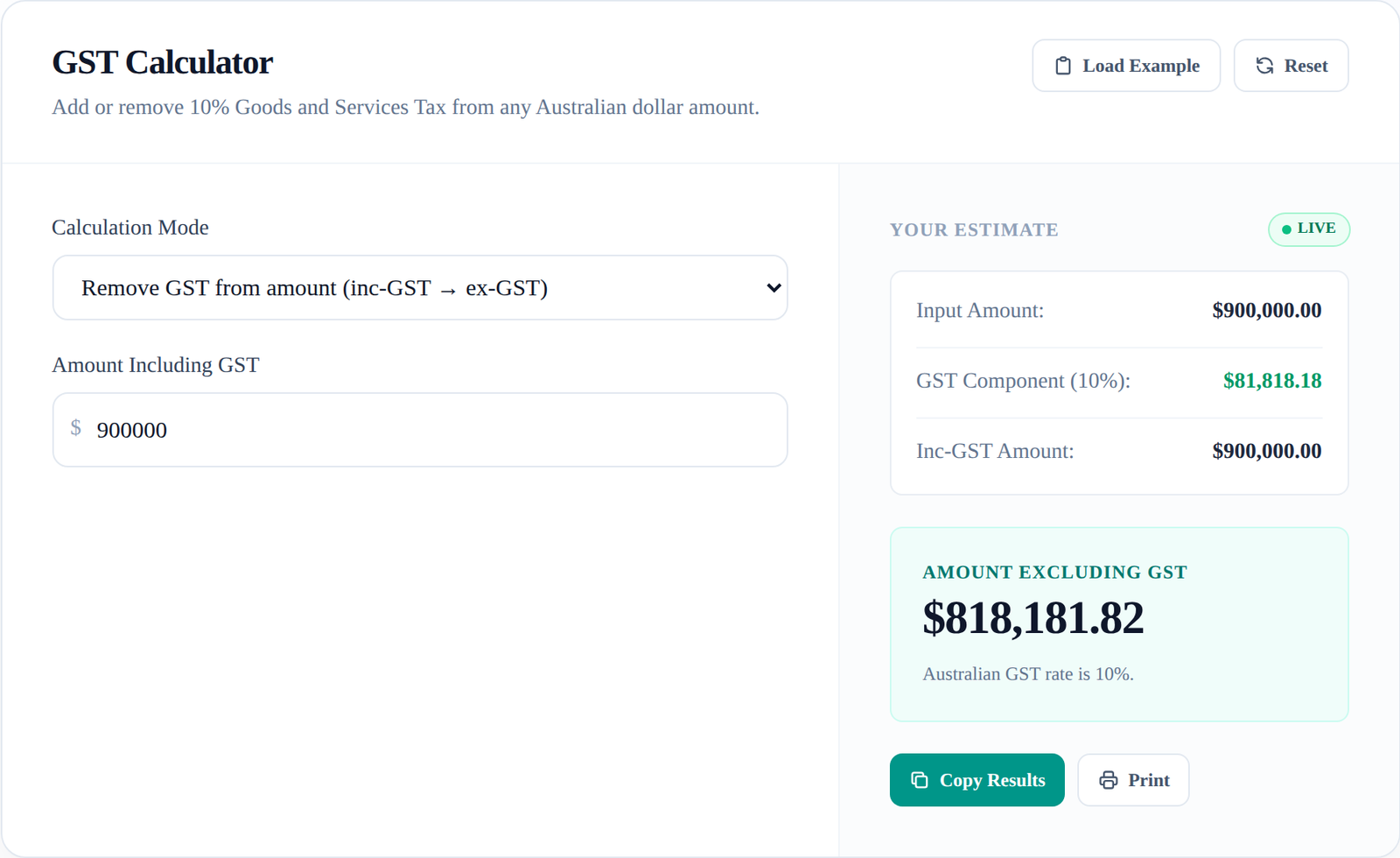
    GST calculator removing 10% GST from $900,000 showing $81,818 GST component
    The cgthub.au GST calculator: removing GST from a $900,000 GST-inclusive sale price shows the $81,818.18 GST component (1/11th).

    The eligibility chain (this is where people get burned)

    You can’t just choose the margin scheme at sale time. The ATO’s rules (section 75-5) block it when:

    • you bought the property as a fully taxable supply and the margin scheme wasn’t used on that purchase;
    • you claimed input tax credits when you bought it;
    • you weren’t GST-registered (or required to be) at the time of sale; or
    • you inherited it from someone who wasn’t eligible to use the scheme.

    Read that first point twice. If you buy land where the seller charged full GST and you later sell, you are locked out of the margin scheme on your sale. Developers buying vacant residential land should insist the margin scheme applies to their purchase, or they can’t use it on the developed sale. Check this before contracts are signed — after settlement it’s too late.

    There’s a second non-negotiable: both buyer and seller must agree in writing to use the margin scheme before settlement. Most standard contracts have a tick box for it. Without that written agreement, no margin scheme — even if every other condition is met.

    One more trade-off: when you sell under the margin scheme, the buyer cannot claim an input tax credit for the GST in the price, and you must not show a GST amount on the tax invoice. For a homebuyer that doesn’t matter; for a GST-registered commercial buyer it can — which is why the margin scheme isn’t automatically the right choice on commercial deals.

    The two ways to calculate the margin

    For property acquired after 1 July 2000, the consideration method applies: margin = sale price minus the actual price you paid (including settlement adjustments). For property acquired before 1 July 2000, the valuation method applies: margin = sale price minus a professional valuation as at 1 July 2000, done by a qualified valuer.

    GST at settlement: the buyer pays the ATO directly

    Since 1 July 2018, buyers of new residential premises or potential residential land withhold the GST from the purchase price and pay it straight to the ATO at settlement. This surprises people — here’s exactly how it works.

    How much is withheld?

    • 1/11 of the contract price — standard taxable sale
    • 7% of the contract price — sale under the margin scheme
    • 10% of the GST-exclusive market value — sales between associates for less than market value

    It’s not an extra cost on top

    The withheld amount comes out of the money that would otherwise go to the seller. On a $1.1 million purchase with standard GST treatment: the buyer withholds $100,000 for the ATO and the seller receives $890,000 at settlement (plus the deposit already paid). The buyer doesn’t pay $1.1m plus $100,000. Your conveyancer handles the split — the contract includes a supplier notification stating the withholding amount, and the buyer’s representative lodges it with the ATO.

    The vendor’s BAS — and the cash-flow gap

    Being withheld doesn’t end the vendor’s obligations. The supplier still reports the sale on their BAS and gets a credit for the withheld amount. And here’s the wrinkle developers feel: the withheld amount is often more than the actual GST owed.

    The ATO’s own example: John buys land for $500,000, builds for $365,000 (claiming $33,181 in GST credits along the way), and sells the finished house for $900,000 under the margin scheme. Margin = $400,000, so actual GST = $36,363. But the buyer withholds 7% of $900,000 = $63,000. John reports $36,363 on his BAS, the $63,000 credit is offset, and he gets a $26,637 refund — but only when the BAS is processed. That timing gap needs to be in the project’s cash-flow plan.

    Commercial property: GST, plus the going-concern escape hatch

    Selling commercial property — offices, retail, industrial — is a taxable supply: 10% GST on the price. The contract must state clearly whether the price is GST-inclusive or GST-exclusive-plus-GST, because that single clause decides who funds the $100k+ swing. The buyer, if GST-registered, claims the GST as an input tax credit, so for business-to-business deals the GST is often close to cash-flow neutral.

    The big exemption is the going concern: sell a tenanted commercial property as a functioning business and the sale is GST-free. All of these must hold:

    • both parties are GST-registered (or required to be);
    • the contract states in writing that it’s a going concern; and
    • everything necessary for the continued operation of the enterprise is supplied.

    And a genuine trap from the ATO’s rulings: the owner of an enterprise that consists solely of leasing property cannot sell it as a going concern to the lessee. When the lease merges with the freehold on sale, the lease covenants — one of the “things necessary” for the enterprise — disappear. A landlord selling the building to their own tenant expecting GST-free treatment can get a nasty surprise.

    Subdivisions and vacant land

    Vacant land is never “residential premises,” so it’s never input taxed — if you sell it in the course of an enterprise, it’s taxable. And subdividing to sell is one of the classic one-off “enterprises” that catches private owners: buy, subdivide, sell the lots for a profit, and you’re in the GST system whether you planned to be or not. (For the income-tax side of subdividing, see our CGT on subdivided land guide.)

    Under the margin scheme, subdivided lots use a reasonable apportionment of the original purchase price. A typical example: a developer buys an 1,800m² block for $216,000, subdivides into two 450m² lots and one 900m² lot. Apportioned by area, the 900m² lot cost $108,000. Sell it for $156,000 and the margin-scheme GST is 1/11 × $48,000 = $4,363.64 — versus $15,600 under the standard method.

    Claiming GST credits on development costs

    If you’re registered and making taxable supplies, you claim GST credits on construction and development costs through your BAS as you go — materials, contractors, consultants. That’s a major cash-flow help during a build.

    But the credits follow the use of the property. Decide mid-project to hold and rent instead of selling, and the supply becomes input taxed (residential rent) — credits claimed may need to be repaid through an increasing adjustment. Mixed projects (sell some lots, hold others) get partial credits in proportion. This is the dual-purpose trap: the rent-then-sell “5-year plan” only works if the change to purely rental use is complete, and you forgo the construction credits for the rental period.

    Common mistakes that cost real money

    1. Assuming one flip means no GST. Intention at acquisition can make a single transaction an enterprise. The $75,000 registration threshold is about turnover, not about being “a developer.”
    2. Buying without securing the margin scheme. If your purchase was fully taxable with no margin scheme, you can’t use it on your sale. Check the chain before exchange, not after.
    3. Forgetting the written margin-scheme agreement. No tick in the contract, no margin scheme — the ATO won’t backdate your intention.
    4. Treating the withholding as an extra cost. Buyers: it’s deducted from the seller’s proceeds, not added to your price. Sellers: budget for the BAS timing gap on any over-withholding.
    5. Claiming the margin scheme makes the buyer happy. A GST-registered commercial buyer loses their input tax credit under the margin scheme — on some deals the standard method is the better commercial outcome.
    6. The going-concern shortcut with your own tenant. Selling a leased property to the lessee isn’t a going concern under the ATO’s view — the lease covenants merge and the exemption fails.

    Tips: keeping the GST bill (and the paperwork) under control

    • Model both methods before you sign anything. Run the standard 1/11 vs margin-scheme numbers on every project — the saving is often five figures, and eligibility depends on how you bought.
    • Get the contract wording right. Margin-scheme election, GST-inclusive vs plus-GST pricing, and the supplier notification for withholding — all three live in the contract. A conveyancer experienced in development sales earns their fee here.
    • Plan for the settlement withholding in your cash flow. On a $900,000 margin-scheme sale, $63,000 leaves at settlement and only returns via the BAS. Finance the gap.
    • Keep every tax invoice. GST credits on a build are claimed invoice by invoice. The ATO’s data-matching on property development is active — “close enough” isn’t a record-keeping system.
    • Revisit purpose changes immediately. The moment a sell-project becomes a hold-project, your GST credit position changes. Don’t discover it at BAS time.
    • Remember the buyer-side stamp duty effect. Because the margin scheme reduces the GST embedded in the price, it can also reduce the dutiable value for the buyer’s stamp duty — a genuine selling point in negotiations.

    Frequently asked questions

    Do I pay GST when selling my house in Australia?

    No — selling an established home is input taxed, so there’s no GST on the sale. GST only enters the picture for new residential premises sold by the creator, substantial renovations, commercial property, or land sold in a property enterprise.

    Is GST added on top of the property price?

    No. For taxable property sales the price is GST-inclusive — the 10% is inside the contract price, not on top of it. And under the GST-at-settlement rules, the buyer withholds the GST component from the balance paid to the seller and remits it to the ATO directly.

    What is the GST margin scheme in simple terms?

    Instead of paying GST on the full sale price (1/11), you pay GST on just your margin — the sale price minus what you paid for the property (1/11 of the difference). Both parties must agree in writing before settlement, and you must have been eligible based on how you acquired the property.

    How much GST is withheld at settlement?

    Since 1 July 2018: 1/11 of the contract price for a standard taxable sale, 7% of the contract price where the margin scheme applies, or 10% of the GST-exclusive market value for associate/undervalue sales. The seller reports the sale on their BAS and receives a credit for the withheld amount.

    Can I use the margin scheme if I bought the property from a developer who charged full GST?

    No. If your purchase was a fully taxable supply and the margin scheme wasn’t applied to it, you cannot use the margin scheme when you sell. This is the most common eligibility trap — always check the acquisition history before relying on the margin scheme.

    Does the 5-year rule let developers avoid GST by renting first?

    Only with real costs. New premises stop being “new” after 5 years of continuous residential rental, making a later sale input taxed — but you can’t claim GST credits on construction costs during the rental period, and the change to purely rental use must be genuine and complete. It’s a strategy, not a loophole.

    The bottom line

    GST on property sales is a game of categories: input taxed for established homes, taxable for new and commercial property, GST-free for genuine going concerns. The money is in the details most guides gloss over — the enterprise test that catches one-off flippers, the purchase-chain rule that decides margin-scheme eligibility, the settlement-day withholding mechanics, and the BAS timing gap on the refund. Model the numbers both ways, get the contract clauses right, and keep every invoice. On a typical development the difference between the standard method and the margin scheme is the difference between a good project and a great one.

    Sources: ATO — GST at settlement; ATO — Margin scheme eligibility; ATO — Calculating the GST payable. Also see our GST for small business guide, CGT on property guide, 6-year rule explained, CGT cost base guide, and the GST calculator.

  • How to Lodge Your Tax Return in Australia: myTax Guide & Deadlines

    How to Lodge Your Tax Return in Australia: myTax Guide & Deadlines

    The short version: you lodge your 2025-26 tax return online through myTax, inside your myGov account linked to the ATO. Sign in, check every income statement shows as “tax ready”, confirm the pre-filled figures, add anything missing, claim your deductions, review the estimate and lodge. Most take 30 to 60 minutes. The self-lodger deadline is 31 October 2026 — but it falls on a Saturday this year, so you effectively have until 11:59pm Monday 2 November 2026. Miss it and the ATO can fine you up to $1,820.

    The deadline, stated plainly

    Lodging your own 2025-26 return — via myTax, the ATO app, or paper — is due 31 October 2026. Because that’s a Saturday, the ATO’s next-business-day rule pushes the effective deadline to Monday 2 November 2026, 11:59pm local time (confirmed in an ATO reminder on 19 October 2026). Note both dates:

    • Lodgement: Monday 2 November 2026 (self-lodgers).
    • Payment: owe tax and it’s due 21 November 2026 — also a Saturday, so effectively Monday 23 November 2026. Lodging on time doesn’t buy extra time to pay.

    Late lodgement can attract one penalty unit per 28-day period (or part), capped at five. The penalty unit rose to $364 on 1 July 2026, so a month late costs $364 and a seriously late return up to $1,820. Owe tax as well and the general interest charge runs from the day after the due date — around 11.51% per year, compounding daily — and since 1 July 2025 it’s no longer tax-deductible.

    Do you actually need to lodge?

    Not everyone. Roughly: an Australian resident whose only income was wages under $18,200, with no tax withheld, generally doesn’t need to. You do need to lodge if any of these apply:

    • tax was withheld from your pay (lodge to get it back — refunds don’t arrive by themselves);
    • you had a HELP, HECS, TSL or other study debt;
    • you earned interest, dividends, rental income, or sold shares, crypto or property;
    • you freelanced, ran a side business, or earned foreign income;
    • the ATO asked you for a return.

    Don’t need to lodge? Submit a non-lodgment advice through your myGov ATO services — two minutes, and it stops the ATO chasing you.

    Before you touch myTax: five things to have ready

    1. myGov linked to the ATO

    myTax lives inside ATO online services: sign in to myGov, choose ATO from your linked services, then Manage tax returns (the ATO app works too). First-timers should link myGov to the ATO a day or two before lodging. The ATO’s guide to lodging online with myTax covers the setup.

    Warning: lodge only through myGov or a registered tax agent. etax.com.au is a private business that charges a fee — its name is widely regarded as designed to catch people searching for the ATO’s old “e-tax”.

    2. Every income statement marked “tax ready”

    Your employer sends pay data to the ATO through Single Touch Payroll; it appears in myTax as an income statement. Employers must finalise it by 14 July (31 July for 19 or fewer staff), and banks, share registries, health funds and agencies feed in through July and August. Each statement is either “tax ready” — final, safe to use — or not.

    By late October this should be settled. If a statement still isn’t tax ready days out, call the employer — only they can finalise it. The ATO says early lodgers are twice as likely to make a mistake, and it adjusts more than 230,000 returns a year against third-party data.

    3. Correct bank details

    The ATO no longer sends refund cheques. A wrong BSB or a closed account means the refund bounces or stalls — one of the most common refund complaints every year. Update your bank details in ATO online services before you lodge.

    4. Your deduction records

    Receipts for work expenses, a diary or logbook for car and home-office claims, donation receipts, last year’s tax agent invoice. The full rules are below.

    5. A rough estimate of your position

    Run your numbers through our income tax calculator first, so the myTax figure doesn’t surprise you.

    The myTax walkthrough, step by step

    1. Pick the 2026 return. myTax labels returns by the year they end — the one you’re lodging now ended 30 June 2026. Select it and prepare it.
    2. Personalise the return. myTax asks whether you had salary, interest, dividends, rental income, capital gains, a HELP debt, private health cover. Answer honestly — this controls which sections appear. Sold shares or crypto but answer “no” to capital gains and that section never shows up. When in doubt, answer yes: an empty section costs nothing; a missing one costs an amendment.
    3. Check every line of pre-filled income. Go through each income statement, bank interest figure, dividend and government payment. Add what hasn’t pre-filled: interest from smaller institutions, distributions, crypto disposals, rental income, foreign income, cash work. Pre-fill is a starting point — you remain responsible for declaring everything.
    4. Claim your deductions. Work through the section methodically: car, work-from-home, clothing, self-education, donations, income protection, last year’s agent fee. Don’t invent round numbers — the ATO compares claims against occupation averages.
    5. Offsets and private health insurance. Your health fund’s statement pre-fills here. No private hospital cover all year and income over $101,000 (singles)? Expect the Medicare levy surcharge — see our Medicare levy guide.
    6. Review the estimate, confirm bank details, lodge. If the refund or bill differs wildly from your expectation, stop and find out why — it’s almost always a missing income line or a mistyped deduction.

    Worked example: Sarah’s 2025-26 return, end to end

    Sarah is a marketing coordinator in Melbourne. She earned $92,000, has a HELP debt, and held private hospital cover all year.

    Step 1 — Income: $92,000

    Her employer’s income statement shows as tax ready in myTax: $92,000 gross, PAYG withholding already taken out.

    Step 2 — Deductions: $3,900

    Deduction Calculation Amount
    Work from home (fixed rate) 70c × 1,200 hours $840
    Car expenses (cents per km) 88c × 3,000 km $2,640
    Donations to registered charities receipts kept $200
    2024-25 tax agent fee invoice kept $220
    Total deductions $3,900

    Taxable income: $92,000 − $3,900 = $88,100.

    Step 3 — The tax calculation (2025-26 resident rates)

    Component Calculation Amount
    Income tax $4,288 + 30c × ($88,100 − $45,000) $17,218
    Medicare levy (2%) 2% × $88,100 $1,762
    HELP repayment 15c × ($88,100 − $67,000) $3,165
    Low income tax offset fully phased out at $66,667 $0
    Total liability $22,145

    The HELP line uses the new marginal system that started in 2025-26: nothing on the first $67,000, then 15 cents per dollar above it — see the ATO’s repayment rates table. Her low income tax offset is zero because it fully phases out at $66,667 (see our tax offsets guide). Bracket rates are on the ATO’s resident tax rates page — note the bottom rate is 16% for this return, dropping to 15% from 2026-27.

    Step 4 — What her employer already withheld: $23,978

    Withholding Amount
    PAYG income tax + Medicare on $92,000 $20,228
    Extra HELP withholding (15c × $25,000) $3,750
    Total withheld $23,978

    Step 5 — The result: a $1,833 refund

    $23,978 withheld − $22,145 owed = $1,833 back. Her employer withheld on the full $92,000, while deductions cut her taxable income to $88,100 — and her HELP withholding ($3,750) slightly overshot her actual HELP liability ($3,165).

    Deductions and the evidence rules people get wrong

    The ATO’s three golden rules: you must have spent the money yourself (not been reimbursed), it must be directly related to earning your income, and you must have a record to prove it. The details that trip people up:

    • The $300 exception. Total work-related claim of $300 or less? You can claim without full receipts — but you still need to show you spent the money and how you calculated it. It does not cover car expenses, meal allowances or travel allowances. Claim $301 and you need written evidence for all of it.
    • Car: 88c per kilometre. The 2025-26 cents-per-km rate, capped at 5,000 work-related km per car — maximum $4,400. No fuel receipts needed under this method, but you must record how you worked out the kilometres (diary or the myDeductions app). The home-to-work commute is never deductible — the most common car-expense error, and the ATO’s closest-watched category in 2026. Our car expenses guide covers logbook vs cents-per-km.
    • Work from home: 70c per hour. The 2025-26 fixed rate, but you need a record of all your hours for the whole year — estimates alone aren’t accepted — plus evidence of at least one covered running cost. Phone and internet can’t be claimed on top; the rate bundles them. See our work-from-home guide.
    • The boring ones people skip. Donations to registered charities, income protection premiums, last year’s tax agent fee, union fees — routinely left off myTax returns, each worth real money at your marginal rate. The full list is in our deductions checklist.

    Mistakes that cost real money

    1. Lodging with income missing. If an employer, bank or share registry hasn’t reported and you lodge anyway, data-matching catches the gap and the ATO amends your assessment — usually after you’ve spent the refund.
    2. Claiming the commute. Home to your normal workplace is private travel. Trips between workplaces or to a temporary location are different — the daily commute never is.
    3. The suspicious 5,000 km. Claiming the maximum 5,000 km at 88c every year is a stated ATO red flag. Keep an honest diary.
    4. Double-dipping the home office. On the 70c fixed rate, electricity, internet and phone are already bundled — claiming them separately is double-dipping.
    5. Forgetting disposals that never hit your bank. Crypto-to-crypto swaps, sell-and-rebuy share trades, reinvested dividends — all CGT events even with no cash changing hands. The ATO has data-matched crypto exchanges since 2019.
    6. Wrong bank details. No cheques anymore. Check BSB and account number in ATO online services before lodging, not after.
    7. Assuming the agent extension. The cut-off to be on an agent’s client list is 31 October 2026 — it does not roll over to the 2 November weekend extension.

    myTax or a tax agent?

    myTax is free and handles simple PAYG returns well — pre-fill does most of the work, and for someone like Sarah it’s genuinely under an hour. An agent earns their fee with complexity: rentals, share and crypto portfolios, a side business, foreign income, capital gains events.

    Cost: roughly $150 to $400 for a straightforward individual return. The fee is deductible — on next year’s return, at your marginal rate only. A $250 fee at the 30% bracket (plus 2% Medicare) gets back about $80, not $250. Anyone saying the fee “comes straight back” is selling you something.

    The other real reason for an agent is time. Taxpayers on a registered agent’s client list at 31 October 2026 generally get until 15 May 2027 (a Saturday, so effectively Monday 17 May 2027) — and with tax owing paid by then, lodgement by 5 June 2027 avoids the failure-to-lodge penalty. Exceptions: prior-year returns still outstanding at 30 June 2026 mean you’re due 31 October 2026 regardless; a latest assessed bill of $20,000+ brings the due date to 31 March 2027. Either way, you sign the return and you are legally responsible for it.

    After you lodge: what happens next

    Your notice of assessment and refund

    Allow up to two weeks for an electronically lodged return; most land within about 12 business days. Track progress in the ATO app or myGov. Two annual surprises: the myTax estimate is calculated before debts (the ATO must legally apply your refund against outstanding debts first), and refunds go to the bank account on your ATO record.

    If you owe money

    Payment is due 21 November 2026 (effectively Monday 23 November 2026). Can’t pay in full? Contact the ATO before the due date — payment plans are routine. The general interest charge runs from the day after the due date and is no longer deductible.

    If you made a mistake

    Do not lodge a second return. Duplicates create confusion and slow everything down. Wait for your notice of assessment, then lodge an amendment via myGov (ATO online services → Manage tax returns → Amend). Individuals generally have two years from the day after the assessment issues. If the error is the ATO’s, not yours, the path is an objection. (Sole traders get four years from the 2024-25 year.)

    Keep records for five years

    Written evidence must be kept for five years from lodgement — receipts, diaries, logbooks, donation receipts, dividend statements. A phone photo of a receipt is fine; a fading thermal-paper receipt in a shoebox is a gamble. The free myDeductions app is the simplest option.

    Frequently asked questions

    Do I need to lodge if I earned less than $18,200?

    Generally no — Australian resident, wages only, under the tax-free threshold, no tax withheld. But if any tax was withheld, lodge to get it back. And if you don’t need to lodge, file a non-lodgment advice so the ATO doesn’t chase you.

    My income statement still isn’t “tax ready” and the deadline is days away. What do I do?

    Contact your employer immediately — only they can finalise it. Don’t lodge with a known-missing employer; the ATO will data-match it later and amend you. Last resort: lodge on final payslip figures and amend once it lands.

    Can I sign up with a tax agent after 31 October to get the extension?

    No. You must be formally on the agent’s client list by 31 October 2026, and this cut-off does not shift to the 2 November weekend rollover.

    Do I get the tax agent’s fee back as a refund?

    Only a fraction. It’s a deduction on next year’s return, not a credit — a $250 fee saves roughly $75–$115 depending on your marginal rate.

    I already lodged but spotted a mistake — lodge again?

    Never lodge a second return. Wait for your notice of assessment, then amend through myGov. You have two years from the day after the assessment. An amendment adjusts the return rather than replacing it.

    Why is my refund smaller than the myTax estimate?

    The estimate is calculated before debts. The ATO must legally apply your refund against outstanding debts first — old tax debt, Centrelink overpayment, child support. The other common cause is a data mismatch flagged in processing (often from lodging before pre-fill completed), which puts the return “under review”.

    The bottom line

    Three things: link the ATO to your myGov, don’t lodge until every income statement is tax ready, and declare everything while claiming every deduction you’re entitled to — with records. The effective deadline is Monday 2 November 2026, but the queues and your own stress levels reward doing it this week. And if your return has rentals, shares or a side business, consider whether this is the year to hand it to a registered agent before the 31 October cut-off.

  • Deceased Estate Tax Return Australia 2026-27: Executor Guide

    Deceased Estate Tax Return Australia 2026-27: Executor Guide

    When someone dies in Australia, their tax obligations don’t die with them — and as executor, they land on your desk. There are two separate tax returns to think about: a “date of death” return for the person who died (covering 1 July up to the day they died), and a trust tax return for the deceased estate itself (covering everything earned after death). Get the split wrong and you’ll face delays, penalties, or a surprise personal liability. This guide walks through exactly what to lodge, when, and how — with worked 2026-27 examples.

    The two returns, side by side

    This is the single most important thing to understand: the deceased person and the deceased estate are two different taxpayers in the ATO’s eyes. Mix them up and everything downstream goes wrong.

    Date-of-death return Estate trust return
    Who is the taxpayer? The deceased individual The deceased estate (treated as a trust)
    Period covered 1 July → date of death Day after death → 30 June (then each year until finalised)
    Form Paper Tax return for individuals (no myTax) Trust tax return (estate needs its own TFN)
    Typical contents Salary to date of death, dividends/interest received before death, super income received before death Rent, dividends, interest earned after death; capital gains on assets the estate sells
    When is it due? Normal lodgment window: 1 July–31 October after year-end (earlier if the estate is finalised sooner) Each year until the estate is finalised

    One edge case worth knowing: if the person died on 30 June, the date-of-death return covers the entire financial year and there is no part-year estate return for that year — the estate’s first trust return starts the following 1 July.

    Do you actually need to lodge a date-of-death return?

    The ATO says you must lodge one if any of these applied to the deceased in the income year they died:

    • Tax was withheld from their income — including from interest or dividends (not just wages)
    • Their taxable income for the part-year was above the $18,200 tax-free threshold
    • They lodged tax returns in the years before they died, or have outstanding returns from earlier years

    If none of those apply, you don’t lodge a return at all — instead you send the ATO a non-lodgment advice form with the reason printed as “DECEASED” followed by the date of death. And if earlier years’ returns were never lodged, those need lodging too — when you notify the ATO of the death, they can tell you exactly which years are outstanding.

    One point executors routinely miss: the final return still gets the full $18,200 tax-free threshold. It is not pro-rated to the part of the year the person was alive. Someone who died in July 2026 gets the same threshold as someone who died in June 2027 — the ATO taxes the part-year income at ordinary resident individual rates.

    The 2026-27 figures your examples will use

    The date-of-death return is taxed at normal resident individual rates. For 2026-27 these are:

    Taxable income Tax on this income
    $0 – $18,200 Nil
    $18,201 – $45,000 15c for each $1 over $18,200
    $45,001 – $135,000 $4,020 plus 30c for each $1 over $45,000
    $135,001 – $190,000 $31,020 plus 37c for each $1 over $135,000
    $190,001 and over $51,370 plus 45c for each $1 over $190,000

    On top of that: the 2% Medicare levy on taxable income, and the Low Income Tax Offset — up to $700 for taxable incomes of $37,500 or less, phasing out to nil at $66,667. If you’re not sure how these stack up on a real income, run the numbers through the income tax calculator before you start the paper form.

    Worked example: Jan’s final return

    Jan died on 14 October 2026. Her date-of-death return covers 1 July 2026 → 14 October 2026. Here’s what the executor puts on it:

    • Salary earned up to the date of death: $34,000 (PAYG withheld: $3,200)
    • Fully franked dividends received 12 August 2026: $1,400 (franking credits: $600)
    • Bank interest earned to 14 October: $900
    • Taxable income: $36,300

    Tax at 2026-27 resident rates: 15% × ($36,300 − $18,200) = 15% × $18,100 = $2,715. The Low Income Tax Offset applies in full ($36,300 is under $37,500): $2,715 − $700 = $2,015. Add the 2% Medicare levy ($726): total liability $2,741.

    Now the credits: $3,200 PAYG withheld plus $600 in franking credits = $3,800. Against a $2,741 liability, that means a $1,059 refund — and here’s the kicker: you can only claim that franking-credit refund on the date-of-death paper return. Miss it and the money stays with the ATO. An accountant who reviewed one estate found the deceased had been leaving roughly $3,000 a year in unclaimed franking refunds for a decade — a $30,000 windfall for the estate once the final return was done properly.

    How to actually lodge it (and why you can’t use myTax)

    1. Notify the ATO of the death. Anyone can phone unofficially to pause correspondence; for official notification you need the death certificate (or probate/letters of administration). The ATO will then tell you which prior-year returns are outstanding.
    2. Work out who the authorised LPR is. To manage the deceased’s tax affairs with full ATO access, you need to be the authorised legal personal representative — grant of probate (executor) or letters of administration (administrator), issued or resealed in Australia. Without it, the ATO legally can’t release full information or transfer refunds and franking credits to you.
    3. Get the paper form. The date-of-death return is lodged on the paper Tax return for individuals. You cannot use myTax or myGov — those only let a person lodge their own return. Write “DECEASED ESTATE” at the top of page one, and name the taxpayer as “THE LEGAL REPRESENTATIVE OF [NAME] DECEASED” — because you are signing, not the deceased.
    4. The one workaround: if the authorised LPR appoints a registered tax agent, the agent can prepare and lodge the return online. This also applies when you’re claiming a franking-credit refund.
    5. Get a separate TFN for the estate if it will keep earning income after death (rent, dividends, interest). The estate’s income goes on trust tax returns — never mixed into the date-of-death return.
    6. Finalise tax before distributing. The ATO says administration typically takes 6–12 months. Do not hand out the inheritance until every return is lodged and assessed — see the liability trap below.

    The estate’s trust returns: the three-year concession

    For the first three income years of the estate, you must lodge a trust tax return if any of these apply: the estate’s net income exceeds the $18,200 tax-free threshold; a beneficiary is presently entitled to income at year-end; or a beneficiary is not an Australian tax resident. From the fourth year onwards, a return is required if the estate earns any income at all.

    The part the legal guides bury: for those first three years, undistributed estate income is taxed at ordinary individual rates — including the $18,200 tax-free threshold. From year four, undistributed income is hit at the top marginal rate (45%). That makes slow administrations genuinely expensive. On $40,000 of undistributed estate income: at individual rates the tax is 15% × ($40,000 − $18,200) = $3,270; at 45% it’s $18,000. The concession is worth nearly $14,730 — a real incentive to finalise within three years.

    Here’s the quieter worked case. Jan’s estate (from the example above) earns, between 15 October 2026 and 30 June 2027: $12,400 net rent and $2,100 in fully franked dividends ($900 franking credits). Net income: $14,500 — under the $18,200 threshold, no beneficiary presently entitled, all beneficiaries resident. Strictly, no trust return is required. But the executor lodges one anyway to claim the $900 franking-credit refund. If no return is lodged, those credits simply vanish.

    7 mistakes executors make (and what they cost)

    1. Trying to lodge in myTax. It won’t work, and weeks get wasted. Paper form, or a tax agent.

    2. Assuming the spouse can just ring the ATO. Unless they’re the authorised LPR (or an authorised contact), the ATO can’t discuss the account or release funds. Next of kin ≠ legal authority.

    3. Distributing the estate before tax is settled. The authorised LPR is liable for the deceased’s outstanding tax debts up to the value of the estate’s assets — and can be personally liable if they distribute assets while on notice of an ATO claim (see the ATO’s practical guideline PCG 2018/4). Finalise tax first, distribute second. Always.

    4. Letting carried-forward losses die unused. Any tax losses or capital losses the deceased was carrying forward cannot transfer to the estate — if they can’t be used in the date-of-death return, they’re gone forever. A $30,000 capital loss with no gains in the final return is $9,000 of tax shelter (at 30%) evaporating.

    5. Forgetting franking credits. Dividends received before death go on the date-of-death return with their franking credits; dividends to the estate go on the trust return. Both can generate refunds. Unclaimed credits are one of the most common executor oversights.

    6. The CGT event K3 trap. If an asset passes to a foreign-resident beneficiary, a tax-exempt entity, or a complying super fund, the deceased is treated as having disposed of it at market value just before death — and the gain lands in the date-of-death return. One reviewed estate copped a $210,000 assessment this way on shares transferred to an overseas beneficiary.

    7. Missing the small-business and sole-trader loose ends. If the deceased ran a business: a final BAS is needed for the quarter they died (ending the day before death), the ABN should be cancelled, and CGT can apply on the sale of business assets. For the property side of inherited assets, see our CGT on inherited property guide and for super payouts the super death benefits tax guide.

    FAQ: the questions executors actually ask

    Can I do the date-of-death return in myTax?

    No. The ATO requires the paper Tax return for individuals — myTax and myGov can only be used by a person lodging their own return. If you’ve appointed a registered tax agent as the authorised LPR’s agent, they can lodge it online for you.

    Do I need probate if the estate is small?

    Maybe not — some states let small estates be administered without a grant. But without probate or letters of administration you are not the authorised LPR, so the ATO has legal restrictions on what it can disclose and may not be able to transfer refunds or franking credits to you. Banks and share registries often demand the grant too.

    They died on 30 June. Do I still lodge two returns?

    No — if death occurred on 30 June, the date-of-death return covers the whole financial year. The estate’s trust returns start from the following 1 July. (Die on 1 July and it’s the opposite: a full new-year return for one day’s income, plus a full estate year.)

    Do beneficiaries pay tax on their inheritance?

    Australia has no inheritance or estate tax — receiving the inheritance itself isn’t taxed. But income the estate distributes to beneficiaries (rent, dividends) is taxable in the beneficiaries’ hands, and selling an inherited asset later can trigger CGT (see our CGT calculator for the numbers). Assets passing to foreign-resident beneficiaries can trigger CGT event K3 in the date-of-death return itself.

    How long do I have to lodge?

    The normal lodgment window applies: 1 July to 31 October following the end of the financial year (a tax agent gets a longer lodgment program). If the estate is finalised before 30 June, you can lodge the final returns earlier. Any outstanding prior-year returns need lodging too — the ATO will tell you which years when you notify them of the death.

    What happens to their carried-forward tax losses?

    They die with the person. Tax losses and capital losses can’t be carried into the estate or transferred to beneficiaries. Use them in the date-of-death return (offsetting any capital gains crystallised before death) or lose them permanently.

    The bottom line

    Being an executor means running two tax files at once: the deceased’s final paper return (1 July to date of death, full $18,200 threshold, franking credits claimed or lost) and the estate’s trust returns (first year starting the day after death, individual rates for three years, top marginal rate after that). Notify the ATO early, get the LPR paperwork sorted, lodge the paper return, claim every franking credit, use up the losses — and don’t distribute a cent until the tax is finalised. Run the date-of-death figures through the income tax calculator first so the numbers on the form are right the first time; the ATO’s own checklist for what to do when someone dies is the official step-by-step to keep beside it.

  • FRCGW Explained: 15% Withholding on Property Sales 2026-27

    FRCGW Explained: 15% Withholding on Property Sales 2026-27

    The 30-second answer

    If you’re selling Australian property in 2026-27, there’s a good chance the buyer will hold back 15% of the sale price at settlement and send it straight to the ATO. That happens unless you hand the buyer an ATO clearance certificate before settlement day. The rule is called foreign resident capital gains withholding (FRCGW) — and despite the name, it catches Australian residents too. Since 1 January 2025 there is no price threshold, so even a modest apartment sale is in scope.

    The 15% is not a final tax. It’s a credit against your actual capital gains tax bill. If you owed less — or nothing at all — you get the difference back when you lodge your tax return. But “eventually” can mean your money sits with the ATO for a year or more. On a $900,000 sale, that’s $135,000 you can’t use for your next deposit.

    This guide walks through exactly how FRCGW works in 2026-27, who needs a clearance certificate, what foreign residents should do instead, the worked numbers, the refund process — and the strengthened foreign-resident CGT regime that commenced on 1 October 2026.

    How FRCGW actually works

    Here’s the mechanic in plain terms. The ATO wants to make sure foreign residents pay capital gains tax on Australian property. The problem: by the time a tax return is due, the seller may have left the country and the money may be gone. So the ATO collects at the source — through the buyer.

    When you sign a contract to sell Australian real property (and the contract is dated on or after 1 January 2025), the purchaser is legally obliged to withhold 15% of the purchase price and remit it to the ATO at settlement — unless the seller provides one of two documents:

    • A clearance certificate — confirms the seller is an Australian resident for tax purposes. The buyer withholds nothing.
    • A variation notice — issued by the ATO, typically to a foreign-resident seller whose actual tax bill will be less than 15% of the price. The buyer withholds at the varied rate (anywhere from 0% to 14.99%).

    No certificate and no variation? The buyer must withhold the full 15%. If the sale isn’t at arm’s length — say you’re selling to a family member for mates’ rates — the 15% is calculated on the property’s market value, not the contract price.

    The buyer’s side matters here too. Purchasers who fail to withhold when they should can face penalties and interest. That’s why conveyancers and solicitors are so twitchy about this paperwork — it’s the buyer’s neck on the line as much as the seller’s cash.

    The rates: what changed on 1 January 2025

    The rules you’re hearing about now are the tightened version. Here’s the timeline:

    Contract signed Withholding rate Price threshold
    On or after 1 January 2025 15% None — every sale
    1 July 2017 – 31 December 2024 12.5% $750,000 or more
    1 July 2016 – 30 June 2017 10% $2,000,000 or more

    The legislative basis is Act No. 135 of 2024 (Treasury Laws Amendment (2024 Tax and Other Measures No. 1)). The critical point for everyday sellers: the old $750,000 threshold is gone. Before 2025, a $600,000 unit sale never triggered the regime. Now it does, which is why sellers who’ve sold before can get caught out — the rule they remember isn’t the rule anymore.

    Note the trigger date is the contract date, not settlement. A contract signed on 20 December 2024 that settles in March 2025 stays on the old 12.5% / $750,000 settings.

    Who’s caught — it’s wider than “foreigners selling houses”

    Two big misconceptions: that this only affects foreign sellers, and that it only covers houses.

    Residency is about tax status, not your passport. An Australian citizen who has been living in London for three years is likely a foreign resident for tax purposes, and the regime treats them that way. Conversely, the ATO will confirm your residency status when you apply for a clearance certificate — and residency can change, so the status at contract time is what counts.

    The scope is broader than residential houses. The regime captures “taxable Australian real property”, which includes vacant land, commercial buildings, rural properties, mining and prospecting rights, and leases over real property. It also reaches indirect interests: shares in a company, or units in a trust, where the underlying value is principally derived from Australian real property. Option fees are in scope too — if the grantor of an option over real property is foreign, the option fee can be withheld on.

    If you’re unsure whether your transaction falls in, this is exactly the sort of pre-contract question to run past your conveyancer or accountant. The regime was designed for substance over form — structuring a sale through shares instead of direct property doesn’t dodge it. For the CGT calculation itself once you’re in the net, our CGT calculator walks through the gain step by step.

    The clearance certificate: the resident seller’s shield

    Every Australian resident selling Australian real property must have a clearance certificate and give it to the purchaser at or before settlement. Without it, the buyer is legally required to withhold 15% — even if you’re as Australian as they come.

    How it works in practice:

    1. Apply online through the ATO as soon as you decide to sell. The application is free. The ATO confirms your residency status as part of processing.
    2. Allow 28 days. That’s the standard processing time, and applications get held up for boring, avoidable reasons: tax returns not lodged, name or address mismatches with ATO records, or records that simply aren’t current. Get your tax house in order before you apply.
    3. The certificate is valid for 12 months. So apply early — even before you’ve found a buyer. There’s no downside to holding one.
    4. Every vendor needs their own. This is the joint-ownership trap: if you and your spouse own a property together and only one of you provides a certificate, the buyer must withhold 15% on the other owner’s share. Each individual vendor is a separate test.

    The number-one reason sellers end up with 15% withheld is embarrassingly simple: they didn’t know, or they applied too late. The certificate is a small piece of admin that protects a very large sum. On a $1.2 million sale, a forgotten certificate means $180,000 diverted to the ATO at settlement.

    Worked example: the $780,000 expat sale

    Let’s make this concrete. Mia moved to Singapore in 2022 and is a foreign resident for tax purposes. In November 2026 she sells her Brisbane investment property:

    • Sale price: $780,000
    • Withholding at settlement (15%): $117,000 — paid to the ATO by the buyer, not to Mia
    • Mia receives at settlement: $663,000

    Now her actual capital gains tax. She bought the property in 2016 for $520,000, paid $15,000 stamp duty and $12,000 in legal and selling costs. Her cost base is $547,000. Capital gain: $780,000 − $547,000 = $233,000.

    Foreign residents generally can’t use the 50% CGT discount on gains accrued after May 2012, so the full $233,000 is taxable. Non-resident individual rates for 2026-27: 30 cents in the dollar up to $135,000, 37 cents from $135,001 to $190,000, 45 cents above $190,000 (no tax-free threshold). Her tax on the gain:

    • $135,000 × 30% = $40,500
    • $55,000 × 37% = $20,350
    • $43,000 × 45% = $19,350
    • Total: $80,200

    The $117,000 withheld is a credit against that $80,200. Mia lodges her Australian tax return, claims the credit, and gets a $36,800 refund. The system worked — but she was $117,000 short at settlement and waited months to get the excess back.

    Now flip it. Same numbers, but Mia is an Australian resident who simply forgot the clearance certificate. The buyer withholds $117,000 from a resident seller. Her actual CGT bill might be far lower (she’d get the 50% discount, bringing the taxable gain to $116,500). She still gets the excess back — but only after lodging, and only because she did the paperwork the ATO expected before settlement.

    Foreign residents: don’t apply for a clearance certificate — apply for a variation

    Here’s a genuine trap flagged by expat tax specialists: agents and conveyancers hand foreign-resident sellers a generic checklist that says “apply for a clearance certificate.” A foreign resident cannot get a clearance certificate. The certificate is proof of Australian tax residency — applying for one when you’re not resident wastes weeks and solves nothing.

    What foreign-resident sellers can do is apply to the ATO for a variation notice before settlement. If your actual tax on the sale will be less than 15% of the price, the ATO can set a lower withholding rate — anywhere from 0% to 14.99%. Common situations where a variation makes sense:

    • You’ll make a small gain, break even, or a loss on the sale
    • You have capital losses carried forward to offset the gain
    • You’ve made (or will make) super contributions that reduce your overall tax
    • The 15% would cause genuine financial hardship

    Getting the variation amount right means estimating your actual gain and liability — the kind of calculation worth having a specialist check. The application must be approved before settlement, so like the clearance certificate, start early.

    And one more thing foreign-resident sellers discover too late: since 1 July 2020, foreign residents have generally lost the main residence exemption altogether. Sell your former Australian home while you’re a non-resident and the gain can be taxable all the way back to purchase — the old six-year absence rule most expats still quote doesn’t apply (there’s only a narrow “life events” exception for those non-resident six years or less). The 15% withholding is just the visible part; the tax bill underneath can be the real shock. Our guide to non-resident CGT on property goes deeper.

    Getting your money back: the refund steps

    If an amount was withheld — whether you’re a resident who missed the certificate or a foreign resident with a genuine credit — the path back is through your tax return:

    1. Get the payment confirmation from the purchaser. This is your proof the amount was remitted to the ATO. Chase it at settlement; don’t discover it’s missing at tax time.
    2. Lodge an Australian tax return for the year of sale — even if your income is below the lodgment threshold. No return, no refund.
    3. Declare the disposal properly: report the capital gain or loss in the CGT section of the return.
    4. Claim the credit for the foreign resident capital gains withholding amount (the return has a specific label for it). One labelling trap accountants see: don’t report the withheld amount at the Foreign Income Tax Offset question — the withholding credit has its own place.
    5. Wait for the assessment. If the withheld amount exceeds your actual tax, the excess comes back as a refund. If you had no tax debt and no gain, it comes back in full.

    Timing matters. If you sign a contract and the financial year has ended, you can lodge straight away for that year. If the year hasn’t ended, you wait until 1 July. Either way, the money can be tied up for many months — which is exactly why avoiding the withholding in the first place (certificate or variation) beats reclaiming it later.

    The 1 October 2026 twist: the regime just got stronger

    FRCGW sits inside a wider foreign-resident CGT framework — and that framework was overhauled weeks ago. The government’s Strengthening the Foreign Resident Capital Gains Tax regime measure received royal assent and commenced on 1 October 2026 (announced in the 2024–25 Budget, enacted via the Treasury Laws Amendment (Strengthening Accountability for Tax Adviser Misconduct and Other Measures) Act 2026).

    What’s new from 1 October 2026:

    • Broader definition of taxable Australian real property. A new statutory definition of “real property” now includes land, rights and interests relating to land, assets fixed to land, and leases or licences over those assets — plus water rights. More foreign-held assets are now inside the CGT net.
    • The principal asset test is now measured over 365 days before a CGT event, not at a single point in time. This decides whether shares or units in a land-rich entity are taxable — and it’s much harder to structure around now.
    • New notification requirements for foreign vendors disposing of assets worth $50 million or more: vendors making a declaration that their membership interests are not indirect Australian real property interests must notify the ATO at least 28 days before settlement, and purchasers must sanity-check declarations they receive.
    • A transitional 50% CGT discount for eligible foreign residents disposing of certain renewable energy assets (extended to 30 June 2040).

    The changes aren’t retrospective for settled disposals, and there’s no grandfathering for assets already held — foreign residents holding shares in land-rich companies, water entitlements, or assets affected by state severance provisions should check whether they’re now inside the net. The ATO published a dedicated overview of the new foreign resident CGT measure with the notification form and instructions.

    Common mistakes that cost real money

    1. Confusing citizenship with tax residency. The ATO doesn’t care about your passport — it applies its own residency tests (where you live, where your home is, how long you’ve been where). Plenty of “Australian” sellers discover at settlement that they’re foreign residents for tax purposes.
    2. Applying for the certificate after signing the contract. Standard processing is 28 days. Apply the week you decide to sell, not the week before settlement. The certificate lasts 12 months — there’s no penalty for being early.
    3. One certificate for a jointly owned property. Each vendor needs their own. If your spouse’s certificate is missing, 15% comes off their share.
    4. Foreign residents chasing a clearance certificate. Wrong document. You need a variation notice — and you need it before settlement.
    5. Assuming the 15% is the final tax. It’s a credit. Residents who had 15% withheld on a modest gain, and foreign residents with carried-forward losses, are often owed most of it back — but only if they lodge and claim it.
    6. Reporting the credit at the wrong label. The withheld amount goes at the specific withholding-credit label, not at the Foreign Income Tax Offset question. Get it wrong and your refund stalls.
    7. Assuming cheap properties are exempt. The $750,000 threshold died on 1 January 2025. A $420,000 regional unit is fully in scope now.
    8. Forgetting the non-arm’s-length rule. Selling to your kids at a discount? The 15% is calculated on market value, not your bargain price.

    Tips to keep the full sale price

    • Residents: apply for the clearance certificate the moment you decide to sell. Free, online, 12 months’ validity, and it costs you nothing to hold one early.
    • Get your tax records current first. Unlodged returns and name/address mismatches are the top reasons applications stall. Fix them before you apply, not after the buyer starts asking questions.
    • Foreign residents: model the variation numbers with an accountant before settlement. If your real tax is 4% of the price, there’s no reason to let 15% sit with the ATO for a year.
    • Everyone: keep the payment confirmation from the purchaser in your tax file. You’ll need it to claim the credit — and chasing it months later is miserable.
    • Check the residency question honestly before you apply for anything. The ATO confirms residency during certificate processing; a wrong guess costs you the 28 days.
    • Model the whole sale — gain, discount eligibility, withholding, and timing — with our CGT calculator and the capital gains tax on property guide before you sign.

    Frequently asked questions

    I’m an Australian citizen living overseas. Does FRCGW apply to me?

    Possibly — and this is the single most common confusion. The test is tax residency, not citizenship. If you’ve been living overseas permanently, you’re likely a foreign resident for tax purposes even with an Australian passport. That means no clearance certificate for you (you can’t get one), the buyer withholds 15%, and you may need a variation. Check your residency status before the sale, not after.

    My partner and I own the property 50/50. We have one clearance certificate between us — is that enough?

    No. Each vendor needs their own certificate. With only one certificate, the buyer must withhold 15% on the other owner’s half of the price. If you’re selling a $800,000 property jointly and only one certificate exists, $60,000 gets withheld on the uncovered half. Apply for both at the same time.

    How long does a clearance certificate take, and when should I apply?

    The ATO’s standard processing time is 28 days, and delays are common when tax records aren’t current. Since the certificate is valid for 12 months, the right time to apply is as soon as you decide to sell — ideally before the property is even listed. It’s free, so there’s no reason to wait.

    Can the 15% be reduced if my actual tax will be lower?

    Yes, for foreign-resident sellers: apply for a variation notice before settlement. The ATO can set any rate from 0% to 14.99% based on your estimated actual liability. This is the right tool if you’ll make a small gain or a loss, have capital losses to carry forward, or the full withholding would cause hardship. Australian residents don’t need a variation — the clearance certificate avoids withholding entirely.

    Does the 15% come back automatically?

    No — nothing is automatic. You must lodge an Australian tax return for the year of sale, declare the capital gain or loss, and claim the withholding as a credit at the correct label. If the withheld amount exceeds your actual tax, the excess is refunded. Keep the purchaser’s payment confirmation; without it, claiming the credit is painful.

    Does FRCGW apply to commercial property or shares, not just houses?

    Yes. The regime covers vacant land, commercial buildings, farms, mining rights, and leases — plus indirect interests like shares or trust units where the value is principally derived from Australian real property. Since 1 October 2026 the definition of taxable Australian real property is broader still. If you’re selling anything connected to Australian land, assume the regime applies until you’ve confirmed otherwise.

    The bottom line

    Foreign resident capital gains withholding is a cash-flow event, not a tax event — but the cash-flow hit is real. Since 1 January 2025, 15% of every Australian property sale goes to the ATO at settlement unless the seller does the paperwork first. For residents, that paperwork is a clearance certificate: free, online, valid 12 months, one per vendor. For foreign residents, it’s a variation notice based on the real numbers.

    The biggest losses don’t come from the 15% itself — they come from surprises: discovering you’re a foreign resident for tax purposes at the settlement table, finding out one joint owner’s certificate doesn’t cover both of you, or learning the hard way that the main residence exemption left with your residency in 2020. Get the certificate, get the variation, or get the refund — but whatever you do, don’t ignore the paperwork and hope for the best. If you’re weighing a sale, start with the CGT calculator and our foreign income tax guide to see the full picture before you sign.

  • Transfer Balance Cap Australia 2026-27: The $2.1 Million Limit, Your Personal Cap, and the Mistakes That Cost Retirees

    Transfer Balance Cap Australia 2026-27: The $2.1 Million Limit, Your Personal Cap, and the Mistakes That Cost Retirees

    Australia’s transfer balance cap is $2.1 million for 2026-27. That’s the lifetime limit on how much super you can shift into the tax-free retirement phase, and it rose $100,000 on 1 July 2026 from the $2.0 million cap of 2025-26. Sounds simple — until you discover the cap that matters most isn’t the $2.1 million headline number at all. It’s your personal transfer balance cap, set the first time you start a retirement-phase pension, which may be lower than $2.1 million and can never be reset. Breach it and you’re looking at excess transfer balance tax of 15% the first time and 30% every time after that, plus a forced commutation of the excess. This guide walks through exactly how the cap works in 2026-27, with worked examples in real dollars, the mistakes that catch people out, and the planning windows the ATO’s rules actually give you.

    How the transfer balance cap works in 2026-27

    The transfer balance cap limits how much of your super can enjoy the zero-tax retirement-phase earnings environment. It was introduced on 1 July 2017 to stop people parking unlimited balances in tax-free pensions. Every time you move money into retirement phase — starting an account-based pension, receiving a reversionary death-benefit pension, or having a defined-benefit credit counted — a credit is recorded against your transfer balance account. Money moved back out (commutations to accumulation, lump-sum withdrawals) creates a debit.

    The account is a running ledger, not a snapshot. What matters is your highest ever credit balance, not your current balance. That’s the trap most people fall into: market growth after the money is in pension phase never creates a credit, but it also never frees cap space. Your personal cap is set, effectively, the first time you enter retirement phase — and it’s the highest-ever balance against that personal cap that determines whether you’ve breached.

    Key things that do not count:

    • Regular pension payments — the monthly or annual income you draw from your pension is not a debit and can’t be “re-credited” later.
    • Investment growth inside the pension — if your $2.1 million pension grows to $3 million, no breach has occurred. Growth is ignored for the cap.
    • Transition to retirement (TTR) pensions — these are not retirement-phase income streams, so starting one creates no credit (until it converts to retirement phase, typically at age 65 or on retirement).

    Transfer balance cap history

    Financial year General transfer balance cap
    2017-18 to 2020-21 $1.6 million
    2021-22 to 2022-23 $1.7 million
    2023-24 to 2024-25 $1.9 million
    2025-26 $2.0 million
    2026-27 $2.1 million

    A quirk worth noting: in July 2023 the cap jumped straight from $1.7 million to $1.9 million — there was never a $1.8 million step, because indexation happens in $100,000 increments tied to CPI movements, and the trigger simply landed at $1.9 million. If you come across an article claiming the cap is “$1.9 million as of 2026” — yes, at least one high-ranking guide is still saying exactly that — it’s stale. The general cap has been $2.0 million since 1 July 2025 and is $2.1 million from 1 July 2026.

    For the small number of Australians with defined-benefit pensions, the related defined benefit income cap for 2026-27 is $131,250 — that’s simply the general cap divided by 16. Defined-benefit pensions don’t move money the same way, so the law deems a credit equal to your annual pension income multiplied by 16. More on that in the examples below.

    Your personal transfer balance cap — step by step

    Here’s the concept that does the real work. Your personal transfer balance cap is set the first time you start a retirement-phase income stream, and it equals the general cap in force at that date. It then gets proportional indexation: when the general cap rises, your personal cap rises only on the portion you hadn’t used.

    1. Work out your used percentage. Divide the amount you transferred into retirement phase by the general cap at that time. If you started a $1.4 million pension when the cap was $2.0 million, you used 70%.
    2. Work out your unused percentage. That’s 100% minus the used percentage — 30% in this example.
    3. Apply indexation to the unused portion only. When the general cap rises by $100,000, your personal cap rises by 30% × $100,000 = $30,000. So your personal cap becomes $2.03 million — not $2.1 million.

    The brutal version: if you used 100% of your cap when you started (transferred $2.0 million under the $2.0 million cap), your personal cap is frozen at $2.0 million forever. You get none of the July 2026 indexation. That’s why some retirees who “maxed out” their pension in 2025-26 are stuck below the new headline number — and why starting slightly under the cap, when you can, preserves indexation.

    You can check your personal cap in ATO online services (myGov → ATO → Super → Transfer balance cap). If your fund has reported correctly, it’s sitting right there. If you need to model what a part-time return to work, a commutation, or a reversionary pension does to your cap, the super calculator can help you sanity-check the moving parts.

    Worked examples in 2026-27 dollars

    Example 1: Margaret’s personal cap across the indexation

    Margaret, 64, started an account-based pension in October 2025 with $1,400,000. The general cap at the time was $2,000,000.

    • Used percentage: $1,400,000 ÷ $2,000,000 = 70%
    • Unused percentage: 30%
    • On 1 July 2026, the general cap rose $100,000 to $2,100,000
    • Margaret’s indexation: 30% × $100,000 = $30,000
    • Margaret’s personal cap from 1 July 2026: $2,030,000

    She still has $630,000 of cap space (her personal cap of $2.03 million minus the $1.4 million she already holds in pension phase). If her unused percentage had been 0%, she’d be stuck at $2.0 million — a $100,000 difference in lifetime tax-free capacity.

    Example 2: the excess, and what it costs

    David started a pension in August 2026 with $2,280,000 — $180,000 over his $2.1 million personal cap. The ATO issues an excess transfer balance determination, and he must commute the excess within 60 days or the ATO will issue a commutation authority forcing his fund to do it.

    Separately, excess transfer balance tax applies to the notional earnings on the excess — the earnings the excess is deemed to have made, compounding daily at (90-day bank bill yield + 7 percentage points) ÷ 365 until the excess is crystallised. Assume the excess sat for 90 days and the notional rate was roughly 10.2% per annum:

    • Notional earnings: $180,000 × 10.2% × (90 ÷ 365) ≈ $4,500
    • First breach: 15% × $4,500 = $675 in excess transfer balance tax
    • Second and subsequent breaches: 30% — the same fact pattern the second time costs $1,350, and it keeps compounding

    Two lessons: the tax itself looks small, but it applies on top of having to commute the excess, and the 30% rate means a repeated breach hurts twice as much. Get the commutation done inside the 60 days.

    Example 3: the couple strategy — $4.2 million, not $2.1 million

    The cap is per person, not per household. A couple where each spouse has a $2.1 million personal cap can hold $4.2 million in tax-free pension phase between them. This is where contribution splitting and spouse contributions years before retirement genuinely pay off: every dollar contributed to the lower-balance spouse’s account (rather than topping up the higher earner’s) is a dollar of future tax-free pension capacity that would otherwise be stranded in accumulation phase, where earnings are taxed at 15%.

    If you’re the higher earner and your super is at $2.0 million while your spouse’s is at $400,000, splitting contributions now builds two usable caps instead of one wasted one. Our income tax calculator can help model the tax cost of the salary-sacrifice contributions you’d use to do it.

    Example 4: the 30 June trap that kills your non-concessional cap

    Your total super balance (TSB) on 30 June 2026 decides your non-concessional contribution (NCC) eligibility for all of 2026-27. If your TSB is $2.1 million or more, your NCC cap is zero — nothing. The bring-forward tiers for 2026-27 are:

    TSB on 30 June 2026 NCC cap for 2026-27
    Less than $1.84 million $390,000 over 3 years (bring-forward)
    $1.84 million to less than $1.97 million $260,000 over 2 years
    $1.97 million to less than $2.1 million $130,000 (annual cap only)
    $2.1 million or more Nil

    Now the trap: your TSB is $2,090,000 in late June 2026. On 28 June you make a $15,000 non-concessional contribution — a perfectly ordinary top-up. On 30 June your TSB is $2,105,000. You have just crossed $2.1 million, and your entire 2026-27 NCC eligibility is gone. That single June contribution cost you up to $130,000 of future contribution capacity. Check your TSB before making late-June contributions if you’re anywhere near the boundary.

    Example 5: pension payments vs commutation — the $60,000 choice

    You’ve breached your cap by $60,000 and need to bring your transfer balance account back down. Two ways to take $60,000 out of the pension:

    • As regular pension payments: no debit is created. Your transfer balance account doesn’t move. The breach stays.
    • As a partial commutation (lump sum): a $60,000 debit is created, reducing your transfer balance account by $60,000. The breach is cleared.

    This is the single most misunderstood mechanic in the whole system: regular pension income does not reduce your cap usage. Only commutations do. When you’re managing an excess, take it as a commutation, not as pension payments. (Note the debit can never take your transfer balance account below zero, and it doesn’t increase your personal cap — it just brings the account balance back within it.)

    Example 6: the reversionary 12-month planning window

    When your spouse dies and a reversionary pension automatically continues to you, the credit to your transfer balance account generally arises 12 months after the date of death — not immediately. That’s a genuine planning window. Suppose you already have $1.9 million in your own pension and your late spouse’s reversionary pension is worth $600,000. In 12 months, your transfer balance account will jump to $2.5 million — $400,000 over a $2.1 million cap.

    The window lets you commute part of your own pension back to accumulation (creating debits) before the reversionary credit lands, or take advice on restructuring. Without the window, the credit would hit instantly and you’d be in breach with a 60-day clock running while grieving. Don’t waste it.

    Example 7: defined-benefit credit — $80,000 × 16

    Tom receives a defined-benefit pension of $80,000 per year. The credit to his transfer balance account is $80,000 × 16 = $1,280,000. That leaves him $820,000 of space under a $2.1 million cap for an account-based pension alongside it. Note the defined benefit income cap of $131,250 for 2026-27 — income above that threshold is taxed less concessionally, so high defined-benefit pensions have their own separate boundary to watch.

    Example 8: Division 296 meets the transfer balance cap

    Priya has a total super balance of $3.2 million, with $2.1 million in retirement-phase pension and $1.1 million in accumulation. Is she in trouble?

    • Transfer balance cap: fine. Only $2.1 million of credits against her $2.1 million personal cap. The $1.1 million in accumulation creates no credits, and growth on the pension doesn’t either.
    • Division 296: bites. From 1 July 2026, the extra 15% tax on earnings applies to the portion of her balance above $3 million — so earnings attributable to roughly $200,000 of her balance attract the additional tax.

    The two regimes measure different things: the transfer balance cap polices what’s in tax-free pension phase; Division 296 polices total balance. You can pass one and fail the other. For the full Division 296 breakdown, see our guide to Division 296 super tax in Australia.

    Common mistakes

    • Assuming the headline cap is your cap. If you started your pension when the general cap was $1.9 million and used all of it, your personal cap is $1.9 million — $200,000 below today’s headline number.
    • Taking pension payments to fix a breach. As Example 5 showed, only commutations create debits. Regular payments leave the breach untouched.
    • Panic-selling when growth pushes a pension past $2.1 million. Growth after the credit is irrelevant. A $2.1 million pension that grows to $3 million has not breached anything.
    • The late-June NCC that trips the TSB test. One contribution on 28 June can zero out a full year of non-concessional eligibility.
    • Ignoring the fund’s reporting. Your transfer balance account is built from what your fund reports to the ATO. Wrong values in, wrong cap position out — check it in ATO online services.
    • Trusting stale guides. Anything quoting “$1.9 million as of 2026” hasn’t been updated since the July 2025 indexation, let alone July 2026.
    • Forgetting the transfer balance cap isn’t the only ceiling. Division 296, the NCC caps, and the defined benefit income cap all run on their own tracks.

    Tips for 2026-27

    • Leave a buffer when you start. Commencing a pension at 95% of the cap instead of 100% preserves indexation on the unused 5% — free lifetime cap space.
    • Equalise spouses early. Contribution splitting and spouse contributions in your 40s and 50s build two full $2.1 million caps instead of one stranded balance.
    • Diary the reversionary date. The 12-month window after a spouse’s death is the most valuable planning period the rules give you — use it to commute and restructure before the credit lands.
    • Commute, don’t just draw, when managing an excess. Only commutations reduce the transfer balance account.
    • Check your TSB in mid-June before any late-June non-concessional contributions near the $2.1 million boundary.
    • Reconcile your fund’s reporting annually. A misreported pension commencement value can manufacture a phantom breach — or hide a real one.
    • Model the whole picture. The transfer balance cap interacts with contribution caps, withdrawal tax, and death benefits — see our guides on super contribution caps for 2026-27, super withdrawal tax, and super death benefits tax.

    Frequently asked questions

    Does investment growth inside my pension breach the cap?

    No. Credits are only created when money moves into retirement phase. Once it’s there, growth is ignored for transfer balance purposes. A pension that started at $2.1 million and grows to $3 million has not breached — and you don’t need to commute the growth out.

    Can I transfer my unused transfer balance cap to my spouse?

    No — the cap is strictly personal and non-transferable. If you die with unused cap space, it dies with you. The practical workaround is lifetime planning: contribution splitting and spouse contributions while you’re both alive build up both spouses’ balances, so each of you can use your own $2.1 million cap.

    What if my fund reported the wrong value to the ATO?

    Your transfer balance account is only as accurate as your fund’s reporting. If the commencement value is wrong, your cap position is wrong — you could be flagged for a breach that never happened, or miss a real one. Contact your fund to correct the reporting, then check that the correction flows through in ATO online services (myGov). Keep the fund’s written confirmation; if a determination is issued on bad data, you’ll need it to have it revoked.

    What happens if I ignore an excess transfer balance determination?

    You have 60 days to commute the excess after the determination issues. If you don’t, the ATO issues a commutation authority directly to your fund, forcing the release — you lose control of which pension is commuted and when. The excess transfer balance tax on the notional earnings applies regardless. Ignoring it is the worst option on every axis.

    Does starting a transition to retirement pension use my cap?

    No. A TTR pension is not a retirement-phase income stream, so starting one creates no credit against your transfer balance account. The credit only arises if and when it converts to retirement phase (for example, when you turn 65 or notify the fund of retirement). This is a genuine timing tool: you can be drawing a TTR pension while your transfer balance cap sits completely untouched.

    Can I start a second pension after commuting the first?

    Yes — commuting creates a debit, and you can commence a new pension later. But your personal cap never resets: the new pension’s credit is measured against the same personal cap, and it’s your highest ever balance that counts for breach purposes. Commuting and restarting doesn’t launder a breach away.

    The bottom line

    The transfer balance cap for 2026-27 is $2.1 million — but the number that governs your retirement is your personal cap, set the day you first entered retirement phase and indexed only on what you left unused. The people who get this right do three things: leave a buffer when they commence, equalise balances between spouses years in advance, and treat commutations — not pension payments — as the lever that moves the account. The people who get it wrong usually discover the rules from a determination letter, with 60 days on the clock. Check your position in ATO online services now, while it’s still a planning exercise rather than a compliance one. The ATO’s own guidance is at ato.gov.au.