Author: admin

  • Is Paid Parental Leave Taxed in Australia? 2026-27 Guide

    Is Paid Parental Leave Taxed in Australia? 2026-27 Guide

    Quick answer: yes — Paid Parental Leave is taxable income in Australia. Every dollar of Parental Leave Pay lands in your taxable income for the year, and the ATO taxes it at your marginal rate like ordinary wages. The part that catches people out isn’t the rule itself — it’s the 15% flat tax Services Australia withholds by default when the payment comes directly from them. That 15% is just a withholding guess, not your tax rate. Depending on what else you earned that year, it can leave you with a surprise refund… or a surprise bill of several thousand dollars. Below: the 2026-27 rates, both payment paths, and the maths in real dollars.

    How Parental Leave Pay works in 2026-27

    Parental Leave Pay (PPL) is the Australian Government payment for parents of a newborn or newly adopted child, administered by Services Australia. For children born or adopted on or after 1 July 2026, the scheme reached its full size:

    2026-27 detail Figure (before tax)
    Daily rate $200.94 (the national minimum wage)
    Weekly equivalent (5-day week) $1,004.70
    Fortnightly $2,009.40
    Maximum entitlement 130 days (26 weeks)
    Full entitlement, total $26,122.20
    Reserved for your partner 20 days — use it or lose it ($4,018.80)
    Superannuation on PPL 12% paid by the ATO after the financial year (~$3,135 on the full entitlement)

    The rate follows the minimum wage each 1 July, so leave straddling 30 June is paid at two daily rates. Days are flexible — blocks or single days, including weekends, any time before your child’s second birthday. An income test also applies (the published individual threshold is $186,487 — indexed, so confirm the current figure on Services Australia), plus a work test of 330 hours in 10 of the 13 months before the birth.

    The two ways the money reaches you — and why it matters for tax

    There are two payment paths, and they withhold tax differently:

    1. Through your employer. If you’ve been with your employer 12+ months and take a block of 8+ weeks, they may have to pass the government payment through payroll. Services Australia reimburses them — but for you it arrives like ordinary wages, with PAYG withheld at your normal payroll rate.
    2. Directly from Services Australia. If the employer path doesn’t apply, Services Australia pays you directly — and withholds a flat 15% from every payment unless you ask for a different rate.

    Either way, the payment is taxable. The only difference is the withholding mechanics — and as the worked examples below show, that difference is where the surprises live.
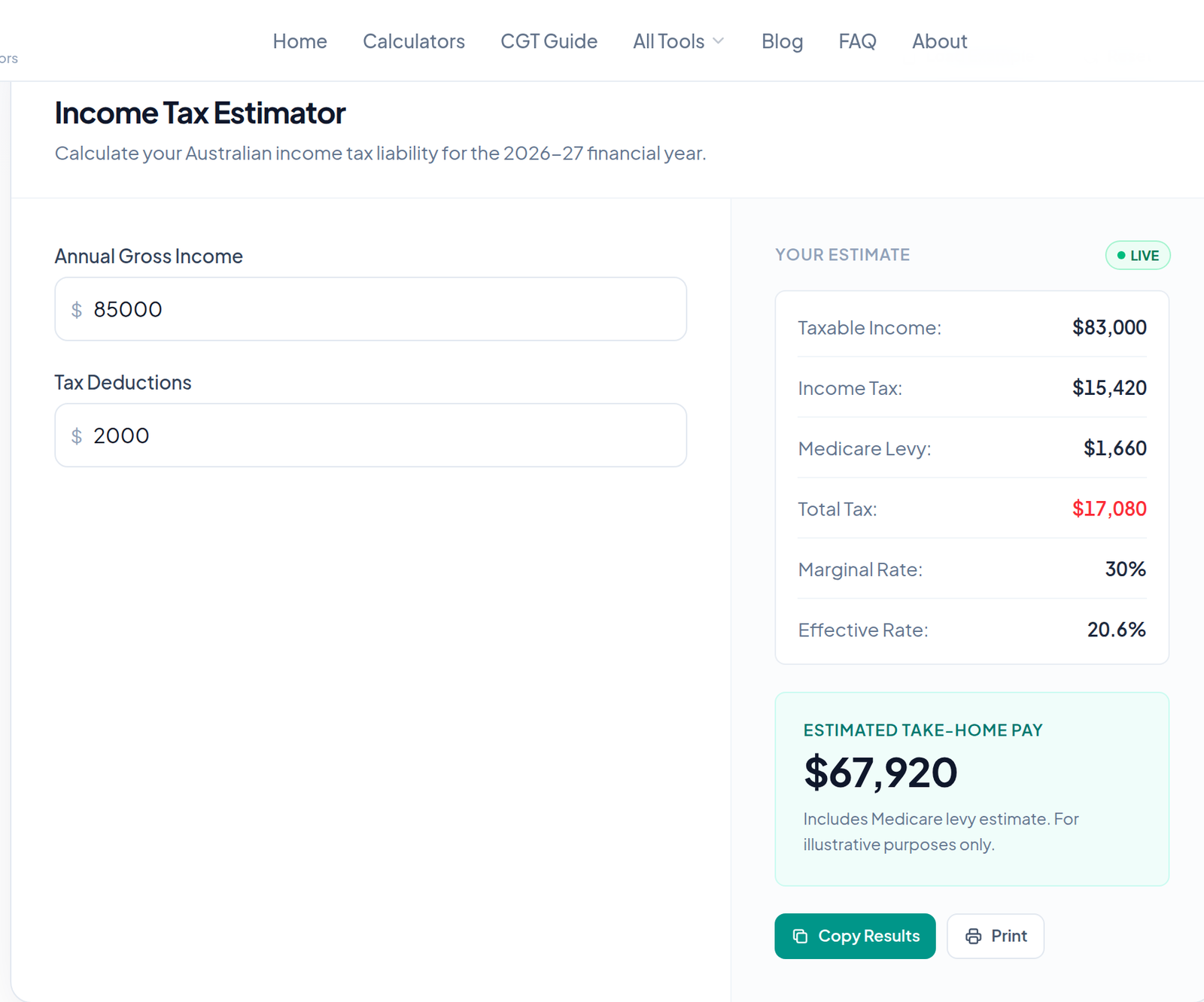
    Income tax calculator showing $15,420 income tax on $83,000 taxable income for 2026-27
    Our income tax calculator with $85,000 income and $2,000 deductions (2026-27 rates): $17,080 total tax.

    How the tax on PPL is actually worked out

    Think of it in two separate steps, because confusing them is the #1 mistake:

    Step 1 — withholding (the guess). Tax taken from each payment before it reaches you: either your employer’s payroll tables or Services Australia’s flat 15%. Not your tax bill — a prepayment credited against it.

    Step 2 — your actual liability (the truth). At tax time, the ATO adds your PPL to everything else you earned and taxes the total at the 2026-27 marginal rates: 0% to $18,200, then 15% to $45,000, 30% to $135,000, 37% to $190,000 and 45% above — plus the 2% Medicare levy where it applies.

    Crucially, your PPL stacks on top of your other income. It doesn’t get its own concessional rate — the last dollar of PPL is taxed at whatever marginal rate your total income puts you in. That’s why the same $26,122 of PPL can produce a refund for one parent and a $4,000+ bill for another.

    On your return, PPL is usually pre-filled in myTax — via Single Touch Payroll if it came through your employer, or a payment summary from Services Australia if it came direct. Check it’s there; don’t assume.

    Worked example 1: PPL as your only income — the refund surprise

    Meet Priya. She takes the full 130 days in 2026-27 and has no other income that year. Here’s her position:

    • Gross PPL: 130 × $200.94 = $26,122.20
    • Tax withheld (15% flat): $26,122.20 × 15% = $3,918.33
    • Actual income tax: ($26,122.20 − $18,200) × 15% = $1,188.33
    • Medicare levy: $0 — $26,122 sits under the 2026-27 single low-income threshold of $28,011
    • Result: a refund of about $2,730

    Why the refund? The 15% withholding ignores the $18,200 tax-free threshold — it taxes the first dollar, while the ATO taxes only dollars above $18,200. If PPL is most or all of your year’s income, the flat withholding over-withholds and the difference comes back. (Exception: a HECS/HELP debt can divert the refund — see below.)

    Worked example 2: salary plus PPL — the shortfall bill

    Now meet Daniel. Across 2026-27 he earned $85,000 all up — part salary, part Parental Leave Pay — and claims $2,000 of work-related deductions. Run it through our income tax calculator (screenshot below):

    • Taxable income: $85,000 − $2,000 = $83,000
    • Income tax: $4,020 + ($83,000 − $45,000) × 30% = $15,420
    • Medicare levy: 2% × $83,000 = $1,660
    • Total liability: $17,080

    Now the withholding sting. Say $26,122 of Daniel’s $85,000 was PPL paid directly by Services Australia, with only the default 15% withheld: $3,918. But that PPL stacks on top of his salary at his 30% marginal rate — the real tax on the PPL portion is $7,837 of income tax plus $522 of Medicare levy = $8,359.

    Shortfall on the PPL alone: roughly $4,441. His employer’s PAYG withholding on the salary was roughly right; the entire bill comes from the under-withheld PPL. This is the single most common PPL tax shock, and it’s entirely predictable once you see the stacking.

    The HECS/HELP sting nobody warns you about

    Here’s the trap that turns even Example 1’s refund into a bill. Parental Leave Pay counts as repayment income for HECS/HELP purposes — it sits inside your taxable income, which is the base the ATO uses for compulsory student-loan repayments. And the 15% Services Australia withholds does not cover HELP at all.

    The real-world version: a parent on maternity leave earns less than usual, expects a refund, then discovers the ATO applied $3,000 of it to their student debt — with a bill on top — because PPL pushed their repayment income over the threshold. If you have a HELP debt, check your TFN declaration has the HELP box ticked, and consider raising the withholding rate on your PPL via myGov. Our HECS/HELP repayment guide has the current thresholds and rates.

    Super is now paid on your PPL — the details that matter

    For children born or adopted from 1 July 2025, the ATO pays a 12% superannuation contribution on your Parental Leave Pay — the Paid Parental Leave Super Contribution (PPLSC). On the full 130-day entitlement that’s 12% × $26,122.20 ≈ $3,135 extra in your super. The fine print:

    • Timing: it’s paid after the financial year ends. PPL paid in 2026-27 won’t land in your fund until after 30 June 2027 — don’t go looking for it in December.
    • Tax treatment: it’s a concessional contribution, taxed at 15% inside your fund — same as employer SG.
    • It counts toward your $32,500 concessional cap. Usually irrelevant while you’re on leave (employer SG drops too), but heavy salary-sacrificers should allow for the ~$3,135 in the year the fund receives it.
    • It’s not counted as income for Centrelink, family assistance or child support purposes.
    • It needs your TFN. If your super fund doesn’t have your tax file number, or your name and address don’t match across Services Australia, the ATO and your fund, the contribution can go astray. Check it in myGov (ATO online → Super).

    The interaction checklist: everywhere else PPL lands

    PPL doesn’t just affect your income tax return. Because it’s ordinary taxable income, it flows into every income-tested calculation in the system:

    Calculation How PPL affects it
    Medicare levy (2%) Applies to your total taxable income including PPL. Under the low-income thresholds (singles $28,011 in 2026-27) you may pay nothing — but the PPL still counts toward the threshold test.
    Medicare levy surcharge PPL counts in your income for surcharge purposes. Only bites if your total pushes you over $105,000 (singles) without hospital cover.
    HECS/HELP repayments PPL is part of your repayment income. Can trigger or increase a compulsory repayment the 15% withholding never covered.
    Child Care Subsidy & Family Tax Benefit You must include PPL in your family assistance income estimate — Services Australia says so explicitly. Underestimating means a reconciliation debt at balancing time.
    Income support payments PPL counts as income for income-support calculations (unlike FTB itself, which isn’t taxable).
    Super contribution (PPLSC) Deliberately excluded — the 12% super top-up is not counted as income for Centrelink or family assistance.

    Six mistakes that cost parents money

    1. Assuming PPL is tax-free. It’s the most common myth — and yes, some websites still claim it. Parental Leave Pay is assessable income, full stop. The ATO’s withholding law was specifically amended to cover it.

    2. Treating the 15% withheld as your tax rate. It’s a default prepayment. Your actual rate is your marginal rate on total yearly income — which for anyone who worked part of the year is almost certainly higher than 15%.

    3. Forgetting the stacking. PPL doesn’t get taxed in isolation at some gentle rate. It piles on top of your salary, and every dollar of it can be taxed at your top marginal rate.

    4. The HECS blind spot. The 15% withholding covers income tax only. If you have a student debt, the compulsory HELP repayment is a separate impost the withholding never anticipated.

    5. Leaving PPL out of the CCS/FTB income estimate. Family assistance is reconciled against actual income at year end. An estimate that “forgot” $26,000 of PPL becomes a debt notice.

    6. Thinking employer-paid and government-paid PPL are taxed differently. They’re not — both are taxable. Only the withholding method differs (normal payroll rates vs flat 15%). The end liability is identical.

    Five tips to get the numbers right

    1. Vary the withholding rate if you’ll have other income. Once your Centrelink record is linked to myGov, you can change the 15% deduction online. If Daniel from Example 2 had raised his to 32%, the $4,441 bill would never have arrived.

    2. Time your days across 30 June deliberately. PPL is taxed in the financial year it’s paid, and days can spread over two years. Loading more days into the lower-income year genuinely cuts the tax — just note the daily rate changes each 1 July.

    3. Lump sum or weekly makes no difference to the total. Whether Services Australia pays you weekly or your employer passes on a lump sum, your liability is driven by total income for the year, not the payment pattern. (Which year it lands in is what matters — see tip 2.)

    4. Match your details everywhere for the super contribution. Name, address and TFN need to agree across Services Australia, the ATO and your super fund, or the 12% PPLSC can miss your account. Check myGov after 30 June.

    5. If PPL is your main income, expect money back — and check the pre-fill. As Example 1 shows, the flat 15% over-withholds when you have little other income. Make sure the PPL appears correctly in myTax before you lodge; a missing pre-fill is your mistake to catch, not the ATO’s.

    One more timing note for planners: if you’re weighing extra income from a second job against leave days in the same year, remember both stack at your marginal rate — model the combined figure, not each in isolation.

    Frequently asked questions

    Centrelink only withholds 15% — is that my actual tax rate, or will I owe more?

    It’s just a default withholding, not your tax rate. PPL is taxed at your marginal rate on total yearly income. If you earned salary as well, 15% almost certainly under-withholds — Example 2 shows a ~$4,441 shortfall on exactly this pattern. Request a higher rate through myGov.

    Is government PPL treated differently from my employer’s paid parental leave for tax?

    No. Both are taxable income. The only difference is withholding: government-paid PPL via Services Australia has 15% withheld by default; employer-paid (or employer-passed-through) PPL goes through normal payroll withholding like ordinary wages. Both are declared on your tax return and end up taxed identically.

    If I take my PPL as a lump sum instead of weekly payments, do I pay more tax?

    No — your total tax follows total income for the year, not the payment pattern. Weekly, fortnightly or lump sum all reconcile to the same liability. What does matter is which financial year the money lands in.

    Will Paid Parental Leave trigger a HECS/HELP repayment?

    It can. PPL forms part of your repayment income, so it can push you over the compulsory repayment threshold (or increase the repayment rate) even in a year you earned less than usual. The 15% Services Australia withholds doesn’t cover HELP — this is the classic surprise where an expected refund gets diverted to a student debt with a bill on top.

    Do I need to include PPL in my income estimate for Family Tax Benefit or the Child Care Subsidy?

    Yes. Services Australia requires PPL to be included in your taxable-income estimate for family assistance, and it counts as income in CCS calculations. If your estimate is too low, you’ll face a reconciliation debt when payments are balanced at year end — update the estimate as soon as your PPL starts.

    When is the super paid on my PPL, and how do I check it arrived?

    The ATO pays the 12% super contribution after the financial year the PPL was paid in — so for 2026-27 PPL, expect it after 30 June 2027. Check myGov (ATO online services → Super) and your fund’s transaction list for an ATO-sourced contribution. If it’s missing, check the timing first, then that your TFN and details match across Services Australia, the ATO and your fund.

    The bottom line

    Paid Parental Leave is taxable income — that part is simple. Everything expensive about it comes from the gap between the 15% withheld and your actual marginal rate. If PPL dominates your year, that gap hands you a refund (around $2,730 on the full entitlement with no other income). If you also worked, the same gap hands you a bill (around $4,400 when PPL stacks at 30%). Add the HECS overlay, the family-assistance estimates and the super timing, and you have the complete picture — in numbers your return will actually match.

    Verification: rates and rules checked against Services Australia’s tax-deduction guidance (15% default withholding, changeable via myGov), Services Australia’s Parental Leave Pay pages (PPL is taxable; include it in family assistance estimates), the ATO’s withholding provisions for parental leave pay (s 12-110, Sch 1 Taxation Administration Act), and the 2026-27 payment figures ($200.94/day, 130 days, 12% PPLSC). Brackets per the 2026-27 income tax rates; Medicare thresholds per the 2026-27 Medicare levy guide; concessional cap per the 2026-27 super caps guide. Rates change — confirm before acting. Not personal tax advice.
  • Donations Tax Deduction Australia 2026-27: DGR Rules, Limits & Worked Examples

    Donations Tax Deduction Australia 2026-27: DGR Rules, Limits & Worked Examples

    If you donated to charity during 2026-27, there’s a good chance you can pay less tax — but only if the gift ticked three boxes: it went to an organisation with deductible gift recipient (DGR) status, it was genuinely a gift with nothing material coming back to you, and you can prove it. Here’s the change most guides have missed: the old $2 minimum is gone. For gifts from 1 July 2024, even a gold-coin bucket donation is deductible if it went to a DGR. Below: where the ATO draws the line — with real 2026-27 numbers.

    How the donation tax deduction actually works

    A donation deduction doesn’t hand you money back dollar-for-dollar. It reduces your taxable income, so your real saving is donation × your marginal tax rate. Give $1,000 in the 30% bracket and your income tax drops by $300; most earners also shave about $20 off the 2% Medicare levy. The higher your bracket, the more each donated dollar is worth back to you.

    Three conditions decide whether a gift is deductible at all:

    1. It went to a DGR at the time you gave. DGR — deductible gift recipient — is an ATO endorsement, not a synonym for “charity”. Many registered charities are not DGRs, and if yours isn’t, the deduction is zero.
    2. It was truly a gift. You transferred money or property voluntarily and received no material benefit or advantage in return. A raffle ticket buys you a chance to win; a gala ticket buys you dinner. Neither is a gift.
    3. It was money or property — including shares — and meets any special gift conditions for that DGR.

    You claim the deduction in your return at the Gifts or donations question (D9), in the income year you made the gift. There is no carrying a donation forward to next year — with one exception, covered below.

    The official rules: what’s deductible and what isn’t

    What you did Deductible? Why / the catch
    Cash gift of any amount to a DGR (the $2 floor is gone for gifts from 1 July 2024) Yes Keep the receipt or bank record
    Bucket / street-appeal cash to a DGR Yes, up to $10/yr with no receipt Above $10 total for the year needs a receipt
    Workplace giving through your employer’s payroll Yes — claim it once Your employer already reduced your withholding; see traps below
    Fundraising event where you paid more than $150 Partly Only if the benefit you got back was worth ≤ $150 and ≤ 20% of what you paid; deduction = payment minus benefit value
    Gift of listed shares worth ≤ $5,000, held 12+ months Yes, at market value Other property follows different tracks — see below
    Political party / independent candidate gift Yes, capped $2 minimum still applies; max $1,500 to parties and $1,500 to independents per year
    Raffle or art-union tickets No A chance to win is a benefit, not a gift
    Charity chocolates, merchandise, auction purchases No Items with an advertised price are purchases
    GoFundMe to a person (mate’s medical bills, a family’s flood appeal) No Individuals aren’t DGRs, however worthy the cause
    Donations under a salary-sacrifice arrangement No Your employer effectively made the gift, not you
    Gifts promised in your will No (to you) The deduction dies with the donor
    Your volunteer time and skills No Not money or property, however valuable
    School “donations” that reduce your fees No A payment tied to enrolment or fee discounts isn’t voluntary

    Two rows deserve a closer look, because they’re where readers get burned: fundraising events and political donations.

    The fundraising dinner test, properly explained

    Pay more than $150 for a fundraising event, and the benefit you received is worth ≤ $150 and ≤ 20% of what you paid — then you deduct the payment minus the benefit’s value. Fail either limb and the whole thing is non-deductible.

    • Passes: you pay $260 for a charity golf day; the game is worth $20. $20 is under $150 and under 20% of $260 ($52). Deductible: $260 − $20 = $240.
    • Fails: you pay $400 for a gala dinner; the meal and entertainment are worth $100. $100 is under $150, but 20% of $400 is only $80 — the benefit exceeds it. Deductible: $0.

    Notice the trap: the more expensive the ticket, the harder the 20% limb is to satisfy, because the benefit is usually a fixed-cost meal. A $400 ticket with a $100 dinner fails; the same $100 dinner on a $600 ticket (20% = $120) would pass, giving a $500 deduction.

    Political donations: separate rules, separate caps

    Political parties are not DGRs, but the law carves out its own deduction (s30-242). Individuals — not businesses — can deduct gifts of $2 or more to registered parties and independent candidates/members, capped at $1,500 per year to parties and a separate $1,500 to independents. So $2,000 to a party plus $900 to an independent candidate gives a $2,400 deduction. The $2 minimum still applies here, and testamentary political gifts are barred.

    Step-by-step: checking DGR status before you give

    The single most common reason claims get disallowed is giving to an organisation that wasn’t a DGR when you gave. “Registered charity” is not the same as DGR-endorsed. Check before you donate, not at tax time:

    1. Ask the organisation for its ABN (reputable charities print it on donation pages and receipts).
    2. Search the name or ABN on ABN Lookup (the Australian Business Register) and look for “Deductible gift recipient status: Endorsed”. Anything else — or nothing — means no deduction.
    3. Confirm the endorsement covered the date you gave. What matters is the status when the money left your hands; organisations can gain or lose DGR status over time.
    4. For overseas causes, check whether the Australian entity is an endorsed overseas aid fund or similar DGR category. Donating directly to a foreign charity is generally not deductible, even if it’s registered in its own country.

    If you’re unsure, the ATO’s gifts and donations page links to the official registers, and the ACNC charity register shows a charity’s financials — handy for sniffing out the scam “charities” that surface after every natural disaster. For where donations sit among your other claims, see our complete 2026-27 tax deductions checklist.

    Worked examples with real 2026-27 figures

    Resident 2026-27 brackets used below: $0–$18,200 nil; $18,201–$45,000 15%; $45,001–$135,000 30%; $135,001–$190,000 37%; over $190,000 45%. (The 15% second bracket is the 2026-27 rate — see our 2026-27 income tax rates guide.)

    Example 1: $90,000 salary, $1,000 donation

    Maya earns $90,000 and donates $1,000 to a DGR-registered disaster appeal, receipt kept. Tax on $90,000: ($45,000 − $18,200) × 15% = $4,020, plus ($90,000 − $45,000) × 30% = $13,500 — $17,520 total. The $1,000 sits entirely in her 30% marginal bracket, so her income tax falls by $300, and her 2% Medicare levy falls by another $20. Total saving: about $320 — the donation cost her $680 out of pocket after tax.

    Try your own numbers in our income tax calculator — enter your salary with and without the donation to see the difference.

    Example 2: a messy year of giving — what actually survives

    Sam earns $120,000 (30% marginal bracket). During 2026-27 he donates $500 online to a DGR (receipt held) → $500 deductible; drops $8 in charity buckets → $8 (under the $10 no-receipt limit); pays $300 for a gala dinner where the meal and show were worth $120 → $0 (20% of $300 is $60, so the $120 benefit fails the test); buys $100 of raffle tickets → $0; and gives $250 to a friend’s GoFundMe → $0 (individual, not a DGR).

    Claimable total: $508, worth $162.56 at 30% plus 2% Medicare levy. Claiming everything he spent ($1,158) would have overstated his deduction by $650 — the kind of round-figure claim that invites an ATO question.

    Example 3: the donation bigger than the income

    Jordan earns $28,000 in 2026-27 and gives $10,000 to a DGR. Here’s the rule almost nobody mentions: a gift deduction can reduce your assessable income to nil, but it can never create or add to a tax loss. Jordan can use only $9,800 of the gift; the remaining $200 is lost — unless he had made an election to spread the gift deduction over up to 5 income years before lodging. That election exists for this: big gifts (money, or property the ATO values above $5,000) that would otherwise exceed your income.

    The lesson: if a gift is large relative to your income, ask your accountant about the spreading election before you lodge — afterwards the excess is gone for good.

    Claiming it: records, timing, and where it goes in your return

    1. Keep a record of every gift. A DGR receipt, bank statement, or email confirmation showing the organisation’s name, amount, date, and that it was a gift. Charities aren’t legally required to issue receipts — always ask.
    2. Bucket donations: up to $10 total for the year with no receipt; above that, you need one.
    3. Workplace giving: use the figure on your income statement or an employer letter/email.
    4. Claim in the year you gave. 11:55pm on 30 June counts for the year just ending; 1 July counts for the next. No carrying donations forward (except via the 5-year election).
    5. Enter it at Gifts or donations in your return (D9). Valuation costs for donated property go at D10 — cost of managing tax affairs, not D9.
    6. Keep everything for five years from lodgment.

    Common mistakes that cost people their deduction

    • Assuming every charity is a DGR. Check ABN Lookup every time — especially for overseas appeals, crowdfunding pages, and new disaster-relief funds.
    • Claiming the name on someone else’s receipt. The deduction follows the payer named on the receipt. Donate in your partner’s name and it’s their deduction, not yours. From a joint account, split it by who actually paid — $200 from a joint account, $100 each.
    • Double-claiming workplace giving. Your employer already reduced your PAYG withholding each payday. You still enter the total at Gifts or donations — but it’s one deduction, not a second windfall.
    • Confusing workplace giving with salary sacrifice. They’re opposites: payroll giving (from after-tax pay) is claimable; salary-sacrifice donations are not, because your employer effectively made the gift.
    • Forgetting the $150 event threshold is a cliff. Pay $150 or less for a fundraising event with any benefit and none of it is deductible — the minor-benefit rules only switch on above $150.
    • Calling a sponsorship a donation. If your business “donates” $2,000 and gets its logo on the fun-run shirts, that’s advertising — deductible as a business expense if genuinely promotional, but not as a gift. Our side-hustle tax guide covers where business expenses and gifts diverge.
    • Leaving the deduction in the will. Gifts made under a will aren’t deductible on your final return — the deduction dies with you. If the tax benefit matters, give during your lifetime.

    Tips: get the timing and structure right

    • 30 June is the real deadline. Expecting to be in a higher bracket this year than next? Bringing a planned gift forward to June can be worth hundreds extra — a $5,000 gift saves $1,500 at 30% but $1,850 at 37%.
    • Big gift? Elect to spread. Money gifts or ATO-valued property over $5,000 to a DGR can be spread over up to 5 years, with an election made before you lodge.
    • Shares instead of cash. Listed shares worth $5,000 or less, held 12+ months, can be donated at market value — with no CGT on the transfer.
    • Cultural gifts and conservation covenants. Donating significant cultural property through the Cultural Gifts Program, or placing a conservation covenant over land, can be deductible under special provisions — get advice first.
    • Check for scams before big gifts. After disasters, fake charities multiply. Verify the ABN and DGR endorsement, and check the ACNC register before committing serious money.

    FAQ: the questions taxpayers actually ask

    Is there still a $2 minimum for donation deductions?

    No — not for recent gifts. The $2 threshold for DGR gifts was removed from 1 July 2026 and backdated to gifts from 1 July 2024. Earlier gifts still needed to be $2 or more. The change doesn’t apply to political donations, which keep their $2 minimum.

    Are raffle tickets or charity dinner tickets tax deductible?

    Raffle tickets are never deductible — you bought a chance to win, which is a benefit, not a gift. Dinner or event tickets are only partly deductible if you paid more than $150 and the benefit was worth no more than $150 and no more than 20% of the ticket price; you deduct the ticket price minus the benefit’s value.

    Can I claim a GoFundMe donation or a gift to an overseas charity?

    Only if the recipient is a DGR. Personal GoFundMe pages (a mate’s medical bills, a family’s flood appeal) are not DGRs, so those gifts aren’t deductible — however worthy. The exception is a GoFundMe fundraiser run for a registered charity, where receipts typically come through its charity partner. Donating directly to a foreign charity isn’t deductible unless the Australian receiving entity holds DGR endorsement (for example, an endorsed overseas aid fund).

    Can I claim a donation made in someone else’s name?

    No. The deduction belongs to the payer named on the receipt — not the person the gift was made “in honour of”. Donations from a joint account are split by who actually paid.

    My employer takes donations from my pay — do I claim them again in my return?

    You claim the total once, at Gifts or donations, using your income statement or employer letter. Your employer already reduced your PAYG withholding through the year, so the tax benefit arrived progressively in your payslips — the return entry reconciles it, not a second benefit. Don’t confuse this with salary-sacrifice donations, which you cannot claim at all.

    What if my donation is bigger than my taxable income?

    You can only use enough of the gift to reduce your taxable income to nil — a gift deduction can never create or add to a tax loss, and the excess is normally lost. The escape hatch is the election to spread large gift deductions (money, or property the ATO values above $5,000) over up to 5 income years — but it must be made before you lodge that year’s return.

    The bottom line

    The donation deduction rewards genuine, documented generosity — and in 2026-27 the rules are simpler than most guides admit, because the $2 floor is gone. Check the DGR endorsement before you give, keep the receipt, watch out for the raffle-ticket and gala-dinner traps, and time big gifts before 30 June.

    Verification: rules and figures checked against the ATO’s Gifts and donations guidance, the D9 Gifts or donations 2026 instructions, and the ATO’s political contributions and gifts page (s30-242), via ATO-published content in reputable sources. Rates change — confirm before acting. Not personal tax advice.
  • CGT on Vacant Land Australia 2026-27: What You Can (and Can’t) Claim

    CGT on Vacant Land Australia 2026-27: What You Can (and Can’t) Claim

    Buy a block of vacant land in Australia and two different tax rules start watching you from opposite directions. Section 26-102 says you generally cannot claim a tax deduction for holding it — no interest, no council rates, no land tax. But capital gains tax says every dollar of profit on sale is taxable. The trap everyone falls into is assuming the denied deductions are simply lost. They aren’t: the denied holding costs are added to the land’s cost base and shrink the CGT bill when you sell. How much that safety net is actually worth in dollars — and where it quietly fails — is what this guide works through.

    Quick answer: how is vacant land taxed in 2026-27?

    Vacant land is a CGT asset. Sell it at a profit and you pay CGT on the gain, with the 50% discount still available in 2026-27 to resident individuals and trusts who have held it for more than 12 months. While you hold it, section 26-102 of the Income Tax Assessment Act 1997 denies deductions for holding costs — interest on the land loan, council rates, land tax, maintenance — for individuals, family trusts and SMSFs, for expenses incurred since 1 July 2019. Companies, non-SMSF super funds and managed investment trusts are excluded from the denial and can still claim. Denied costs that would otherwise be cost-base elements are capitalised instead — into the third element (costs of owning) the asset — and reduce the eventual capital gain.

    The one legitimate escape from CGT entirely is building your home on it: s118-150 lets you treat the land as your main residence for up to 4 years before you move in, provided you actually build, move in as soon as practicable, and live there for at least 3 months. Intention alone is not enough.

    What s26-102 does to your deductions

    Before 1 July 2019, holding costs were broadly deductible under the general rules where the land was held for an income-producing purpose. Section 26-102 ended that for expenses incurred on or after 1 July 2019. The ATO treats “holding costs” as: ongoing borrowing costs including interest on money borrowed to acquire the land, land tax, council rates, and maintenance.

    Fine print from Taxation Ruling TR 2023/3 and the ATO’s guidance:

    • The land-loan interest is caught; the construction-loan interest is not. Interest on borrowings to construct a structure is not a cost of holding land. Fund the purchase and the build with two separate loans and s26-102 kills the deduction on the land-loan interest but leaves the construction-loan interest to the normal deduction rules.
    • It catches individuals, partnerships with an individual partner, discretionary trusts, unit trusts with individual unitholders, and SMSFs. The excluded entities — corporate tax entities, super funds other than SMSFs, managed investment trusts and public unit trusts — are untouched.
    • It can also bite land you are developing. Land with a house under construction (or substantially renovated) while you hold it is still treated as vacant until the premises are lawfully able to be occupied and rented or available for rent.
    • It ends when the land stops being vacant. Once a substantial and permanent structure is in use or available for use — a rental home with an occupancy certificate, genuinely listed for lease — normal deduction rules resume (apportion expenses that straddle the date).
    Holding cost Pre-1 Jul 2019 (income purpose) Now: individuals, family trusts, SMSFs Now: companies, non-SMSF super, MITs Goes to cost base?
    Interest on the land loan Generally deductible Denied Deductible Yes — third element
    Council rates Generally deductible Denied Deductible Yes — third element
    Land tax Generally deductible Denied Deductible Yes — third element
    Maintenance (mowing, fencing upkeep) Generally deductible Denied Deductible Yes — third element
    Interest on a separate construction loan Deductible under general rules Deductible under general rules Deductible under general rules n/a (not a holding cost)

    Cost-base capitalisation: the safety net explained

    Denied does not mean destroyed. Under CGT law, holding costs that are not deductible can be included in the cost base of the land — the ATO says so explicitly on its vacant-land page — which reduces the capital gain when you sell. Mechanically, they go into the third element of the cost base: costs of owning the asset.

    Two caveats most articles never mention:

    Caveat 1 — the safety net only works if there is a gain. Under s100-45(7), third-element costs can only be included in the cost base if you actually make a capital gain. If you sell the land at a loss (or merely break even against the other elements), the denied holding costs add nothing and cannot be used to inflate the capital loss. RSM and other technical sources confirm this; it matters a lot in flat markets.

    Caveat 2 — the safety net is worth roughly half a deduction. Because a deduction saves tax at your full marginal rate, while a cost-base addition saves tax only after the gain is halved by the 50% CGT discount. The next worked example puts dollars on this.

    Worked example 1: the $66,900 of denied deductions, in dollars

    Marcus buys vacant land on 15 February 2023 for $400,000 (stamp duty $14,000, legal fees $2,000), borrowing $320,000 at about 5.625%. Annual holding costs: interest $18,000, council rates $2,500, land tax $1,800 — $22,300 a year. He sells three years later, on 20 March 2027, for $620,000 (agent commission $12,400, legal $2,000).

    Denied deductions: $22,300 × 3 = $66,900 — not a cent deductible under s26-102. All of it capitalises into the third element of the cost base.

    CGT calculation:

    Item Calculation Amount
    Sale price $620,000
    Cost base (1st + 2nd elements: price, duty, legals, selling costs) $400,000 + $14,000 + $2,000 + $14,400 $430,400
    Cost base (3rd element: denied holding costs) $22,300 × 3 $66,900
    Total cost base $497,300
    Capital gain $620,000 − $497,300 $122,700
    Discounted gain (50%, held >12 months) $122,700 × 50% $61,350

    Without the cost-base safety net, the gain would have been $189,600 and the discounted gain $94,800. The $66,900 of denied costs saved Marcus tax on $33,450 of discounted gain. Compare the two worlds:

    Your marginal rate in 2026-27 If the $66,900 had been deductible As cost-base additions (via 50% discount) Extra tax the denial costs you
    30% (+ 2% Medicare) $21,408 saved $10,704 saved $10,704
    37% (+ 2% Medicare) $26,091 saved $13,046 saved $13,045
    47% (+ 2% Medicare) $31,443 saved $15,722 saved $15,721

    The rule of thumb: a denied holding cost is worth roughly half what a deduction was worth — and higher-bracket taxpayers lose the most in absolute dollars. Model your own position with our CGT calculator and income tax calculator.

    Worked example 2: the 4-year build-and-live-in-it rule (s118-150), with real dates

    Priya buys a vacant block on 1 February 2023 for $450,000 (cash, no loan), intending to build her home. Development approval comes through in August 2023. The builder starts in March 2024, the house is finished in January 2025, and the occupancy certificate is issued on 10 March 2025. Priya moves in on 15 March 2025 — five days later, clearly “as soon as practicable”. She lives there for two and a half years and sells on 1 July 2027 for $880,000.

    Section 118-150 lets her treat the land as her main residence for the whole period back to acquisition if four conditions are met: the dwelling is built and she moves in within 4 years of acquiring the land (1 Feb 2023 to 15 Mar 2025 is about two years), she moves in as soon as practicable after completion, the home is her main residence for at least 3 months (two and a half years), and she does not treat any other dwelling as her main residence for the same period.

    All four hold, so the roughly $410,000 gain is fully exempt. Note that the land was still “vacant” for CGT purposes during construction — had Priya carried a land loan, that interest would not have been deductible for those years either.

    Now the trap: if Priya had sold the bare block in 2024 before building, no exemption at all — ATO private rulings are blunt that a mere intention to build is insufficient, even with a development approval in hand. And the exemption caps at four years before move-in: if delays push the move past the 4-year mark, you can apply for a private ruling asking the Commissioner to extend it, but you must show genuine steps to rebuild — land listed for sale kills the application. (The ATO’s TD 2000/16 sets out the full mechanics; see our main residence exemption guide.)

    The traps: SMSF, adjacent land, subdivision and the 2027 reform

    The SMSF trap

    Many investors assume their SMSF can keep claiming vacant-land interest because “super funds are excluded”. Wrong way around: s26-102 excludes super funds other than SMSFs. An SMSF holding vacant land is squarely caught — interest, rates and land tax denied — and the denied costs still flow into the cost base. Worse, an SMSF only gets the 33.33% CGT discount, not 50%, so the safety net is worth even less inside an SMSF.

    The adjacent-land trap (the 2-hectare rule)

    Vacant land adjacent to your home can be exempt as part of the main residence exemption — up to 2 hectares total, used mainly for private or domestic purposes. The tripwire: the adjacent land is only exempt when sold with the dwelling. Subdivide off the paddock and sell it separately and its gain is fully taxable (exceptions: accidental destruction of the dwelling, or compulsory acquisition). This catches retirees subdividing the back block.

    The company “loophole” isn’t free

    Yes — a company is a corporate tax entity and s26-102 does not touch it, so a company can deduct vacant-land holding costs. But companies get no 50% CGT discount, and profits distributed to you are taxed again as dividends. For a block you plan to sell at a big gain in a few years, the discounted individual gain usually beats the deductible-but-undiscounted company path. Compare both with real numbers first.

    Subdivision: get GST advice before contracts

    Subdividing vacant land doesn’t trigger CGT by itself — the tax event happens when you sell each block. But if the activity is an enterprise with turnover over $75,000, GST can apply to the sale of vacant residential lots (the margin scheme can reduce it, but both parties must agree in writing). Get GST advice before you sign contracts, not after — the full treatment is in our subdivided land CGT guide.

    The 1 July 2027 reform — future law, not current law

    The Government’s announced Budget reform changes this from 1 July 2027: for gains accrued after 30 June 2027, the 50% discount is replaced by cost-base indexation plus a 30% minimum tax rate on the real gain (income-support recipients are exempt from the minimum rate). It is legislated for 2027-28 onwards, not for the year you are lodging now.

    One nuance for landbankers in the announced design: indexation applies to the purchase cost, but the ongoing third-element ownership costs — your denied interest, rates and land tax — are not indexed. So the cost-base safety net, already worth only half a deduction, does comparatively worse for anyone still holding past 30 June 2027. More on the discount in our CGT discount guide.

    Common mistakes

    • Claiming land-loan interest “because I intend to build a rental.” Intention changes nothing. Until a substantial and permanent structure is lawfully occupiable and available for rent, s26-102 denies it. The ATO’s private rulings have rejected this exact argument repeatedly.
    • Assuming the SMSF is an excluded entity. It is not — only non-SMSF super funds are. One of the most repeated mistakes in accountant blogs’ comment sections.
    • Treating a shed, garage or letterbox as a “structure”. The ATO requires a substantial and permanent structure with an independent purpose — a residential shed, pipes, powerlines and landscaping do not count.
    • Throwing away records of denied costs. Every rates notice, land tax assessment and loan statement from the vacant years is third-element cost base. No records, no reduction. Keep them for five years after you sell.
    • Selling the back block separately and expecting the main residence exemption. Adjacent land is only exempt when sold with the dwelling — subdivide and sell alone, and it is fully taxable.
    • Thinking pre-2019 purchase date protects post-2019 expenses. The denial applies to expenses incurred on or after 1 July 2019, regardless of when you bought the land.

    Tips

    • Run two separate loans. One for the land, one for the construction. The construction-loan interest escapes s26-102 under the general deduction rules; mixing them into one facility makes apportionment painful.
    • Diary the two dates that end the denial: the day the home is lawfully able to be occupied (occupancy certificate) and the day it is first listed for rent. From then, normal deductions apply.
    • Keep a holding-cost file per year. Interest, rates, land tax, maintenance — your third-element cost base. A spreadsheet plus scanned statements is enough.
    • Check who holds the land. Individual, family trust or SMSF? s26-102 applies. Company or large super fund? It doesn’t — but weigh the lost CGT discount before choosing.
    • If fire, flood or major defects destroy a structure, act inside 3 years. The exceptional-circumstances exception lets you keep claiming holding costs for up to 3 years from the event; beyond that you need a private ruling.
    • Model the 2027 boundary. If a sale might fall after 30 June 2027, get advice on the indexation design now — the discount-only-covers-gains-to-30-June-2027 split can change the answer. Our cost base guide covers what feeds into each element.

    Frequently asked questions

    Can I claim interest on a vacant-land loan in 2026-27?
    For most individuals, family trusts and SMSFs: no. Section 26-102 has denied holding-cost deductions since 1 July 2019 unless you are an excluded entity (company, non-SMSF super fund, MIT), use the land in a business, lease it at arm’s length for someone else’s business, or are a primary producer. Interest on a separate construction loan is assessed under the normal rules, not s26-102.

    If I can’t deduct the holding costs, are they just lost?
    Usually not. They go into the third element of the land’s cost base and reduce the capital gain — but only if there is a gain. Sell at a loss and they add nothing. And the saving is roughly half what a deduction was worth, because the gain gets the 50% discount.

    I bought land to build my home — is it exempt from day one?
    Only via s118-150, and only if you actually build: the dwelling must be constructed, you must move in as soon as practicable and within 4 years of acquiring the land, live there at least 3 months, and not claim another dwelling as your main residence for the period. Intention to build is not enough — the ATO has ruled against taxpayers who sold the bare land with a DA in hand.

    Can my SMSF buy vacant land and claim the interest?
    No. SMSFs are not excluded entities under s26-102, so holding costs are denied. The SMSF also gets a smaller CGT discount (33.33%) than an individual, which weakens the cost-base safety net. Get specialist advice before settlement.

    Can I avoid s26-102 by holding the land in a company?
    Technically the company can deduct the holding costs, but it gets no 50% CGT discount and pays tax on the full nominal gain. For most landbanking horizons the discounted individual gain wins despite the denied deductions.

    How does the 1 July 2027 CGT reform affect vacant land?
    In 2026-27 nothing changes: the 50% discount still applies for gains accrued to 30 June 2027. From 1 July 2027 the announced reform replaces the discount (for later-accruing gains) with cost-base indexation plus a 30% minimum tax rate on the real gain. If you plan to hold across that boundary, get advice before 30 June 2027.

    The bottom line

    Vacant land is taxed on the sale and untouchable on the deductions — that is the s26-102 reality since 2019. But the tax system gives you a partial refund at sale through the cost base: roughly half the value of the deductions you lost — about $10,700 in extra tax on three years of $22,300-a-year holding costs for a 30%-bracket holder, and about $15,700 at the top bracket. Keep every statement, split the land and construction loans, and if you are building your own home, hit the four s118-150 conditions with real dates — that 4-year window is the only full exemption on the table. Run the numbers on our CGT calculator before you list the block.

  • Personal Services Income Australia 2026-27: PSI Rules & Tests

    Personal Services Income Australia 2026-27: PSI Rules & Tests

    Personal services income, or PSI, is the ATO’s label for income earned mainly from your own skills, effort or expertise — not from selling goods, hiring out equipment, or running a business with staff and assets. If you are a contractor, consultant, freelancer or tradie billing through a company or trust, there is a good chance your income is PSI. The rules on top of it decide whether you can keep profits in your company at the company tax rate, split income with a spouse, and claim the deductions you expected. If you fail the ATO’s tests, the income is attributed to you personally and taxed at your marginal rates — the company structure becomes, for tax purposes, mostly decoration.

    Quick answer: what do the PSI rules do to a contractor?

    The PSI rules are an anti-avoidance measure. They stop you diverting income earned from your own personal effort into a company, trust or partnership to pay less tax than you would as an individual. If the rules catch you, the net PSI is attributed to you personally — taxed at your marginal rates (up to 45% in 2026-27, plus the 2% Medicare levy), even though the invoice went out under your company’s name. And your deductions are limited to roughly what an employee could claim: home-office occupancy costs and payments to associates for non-principal work are off the table.

    The PSI rules do not change your legal status: they do not affect your client contracts, ABN, GST registration, or whether you are running a business. (More on this in the FAQ.)

    Is your income PSI at all? The 50% question

    Income is PSI only if more than 50% of a particular contract’s value is a reward for your personal efforts or skills — judged contract by contract. An IT contractor billing hourly is earning PSI; a carpenter on a fixed kitchen price earns PSI on the labour component, not the materials markup; a business selling software licences or hiring out a truck is generally not, because the income is mainly for the asset.

    Income is generally not PSI when it is for supplying goods, for the use of an income-producing asset, for licensing or royalties, or when it comes from a genuine business structure — substantial assets, multiple arm’s-length employees, and goodwill that does not live and die with one individual. If your income is not PSI, the rules do not apply. If it is, the question is whether you qualify as a personal services business.

    The four PSB tests, in the order that matters

    Qualifying as a personal services business (PSB) is how you escape the deduction limits and attribution. The ATO’s logic runs like a flowchart — and the order matters.

    1. The results test — the strongest exit

    You pass the results test for a contract when three conditions are all true: you are paid to produce a specific result (not for your time), you supply your own tools and equipment, and you are liable to fix defects at your own cost. If at least 75% of your PSI for the year meets all three, you are a PSB — full stop. The other tests and the 80% rule never enter the picture.

    A freelance carpenter on a fixed price, bringing his own tools, with a rectification warranty he honours at his own expense, passes. A contractor paid by the hour to sit in a client’s team, using the client’s laptop, with the client wearing the cost of rework, does not.

    The 80% rule — the gate, not a test

    If you do not pass the results test, you hit the 80% rule: does 80% or more of your PSI in the income year come from one client, counting that client’s associates as the same client? The nickname “80/20 rule” misleads — this is not a test you pass and not a safe harbour. It is a gate. Coming in under 80% does not make you a PSB; it only unlocks the other three tests.

    Two traps live here. Associates are grouped with the client — two companies in the same group count as one client. And the ATO applies the 80% rule per individual, not per entity. Fail the gate and the PSI rules apply — the only exit left is a PSB determination from the Commissioner (below).

    2. The unrelated clients test

    Under the 80% gate, you pass when you serve two or more unrelated clients and won the work by making offers to the public — advertising, a website, tendering — rather than through a labour-hire agency. Work won purely through a recruitment agency may fail this element even with several end-clients.

    3. The employment test

    You pass when employees or contractors you engage perform at least 20% of the principal work by market value, or you have at least one apprentice for half the income year or more. “Principal work” is the actual service the client pays for — not admin. A subcontractor doing 25% of the labour value counts; paying your spouse to do the invoicing does not, and that payment is likely not deductible anyway.

    4. The business premises test

    You pass when, throughout the income year, you maintain and use business premises where you mainly conduct the PSI work, used exclusively by you and physically separate from your home, your clients’ premises, and any premises used privately by you or your associates. A rented studio used only for your work qualifies; a home office or a desk inside a client’s building does not.

    Worked example 1: the $180k IT contractor caught by the rules

    Sam is a developer contracting through Samsoft Pty Ltd. In 2026-27 the company invoices one bank client $180,000 (excluding GST). Sam bills by the hour, works on the client’s laptop at the client’s office, and the contract has no rectification clause.

    Is it PSI? Yes. Results test? Paid for time, no own tools, no defect liability — 0% of his PSI. The 80% gate? 100% of PSI from one client — the gate is shut, the PSI rules apply, and Sam cannot self-assess as a PSB.

    Samsoft’s deductions are now limited. Allowed: professional indemnity insurance ($2,800), accounting fees ($2,200), apportioned home-office running costs ($1,500) — total $6,500. Denied: $12,000 of “rent” the company pays him for his home office, and $18,200 paid to his wife for admin. Net PSI = $180,000 − $6,500 = $173,500, attributed to Sam personally and payable to him promptly as salary or attributed with PAYG withholding. Sam’s tax on $173,500 in 2026-27:

    Item Calculation Amount
    Income tax ($135,001–$190,000 bracket) $31,020 + 37c × ($173,500 − $135,000) $45,265
    Medicare levy (2%) 2% × $173,500 $3,470
    Total $48,735

    Sam’s plan was a $90,000 salary with the rest retained in the company at the 25% company rate. Instead the $173,500 is taxed at his marginal rates and $30,200 of planned deductions vanished. Run your own numbers with our income tax calculator.

    Worked example 2: the one-client consultant through a trust

    Maya is a marketing consultant invoicing through a family trust. In 2026-27 she earns $150,000 of PSI: $132,000 (88%) from one retail client and $18,000 from a side client. She bills monthly, works from the client’s premises, and has no rectification obligations — the results test fails and the 80% gate is shut.

    Her plan — distribute $65,000 of trust income to her spouse — fails. The net PSI is attributed to Maya, the individual who did the work: the trust cannot distribute PSI-linked income to family who did not earn it, and the spouse’s admin payments are not deductible. Her position is the same as invoicing as a sole trader: most of the $150,000 taxed at 30c and 37c in the dollar, plus the 2% Medicare levy. The family trust, for this income, is an empty wrapper.

    Worked example 3: the two-client consultant who stays a PSB

    Dev is a data consultant invoicing through Dev Analytics Pty Ltd. In 2026-27 he earns $160,000 of PSI: $104,000 (65%) from a logistics company and $56,000 (35%) from a retailer — unrelated clients, both won through his own website and open tendering, not an agency. He bills hourly and does not pass the results test.

    The 80% gate is open and he passes the unrelated clients test, so he is a PSB: no deduction limits, no attribution, normal company deductions, and profits can be retained at the company rate.

    Under the ATO’s PCG 2025/5 guideline, even a PSB can be reviewed under the general anti-avoidance rules (Part IVA) if the arrangement looks like it exists mainly to pay less tax. Red flags: paying yourself well below a market salary, splitting income with family whose pay does not match their work, hoarding profits with no genuine business reason, borrowing company money for personal use. The low-risk zone: a salary reflecting the commercial value of your work — usually most of the profit — and retained profits only for a genuine purpose. Before choosing a structure for the wrong reasons, read our company tax rates guide for 2026-27 and our ABN vs ACN comparison.

    Deduction limits: what survives and what does not

    When the PSI rules apply, deductions are limited to roughly what an employee could claim:

    Deduction Sole trader (PSI rules apply) Company/trust (PSI rules apply) Company/trust (PSB)
    Home-office occupancy costs (rent, mortgage interest, rates, land tax) Not deductible Not deductible Normal business rules
    Home-office running costs (heating, lighting, internet) Deductible (apportioned) Deductible (apportioned) Deductible
    Payments to spouse/associate for admin (non-principal work) Not deductible Not deductible Deductible if reasonable
    Payments to associates for principal work Deductible if reasonable Deductible if reasonable Deductible
    Arm’s-length employees/subcontractors Deductible Deductible Deductible
    Insurance, registration, licensing Deductible Deductible Deductible
    Advertising, tendering, costs of gaining work Deductible Deductible Deductible
    Tools and depreciation of income-producing assets Deductible (over time) Deductible (over time) Deductible
    Retaining profits in the company at the company rate n/a Not allowed — net PSI must be paid promptly as salary or attributed to the individual, with PAYG withholding Allowed (but see PCG 2025/5)
    Splitting income to a spouse/associate n/a Not allowed — PSI is attributed to the individual who did the work Part IVA review risk if it does not reflect actual work

    If the PSI rules apply through an entity, the PSI is reported against you as the individual and the entity has PAYG withholding obligations. For a general refresher, see our tax deductions checklist for 2026-27.

    PSB determinations: what a PSBD can and cannot do

    Fail the 80% gate and self-assessment is closed — you need the Commissioner to agree you are a personal services business. A personal services business determination (PSBD) is available where you could reasonably be expected to meet the results, employment or business premises test, or where unusual circumstances stopped you meeting a test (or, for the unrelated clients test, stopped you meeting the 80% rule). “Unusual circumstances” is a real threshold: the Commissioner must be satisfied you would have passed but for them.

    Three practical points. You apply through the ATO’s Personal services income tool or the Personal services business determination application form. Through a company, partnership or trust, you need a separate application for each person earning PSI. And a determination relates to a specific income year — it is not a lifetime pass. Relying on one obtained years ago, after circumstances changed, is an ATO red flag for review. The ATO’s application details are on the PSBD application page.

    Common mistakes contractors make

    • The 80/20 trap. Treating the 80% rule as a test you “pass” at 79%. It is a gate — under 80% only unlocks three more tests. Splitting invoices across related entities fails, because associates are grouped with the client.
    • The retained-profits illusion. Passing a PSB test, then leaving profits in the company at the 25% rate indefinitely. PCG 2025/5 makes this high-risk under Part IVA unless you pay yourself a market salary and retain profits for a genuine business reason.
    • Home-office rent paid to yourself. Your company “paying you rent” for the home office is denied — occupancy costs are off the table.
    • Employee-style deductions. Mortgage interest, rates, land tax on the family home, and payments to a spouse for admin work do not survive.
    • Assuming an agency placement protects you. A recruitment agency does not switch the PSI rules off — and agency-sourced work can fail the “offers to the public” element.
    • Checking the 80% number at lodgement. By then the year is set. Track your biggest client’s share of PSI during the year, while you can still act.

    Tips to stay on the right side

    • Check your biggest client’s share early. That one percentage decides which tests you are allowed to attempt. Track it quarterly.
    • Write contracts like a business. Fixed price for a result, your own tools, a rectification clause you honour — the three limbs of the results test, your strongest exit.
    • Market yourself publicly. A website, advertising, open tendering. Evidence of offers to the public powers the unrelated clients test; agency-only history is thin evidence.
    • Pay yourself properly. As a PSB, pay a salary reflecting the commercial value of your work. Below-market pay plus retained profits is exactly what PCG 2025/5 targets.
    • Keep the evidence. Contract terms, client lists with percentages, marketing records, subcontractor invoices, leases. The tests turn on your specific facts.
    • Reassess every year. PSB status is per income year, per individual. Last year’s position does not automatically cover this year.

    Frequently asked questions

    Does being caught by the PSI rules mean I am an employee?

    No. The rules are a tax measure about deductions and attribution — they do not change your legal status, entitlements or client relationship.

    I invoice through a company — surely the income belongs to the company?

    Not when the PSI rules apply. Net PSI is attributed to the individual who did the work and taxed at their personal marginal rates. This is the single most expensive misunderstanding in contracting.

    Can I beat the 80% rule by invoicing two companies in the same group?

    No. A client and its associates count as one client, and the percentage is measured per individual, not per entity.

    Does working through a recruitment agency help?

    No. The rules look at the nature of the income and whether you qualify as a PSB, not who pays your invoice. Agency placements frequently fail the 80% rule, and agency-sourced work may not satisfy the “offers to the public” element of the unrelated clients test.

    Can my company pay me rent for my home office and claim it?

    No. Home-office occupancy expenses — rent, mortgage interest, rates, land tax — are not deductible when the PSI rules apply. Apportioned running costs like electricity and internet are still claimable.

    I got a PSB determination a few years ago — am I covered?

    Not automatically. A determination relates to a specific income year and your circumstances then. If your client mix, contracts or structure changed, reassess each year. Earning PSI alongside a side business? Read our side hustle tax guide, and GST-registered contractors should check our GST calculator. The ATO’s myTax 2026 PSI instructions summarise what to report.

    The bottom line

    The PSI rules reward contractors who genuinely run a business and penalise those who use a structure mainly to cut tax. The path is short: is the income mainly for your personal effort, do you pass the results test for 75% of it, does one client supply 80% or more, and if not, can you pass one of the other three tests? Work through it with real numbers before 30 June, not after — and if you are banking on a company structure to lower your rate, run the attribution maths first. The company does not make the PSI disappear; it just makes the paperwork more expensive.

  • CGT on Overseas Property Australia 2026-27: Rules Guide

    CGT on Overseas Property Australia 2026-27: Rules Guide

    If you are an Australian resident for tax purposes and you sell a property overseas, the gain is reported in your Australian tax return — in Australian dollars, at your normal marginal rates. The money can stay in a foreign bank account, the price in the local currency can barely move, and Australia still wants its share. Plenty of migrants and returning expats learn this the expensive way.

    This guide covers how capital gains tax applies to overseas property in 2026-27: when it applies, how your cost base is set from the day you arrived in Australia, the currency trap that manufactures gains out of flat prices, the foreign tax offset that stops double taxation, and the traps — including the 1 July 2027 reform deadline — that can cost you tens of thousands if you get the timing wrong.

    Quick answer: do I pay CGT on a property sold overseas?

    Yes, if you were an Australian resident for tax purposes (and not a temporary resident) when you signed the sale contract. The ATO’s position is unambiguous: “If you are an Australian resident, your capital gains on overseas assets are treated in the same way as your capital gains on Australian property.” The gain is worked out in Australian dollars, the 50% CGT discount applies if you held the property more than 12 months, and tax paid overseas on the same gain can usually be claimed as a foreign income tax offset — capped at the Australian tax on that gain.

    Who is in, and who is out

    Everything turns on your tax residency on the day the sale contract was signed — not settlement, not when the money arrived. Citizenship and visas are not the test.

    Your status when you signed the contract Australian CGT on the overseas property
    Australian resident for tax purposes (most citizens and permanent residents living here) Yes. The gain or loss is reported in your Australian return.
    Temporary resident (temporary visa, and neither you nor your spouse is an Australian citizen or permanent resident) Generally no. Temporary residents are taxed like foreign residents on capital gains — only taxable Australian property counts.
    Foreign resident for tax purposes No. Only taxable Australian property is subject to Australian CGT. (Australia’s right to tax your overseas property belongs to the country it sits in.)

    People who work overseas can remain Australian residents under the domicile test even while living abroad, so “I live overseas now” is not, on its own, an answer. If your status during the year is murky, settle it before you lodge — the residency tests decide everything that follows.

    Your cost base is probably not what you paid

    This is where most self-prepared calculations go wrong. When you become an Australian resident for tax purposes (and you are not a temporary resident), the law treats you as having acquired your CGT assets on that day, at their market value. The ATO calls this deemed acquisition.

    So if you bought an apartment in Shanghai in 2012 and moved to Australia in July 2023, your Australian cost base starts from the apartment’s market value in July 2023 — not the 2012 price. Growth before you became a resident is outside Australian tax entirely; growth after it is inside. Two consequences follow:

    • The 12-month discount clock restarts on residency day. Own it for a decade, arrive in September 2026, sell in May 2027 — no 50% discount, because the Australian clock ran under 12 months.
    • You need evidence of value on a day you may not have documented. A contemporaneous valuation is best; otherwise a retrospective valuation from a qualified valuer, or documented comparable sales from around that date. This single document is often the difference between a clean audit and a painful one.

    Deemed acquisition does not apply to assets you acquired before 20 September 1985 (pre-CGT) or to taxable Australian property such as Australian real estate.

    Every amount is converted to AUD on its own date

    Under the translation rule (section 960-50 of the tax law), each amount in the calculation is converted to Australian dollars at the exchange rate applying at the time of that transaction or event. The cost is converted on the day you acquired the property (or the day you became a resident, for a deemed acquisition); buying costs on the dates they were paid; the sale price on the contract date; selling costs on the dates incurred. The ATO publishes exchange rates and uses the Reserve Bank of Australia’s rates.

    The common shortcuts — converting the whole deal at a year-end or annual-average rate, or at the rate on the day the money landed in your Australian account — do not follow the rule for capital assets and can move the result by tens of thousands of dollars in either direction.

    The currency trap: a flat price that produces a taxable gain

    This is the trap that catches nearly everyone. Watch what happens when a property doesn’t move in the local currency at all:

    • Mei became an Australian resident in July 2023, keeping a Beijing apartment valued at ¥2,000,000. Rate then: 4.83 CNY per A$1 → cost base in AUD: A$414,039.
    • She sold in May 2025 for the same ¥2,000,000. Rate then: 4.55 CNY per A$1 → sale proceeds in AUD: A$439,560.
    • Result: a capital gain of A$25,521 — on a property whose price in yuan never moved. The Australian dollar weakened in between, inflating the yuan amount in Australian-dollar terms.

    The mirror image exists too: a rising local price can still produce an Australian-dollar loss if the AUD strengthened hard during your ownership. Always do the conversion twice, on the two real dates, before deciding whether a sale is even profitable in Australian terms.

    2026-27 tax rates that apply to the gain

    A net capital gain is not taxed at a special CGT rate — it is added to your other income and taxed at your marginal rate, plus the 2% Medicare levy. For 2026-27, resident rates are:

    Taxable income Tax on this income
    $0 – $18,200 Nil
    $18,201 – $45,000 15c for each $1 over $18,200
    $45,001 – $135,000 $4,020 plus 30c for each $1 over $45,000
    $135,001 – $190,000 $31,020 plus 37c for each $1 over $135,000
    $190,001 and over $51,370 plus 45c for each $1 over $190,000

    Note the second bracket is 15% from 1 July 2026 — some older calculators and guides still show the previous 16%, which understates nothing for the gain itself but will make their worked examples disagree with yours. And the 50% CGT discount shown below still applies for gains on contracts signed before 1 July 2027; what replaces it after that date is covered near the end of this article.

    Step-by-step: calculating CGT on an overseas property sale

    1. Confirm the CGT event date. The gain is made when the contract is signed, not at settlement. A contract signed in May 2027 belongs in your 2026-27 return even if settlement is in August 2027.
    2. Confirm your residency on that date — resident, temporary resident, or foreign resident.
    3. Set the cost base. Resident when you bought: original price + buying costs + eligible improvements. Bought before becoming a resident: market value on the day you became a resident, plus improvements made after that date.
    4. Convert every amount to AUD at the rate on its own date — cost, improvements, sale price, selling costs.
    5. Gross gain = AUD capital proceeds minus AUD cost base.
    6. Apply the 50% discount if held (or deemed held) more than 12 months.
    7. Subtract capital losses first — current-year losses and carry-forwards come off the gross gain, and the 50% discount then applies to what is left. Getting the order wrong inflates the tax: see our guide to carrying capital losses forward.
    8. Add the net gain to your taxable income — taxed at your marginal rate plus 2% Medicare levy.
    9. Claim the foreign income tax offset for tax paid overseas on the same gain, capped at the Australian tax on the gain. To check the arithmetic, cgthub.au’s CGT calculator handles the discount and marginal-rate maths — just feed it AUD figures you have already converted.

    Worked example: Meera’s London flat (2026-27 figures)

    Meera moved to Australia on a permanent visa in July 2022 and became an Australian resident for tax purposes that month. She kept her London flat, bought in 2016 while she was a UK resident. In May 2027 she signs a contract to sell it.

    Step Detail Amount (AUD)
    Cost base Market value July 2022: £620,000 at £1 = A$1.7857 (deemed acquisition — the 2016 purchase price is irrelevant) $1,107,134
    Capital proceeds Contract May 2027: £700,000 at £1 = A$2.08 $1,456,000
    Gross capital gain $1,456,000 − $1,107,134 $348,866
    50% CGT discount Held (deemed) for nearly 5 years — well over 12 months −$174,433
    Net capital gain Added to her $120,000 salary $174,433
    Tax on the gain At 30% + 2% Medicare levy $55,819

    The flat gained roughly 13% in pounds over five years, but the Australian-dollar gain is far larger because sterling strengthened against the AUD — $55,819 of tax at 30% + 2% Medicare, before any foreign tax offset.

    Suppose the UK charged her £24,000 in UK capital gains tax — about A$49,920 at the sale-date rate. Her foreign income tax offset is $49,920 (under the $55,819 Australian-tax cap), leaving a net Australian tax of $5,899. Had the UK tax been A$70,000, the offset would stop at $55,819 and the $14,181 excess would simply be lost — no refund, no carry-forward. That cap is the part most guides skip.

    Tax paid overseas: what the offset does and doesn’t do

    • Only foreign income tax counts. Transfer duties, stamp duties, VAT and agent commissions are not income tax — though some legitimately form part of your cost base or selling costs.
    • The offset is capped at the Australian tax on the gain. If the foreign tax was higher, the excess is lost — no refund, no carry-forward. Keep the overseas assessment or receipt as evidence; without it, the ATO can deny the offset.
    • If your total foreign tax paid for the year is $1,000 or less, you enter it directly in your return. Above $1,000 you work through the offset limit calculation.
    • A double-tax treaty does not, on its own, remove the Australian tax — it generally preserves Australia’s right to tax its residents on worldwide gains. The treaty may affect what the other country can charge; the offset does the double-tax relief work here.

    Can the overseas property be exempt as your main residence?

    Sometimes — and the conditions are strict. Where the property was genuinely your home before you moved to Australia, the ATO has confirmed (Taxation Determination TD 95/7) that you can choose to keep treating it as your main residence during your absence, disregarding the gain. But it must have been your home first (a property rented out from day one does not qualify); if it was rented while you were away, the choice covers up to 6 years of absence (unlimited if it sat vacant or family lived there rent-free); and while the choice applies, no other property can be your main residence — apart from up to 6 months of overlap when moving. If you bought a home in Australia in the meantime, it is a this-or-that trade-off: exempting the overseas sale means the Australian home was not your main residence for the same period. TD 95/7’s own example is a UK resident who moved to Australia, rented out her UK home, bought nothing here, and sold the UK home the next year — her choice meant the gain was disregarded entirely. Run the numbers both ways before choosing.

    The traps nobody warns you about

    Trap 1: Leaving Australia triggers a deemed sale

    Residency cuts both ways. If you stop being an Australian resident while still owning the overseas property, CGT event I1 treats you as having sold it and re-acquired it at market value on the day you left — crystallising a gain you never actually realised. You can elect to disregard that deemed disposal, keeping the property inside the Australian CGT net until you genuinely sell. Make the election in the year you leave; forgetting it exists is how phantom tax bills are born. (The mirror image is covered in our guide to CGT for non-residents.)

    Trap 2: The 1 July 2027 reform boundary

    From 1 July 2027, the 50% CGT discount is being replaced by cost-base indexation plus a 30% minimum tax on real capital gains — and the contract date decides which regime your sale falls under. Take Meera’s $348,866 gain: a contract signed in May 2027 keeps the 50% discount ($55,819 tax). Signed in August 2027, the discount is gone and indexed real gains face a 30% minimum. On a large gain that difference is not small. If an overseas sale is on the cards, the contract date is now a tax-planning decision. Full breakdown: CGT reform from 1 July 2027.

    Trap 3: “The money never came to Australia”

    Irrelevant. Australian residency taxes the gain, not the remittance. Proceeds sitting in a London, Mumbai or Shanghai bank account are fully taxable here. This myth survives because it used to be true in some other countries’ systems — it has never been true in Australia’s.

    Trap 4: Selling just after you arrive

    Bought a flat in 2014, moved to Australia in September 2026, signed a sale contract in May 2027? The discount clock started in September 2026 — under 12 months, so no 50% discount, despite a decade of real ownership. The full gross gain (in AUD) lands in your return. Where a sale can wait a few months to cross the 12-month mark, the saving is half the tax on the gain.

    Common mistakes on overseas property sales

    • Using the original purchase price instead of the market value on the day you became a resident. This understates the cost base and overstates the gain.
    • Converting everything at one rate — year-end, average, or the rate when the money arrived. Each amount gets its own date.
    • Forgetting the discount clock restarted when you moved here.
    • Assuming the main residence exemption is automatic for a property you once lived in — it requires an active choice, and it trades off against any Australian home you owned in the same period.
    • Claiming the whole foreign tax bill as an offset — the offset is capped at the Australian tax on the gain; excess foreign tax is lost, not refunded.
    • Missing the contract date — signing in June vs July decides which income year the gain lands in, and from 2027, which CGT regime applies.

    Records to gather before you lodge

    1. Your residency timeline: the date you became an Australian resident for tax purposes, and your visa history.
    2. The sale contract — signed date and price in the foreign currency.
    3. Evidence of market value on the day you became a resident (valuation or comparable sales), or the original purchase contract if you were already a resident when you bought.
    4. Buying and selling costs with dates, plus capital improvements made after you became a resident.
    5. The exchange rate for each of those dates, how the property was used while you lived here, and overseas tax documents for any tax paid on the sale.

    In myTax, the sale goes at Item 18 (Capital gains) — tick “You had a CGT event” — and foreign tax paid is claimed in the foreign income section, with the offset limit worksheet kicking in once total foreign tax for the year exceeds $1,000.

    FAQ: CGT on overseas property

    I sold my flat in India this year. Do I have to declare it in Australia?

    Yes, if you were an Australian resident for tax purposes (and not a temporary resident) when you signed the sale contract. A contract signed between 1 July 2026 and 30 June 2027 belongs in your 2026-27 return, even if settlement happens later.

    I bought the property years before moving to Australia. What cost do I use?

    Usually the market value on the day you became an Australian resident for tax purposes — the deemed acquisition. Your original purchase price is irrelevant (unless you were already a resident when you bought).

    The price barely moved in the local currency. Why do I have a gain in AUD?

    Because the gain is measured in Australian dollars after converting each amount at its own date’s exchange rate. If the AUD weakened between your residency date and the sale date, a flat local price becomes a taxable Australian gain — see Mei’s ¥2,000,000 example above: same yuan price, A$25,521 gain.

    The other country already taxed the sale. Do I pay tax twice?

    Generally no — the foreign income tax offset reduces your Australian tax on the same gain. But it is capped at the Australian tax on the gain, so a higher foreign tax leaves the excess lost. Only foreign income tax counts, and you need the overseas assessment as evidence.

    I was on a temporary visa when I sold. Am I still liable?

    Generally no. Temporary residents are taxed on capital gains like foreign residents — only taxable Australian property is caught. But the definition is precise (temporary visa and neither you nor your spouse is an Australian citizen or permanent resident), so confirm you genuinely met it for the whole ownership period.

    Does the 1 July 2027 CGT reform affect my overseas property?

    If your sale contract is signed on or after 1 July 2027, the 50% discount is replaced by cost-base indexation plus a 30% minimum tax on real gains — the same as for Australian property. Gains accrued before that date keep the discount treatment, so the contract date is doing real tax-planning work now. Read the full reform breakdown before you sign anything in 2027.

    The bottom line

    An Australian resident who sells property overseas reports the gain here: starting from the market value on the day they became a resident, with every amount converted to Australian dollars on its own date. A flat price in the local currency can still mean an Australian gain, the 50% discount clock starts when you arrive — not when you bought — and foreign tax paid only offsets up to the Australian tax on the gain. Get the residency date, the valuation, the exchange rates and the contract date right, and the rest is arithmetic.

    Sources: ATO, “Capital gains on overseas assets” (QC 45588); ATO community guidance on CGT and overseas property; the exchange-rate examples use illustrative RBA-style rates. This article is general information, not personal tax advice — cross-border sales with large gains are worth a registered tax agent’s review.

  • Super Spouse Contributions 2026-27: Splitting, the $540 Offset & How Both Work Together

    Super Spouse Contributions 2026-27: Splitting, the $540 Offset & How Both Work Together

    Super Spouse Contributions 2026-27: Splitting, the $540 Offset & How Both Work Together

    The short answer: you can do both at once. Split up to 85% of your concessional contributions into your partner’s super in the year after they’re made, and make a separate after-tax contribution to your spouse’s account to claim up to a $540 tax offset — provided your spouse earns $40,000 or less. They’re separate mechanisms with separate rules, and almost every guide online explains them in isolation without showing what a combined strategy looks like in real dollars. This one does.

    Run your own numbers through our super calculator as you read — contribution caps, balances and tax offsets all interact, and it’s worth seeing the effect on your specific salary.

    Two strategies, one household: what’s the difference?

    People mix these up constantly, so let’s be blunt:

    • The spouse tax offset: you pay an after-tax (non-concessional) contribution into your spouse’s super — up to $3,000 — and the ATO gives you a tax offset of up to $540. It’s an actual tax saving on your return.
    • Contribution splitting: you transfer up to 85% of your own concessional contributions (employer SG, salary sacrifice, deductible personal contributions) to your spouse’s account. There’s no tax saving in the year you apply — it’s a rollover, not a contribution. The benefit is strategic: balancing super between two partners over time.

    They use different money, count against different caps, and get claimed in different tax years. Keep that separation in your head and the rest follows.

    The $540 spouse offset: official rules for 2026-27

    The rules are set by the ATO and haven’t changed for 2026-27. Here’s the official picture:

    Rule 2026-27 detail
    Maximum offset $540 per year
    Qualifying contribution Up to $3,000 after-tax contribution to spouse’s complying fund or RSA
    Spouse income — full offset $37,000 or less (assessable income + reportable fringe benefits + reportable super)
    Spouse income — partial offset $37,000 to $40,000 (phases out dollar-for-dollar)
    Spouse income — no offset $40,000 or more
    Receiving spouse’s age Under 75 at the time of contribution
    Receiving spouse’s balance Total super balance below the $2.1 million general transfer balance cap (30 June of prior year)
    Who claims it The contributing spouse, in their own tax return

    The formula the ATO applies: 18% of the lesser of ($3,000 minus $1 for every $1 your spouse earns over $37,000) and the total contributions you paid. Stating it as a formula is why most guides are useless — here’s what it means in real dollars:

    Spouse’s income $3,000 contribution → offset $2,000 contribution → offset
    $37,000 or less $540 $360
    $37,500 $450 $360
    $38,500 $270 $270
    $39,000 $180 $180
    $39,500 $90 $90
    $40,000+ $0 $0

    Notice the “lesser of” interaction most articles skip: at $38,500, a $3,000 contribution only qualifies $1,500 (because $1,500 of the $3,000 is eaten by the taper), so contributing the full $3,000 gets you the same $270 as a $2,000 contribution. Know where the taper bites before you write the cheque.

    One more thing that trips people up: the $3,000 counts against the receiving spouse’s non-concessional cap — $130,000 for 2026-27 — not yours. And if your spouse’s non-concessional contributions have already hit the cap, or their total super balance is at or above $2.1 million, the contribution isn’t eligible for the offset at all. Brush up on the caps in our super contribution caps guide before you plan around it.

    Contribution splitting: official rules for 2026-27

    Rule 2026-27 detail
    Maximum you can split 85% of a financial year’s taxed splittable contributions (or the lesser of 85% / the concessional cap)
    What can be split Concessional contributions: employer SG, salary sacrifice, personal contributions you claim as a deduction
    What can’t be split After-tax/non-concessional contributions, spouse contributions, downsizer, co-contributions, LISTO, FHSS amounts, rollovers
    When to apply In the financial year after the contribution year — one application per fund per year
    Eligible spouse Husband, wife, or de facto partner (any gender); not other family members
    Receiving spouse’s age status Below preservation age, or 60–65 and not retired; splitting to a 65+ or retired spouse is invalid
    Whose cap it counts against Yours (the splitter’s concessional cap) — it’s a rollover, not a new contribution
    SMSFs Allowed if the fund offers it — check the deed and pass a trustee resolution

    The line everyone needs to read twice: a split does not use any of your spouse’s contribution caps. Each of you keeps your own concessional cap — nothing is combined. Your spouse’s cap isn’t touched by what you split to them.

    The combined game plan: a worked example in real dollars

    This is the scenario no competitor runs. Meet Daniel and Priya:

    • Daniel earns $200,000 a year. His employer pays 12% SG on his salary: $24,000. He salary sacrifices another $6,000, taking his 2025-26 concessional contributions to $30,000 (check how that works with our salary sacrifice guide).
    • Priya works part-time and earns $38,500. Her super balance is modest.

    Move 1 — the split (applying in 2026-27 for 2025-26 contributions). Daniel applies to split 85% of his 2025-26 concessional contributions: 85% × $30,000 = $25,500 rolls into Priya’s super as a contributions-splitting super benefit. Immediate tax saving for Daniel this year: zero — it’s a rollover, not a deduction or offset. The long-term payoff: $25,500 moves from Daniel’s balance (which is drifting toward the $3 million Division 296 territory) into Priya’s, where it has room to grow. Read our Division 296 guide for why that matters from 2026-27.

    Move 2 — the offset (2026-27 year). Separately, Daniel makes a $3,000 after-tax contribution to Priya’s super. Her income is $38,500, so: $3,000 − ($38,500 − $37,000) = $1,500 qualifying; offset = 18% × $1,500 = $270. Daniel claims that $270 in his 2026-27 tax return. Priya’s non-concessional cap still has plenty of room, and her total super balance is well under $2.1 million, so eligibility is clean.

    The combined result: $25,500 shifted toward balance equalisation + a real $270 tax saving on the offset + nothing extra used of Priya’s caps (the split counts against Daniel’s concessional cap, and the $3,000 sits inside her $130,000 non-concessional cap). One couple, two mechanisms, one tax year — and yes, doing both is entirely allowed, because the split isn’t a “contribution” for offset purposes and the offset contribution isn’t splittable. The ATO confirms this in one buried line that nobody expands on: you can’t claim the offset for contributions you split, because a split is a rollover. Daniel didn’t split his $3,000 — he split his concessional contributions and made a separate after-tax spouse contribution. Different money, no conflict.

    Step-by-step: doing it without tripping over

    The order matters more than the amounts:

    1. Work out your concessional position first. Confirm how much of the $32,500 cap (2026-27) you’ve used, including unused cap you might be carrying forward — see our carry-forward guide.
    2. Lodge your notice of intent to claim a deduction before applying to split. If you made deductible personal contributions and want them included in the split, the deduction notice must be accepted by the fund first. Splitting first and noticing later breaks the chain.
    3. Split before you change funds. This is the trap Passive Investing Australia flags and almost nobody else does: if you leave a super fund mid-year, you generally lose the ability to split that year’s contributions from that fund. Apply the split first, then roll over.
    4. Apply in the year after the contribution year. You can only split a given year’s contributions during the following financial year, once per fund per year. The only exception: if the entire benefit is being withdrawn, rolled over or cashed in that same year.
    5. Make the spouse contribution (offset move) in the income year you want to claim it. Daniel’s $270 offset belongs to 2026-27 because the $3,000 landed in 2026-27.
    6. Check the receiving spouse’s side: under 75, balance under $2.1 million, non-concessional cap not exceeded.
    7. SMSF? Confirm the trust deed permits splitting and record a trustee resolution before lodging the ATO splitting application.

    Common mistakes (the expensive ones)

    • Expecting the $540 offset on split contributions. A split is a rollover, not a contribution — no offset attaches to it, ever.
    • Assuming you share one concessional cap. You don’t. The InvestSMART reader who asked “is he limited to $25,000 between us?” got it wrong in a very human way — each person keeps their own $32,500 cap.
    • Forgetting the notice of intent. Deductible personal contributions can’t be split until the fund accepts your deduction notice. Miss it, and the contributions sit in the wrong category.
    • Leaving a fund before splitting. The fund-change trap costs people a whole year’s splitting rights. Apply first, then move.
    • Assuming splitting fixes Division 293. It doesn’t — Division 293 liability stays with the original contributor, regardless of where the money rolls. Nobody’s guide mentions this; it’s exactly what high-income splitters assume wrongly.
    • Thinking the split gets early access. Split amounts keep their preservation status — they land in the receiving spouse’s account as preserved money. You can’t split to get your hands on it sooner.
    • Splitting to a 65+ or retired spouse. The application is invalid. Check the age/status test before lodging.

    Tips worth knowing

    • Time the split early in the financial year rather than leaving it to June — forms, ID verification and trustee processes can drag, and a real Whirlpool thread shows AustralianSuper members fighting annual identity-verification failures on the splitting form.
    • Combine with the government co-contribution if your spouse is a low-income earner — a separate $500 boost that stacks alongside both strategies. See our co-contribution guide.
    • Think in balances, not just years. The real payoff of splitting is equalising two balances before retirement — two people near the $2.1 million transfer balance cap each can hold far more in tax-free pension phase than one person at $3 million-plus (where Division 296’s extra earnings tax kicks in from 2026-27).
    • A younger-spouse angle: parking contributions with the younger partner can delay when super counts toward Age Pension means-testing — worth modelling with advice, not guessing.
    • Keep the paperwork. Splitting applications, deduction notices and trustee resolutions should live in one folder; the ATO and your fund can ask about all of them years later.

    FAQ: the questions people actually ask

    Can my spouse and I share one concessional cap between us?

    No. Each of you has your own $32,500 concessional cap for 2026-27. A split from your account to your spouse’s doesn’t use a cent of their cap — it’s treated as a rollover, and it stays counted against yours. This is the single most-asked question on the topic, and the answer is reassuringly simple.

    Can I get the $540 offset AND split my contributions in the same year?

    Yes. They’re different mechanisms using different money. You split up to 85% of your concessional contributions (a rollover — no offset), and separately make an after-tax spouse contribution of up to $3,000 to claim the offset. What you can’t do is claim the offset on the split itself.

    When exactly do I apply for a split — and what if I change super funds?

    Apply in the financial year after the contribution year — one application per fund per year. If you’re leaving a fund, apply the split before you roll over; leaving first generally forfeits that year’s splitting from that fund. Also lodge any deduction notice before the split application.

    What happens to split amounts if we separate or divorce?

    Already-split amounts are your spouse’s preserved super — they stay in your spouse’s account and enter the property pool like any other super. A family-law payment split is a completely separate court-order process; it doesn’t reverse or interact with voluntary contribution splitting.

    Will splitting help me avoid Division 293 tax?

    No. Division 293 liability stays with the original contributor even after the split. Splitting helps with Division 296 exposure (the $3 million earnings tax from 2026-27) and transfer-balance-cap equalisation, not Division 293.

    My spouse earns just over $40,000. Is there any offset at all?

    No — the offset cuts out entirely at $40,000 of spouse income. But the splitting strategy doesn’t care about your spouse’s income at all: you can split to a spouse earning $200,000 if the age and status tests are met. The two strategies have completely different income tests.

    The bottom line

    Spouse contributions and contribution splitting are the two legitimate ways to grow a partner’s super while cutting your own tax — but they solve different problems. The offset is a small, immediate tax saving ($540 max) for couples where one partner earns $40,000 or less. Splitting is a long-term balance play with no immediate tax saving, built for equalising two balances ahead of retirement, the transfer balance cap, and Division 296. Run both in the same year, in the right order — notice of intent first, split before changing funds, spouse contribution in the claim year — and avoid the traps nobody warns you about: no offset on splits, no shared caps, Division 293 stays put, and split money is preserved in your spouse’s name. The ATO’s pages confirm every figure here; check the spouse contributions page and contributions splitting form page before you act.

  • Working Holiday Maker Tax 2026-27: Rates, Refunds & Super

    Working Holiday Maker Tax 2026-27: Rates, Refunds & Super

    If you’re in Australia on a working holiday visa (subclass 417 or 462), your income is taxed under a special schedule: a flat 15% on the first $45,000 you earn in 2026-27, with no tax-free threshold. Your employer withholds it from each pay; your final figure — and any refund — is sorted when you lodge a tax return.

    How working holiday maker tax works

    The so-called “backpacker tax” is the ATO’s working holiday maker (WHM) tax schedule. It applies from the first dollar you earn: there is no $18,200 tax-free threshold for WHM income, and you don’t pay the Medicare levy on it.

    Working holiday maker tax rates 2026-27

    Taxable income (2026-27) Tax on this income
    $0 – $45,000 15c for each $1
    $45,001 – $135,000 $6,750 plus 30c for each $1 over $45,000
    $135,001 – $190,000 $33,750 plus 37c for each $1 over $135,000
    $190,001 and over $54,100 plus 45c for each $1 over $190,000

    These rates apply to income paid from 1 July 2026 and cover both subclass 417 and subclass 462 visa holders — there is no tax difference between the two visas. Above $45,000 the rates are identical to the ordinary foreign resident schedule. They’re published by the ATO in Schedule 15 – Tax table for working holiday makers.

    The mechanism that makes this work is employer registration. Your employer must register with the ATO as a WHM employer to withhold at 15%. If they’re registered and you gave them your TFN, they withhold a flat 15% on every pay until your total with them passes $45,000 for the year, then move to the higher rates.

    Two situations blow that up: an unregistered employer must withhold at the foreign resident rate — 30% from the first dollar (roughly double what you owe under $45,000; the excess comes back when you lodge) — and with no TFN your employer must withhold 45% on every pay.

    Withholding is a prepayment, not your final tax. What your payslips show during the year is what your employers withheld. What you actually owe is calculated on your total income when you lodge — the difference is your refund or, occasionally, a bill.

    Is your employer registered? Check your payslip

    Look at the tax line on your first payslip. If you’re earning, say, $900 a week and roughly $135 is withheld, that’s the 15% rate. If roughly $270 is withheld, you’re being hit at 30%: your employer is probably not registered. Ask them directly — and remember the excess comes back when you lodge.

    The residency trap: visa status vs tax residency

    This is the most misunderstood part of backpacker tax. Your visa and your tax residency are two separate tests. Holding a 417 or 462 visa says nothing about whether you’re an Australian resident for tax purposes.

    In practice, most working holiday makers are foreign residents for tax purposes. You’re travelling and don’t intend to settle, so under the ATO’s resides/domicile/183-day tests you typically don’t qualify as a resident. That’s fine, because for your working holiday income it hardly matters: WHM employment income with a registered employer is taxed at WHM rates regardless of your residency.

    Where residency does matter is everything else: bank interest, income from an unregistered employer, and any other Australian-sourced income not covered by the WHM schedule — taxed at foreign resident rates (30% from the first dollar). If you’ve genuinely settled enough to be a tax resident, that other income gets resident treatment instead.

    Our full guide to tax residency in Australia for 2026-27 walks through the resides test, the domicile test and the 183-day test in detail.

    The treaty-country exception (the Addy ruling)

    There is one narrow but valuable exception. Following the 2021 Federal Court decision in Addy, a working holiday maker who is genuinely an Australian resident for tax purposes and a national of a country with a non-discrimination article in its tax treaty with Australia can be taxed as a resident — including the $18,200 tax-free threshold. The countries are Chile, Finland, Germany, Israel, Japan, Norway, Turkey and the United Kingdom. See the ATO’s tax rates for working holiday makers page, which confirms the treaty-country condition.

    If you’re, say, a German backpacker who spent a full year living in one place and genuinely settled, you may be entitled to resident rates on your income. On $45,000 that’s roughly $3,400 less tax than the WHM schedule (partly offset by the 2% Medicare levy). But the bar is high: you must genuinely satisfy the ATO’s residency tests, not just hold one of those passports — get advice before claiming it.

    Getting a TFN

    A tax file number is your identifier in the Australian tax system, and you need one to work and to lodge a return. Apply through the ATO’s website as soon as you arrive — it’s free, but allow around 28 days for processing. You’re not legally required to have one, but without it your employer must withhold 45%, so apply early.

    WHMs can’t claim tax offsets or Medicare levy adjustments through withholding — anything you’re entitled to is sorted out on your return.

    How to lodge your tax return

    The Australian tax year runs 1 July to 30 June. If you lodge yourself, you can file any time from 1 July to 31 October for the year just ended; penalties can apply if you miss the deadline. For a straightforward backpacker return the free online lodgement is usually all you need.

    You lodge through myGov linked to ATO services. Employer pay data should pre-fill through Single Touch Payroll — check every employer appears, and add missing ones manually from your payslips.

    Lodging after you’ve left Australia

    You don’t need to be in Australia to lodge. Set up myGov while you’re still here and lodge online from home after 1 July. Two practical warnings from people who’ve been caught out:

    • Two-factor authentication. myGov security codes often go to your Australian mobile number. If you’ll change numbers when you leave, switch to the myGov Code Generator app before you fly.
    • Leaving before 30 June. If you leave permanently mid-year with no further Australian income expected, you can lodge a paper return early. Otherwise wait and lodge online after 1 July.

    Worked examples with 2026-27 figures

    Here are two typical scenarios, calculated on 2026-27 rates. You can check your own numbers with an income tax calculator set to the working holiday maker schedule.

    Example 1: Six months, $35,000 earned

    Ella, from France on a 417 visa, works in hospitality in Melbourne from January to June 2027, earning $35,000. Her employer is registered and withholds 15%: $5,250 over the half-year. Her final liability: 15% × $35,000 = $5,250. No Medicare levy — she’s a foreign resident not entitled to Medicare. Lodging mainly confirms the numbers; if the right amount was withheld, there’s no refund and no bill. An Australian resident on the same income would pay about $2,520 all up (after the tax-free threshold, low income tax offset and 2% Medicare levy) — Ella pays roughly $2,730 more, the price of no tax-free threshold.

    Example 2: Full year, $62,000 earned

    Jonas, from Denmark on a 462 visa, works the full 2026-27 year across two registered employers, earning $62,000. His final liability:

    • 15% × $45,000 = $6,750
    • 30% × ($62,000 − $45,000 = $17,000) = $5,100
    • Total: $11,850

    If his employers withheld correctly, he’s paid $11,850 across the year. A resident on the same income would pay $10,290 (income tax after the offset, plus Medicare levy). Notice how close the two are above $45,000 — the WHM schedule converges with the resident schedule after the first band. The real WHM penalty sits in the first $45,000.

    Example 3: The unregistered-employer refund

    Tom, from Ireland on a 417 visa, earns $30,000 doing farm work. His labour-hire employer never registered with the ATO and withholds 30%: $9,000. His actual liability is 15% × $30,000 = $4,500. When he lodges, the ATO credits the excess — a refund of roughly $4,500. This is the single biggest source of “tax back” windfalls for backpackers.

    Second and third year visas: what changes (and what doesn’t)

    To get a second or third year on a working holiday visa you need specified work — currently three months (88 days) in designated industries and postcodes. The eligible industry list and regional rules have changed over time, so check Home Affairs’ current list before counting on a particular job. The key point: specified work is an immigration rule, not a tax rule — your tax rates, TFN and lodgement obligations stay exactly the same.

    ABN and freelance side income

    Picked up odd jobs on an ABN — web design, handyman work, photography gigs? The 15% WHM rate is built around employment with a registered employer; income that isn’t WHM employment income generally follows your ordinary residency-based rates. For most WHMs (foreign residents) that means 30% from the first dollar, with no employer withholding to soften it — the full amount lands in your final assessment, and you must declare all of it.

    This area catches people out precisely because it’s not covered by the 15% rate. If you’re earning meaningful money on an ABN, get a tax agent to check your position — and our guide to side hustle tax in Australia covers deductions and record-keeping.

    Super on departure: the 65% DASP rate

    Your employer pays 12% super guarantee on top of your wages in 2026-27. When you leave Australia permanently and your visa has ended, you can claim that super back as a Departing Australia Superannuation Payment (DASP) — but for working holiday makers it’s heavily taxed:

    DASP payment component Ordinary rate WHM rate
    Tax-free component Nil Nil
    Taxable component – taxed element 35% 65%
    Taxable component – untaxed element 45% 65%

    The 65% WHM rate has applied since 1 July 2017 and is a final tax — you can’t get any of it back through a tax return. To put it in perspective: on $7,200 of super from a year of full-time work at $60,000, roughly $1,080 goes to contributions tax inside the fund and 65% of the rest is withheld as DASP tax, leaving you around $2,100. The ATO’s DASP page sets out the rates and the claim process.

    Practical tips:

    • You can’t claim while you’re still in Australia or while your visa is active. You can prepare the application, but you can only submit it after you’ve left and the visa has ended.
    • Don’t wait too long. If you haven’t claimed within 6 months of leaving and your visa ceasing, your fund must transfer the balance to the ATO as unclaimed super. You can still claim it from the ATO afterwards, but it stops earning investment returns in the meantime.
    • Claims are free through the ATO’s DASP online system and are generally processed within about 28 days. Third-party services charge for doing the same paperwork — fine if you’ve lost track of multiple funds, but unnecessary for one or two.
    • One day on a 417/462 visa taints the lot. The 65% rate applies if you’ve ever held a working holiday visa, including super earned later on other visas.

    Our super withdrawal tax guide covers the broader rules, and you can model scenarios with the super calculator.

    Common mistakes backpackers make

    1. Assuming no tax return is needed. If you earned taxable income, lodge — it’s also the only way to get over-withheld tax back.
    2. Believing “I’ll get all my tax back.” The 15% on your first $45,000 is genuinely owed. Refunds come from over-withholding or deductions — not from the base rate itself.
    3. Not getting a TFN until the last minute. 45% withholding on every early pay is a cash-flow disaster, even if it reconciles later.
    4. Forgetting about multiple employers. The 15% band applies to your total income across all employers. Each employer withholds 15% on the first $45,000 they pay you — at higher totals this can under-withhold, leaving you a small bill.
    5. Ignoring super. Leaving a few thousand dollars in an Australian fund because “it’s too hard” is common — and unnecessary, since the free ATO claim takes minutes.
    6. Forgetting foreign income. If you’re a tax resident for part of the year (the treaty-country scenario), Australia taxes your worldwide income for that period — see foreign income tax rules.

    Tips to maximise your take-home pay

    • Apply for your TFN the week you arrive. Free, ~28 days, stops 45% withholding.
    • Check every payslip against 15%. If it’s 30% with no explanation, ask about WHM employer registration.
    • Keep receipts for work-related expenses. WHMs claim the same deductions as anyone else: work-specific clothing, tools, travel between jobs, donations.
    • Consolidate your super into one fund before you leave, then claim it via DASP.
    • Start your DASP paperwork before you fly — name and passport mismatches are the top cause of delays.
    • Lodge even if you think you owe nothing. The ATO can’t refund you if you never lodge.

    FAQ

    Do backpackers pay tax in Australia?

    Yes. Working holiday makers (417/462 visas) pay a flat 15% on the first $45,000 of income in 2026-27, with no tax-free threshold — tax applies from the first dollar.

    Am I a tax resident if I’ve been in Australia over 6 months?

    Not automatically. Most backpackers remain foreign residents, and for WHM wages it usually doesn’t matter: WHM income with a registered employer is taxed at WHM rates either way.

    Can I get all my tax back when I leave Australia?

    No — the 15% base rate is genuinely owed. You get back what was over-withheld (e.g. 30% from an unregistered employer or 45% without a TFN) plus the value of any deductions. Lodge a return; the ATO does the maths.

    Can I lodge my tax return from overseas?

    Yes. Lodge online via myGov after 1 July for the year just ended. If you leave permanently mid-year with no further Australian income, you can lodge a paper return early instead.

    How much super do I get back when I leave?

    Working holiday makers face a 65% final withholding tax on the taxable component of their DASP — roughly $2,100 back from $7,200 of super. You can only claim after leaving Australia with your visa ended.

    Does a second-year visa change my tax?

    No. The 88 days of specified work needed for a second or third year is an immigration requirement. Your tax rates, TFN and lodgement obligations stay exactly the same.

    The bottom line

    Working holiday maker tax is simpler than it looks once you separate the three moving parts: the 15% rate your registered employer withholds, your final liability settled when you lodge, and the 65% super hit waiting when you leave. Get a TFN early, check your payslips, keep your receipts, sort out myGov before you fly — and lodge your return. The paperwork is what gets you every dollar you’re owed.

  • Granny Flat CGT Australia 2026-27: Rules, Mistakes, Examples

    Granny Flat CGT Australia 2026-27: Rules, Mistakes, Examples

    Mum hands over $400,000 so a flat can be built on your property for her to live in. Everyone’s heard a version of this story — and then someone asks: does the tax office treat that $400,000 as a taxable capital gain?

    The short answer: no CGT applies, as long as the arrangement meets the ATO’s granny flat rules. Since 1 July 2021, creating, varying or terminating an eligible granny flat arrangement is exempt from CGT. Get any of the conditions wrong, though, and the owner can face a five- or six-figure capital gain on what was meant to be a family favour. This guide walks through the rules, the traps, and two worked examples with real numbers.

    What counts as a granny flat arrangement (for tax purposes)?

    Forget the building itself. For tax purposes, a granny flat arrangement is a written agreement that gives an individual the right to occupy a property for life. It doesn’t have to be a literal granny flat out the back — the interest can be over part or all of the property, and it can be any dwelling, including the owner’s own home. What matters is the lifetime right to occupy, granted under a written, binding agreement that isn’t commercial in nature.

    This matters because, without a special exemption, handing someone a lifetime right to occupy your property is a CGT event — specifically CGT event D1, the creation of a contractual or other right. The ATO recognised this was a cruel trap for families caring for ageing parents, so the exemption was introduced from 1 July 2021.

    The CGT exemption: four conditions, all of them mandatory

    A granny flat arrangement is exempt from CGT only if every one of these is true:

    Condition What it means in practice
    Owner is an individual The property owner or owners must be individuals — not a company or a trust.
    Eligible granny flat interest One or more individuals hold a lifetime right to occupy under the arrangement, and they are pension age or need daily assistance (see below).
    Written and binding agreement The arrangement must be in writing and show the parties intend to be legally bound. A handshake doesn’t count.
    Not commercial in nature Contributing to household costs like electricity and water is fine; paying market-rate rent is not.

    The exemption covers only the creation, variation and termination of the arrangement. It is not a blanket shield around the property. The ATO is explicit: CGT events that sit outside the arrangement follow the normal CGT rules.

    CGT calculator worked example — $25,637 estimated tax on a $135,000 capital gain for 2026-27
    The cgthub.au CGT calculator with a worked example: $500,000 purchase, $650,000 sale, $15,000 expenses, $90,000 taxable income — estimated tax $25,637 for 2026–27 (50% discount applied).

    Who is “eligible” for a granny flat interest?

    The person getting the lifetime right must meet one of two tests at the time the arrangement is entered into:

    • Pension age. They have reached the qualifying age for the Age Pension. For anyone born on or after 1 January 1957, that age is 67 — and it applies equally to men and women. (Older birth cohorts have lower thresholds; the transition from 65 to 67 completed on 1 July 2023.)
    • Disability. They need, and are likely to continue needing for the next 12 months, assistance to carry out most day-to-day activities because of a disability. Employment or a chance of recovery doesn’t disqualify them.

    Note the subtlety: the test is about being of pension age, not about actually receiving the pension. And the right covers the dwelling plus adjacent land and structures, up to a 2-hectare limit.

    What the exemption covers — and what it doesn’t

    Event CGT treatment
    Creating the arrangement (parent pays to build) Exempt — CGT event D1 doesn’t happen.
    Varying the arrangement (e.g. changing who pays for repairs) Exempt.
    Terminating the arrangement (parent moves into aged care) Exempt.
    Parent sells shares to fund the build Taxable. The share sale isn’t part of the arrangement — normal CGT applies.
    Owner later sells the whole property Normal CGT rules. The main residence exemption still works as usual (see below).
    Owner rents the “granny flat” out at market rent Taxable. This is now a commercial arrangement — the exemption doesn’t apply.

    Step-by-step: getting the exemption right

    1. Check eligibility. Confirm the person receiving the lifetime right is of pension age (67 for anyone born on/after 1 January 1957) or meets the disability test.
    2. Put it in writing. A written, binding agreement naming both parties, the property, and the lifetime right to occupy. Have it witnessed or drafted by a solicitor — this is the single most common failure point.
    3. Keep it non-commercial. The parent can chip in for power, water and maintenance, but don’t set anything resembling market rent. Also make sure the owner is an individual, not a trust or company.
    4. Sort Centrelink separately. Services Australia assesses the granny flat interest for the assets test under its own rules — tax exemption and Centrelink treatment are two different systems. Don’t assume one follows the other.
    5. Keep records. File the signed agreement, the build invoices, and any payments. If the ATO ever asks, this paper trail is your proof.

    Worked example 1: an eligible arrangement — $450,000 contribution

    Margaret, 71, gives her daughter Sandra $450,000 to build an attached flat on Sandra’s Sydney property, where Margaret will live for the rest of her life. They sign a written, binding agreement. Sandra owns the property as an individual, Margaret pays $150 a fortnight toward electricity and water, and legal fees for the agreement are $2,000.

    Without the exemption: Sandra has created a contractual right in exchange for $450,000 — CGT event D1. Her capital gain would be the $450,000 capital proceeds less her $2,000 incidental costs: $448,000. Sandra has owned the property for more than 12 months, so the 50% CGT discount would apply, leaving $224,000 added to her taxable income. On top of a $110,000 salary in 2026-27, that extra income sits squarely in the 45% bracket plus the 2% Medicare levy — a marginal hit of roughly $105,000 in extra tax, all from helping her mum.

    With the exemption: all four conditions are met — individual owner, eligible interest (Margaret is 71), written agreement, non-commercial. CGT event D1 doesn’t happen. Capital gain: $0.

    The numbers above are illustrative — your marginal rate, other income and cost base will differ — but they show why getting the paperwork right matters. Run your own figures on our CGT calculator to see the scale.

    Worked example 2: verbal agreement plus market rent — the exemption fails

    Now flip the facts. Tom, 68, gives his son James $300,000 to build a granny flat on James’s investment property. There’s no written agreement — “we’re family, we trust each other” — and when Tom later moves into residential aged care, James rents the flat out at $420 a week, which is market rent for the area.

    Two things have gone wrong. First, without a written and binding agreement, the arrangement fails the exemption conditions from day one — CGT event D1 happened when the $300,000 changed hands. Second, renting the flat at market rent makes the arrangement commercial in nature, which independently kills the exemption.

    The rough maths: James created a right for $300,000 in capital proceeds. After the 50% discount (property held over 12 months), about $150,000 lands in his taxable income — worth roughly $67,000+ in extra tax at top marginal rates. A one-page agreement would have cost a fraction of that.

    This is also where family gifts can create a second problem: handing property interests to relatives without the exemption can trigger CGT at market value even when no money changes hands. See our guide to CGT on gifting property to family for the full picture.

    Common mistakes families make

    • No written agreement. The single biggest trap. A verbal family understanding is not a “written and binding arrangement”, and the ATO has no discretion to waive this.
    • Charging market rent. Any payment that looks like rent at market rates makes the arrangement commercial. Modest contributions to bills are fine.
    • Owner is a trust or company. The exemption requires the owner to be an individual. If the property sits in a family trust, the exemption is unavailable.
    • Assuming Centrelink and the ATO agree. Services Australia values the granny flat interest for the assets test separately. Tax-exempt doesn’t mean pension-exempt.
    • Thinking the exemption covers the eventual sale. When the property is sold later, the main residence exemption and normal CGT on property rules decide the outcome — the granny flat history doesn’t change that.
    • Selling assets to fund the build. If mum sells shares or an investment property to raise the contribution money, that sale is a normal CGT event — the proceeds’ use doesn’t make it exempt.

    Tips for setting one up cleanly

    • Get a solicitor to draft the agreement, even for a simple family setup. One page, properly witnessed, beats a handshake every time.
    • Spell out what happens if the arrangement ends — for example, if the parent moves into aged care — so the termination is clearly covered by the same exemption.
    • If the parent is under pension age and relying on the disability test, get the medical evidence documented at the time, not years later.
    • Talk to Services Australia before signing if the parent receives or may apply for the Age Pension — the granny flat interest affects the assets test.
    • Keep the build invoices and payment records with the agreement; your cost base records matter too. See our guide to CGT cost base rules.

    How this affects the main residence exemption

    Good news: creating a granny flat arrangement over your main residence doesn’t dent your main residence exemption. The ATO treats the arrangement as a right to occupy the property, not a right to the property itself, so the full exemption survives. If you sell the home years later, the normal main residence rules apply — read our main residence exemption guide for the details.

    Frequently asked questions

    Does CGT apply when my parent pays me to build a granny flat?

    No — as long as the arrangement meets all four exemption conditions (individual owner, eligible interest, written binding agreement, non-commercial), no CGT event happens when the arrangement is created. This has been the rule since 1 July 2021.

    What is a “reverse” granny flat arrangement?

    It’s when the younger generation builds on the parents’ property — for example, you build a $300,000 transportable on your parents’ rural land and live in it. The CGT exemption works exactly the same way, provided the conditions are met: the owners (your parents) are individuals, you hold an eligible interest, the agreement is written and binding, and it’s non-commercial. The ATO has confirmed this in its community guidance.

    Do I need a lawyer, or can we write the agreement ourselves?

    The law doesn’t require a solicitor — it requires the arrangement to be in writing and to show the parties intend to be legally bound. In practice, a solicitor-drafted agreement is cheap insurance: it removes any argument about whether your document qualifies.

    What happens when the arrangement ends — for example, if mum moves into aged care?

    Terminating the arrangement is also covered by the exemption, so no CGT arises on termination. If the property is later sold, normal CGT rules apply to the sale itself.

    Can the parent still get the Age Pension with a granny flat interest?

    Maybe — but it’s a separate assessment. Services Australia values the granny flat interest for the assets test under social security law, which is independent of the tax exemption. Get Centrelink advice before signing.

    What if we never wrote anything down?

    Then you don’t have a granny flat arrangement in the tax law’s eyes, and the CGT exemption doesn’t apply. Creating the right to occupy is CGT event D1, and the owner may face a capital gain based on the money received. Get an agreement put in place and seek tax advice on the position so far.

    Final word

    The granny flat CGT exemption is one of the more generous provisions in the tax law: it lets families care for ageing parents without a tax bill landing on the gesture. But it is a checklist exemption — individual owner, eligible interest, written binding agreement, non-commercial — and missing any single item turns a $0 outcome into a five- or six-figure one. Get the agreement signed, keep it genuine, and the tax side takes care of itself.

  • Tax on Dividends in Australia 2026-27: Franking Credits Explained

    Tax on Dividends in Australia 2026-27: Franking Credits Explained

    If you received a $7,000 fully franked dividend this year, here’s the number that matters most: you don’t declare $7,000. You declare $10,000 — the cash plus a $3,000 franking credit for company tax already paid on your behalf. That $3,000 then comes straight off your tax bill. Depending on your marginal rate, the same dividend can produce a cash refund or a top-up bill. Here’s exactly how that works in 2026–27 dollars, including the traps that catch even experienced investors.

    How dividends are taxed in Australia

    Start with the non-negotiable rule: every dividend is assessable income — ASX shares, ETFs, managed funds, overseas companies, all of it. There is no special “dividend tax rate”; dividends join your other income and are taxed at your marginal rate.

    What changes the outcome is franking — whether the company already paid Australian tax on the profit it’s distributing:

    • Fully franked — the company paid tax on the whole amount. A $700 fully franked dividend from a company taxed at 30% carries a $300 credit.
    • Partially franked — tax was paid on only part of it, common when a company earns income overseas. A 50% franked $700 dividend carries a $150 credit.
    • Unfranked — no Australian company tax was paid, so there’s no credit. You pay your full marginal rate on the cash. This is standard for overseas shares and some trusts.

    The same $7,000 of cash income can therefore produce wildly different tax bills. That difference is the entire game.

    Franking credits and the gross-up: how the maths actually works

    Australia runs a dividend imputation system: company profit is meant to be taxed once, not twice. When a company pays tax and distributes what’s left, it attaches a franking credit as a receipt for the tax paid. You “gross up” the dividend — add the credit to the cash — declare that larger figure, then claim the credit as a tax offset.

    The formula depends on the company’s tax rate. Most large ASX companies pay 30%; smaller base rate entities pay 25% (the company-rate rules are in our company tax rates guide).

    • 30% company: credit = cash dividend × 30 ÷ 70. Grossed-up dividend = cash ÷ 0.7.
    • 25% company: credit = cash dividend × 25 ÷ 75. Grossed-up dividend = cash ÷ 0.75.

    So $700 fully franked from a 30% company = $300 credit = $1,000 of declared income. The same $700 from a 25% company = $233 credit = $933 of declared income. Keep that second formula in mind — it becomes a trap later.

    Here’s what that $700 / $300 / $1,000 dividend is worth after tax at every 2026–27 resident marginal rate, including the 2% Medicare levy:

    Your marginal rate (incl. Medicare) Tax on $1,000 grossed-up Less $300 credit Net result
    0% (under $18,200) $0 −$300 $300 refunded
    17% ($18,201–$45,000) $170 −$300 $130 refunded
    32% ($45,001–$135,000) $320 −$300 $20 to pay
    39% ($135,001–$190,000) $390 −$300 $90 to pay
    47% (over $190,000) $470 −$300 $170 to pay

    Two things fall out of that table. First, the break-even point sits just above 30% — the company rate the credit represents. Below it you get cash back; above it you top up. That’s why franking credits are gold for retirees and nearly irrelevant to top-bracket earners. Second, the Medicare levy is the bit the credit can never cover — it’s calculated on the grossed-up income and there’s no offset against it. Note the 2026–27 brackets above use the new 15% second bracket (it was 16% last year).

    Worked examples in real 2026–27 dollars

    Example 1 — the retiree refund. Diane has $12,000 of other income and receives $10,500 in fully franked dividends from 30%-taxed companies. Credit = $10,500 × 30 ÷ 70 = $4,500. Grossed-up dividend = $15,000. Taxable income = $27,000.

    • Income tax: ($27,000 − $18,200) × 15% = $1,320
    • Less low income tax offset: $1,320 − $700 = $620 (see our tax offsets guide — most refund examples quietly ignore this)
    • Medicare levy: $27,000 × 2% = $540*
    • Total tax: $1,160. Franking offset: $4,500.
    • Refund: $3,340.

    *The 2026–27 low-income Medicare thresholds hadn’t been published when this was written; at the 2025–26 thresholds an income of $27,000 would pay little or no levy, which would make this refund slightly larger.

    Example 2 — the mid-career top-up. Marcus earns a $95,000 salary (see what that costs in our $100k salary tax breakdown) and receives a $7,000 fully franked dividend: $3,000 credit, $10,000 grossed-up. His marginal rate is 30% + 2% Medicare = 32%. Tax on the dividend slice: $10,000 × 32% = $3,200, less the $3,000 credit = $200 extra tax. He keeps $6,800 of the $7,000 — the franked dividend almost pays its own tax.

    Example 3 — the top bracket. Priya earns $210,000 and receives $14,000 fully franked: $6,000 credit, $20,000 grossed-up. Marginal rate 45% + 2% = 47%. Tax on the slice: $20,000 × 47% = $9,400, less $6,000 credit = $3,400 top-up. Franking doesn’t cap her rate at 30% — it just removes the double tax. Want to check your own numbers? Run them through our income tax calculator.

    The 25% franking trap: “fully franked” doesn’t always mean a 30% credit

    Here’s the trap almost nobody warns you about. “Fully franked” only means the company attached the maximum credit its own tax rate allows — and for a base rate entity, that’s calculated at 25%, not 30%.

    Take a $7,500 fully franked dividend from a small-cap base rate entity: credit = $7,500 × 25 ÷ 75 = $2,500, grossed-up to $10,000. The identical dividend from a 30% company would carry $3,214 and gross up to $10,714. For our 32% marginal-rate investor, the small-cap dividend costs $3,200 − $2,500 = $700 in top-up tax versus $3,429 − $3,214 = $215 from the big company. Same “fully franked” label, nearly $500 difference.

    It gets worse on the company side. A business that paid tax at 30% in earlier years but now qualifies as a base rate entity can only frank new dividends at 25% — the older 30%-rate credits sit trapped in its franking account. And a company that attaches more franking than its rate allows pays franking deficit tax — which is why companies almost never over-frank, and why you should always read the actual credit on your statement rather than assuming 30%.

    The 45-day rule and the $5,000 exemption

    To stop people buying shares the day before a dividend just to harvest the credit, the ATO’s holding period rule requires you to hold shares “at risk” for at least 45 days (90 for certain preference shares) — excluding the day you buy and the day you sell. “At risk” means genuine economic exposure: hedging the position with options or derivatives pauses the count.

    A worked count: you buy on 1 April and sell on 20 May. Exclude both days and count 2 April → 19 May = 48 days. That clears 45, so the credits are yours. Sell on 10 May instead and you count only 38 days — the credits are gone.

    The relief valve is the $5,000 small-shareholder exemption: if your total franking credit entitlement for the year stays at or below $5,000, the 45-day rule doesn’t apply at all. The ATO notes that’s roughly a $11,667 fully franked dividend from a 30% company, or $15,000 from a 25% company. But understand the cliff: exceed $5,000 and the exemption vanishes entirely — you can’t cap your claim at $5,000. It’s for individuals only; SMSFs must satisfy the holding rule regardless.

    Two related integrity rules complete the picture. The related payments rule denies the credit if you’re obliged to pass the dividend to someone else (securities lending is the classic case). And dividend washing — selling after the dividend then buying near-identical shares to claim two sets of credits — lets the ATO deny the second claim.

    Dividend reinvestment plans are still taxed

    Enrolling in a DRP changes nothing about the tax. The ATO treats you as if you received the cash dividend and immediately used it to buy shares — so you declare the dividend (and claim the franking credit) exactly as normal.

    The part people get wrong is the CGT cost base of the new shares: it’s the cash dividend amount used to acquire them — not the grossed-up figure. Reinvest a $360 dividend and your 45 new shares have a total cost base of $360, even though you declared more than that as income. The franking credit never enters the cost base. The acquisition date is the day the new shares are issued, which also restarts the 12-month CGT discount clock on that parcel.

    One practical warning: DRPs are among the dividends most often missing or incomplete in myTax pre-fill, so reconcile them manually from your statements.

    Getting excess credits back as a refund

    Since 1 July 2000, excess franking credits have been fully refundable in cash — before that, any leftover credit was simply lost. If your credits exceed your total tax, the ATO pays you the difference. This is why franked dividends are so valuable to retirees, low-income investors and SMSFs in pension phase (0% tax → the whole credit comes back).

    Claiming is straightforward if you lodge a return: dividends go at item 11 — 11U for the unfranked amount, 11T for the franked amount, 11V for the franking credit — and the ATO does the rest on your notice of assessment. Two details matter:

    • If you fail the holding-period rule, you declare the franked cash amount at 11T but put nothing at 11V — no gross-up, no credit.
    • If you don’t need to lodge a return at all, you can still claim via the ATO’s standalone Refund of franking credits application through myGov/ATO online, by phone, or on paper.

    Never trust pre-fill blindly: overseas dividends, small caps and DRPs are the entries most likely to be wrong or absent. Under-reporting draws ATO attention; over-reporting costs you money.

    Overseas investors and foreign dividends

    If you’re a non-resident, the franked portion of Australian dividends is generally exempt from withholding tax and treated as non-assessable non-exempt income. The unfranked portion faces 30% withholding tax at source, reduced by tax treaties (for example, 15% under the Australia–US treaty).

    If you’re an Australian resident receiving foreign dividends — say from US shares — the dividend is fully assessable here with no franking credits, but the foreign withholding tax isn’t lost: with a W-8BEN form the US withholds 15%, and you claim a foreign income tax offset for it on your Australian return. Our foreign income tax guide works through that claim step by step.

    ETF investors sit in the middle: Australian equity ETFs pass franking credits straight through to you in the same proportion as the underlying dividends, while international equity ETFs generally distribute no franking at all. Check the fund’s distribution history and franking percentage before you buy for yield — our ETF tax guide covers the full picture.

    Common mistakes that cost real money

    • Declaring the cash amount instead of the grossed-up amount. The most common error. Declare cash + credit, then claim the credit — declare only the cash and you’ve understated income.
    • Assuming “fully franked” means a 30% credit. Check the actual credit and franking percentage on every statement — small-caps frank at 25%.
    • Forgetting the DRP is taxable. No cash arrived, but the ATO still wants its cut — and the new shares’ cost base is the cash dividend only.
    • Not quoting your TFN to the share registry. No TFN means the payer withholds tax at 47% from your dividends. Quote it once and the problem disappears.
    • Trusting myTax pre-fill. It’s a starting point, not a finished return — especially for DRPs, small caps and foreign dividends.

    Tips to keep more of your dividends

    • Compare investments on grossed-up yield, not cash yield — a 5% fully franked dividend from a 30% company is a 7.14% pre-tax yield.
    • If your total franking credits will exceed $5,000 and you trade actively, track your 45-day holding periods per parcel — a spreadsheet beats a surprise denial.
    • There’s no tax difference between taking a DRP and taking cash on the dividend itself — decide on investment grounds, but remember the new parcel’s CGT clock.
    • Low-income year? Franked dividends can generate a genuine cash refund — don’t leave it unclaimed because you assumed you “don’t need to lodge”.

    Frequently asked questions

    Do I declare the cash I received or the grossed-up amount?

    The grossed-up amount — cash plus franking credit. myTax splits them across 11U (unfranked), 11T (franked) and 11V (credit), and the credit comes off your tax as an offset.

    I never saw the cash — my dividend was reinvested. Is it still taxable?

    Yes. A DRP is taxed exactly as if you’d received the cash, franking credit included. The new shares get a CGT cost base equal to the cash dividend amount (not grossed-up), acquired on the issue date.

    Why did my refund get smaller when I added franking credits?

    The credit itself never shrinks a refund — it always adds to it dollar for dollar against the tax on the dividend. What can shrink your overall refund is the extra grossed-up income: it can push you over thresholds for the Medicare levy, HECS/HELP repayments, or the phase-out of offsets like LITO. If your refund moved the wrong way, check which threshold you crossed rather than blaming the credit.

    I sold my shares, then the dividend arrived. Whose income is it?

    Yours, if you held the shares on the record date (in practice, bought before the ex-dividend date). The payment date is irrelevant — entitlement is fixed at the record date, so a dividend landing in your account after a sale is still your assessable income for that year.

    I’m a non-resident now. Do I pay Australian tax on dividends?

    On the franked portion, generally no — no withholding tax and it’s non-assessable. On any unfranked portion, withholding tax (usually 30%, treaty rates may be lower) is deducted before the money reaches you, and that’s the end of your Australian obligation on it.

    Do I have to lodge a tax return just to get franking credits back?

    No. If your income is below the lodgement threshold, use the ATO’s Refund of franking credits application via myGov, phone or paper instead of lodging a full return — as long as you meet the holding-period and related-payment rules.

    Wrapping up

    Dividend tax in Australia rewards one habit above all: reading the dividend statement properly. The cash amount, the franking percentage and the actual credit tell you everything — what to declare, what you’ll get back, and whether the 45-day rule or the 25% trap applies. Get those three numbers right and the rest is arithmetic. This is general information, not personal tax advice — if your situation involves trusts, SMSFs or residency changes, a registered tax agent is worth the fee.

  • Rentvesting Tax Australia 2026-27: CGT, Deductions & Rules

    Rentvesting Tax Australia 2026-27: CGT, Deductions & Rules

    Rentvesting Tax in Australia 2026-27: The Rules That Actually Apply to You

    Rent where you want to live, buy where you can afford. That’s rentvesting in one line. The tax side is messier than most guides admit — two of the biggest breaks investors talk about, the 6-year rule and the 50% CGT discount, may barely help you at all in 2026-27:

    • Your investment property gets no main residence exemption — you’ll pay CGT when you sell, even if you never lived in it.
    • The 6-year rule only helps if you lived in the property first. Never lived in it? It doesn’t exist for you.
    • The 50% CGT discount is on its way out. Under the 2026-27 Budget reforms, from 1 July 2027 cost-base indexation plus a 30% minimum tax replaces it — and established properties bought after 12 May 2026 never get the discount at all.
    • While you hold the property you can claim interest, rates, insurance, agent fees, repairs and depreciation — but negative gearing changed too: for established properties bought after 12 May 2026, rental losses can no longer be offset against your salary.
    • Land tax applies to the investment property (your own home is exempt), with thresholds that differ wildly by state.

    Model your exit before you commit — run the numbers on our CGT calculator and income tax calculator with the figures below.

    How rentvesting works, tax-wise

    For tax purposes, rentvesting splits your life into two halves. The property you rent to live in? The ATO doesn’t care about it — the rent comes out of after-tax pay and isn’t deductible. The property you own and rent out? That’s a full investment asset, taxed like one.

    On the income side, every dollar of rent is assessable income, taxed at your marginal rate — for 2026-27 that’s 15% from $18,201, 30% from $45,001, 37% from $135,001 and 45% from $190,001, plus the 2% Medicare levy.

    On the deductions side, just about every cost of earning that rent is claimable: mortgage interest, council and water rates, landlord insurance, property management fees, repairs, pest control, body corporate fees, land tax, and accounting fees. This is the one genuine tax advantage over owner-occupying — an owner-occupier can’t deduct a cent of their mortgage interest, while you can deduct all of yours.

    That’s the trade: deductions while you hold it, CGT when you sell it.

    The 6-year-rule trap: most rentvestors can’t use it

    If you’ve spent time on property forums, you’ve seen the 6-year rule invoked like a magic spell. Section 118-145 of the tax law really does let you move out, rent your former home for up to six years, and sell it tax-free — but it has a starting condition that disqualifies the typical rentvestor completely.

    The property must have been your main residence first. The ATO looks at the facts: where you actually lived, where your belongings were, your electoral roll address. Buy and rent it out from day one — the standard rentvesting pattern — and the 6-year rule never switches on. There is no main residence to be “absent” from.

    • Lived in it first, then rented it: treat it as your main residence for up to 6 years of income-producing use; sell inside that window (no other main residence claimed) and the gain can be fully exempt.
    • Left it vacant: no 6-year cap — the exemption can run indefinitely.
    • Never lived in it: none of this applies. Full stop.

    This is also why the common forum advice — “just move into your investment property before you sell and it’s your main residence, so no CGT” — is wrong. Moving in late doesn’t backdate the exemption. The gain gets apportioned: years as an investment are taxable, years as your home are exempt. Own for 10 years, rent for 7, live in it for 3 — roughly 70% of the gain is still taxable.

    There is one related rule worth knowing for later: if you eventually buy a home to live in, the moving-between-homes overlap lets you treat both properties as your main residence for up to six months while you sell the old one. Otherwise you can only treat one property as your main residence at a time.

    For the full mechanics and worked scenarios, see our 6-year rule guide and main residence exemption explainer.

    Worked CGT example: what selling actually costs in 2026-27

    This is where the 2026-27 Budget rewrites the playbook. Legislation (Royal Assent June 2026) replaced the 50% CGT discount with cost-base indexation plus a 30% minimum tax on net capital gains, applying to gains arising from 1 July 2027. The detail that matters for rentvestors: established properties bought after 12 May 2026 (contract date) never get the 50% discount on any portion of future gains.

    Here’s what that looks like with realistic numbers. Say you rentvest in October 2026:

    The numbers: established unit in Melbourne, contract October 2026. Purchase $620,000 plus stamp duty, legal fees and buyer’s agent — all-in cost base ~$660,000. Rented continuously for 8 years; you never live in it. Sold 2034 for $900,000, less ~$18,000 selling costs → nominal gain ~$222,000. Under the new regime: no 50% discount (contract after 12 May 2026). The $660,000 cost base is indexed for inflation — illustratively, ~2.5% a year for 8 years lifts it to about $805,000. Taxable “real” gain ≈ $77,000, and the 30% minimum tax means at least ~$23,000 in CGT (the 30% is a floor, not a flat rate). Under the old 50%-discount world the same gain would have been halved to $111,000 and taxed at your marginal rate — ~$33,300 for a 30% taxpayer. So in moderate-inflation scenarios the new system can be gentler for middle-income investors, but it bites harder when inflation is low, and the 30% floor hurts anyone whose marginal rate would otherwise sit below 30%.

    Contrast — the old rules: gains realised before 1 July 2027 still get the 50% discount. And if you bought before 12 May 2026 but sell after 1 July 2027, transitional rules split the gain: 50% discount on the portion accrued to 30 June 2027, indexation plus minimum tax on the rest (the property’s 1 July 2027 value becomes the new cost base — yes, that may mean a valuation).

    Two carve-outs soften the blow for some rentvestors: investors in new residential property can choose on disposal between the old 50% discount and the new indexation-plus-minimum-tax regime — and the main residence exemption is unchanged. Our full CGT reform guide covers the transitional rules in detail.

    Rental income, deductions and the new negative gearing reality

    While you hold the property, the annual tax picture is straightforward — with one big 2026-27 change hiding in it:

    • Rent: $520/week → $27,040 a year, all assessable income
    • Mortgage interest: $30,000
    • Rates, insurance, management fees, repairs: $8,000
    • Depreciation (see below): $9,000
    • Net rental loss: ~$20,000

    Before the Budget changes, that $20,000 loss would simply reduce your salary — at a 30% marginal rate plus 2% Medicare levy, worth about $6,400 back. That was negative gearing, the engine room of rentvesting cashflow. Now, for established residential properties bought after 7:30pm AEST on 12 May 2026, net rental losses can no longer offset salary — they’re quarantined and carried forward against future rental profits or the eventual capital gain. New builds are excluded.

    One more thing people get backwards: the rent you pay on your own home is never deductible. Only the investment side of your life generates deductions.

    Depreciation: the deduction rentvestors actually under-claim

    Depreciation is the deduction you get without spending a dollar that year, and it’s where a lot of rentvestors leave money on the table. Two separate divisions apply:

    Division 43 — capital works (the building itself). For residential buildings constructed after 15 September 1987, claim 2.5% of the construction cost each year for up to 40 years — a $400,000 build means up to $10,000 a year. It applies even to second-hand purchases; the remaining depreciable life comes with the building.

    Division 40 — plant and equipment (the removable stuff). Air conditioners, carpets, blinds, hot water systems, ovens. The trap: since the 2017 Budget changes, buyers of established property can’t claim depreciation on second-hand plant and equipment already in it. You can still claim brand-new items you install after settlement — and everything if you buy new.

    Practical takeaway: get a depreciation schedule from a quantity surveyor after settlement — it usually pays for itself many times over.

    Land tax: the bill owner-occupiers never see

    Your own home is exempt from land tax in every state. Your investment property isn’t — and as a rentvestor it’s the only property you own, so no PPR exemption shields you. For 2026:

    • NSW: $1,075,000 (frozen since the 2025 land tax year) — $100 plus 1.6% above; premium 2% above $6,571,000.
    • Victoria: just $50,000 — including the temporary COVID debt levy to 30 June 2033.
    • Queensland: $600,000 for individuals; WA: $300,000; SA: $936,000.

    The Victorian threshold is the one that ambushes rentvestors: a $700,000 Melbourne unit with a $250,000 land value attracts land tax from year one — an annual cost an owner-occupier of the identical property never faces. It’s deductible against rental income, but still cash out the door. See our land tax by state guide.

    What if you move into the investment property later?

    Plans change. Many rentvestors eventually move into their investment property — and the tax treatment changes with you, but not the way forums suggest. Moving in stops the deductions from that day, and it stops future CGT from accruing — but the gain built up while it was rented stays taxable, apportioned by time. Ten years owned, seven as a rental, three as your home: roughly 70% of the gain remains taxable. A token two-week move-in before settlement doesn’t change the maths, and anti-avoidance rules target arrangements set up purely to dodge the tax.

    One main residence at a time. If you buy a separate home while still holding the rented-out investment, you must choose which property gets the main residence exemption for the overlap — you can’t exempt both. The exception is the six-month overlap when genuinely moving from one home to another while selling the old one.

    Common mistakes rentvestors make

    1. Assuming the 6-year rule covers them. It doesn’t, unless you lived in the property first. This is the single most expensive misunderstanding in rentvesting.
    2. Believing a last-minute move-in wipes out CGT. The gain is apportioned — late residency exempts a late slice, nothing more.
    3. Counting on negative gearing against salary. For established properties bought after 12 May 2026, rental losses are quarantined and carried forward — they don’t reduce this year’s salary.
    4. Forgetting land tax in Victoria. A $50,000 threshold catches almost every Melbourne investment. Budget for it from year one.
    5. Trashing the paperwork. Keep the settlement statement, improvement invoices and loan records — they build your cost base and shrink your eventual CGT. Keep records for at least five years after you sell.
    6. Claiming improvements as repairs. A renovation isn’t a repair — it generally goes into the cost base (reducing CGT later) or Division 43, not into this year’s deductions.

    Tips to get the tax side right

    • Price the reform into your buy decision. New builds now carry a genuine tax edge: the choice of 50% discount or indexation on sale, full depreciation on everything, and no negative-gearing quarantine. Weigh that against the developer price premium.
    • Get the depreciation schedule early. A quantity surveyor’s report after settlement captures Division 43 and any new Division 40 items — don’t guess construction costs yourself.
    • Keep a cost-base file from day one. Stamp duty, legal fees, buyer’s agent fees, improvements, selling costs — every dollar documented is a dollar off your eventual capital gain.
    • Don’t burn first home buyer benefits blindly. Buying investment-first forfeits stamp duty concessions, cash grants and the federal 5% Deposit Scheme on this purchase — and in most states you stop being a “first home buyer” the moment you own anything. Some states still let you claim concessions later on a home you buy to live in, provided you never lived in the investment — check your state’s rules first.
    • Talk to an accountant before you sell, not after. The CGT event happens on the contract date, and the transitional valuation questions for the 1 July 2027 changeover are genuinely tricky.

    Frequently asked questions

    Can I claim the main residence exemption on a property I never lived in?

    No. The main residence exemption — and the 6-year absence rule that extends it — only applies to a property that was genuinely your home first. A rentvestor who buys and immediately rents out the property has no main residence exemption to claim, ever, on that property.

    Does the 6-year rule help rentvestors?

    Only the unusual ones who lived in the property first, then moved out and rented elsewhere. Never lived in it? The rule can’t apply. Lived in it first? You can rent it up to 6 years and still sell CGT-free, provided you don’t claim another main residence in between.

    Does the 50% CGT discount still apply if I buy in 2026-27?

    It depends on the contract date. For established property bought after 12 May 2026, the 50% discount is gone for gains arising from 1 July 2027 — indexation of your cost base plus a 30% minimum tax applies instead. Gains realised before 1 July 2027 still get the discount, and new builds keep a choice of either treatment. See the ATO’s guidance on treating a former home as your main residence and our CGT reform guide for detail.

    If I move into my investment property before selling, is the sale CGT-free?

    No — the gain is apportioned. Only the period it was your main residence is exempt; the years it was rented remain taxable. Moving in stops future CGT from accruing but doesn’t erase the past.

    Can I still negatively gear my rentvesting property against my salary?

    For established residential properties bought after 7:30pm AEST on 12 May 2026, no — net rental losses can no longer offset salary or other non-rental income. They’re carried forward against future rental profits or the eventual capital gain. New builds are excluded, and pre-cutoff purchases keep the old treatment.

    Do I pay land tax as a rentvestor?

    Yes, if the land value exceeds your state’s threshold — and unlike owner-occupiers, you have no principal-residence exemption. In Victoria the $50,000 threshold means most investments attract land tax from year one; in NSW the $1,075,000 threshold means many single-property investors pay nothing. It’s deductible against rental income either way.

    Rentvesting can still work — deductible debt, depreciation, and a foot on the property ladder while living where you want. But in 2026-27 the tax maths has shifted: no 6-year rule without prior residency, no 50% discount on post-May-2026 established purchases, and quarantined rental losses. Go in with the real numbers, and the strategy stays honest.